Englisch Ausgabe
Literatur
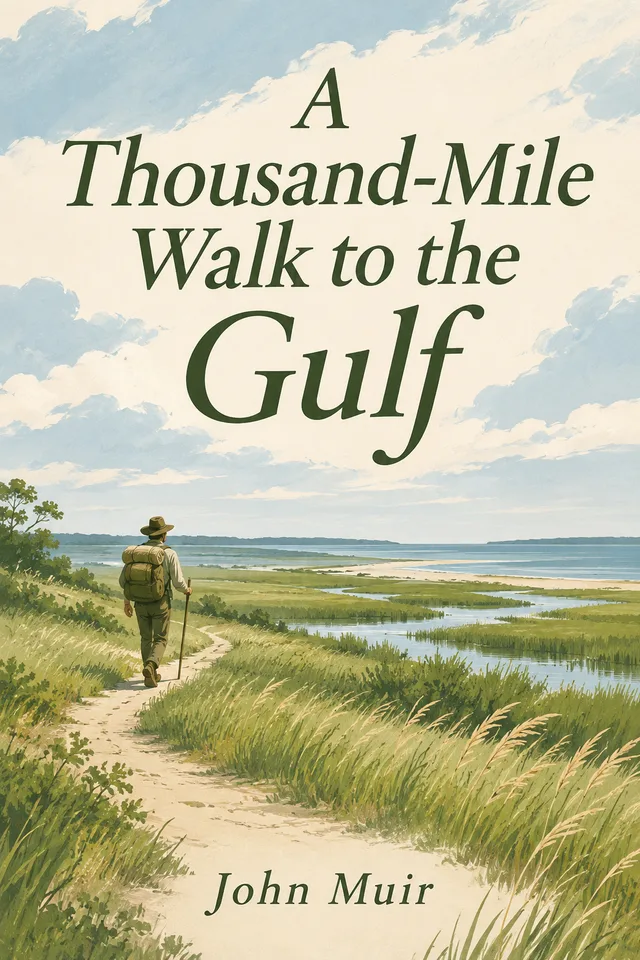
A Thousand-Mile Walk to the Gulf
BooksWhale-Ausgabe auf Englisch von John Muir
John Muir's early journey from Kentucky toward the Gulf joins botanical observation with encounters across a changing landscape.
- Vorschau
- Auszug aus dem vorbereiteten Text
- Formate
- Online-Reader, EPUB, PDF
- Zugriff
- Bibliotheks-Claim
Bucheinführung
A Thousand-Mile Walk to the Gulf
Following a severe industrial accident, John Muir set out on a long walking journey in 1867. His account travels from Kentucky toward Florida and continues through illness, a visit to Cuba, and the prospect of California. Plants, forests, local inhabitants, and the physical demands of travel shape this early expression of the naturalist's enduring fascination with wild places.
BooksWhale-Ausgabe
Wie diese Ausgabe vorbereitet wurde
Diese Ausgabe basiert auf einem gemeinfreien Text und wurde von BooksWhale für digitales Lesen vorbereitet.
Public-Domain-Grundlage
Warum diese Ausgabe geteilt werden kann
First published in 1916; John Muir died in 1914. This edition uses the public-domain English text from Project Gutenberg.
Vorschau lesen
Auszug aus dem vorbereiteten Text
Vorschau aus dem vorbereiteten Lesetext.
VorschaukapitelFull textVorschau lesen
A Thousand-Mile Walk to the Gulf
John Muir
VorschaukapitelChapter I. Kentucky Forests and CavesVorschau
I had long been looking from the wildwoods and gardens of the Northern States to those of the warm South, and at last, all draw-backs overcome, I set forth [from Indianapolis] on the first day of September, 1867, joyful and free, on a thousand-mile walk to the Gulf of Mexico. [The trip to Jeffersonville, on the banks of the Ohio, was made by rail.] Crossing the Ohio at Louisville [September 2], I steered through the big city by compass without speaking a word to any one. Beyond the city I found a road running southward, and after passing a scatterment of suburban cabins and cottages I reached the green woods and spread out my pocket map to rough-hew a plan for my journey.
My plan was simply to push on in a general southward direction by the wildest, leafiest, and least trodden way I could find, promising the greatest extent of virgin forest. Folding my map, I shouldered my little bag and plant press and strode away among the old Kentucky oaks, rejoicing in splendid visions of pines and palms and tropic flowers in glorious array, not, however, without a few cold shadows of loneliness, although the great oaks seemed to spread their arms in welcome.
I have seen oaks of many species in many kinds of exposure and soil, but those of Kentucky excel in grandeur all I had ever before beheld. They are broad and dense and bright green. In the leafy bowers and caves of their long branches dwell magnificent avenues of shade, and every tree seems to be blessed with a double portion of strong exulting life. Walked twenty miles, mostly on river bottom, and found shelter in a rickety tavern.
September 3. Escaped from the dust and squalor of my garret bedroom to the glorious forest. All the streams that I tasted hereabouts are salty and so are the wells. Salt River was nearly dry. Much of my way this forenoon was over naked limestone. After passing the level ground that extended twenty-five or thirty miles from the river I came to a region of rolling hills called Kentucky Knobs—hills of denudation covered with trees to the top. Some of them have a few pines. For a few hours I followed the farmers’ paths, but soon wandered away from roads and encountered many a tribe of twisted vines difficult to pass.
Emerging about noon from a grove of giant sunflowers, I found myself on the brink of a tumbling rocky stream [Rolling Fork]. I did not expect to find bridges on my wild ways, and at once started to ford, when a negro woman on the opposite bank earnestly called on me to wait until she could tell the “men folks” to bring me a horse—that the river was too deep and rapid to wade and that I would “sartain be drowned” if I attempted to cross. I replied that my bag and plants would ballast me; that the water did not appear to be deep, and that if I were carried away, I was a good swimmer and would soon dry in the sunshine. But the cautious old soul replied that no one ever waded that river and set off for a horse, saying that it was no trouble at all.
In a few minutes the ferry horse came gingerly down the bank through vines and weeds. His long stilt legs proved him a natural wader. He was white and the little sable negro boy that rode him looked like a bug on his back. After many a tottering halt the outward voyage was safely made, and I mounted behind little Nig. He was a queer specimen, puffy and jet as an India rubber doll and his hair was matted in sections like the wool of a merino sheep. The old horse, overladen with his black and white burden, rocked and stumbled on his stilt legs with fair promises of a fall. But all ducking signs failed and we arrived in safety among the weeds and vines of the rugged bank. A salt bath would have done us no harm. I could swim and little Afric looked as if he might float like a bladder.
VorschaukapitelChapter II. Crossing the Cumberland MountainsVorschau
I had climbed but a short distance when I was overtaken by a young man on horse-back, who soon showed that he intended to rob me if he should find the job worth while. After he had inquired where I came from, and where I was going, he offered to carry my bag. I told him that it was so light that I did not feel it at all a burden; but he insisted and coaxed until I allowed him to carry it. As soon as he had gained possession I noticed that he gradually increased his speed, evidently trying to get far enough ahead of me to examine the contents without being observed. But I was too good a walker and runner for him to get far. At a turn of the road, after trotting his horse for about half an hour, and when he thought he was out of sight, I caught him rummaging my poor bag. Finding there only a comb, brush, towel, soap, a change of underclothing, a copy of Burns’s poems, Milton’s Paradise Lost, and a small New Testament, he waited for me, handed back my bag, and returned down the hill, saying that he had forgotten something.
I found splendid growths of shining-leaved Ericaceæ (heathworts) for which the Alleghany Mountains are noted. Also ferns of which Osmunda cinnamomea [Cinnamon Fern] is the largest and perhaps the most abundant. Osmunda regalis [Flowering Fern] is also common here, but not large. In Wood’s and Gray’s Botany Osmunda cinnamomea is said to be a much larger fern than Osmunda claytoniana. This I found to be true in Tennessee and southward, but in Indiana, part of Illinois, and Wisconsin the opposite is true. Found here the beautiful, sensitive Schrankia, or sensitive brier. It is a long, prickly, leguminous vine, with dense heads of small, yellow fragrant flowers.
Vines growing on roadsides receive many a tormenting blow, simply because they give evidence of feeling. Sensitive people are served in the same way. But the roadside vine soon becomes less sensitive, like people getting used to teasing—Nature, in this instance, making for the comfort of flower creatures the same benevolent arrangement as for man. Thus I found that the Schrankia vines growing along foot-paths leading to a backwoods schoolhouse were much less sensitive than those in the adjacent unfrequented woods, having learned to pay but slight attention to the tingling strokes they get from teasing scholars.
It is startling to see the pairs of pinnate leaves rising quickly out of the grass and folding themselves close in regular succession from the root to the end of the prostrate stems, ten to twenty feet in length. How little we know as yet of the life of plants—their hopes and fears, pains and enjoyments!
Traveled a few miles with an old Tennessee farmer who was much excited on account of the news he had just heard. “Three kingdoms, England, Ireland, and Russia, have declared war agin the United States. Oh, it’s terrible, terrible,” said he. “This big war comin’ so quick after our own big fight. Well, it can’t be helped, and all I have to say is, Amerricay forever, but I’d a heap rather they didn’t fight.”
“But are you sure the news is true?” I inquired. “Oh, yes, quite sure,” he replied, “for me and some of my neighbors were down at the store last night, and Jim Smith can read, and he found out all about it in a newspaper.”
Passed the poor, rickety, thrice-dead village of Jamestown, an incredibly dreary place. Toward the top of the Cumberland grade, about two hours before sundown I came to a log house, and as I had been warned that all the broad plateau of the range for forty or fifty miles was desolate, I began thus early to seek a lodging for the night. Knocking at the door, a motherly old lady replied to my request for supper and bed and breakfast, that I was welcome to the best she had, provided that I had the necessary change to pay my bill. When I told her that unfortunately I had nothing smaller than a five-dollar greenback, she said, “Well, I’m sorry, but cannot afford to keep you. Not long ago ten soldiers came across from North Carolina, and in the morning they offered a greenback that I couldn’t change, and so I got nothing for keeping them, which I was ill able to afford.” “Very well,” I said, “I’m glad you spoke of this beforehand, for I would rather go hungry than impose on your hospitality.”
Inhaltsverzeichnis
In dieser Ausgabe
- 01Full text
- 02Chapter I. Kentucky Forests and Caves
- 03Chapter II. Crossing the Cumberland Mountains
- 04Chapter III. Through the River Country of Georgia
- 05Chapter IV. Camping among the Tombs
- 06Chapter V. Through Florida Swamps and Forests
- 07Chapter VI. Cedar Keys
- 08Chapter VII. A Sojourn in Cuba
- 09Chapter VIII. By a Crooked Route to California
- 10Chapter IX. Twenty Hill Hollow
Sprachverfügbarkeit
Andere Sprachen
Weitere Sprachausgaben sind noch nicht veröffentlicht. Sobald verfügbar, werden sie hier verlinkt.
Andere Sprache anfragen