Englisch Ausgabe
Literatur
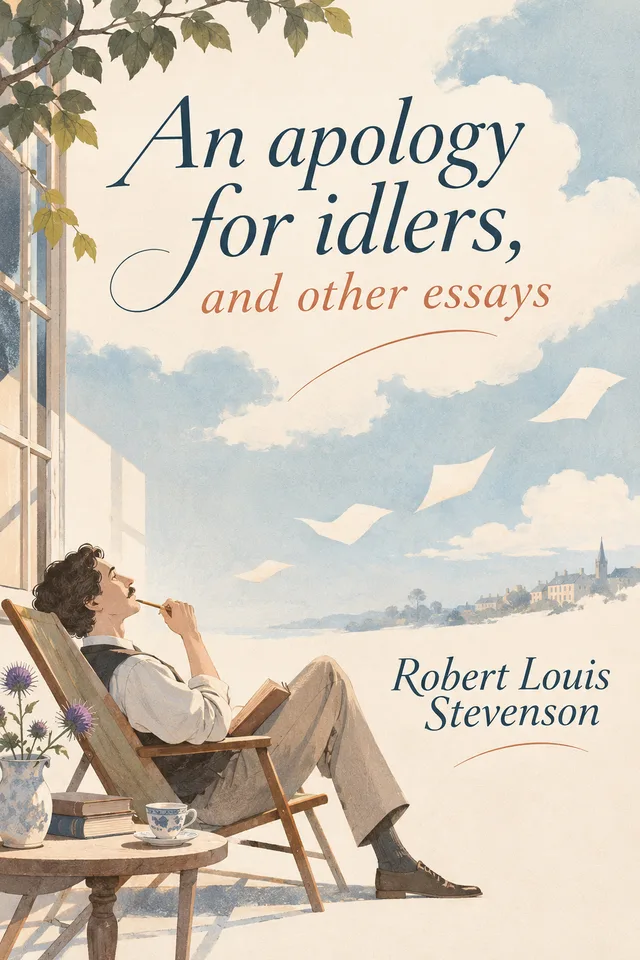
An apology for idlers, and other essays
BooksWhale-Ausgabe auf Englisch von Robert Louis Stevenson
Four essays on idleness, ambition, English admirals, and the imaginative life of children.
- Vorschau
- Auszug aus dem vorbereiteten Text
- Formate
- Online-Reader, EPUB, PDF
- Zugriff
- Bibliotheks-Claim
Bucheinführung
An apology for idlers, and other essays
Four essays on idleness, ambition, English admirals, and the imaginative life of children. The volume brings together An Apology for Idlers, El Dorado, The English Admirals, and Child’s Play. Stevenson considers the uses of leisure, the pursuit of distant goals, historical courage, and children’s ways of understanding their world.
BooksWhale-Ausgabe
Wie diese Ausgabe vorbereitet wurde
Diese Ausgabe basiert auf einem gemeinfreien Text und wurde von BooksWhale für digitales Lesen vorbereitet.
Public-Domain-Grundlage
Warum diese Ausgabe geteilt werden kann
The original work by Robert Louis Stevenson is in the public domain in the United States. This edition uses the historical English text from Project Gutenberg and excludes modern editorial material.
Vorschau lesen
Auszug aus dem vorbereiteten Text
Vorschau aus dem vorbereiteten Lesetext.
VorschaukapitelAN APOLOGY FOR IDLERSVorschau lesen
JUST now, when every one is bound, under pain of a decree in absence convicting them of lèse-respectability, to enter on some lucrative profession, and labour therein with something not far short of enthusiasm, a cry from the opposite party who are content when they have enough, and like to look on and enjoy in the meanwhile, savours a little of bravado and gasconade. And yet this should not be. Idleness so called, which does not consist in doing nothing, but in doing a great deal not recognised in the dogmatic formularies of the ruling class, has as good a right to state its position as industry itself. It is admitted that the presence of people who refuse to enter in the great handicap race for sixpenny pieces, is at once an insult and a disenchantment for those who do. A fine fellow (as we see so many) takes his determination, votes for the sixpences, and in the emphatic Americanism, “goes for” them. And while such an one is ploughing distressfully up the road, it is not hard to understand his resentment, when he perceives cool persons in the meadows by the wayside, lying with a handkerchief over their ears and a glass at their elbow. Alexander is touched in a very delicate place by the disregard of Diogenes. Where was the glory of having taken Rome for these tumultuous barbarians, who poured into the Senate house, and found the Fathers sitting silent and unmoved by their success? It is a sore thing to have laboured along and scaled the arduous hilltops, and when all is done, find humanity indifferent to your achievement. Hence physicists condemn the unphysical; financiers have only a superficial toleration for those who know little of stocks; literary persons despise the unlettered; and people of all pursuits combine to disparage those who have none.
But though this is one difficulty of the subject, it is not the greatest. You could not be put in prison for speaking against industry, but you can be sent to Coventry for speaking like a fool. The greatest difficulty with most subjects is to do them well; therefore, please to remember this is an apology. It is certain that much may be judiciously argued in favour of diligence; only there is something to be said against it, and that is what, on the present occasion, I have to say. To state one argument is not necessarily to be deaf to all others, and that a man has written a book of travels in Montenegro, is no reason why he should never have been to Richmond.
It is surely beyond a doubt that people should be a good deal idle in youth. For though here and there a Lord Macaulay may escape from school honours with all his wits about him, most boys pay so dear for their medals that they never afterwards have a shot in their locker, and begin the world bankrupt. And the same holds true during all the time a lad is educating himself, or suffering others to educate him. It must have been a very foolish old gentleman who addressed Johnson at Oxford in these words: “Young man, ply your book diligently now, and acquire a stock of knowledge; for when years come upon you, you will find that poring upon books will be but an irksome task.” The old gentleman seems to have been unaware that many other things besides reading grow irksome, and not a few become impossible, by the time a man has to use spectacles and cannot walk without a stick. Books are good enough in their own way, but they are a mighty bloodless substitute for life. It seems a pity to sit, like the Lady of Shalott, peering into a mirror, with your back turned on all the bustle and glamour of reality. And if a man reads very hard, as the old anecdote reminds us, he will have little time for thought.
VorschaukapitelEL DORADOVorschau
IT seems as if a great deal were attainable in a world where there are so many marriages and decisive battles, and where we all, at certain hours of the day, and with great gusto and despatch, stow a portion of victuals finally and irretrievably into the bag which contains us. And it would seem also, on a hasty view, that the attainment of as much as possible was the one goal of man’s contentious life. And yet, as regards the spirit, this is but a semblance. We live in an ascending scale when we live happily, one thing leading to another in an endless series. There is always a new horizon for onward-looking men, and although we dwell on a small planet, immersed in petty business and not enduring beyond a brief period of years, we are so constituted that our hopes are inaccessible, like stars, and the term of hoping is prolonged until the term of life. To be truly happy is a question of how we begin and not of how we end, of what we want and not of what we have. An aspiration is a joy forever, a possession as solid as a landed estate, a fortune which we can never exhaust and which gives us year by year a revenue of pleasurable activity. To have many of these is to be spiritually rich. Life is only a very dull and ill-directed theatre unless we have some interests in the piece; and to those who have neither art nor science, the world is a mere arrangement of colours, or a rough footway where they may very well break their shins. It is in virtue of his own desires and curiosities that any man continues to exist with even patience, that he is charmed by the look of things and people, and that he wakens every morning with a renewed appetite for work and pleasure. Desire and curiosity are the two eyes through which he sees the world in the most enchanted colours: it is they that make women beautiful or fossils interesting: and the man may squander his estate and come to beggary, but if he keeps these two amulets he is still rich in the possibilities of pleasure. Suppose he could take one meal so compact and comprehensive that he should never hunger any more; suppose him, at a glance, to take in all the features of the world and allay the desire for knowledge; suppose him to do the like in any province of experience—would not that man be in a poor way for amusement ever after?
One who goes touring on foot with a single volume in his knapsack reads with circumspection, pausing often to reflect, and often laying the book down to contemplate the landscape or the prints in the inn parlour; for he fears to come to an end of his entertainment, and be left companionless on the last stages of his journey. A young fellow recently finished the works of Thomas Carlyle, winding up, if we remember aright, with the ten notebooks upon Frederick the Great. “What!” cried the young fellow, in consternation, “is there no more Carlyle? Am I left to the daily papers?” A more celebrated instance is that of Alexander, who wept bitterly because he had no more worlds to subdue. And when Gibbon had finished the Decline and Fall, he had only a few moments of joy; and it was with a “sober melancholy” that he parted from his labours.
Happily we all shoot at the moon with ineffectual arrows; our hopes are set on inaccessible El Dorado; we come to an end of nothing here below. Interests are only plucked up to sow themselves again, like mustard. You would think, when the child was born, there would be an end to trouble; and yet it is only the beginning of fresh anxieties; and when you have seen it through its teething and its education, and at last its marriage, alas! it is only to have new fears, new quivering sensibilities, with every day; and the health of your children’s children grows as touching a concern as that of your own. Again, when you have married your wife, you would think you were got upon a hilltop, and might begin to go downward by an easy slope. But you have only ended courting to begin marriage. Falling in love and winning love are often difficult tasks to overbearing and rebellious spirits; but to keep in love is also a business of some importance, to which both man and wife must bring kindness and goodwill. The true love story commences at the altar, when there lies before the married pair a most beautiful contest of wisdom and generosity, and a life-long struggle towards an unattainable ideal. Unattainable? Ay, surely unattainable, from the very fact that they are two instead of one.
VorschaukapitelTHE ENGLISH ADMIRALSVorschau
THERE is one story of the wars of Rome which I have always very much envied for England. Germanicus was going down at the head of the legions into a dangerous river—on the opposite bank the woods were full of Germans—when there flew out seven great eagles which seemed to marshal the Romans on their way; they did not pause or waver, but disappeared into the forest where the enemy lay concealed. “Forward!” cried Germanicus, with a fine rhetorical inspiration, “Forward! and follow the Roman birds.” It would be a very heavy spirit that did not give a leap at such a signal, and a very timorous one that continued to have any doubt of success. To appropriate the eagles as fellow-countrymen was to make imaginary allies of the forces of nature; the Roman Empire and its military fortunes, and along with these the prospects of those individual Roman legionaries now fording a river in Germany, looked altogether greater and more hopeful. It is a kind of illusion easy to produce. A particular shape of cloud, the appearance of a particular star, the holiday of some particular saint, anything in short to remind the combatants of patriotic legends or old successes, may be enough to change the issue of a pitched battle; for it gives to the one party a feeling that Right and the larger interests are with them.
If an Englishman wishes to have such a feeling, it must be about the sea. The lion is nothing to us; he has not been taken to the hearts of the people, and naturalised as an English emblem. We know right well that a lion would fall foul of us as grimly as he would of a Frenchman or a Moldavian Jew, and we do not carry him before us in the smoke of battle. But the sea is our approach and bulwark; it has been the scene of our greatest triumphs and dangers; and we are accustomed in lyrical strains to claim it as our own. The prostrating experiences of foreigners between Calais and Dover have always an agreeable side to English prepossessions. A man from Bedfordshire, who does not know one end of the ship from the other until she begins to move, swaggers among such persons with a sense of hereditary nautical experience. To suppose yourself endowed with natural parts for the sea because you are the countryman of Blake and mighty Nelson, is perhaps just as unwarrantable as to imagine Scotch extraction a sufficient guarantee that you will look well in a kilt. But the feeling is there, and seated beyond the reach of argument. We should consider ourselves unworthy of our descent if we did not share the arrogance of our progenitors, and please ourselves with the pretension that the sea is English. Even where it is looked upon by the guns and battlements of another nation we regard it as a kind of English cemetery, where the bones of our seafaring fathers take their rest until the last trumpet; for I suppose no other nation has lost as many ships, or sent as many brave fellows to the bottom.
There is nowhere such a background for heroism as the noble, terrifying, and picturesque conditions of some of our sea fights. Hawke’s battle in the tempest, and Aboukir at the moment when the French Admiral blew up, reach the limit of what is imposing to the imagination. And our naval annals owe some of their interest to the fantastic and beautiful appearance of old warships and the romance that invests the sea and everything sea-going in the eyes of English lads on a half-holiday at the coast. Nay, and what we know of the misery between decks enhances the bravery of what was done by giving it something for contrast. We like to know that these bold and honest fellows contrived to live, and to keep bold and honest, among absurd and vile surroundings. No reader can forget the description of the Thunder in Roderick Random: the disorderly tyranny; the cruelty and dirt of officers and men; deck after deck, each with some new object of offence; the hospital, where the hammocks were huddled together with but fourteen inches space for each; the cockpit, far under water, where, “in an intolerable stench,” the spectacled steward kept the accounts of the different messes; and the canvas enclosure, six feet square, in which Morgan made flip and salmagundi, smoked his pipe, sang his Welsh songs, and swore his queer Welsh imprecations. There are portions of this business on board the Thunder over which the reader passes lightly and hurriedly, like a traveller in a malarious country. It is easy enough to understand the opinion of Dr. Johnson: “Why, sir,” he said, “no man will be a sailor who has contrivance enough to get himself into a jail.” You would fancy any one’s spirit would die out under such an accumulation of darkness, noisomeness, and injustice, above all when he had not come there of his own free will, but under the cutlasses and bludgeons of the press-gang. But perhaps a watch on deck in the sharp sea air put a man on his mettle again; a battle must have been a capital relief; and prize-money, bloodily earned and grossly squandered, opened the doors of the prison for a twinkling. Somehow or other, at least, this worst of possible lives could not overlie the spirit and gayety of our sailors; they did their duty as though they had some interest in the fortune of that country which so cruelly oppressed them, they served their guns merrily when it came to fighting, and they had the readiest ear for a bold, honourable sentiment, of any class of men the world ever produced.
Inhaltsverzeichnis
In dieser Ausgabe
- 01AN APOLOGY FOR IDLERS
- 02EL DORADO
- 03THE ENGLISH ADMIRALS
- 04CHILD’S PLAY
Sprachverfügbarkeit
Andere Sprachen
Weitere Sprachausgaben sind noch nicht veröffentlicht. Sobald verfügbar, werden sie hier verlinkt.
Andere Sprache anfragen