Englisch Ausgabe
Literatur
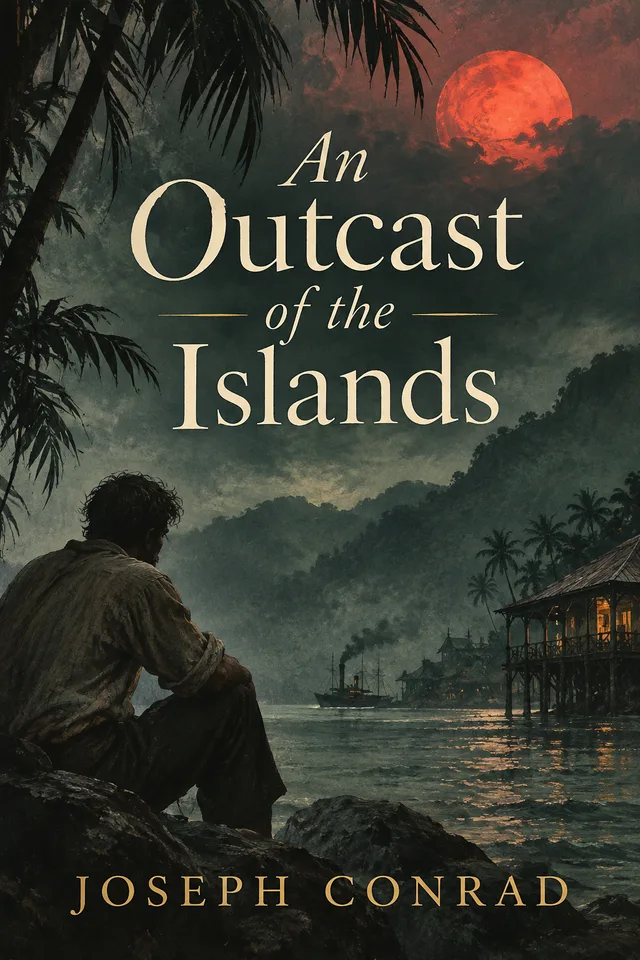
An Outcast of the Islands
BooksWhale-Ausgabe auf Englisch von Joseph Conrad
Willems’s betrayal and desire unravel a precarious trading world of competing loyalties, private ambitions and colonial encounters.
- Vorschau
- Auszug aus dem vorbereiteten Text
- Formate
- Online-Reader, EPUB, PDF
- Zugriff
- Bibliotheks-Claim
Bucheinführung
An Outcast of the Islands
Joseph Conrad follows Peter Willems after disgrace sends him into an isolated trading settlement. His attraction to Aïssa entangles him in rival commercial interests and the plans of Lingard and Almayer. The complete five-part novel, with the author’s note, examines dependence, self-deception and betrayal through a dense network of competing perspectives.
BooksWhale-Ausgabe
Wie diese Ausgabe vorbereitet wurde
Diese Ausgabe basiert auf einem gemeinfreien Text und wurde von BooksWhale für digitales Lesen vorbereitet.
Public-Domain-Grundlage
Warum diese Ausgabe geteilt werden kann
Joseph Conrad died in 1924. This edition uses the original-language text supplied by Project Gutenberg, identified there as public domain in the United States. Added illustrations and editorial notes are excluded.
Vorschau lesen
Auszug aus dem vorbereiteten Text
Vorschau aus dem vorbereiteten Lesetext.
VorschaukapitelFull textVorschau lesen
An Outcast of the Islands
Joseph Conrad
VorschaukapitelAUTHOR’S NOTEVorschau
“An Outcast of the Islands” is my second novel in the absolute sense of the word; second in conception, second in execution, second as it were in its essence. There was no hesitation, half-formed plan, vague idea, or the vaguest reverie of anything else between it and “Almayer’s Folly.” The only doubt I suffered from, after the publication of “Almayer’s Folly,” was whether I should write another line for print. Those days, now grown so dim, had their poignant moments. Neither in my mind nor in my heart had I then given up the sea. In truth I was clinging to it desperately, all the more desperately because, against my will, I could not help feeling that there was something changed in my relation to it. “Almayer’s Folly,” had been finished and done with. The mood itself was gone. But it had left the memory of an experience that, both in thought and emotion was unconnected with the sea, and I suppose that part of my moral being which is rooted in consistency was badly shaken. I was a victim of contrary stresses which produced a state of immobility. I gave myself up to indolence. Since it was impossible for me to face both ways I had elected to face nothing. The discovery of new values in life is a very chaotic experience; there is a tremendous amount of jostling and confusion and a momentary feeling of darkness. I let my spirit float supine over that chaos.
A phrase of Edward Garnett’s is, as a matter of fact, responsible for this book. The first of the friends I made for myself by my pen it was but natural that he should be the recipient, at that time, of my confidences. One evening when we had dined together and he had listened to the account of my perplexities (I fear he must have been growing a little tired of them) he pointed out that there was no need to determine my future absolutely. Then he added: “You have the style, you have the temperament; why not write another?” I believe that as far as one man may wish to influence another man’s life Edward Garnett had a great desire that I should go on writing. At that time, and I may say, ever afterwards, he was always very patient and gentle with me. What strikes me most however in the phrase quoted above which was offered to me in a tone of detachment is not its gentleness but its effective wisdom. Had he said, “Why not go on writing,” it is very probable he would have scared me away from pen and ink for ever; but there was nothing either to frighten one or arouse one’s antagonism in the mere suggestion to “write another.” And thus a dead point in the revolution of my affairs was insidiously got over. The word “another” did it. At about eleven o’clock of a nice London night, Edward and I walked along interminable streets talking of many things, and I remember that on getting home I sat down and wrote about half a page of “An Outcast of the Islands” before I slept. This was committing myself definitely, I won’t say to another life, but to another book. There is apparently something in my character which will not allow me to abandon for good any piece of work I have begun. I have laid aside many beginnings. I have laid them aside with sorrow, with disgust, with rage, with melancholy and even with self-contempt; but even at the worst I had an uneasy consciousness that I would have to go back to them.
“An Outcast of the Islands” belongs to those novels of mine that were never laid aside; and though it brought me the qualification of “exotic writer” I don’t think the charge was at all justified.
VorschaukapitelPART IVorschau
PART I
Inhaltsverzeichnis
In dieser Ausgabe
- 01Full text
- 02AUTHOR’S NOTE
- 03PART I
- 04CHAPTER ONE
- 05CHAPTER TWO
- 06CHAPTER THREE
- 07CHAPTER FOUR
- 08CHAPTER FIVE
- 09CHAPTER SIX
- 10CHAPTER SEVEN
- 11PART II
- 12CHAPTER ONE
- 13CHAPTER TWO
- 14CHAPTER THREE
- 15CHAPTER FOUR
- 16CHAPTER FIVE
- 17CHAPTER SIX
- 18PART III
- 19CHAPTER ONE
- 20CHAPTER TWO
- 21CHAPTER THREE
- 22CHAPTER FOUR
- 23PART IV
- 24CHAPTER ONE
- 25CHAPTER TWO
- 26CHAPTER THREE
- 27CHAPTER FOUR
- 28CHAPTER FIVE
- 29PART V
- 30CHAPTER ONE
- 31CHAPTER TWO
- 32CHAPTER THREE
- 33CHAPTER FOUR
Sprachverfügbarkeit
Andere Sprachen
Weitere Sprachausgaben sind noch nicht veröffentlicht. Sobald verfügbar, werden sie hier verlinkt.
Andere Sprache anfragen