Englisch Ausgabe
Literatur
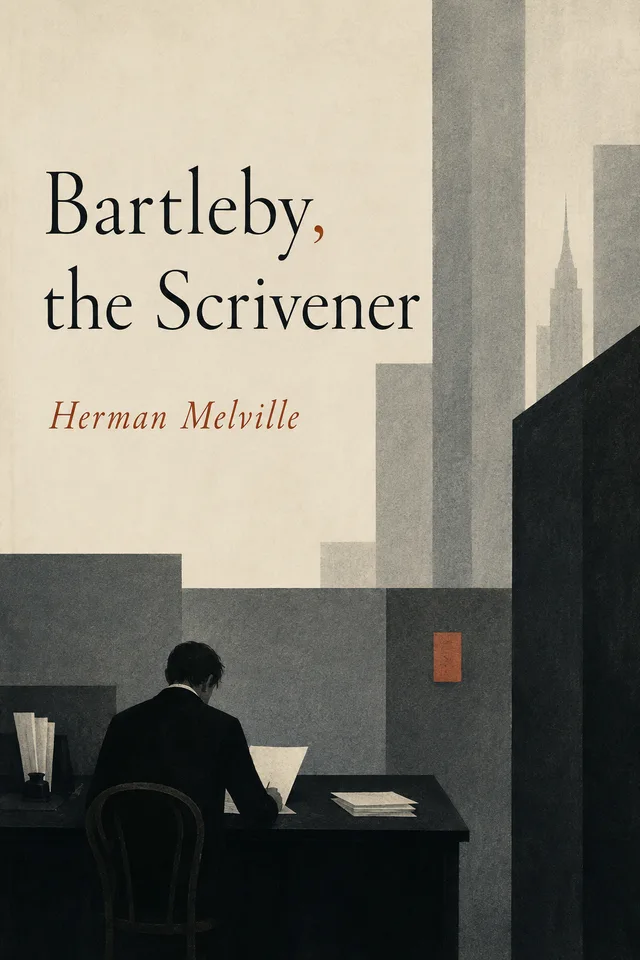
Bartleby, the Scrivener
BooksWhale-Ausgabe auf Englisch von Herman Melville
A haunting Wall Street tale of refusal, office routine, alienation, and moral bewilderment.
- Vorschau
- Auszug aus dem vorbereiteten Text
- Formate
- Online-Reader, EPUB, PDF
- Zugriff
- Bibliotheks-Claim
Bucheinführung
Bartleby, the Scrivener
Bartleby, the Scrivener compresses Herman Melville’s dark social vision into the strange figure of a copyist who answers every demand with “I would prefer not to.” Set in a Wall Street law office, the story turns routine paperwork, business language, charity, imprisonment, and silence into a lasting portrait of modern alienation and uneasy conscience.
BooksWhale-Ausgabe
Wie diese Ausgabe vorbereitet wurde
Diese Ausgabe basiert auf einem gemeinfreien Text und wurde von BooksWhale für digitales Lesen vorbereitet.
Public-Domain-Grundlage
Warum diese Ausgabe geteilt werden kann
Herman Melville died in 1891, and Bartleby, the Scrivener was first published in 1853; these dates support public-domain status.
Vorschau lesen
Auszug aus dem vorbereiteten Text
Vorschau aus dem vorbereiteten Lesetext.
VorschaukapitelPart 1Vorschau lesen
Bartleby, the Scrivener
Herman Melville
I am a rather elderly man. The nature of my avocations for the last thirty years has brought me into more than ordinary contact with what would seem an interesting and somewhat singular set of men, of whom as yet nothing that I know of has ever been written:—I mean the law-copyists or scriveners. I have known very many of them, professionally and privately, and if I pleased, could relate divers histories, at which good-natured gentlemen might smile, and sentimental souls might weep. But I waive the biographies of all other scriveners for a few passages in the life of Bartleby, who was a scrivener of the strangest I ever saw or heard of. While of other law-copyists I might write the complete life, of Bartleby nothing of that sort can be done. I believe that no materials exist for a full and satisfactory biography of this man. It is an irreparable loss to literature. Bartleby was one of those beings of whom nothing is ascertainable, except from the original sources, and in his case those are very small. What my own astonished eyes saw of Bartleby, _that_ is all I know of him, except, indeed, one vague report which will appear in the sequel.
Ere introducing the scrivener, as he first appeared to me, it is fit I make some mention of myself, my employés, my business, my chambers, and general surroundings; because some such description is indispensable to an adequate understanding of the chief character about to be presented.
Imprimis: I am a man who, from his youth upwards, has been filled with a profound conviction that the easiest way of life is the best. Hence, though I belong to a profession proverbially energetic and nervous, even to turbulence, at times, yet nothing of that sort have I ever suffered to invade my peace. I am one of those unambitious lawyers who never addresses a jury, or in any way draws down public applause; but in the cool tranquility of a snug retreat, do a snug business among rich men’s bonds and mortgages and title-deeds. All who know me, consider me an eminently _safe_ man. The late John Jacob Astor, a personage little given to poetic enthusiasm, had no hesitation in pronouncing my first grand point to be prudence; my next, method. I do not speak it in vanity, but simply record the fact, that I was not unemployed in my profession by the late John Jacob Astor; a name which, I admit, I love to repeat, for it hath a rounded and orbicular sound to it, and rings like unto bullion. I will freely add, that I was not insensible to the late John Jacob Astor’s good opinion.
Some time prior to the period at which this little history begins, my avocations had been largely increased. The good old office, now extinct in the State of New York, of a Master in Chancery, had been conferred upon me. It was not a very arduous office, but very pleasantly remunerative. I seldom lose my temper; much more seldom indulge in dangerous indignation at wrongs and outrages; but I must be permitted to be rash here and declare, that I consider the sudden and violent abrogation of the office of Master in Chancery, by the new Constitution, as a—premature act; inasmuch as I had counted upon a life-lease of the profits, whereas I only received those of a few short years. But this is by the way.
My chambers were up stairs at No.—Wall-street. At one end they looked upon the white wall of the interior of a spacious sky-light shaft, penetrating the building from top to bottom. This view might have been considered rather tame than otherwise, deficient in what landscape painters call “life.” But if so, the view from the other end of my chambers offered, at least, a contrast, if nothing more. In that direction my windows commanded an unobstructed view of a lofty brick wall, black by age and everlasting shade; which wall required no spy-glass to bring out its lurking beauties, but for the benefit of all near-sighted spectators, was pushed up to within ten feet of my window panes. Owing to the great height of the surrounding buildings, and my chambers being on the second floor, the interval between this wall and mine not a little resembled a huge square cistern.
VorschaukapitelPart 2Vorschau
At first Bartleby did an extraordinary quantity of writing. As if long famishing for something to copy, he seemed to gorge himself on my documents. There was no pause for digestion. He ran a day and night line, copying by sun-light and by candle-light. I should have been quite delighted with his application, had he been cheerfully industrious. But he wrote on silently, palely, mechanically.
It is, of course, an indispensable part of a scrivener’s business to verify the accuracy of his copy, word by word. Where there are two or more scriveners in an office, they assist each other in this examination, one reading from the copy, the other holding the original. It is a very dull, wearisome, and lethargic affair. I can readily imagine that to some sanguine temperaments it would be altogether intolerable. For example, I cannot credit that the mettlesome poet Byron would have contentedly sat down with Bartleby to examine a law document of, say five hundred pages, closely written in a crimpy hand.
Now and then, in the haste of business, it had been my habit to assist in comparing some brief document myself, calling Turkey or Nippers for this purpose. One object I had in placing Bartleby so handy to me behind the screen, was to avail myself of his services on such trivial occasions. It was on the third day, I think, of his being with me, and before any necessity had arisen for having his own writing examined, that, being much hurried to complete a small affair I had in hand, I abruptly called to Bartleby. In my haste and natural expectancy of instant compliance, I sat with my head bent over the original on my desk, and my right hand sideways, and somewhat nervously extended with the copy, so that immediately upon emerging from his retreat, Bartleby might snatch it and proceed to business without the least delay.
In this very attitude did I sit when I called to him, rapidly stating what it was I wanted him to do—namely, to examine a small paper with me. Imagine my surprise, nay, my consternation, when without moving from his privacy, Bartleby in a singularly mild, firm voice, replied, “I would prefer not to.”
I sat awhile in perfect silence, rallying my stunned faculties. Immediately it occurred to me that my ears had deceived me, or Bartleby had entirely misunderstood my meaning. I repeated my request in the clearest tone I could assume. But in quite as clear a one came the previous reply, “I would prefer not to.”
“Prefer not to,” echoed I, rising in high excitement, and crossing the room with a stride. “What do you mean? Are you moon-struck? I want you to help me compare this sheet here—take it,” and I thrust it towards him.
“I would prefer not to,” said he.
I looked at him steadfastly. His face was leanly composed; his gray eye dimly calm. Not a wrinkle of agitation rippled him. Had there been the least uneasiness, anger, impatience or impertinence in his manner; in other words, had there been any thing ordinarily human about him, doubtless I should have violently dismissed him from the premises. But as it was, I should have as soon thought of turning my pale plaster-of-paris bust of Cicero out of doors. I stood gazing at him awhile, as he went on with his own writing, and then reseated myself at my desk. This is very strange, thought I. What had one best do? But my business hurried me. I concluded to forget the matter for the present, reserving it for my future leisure. So calling Nippers from the other room, the paper was speedily examined.
A few days after this, Bartleby concluded four lengthy documents, being quadruplicates of a week’s testimony taken before me in my High Court of Chancery. It became necessary to examine them. It was an important suit, and great accuracy was imperative. Having all things arranged I called Turkey, Nippers and Ginger Nut from the next room, meaning to place the four copies in the hands of my four clerks, while I should read from the original. Accordingly Turkey, Nippers and Ginger Nut had taken their seats in a row, each with his document in hand, when I called to Bartleby to join this interesting group.
VorschaukapitelPart 3Vorschau
Now, the utterly unsurmised appearance of Bartleby, tenanting my law-chambers of a Sunday morning, with his cadaverously gentlemanly _nonchalance_, yet withal firm and self-possessed, had such a strange effect upon me, that incontinently I slunk away from my own door, and did as desired. But not without sundry twinges of impotent rebellion against the mild effrontery of this unaccountable scrivener. Indeed, it was his wonderful mildness chiefly, which not only disarmed me, but unmanned me, as it were. For I consider that one, for the time, is a sort of unmanned when he tranquilly permits his hired clerk to dictate to him, and order him away from his own premises. Furthermore, I was full of uneasiness as to what Bartleby could possibly be doing in my office in his shirt sleeves, and in an otherwise dismantled condition of a Sunday morning. Was any thing amiss going on? Nay, that was out of the question. It was not to be thought of for a moment that Bartleby was an immoral person. But what could he be doing there?—copying? Nay again, whatever might be his eccentricities, Bartleby was an eminently decorous person. He would be the last man to sit down to his desk in any state approaching to nudity. Besides, it was Sunday; and there was something about Bartleby that forbade the supposition that he would by any secular occupation violate the proprieties of the day.
Nevertheless, my mind was not pacified; and full of a restless curiosity, at last I returned to the door. Without hindrance I inserted my key, opened it, and entered. Bartleby was not to be seen. I looked round anxiously, peeped behind his screen; but it was very plain that he was gone. Upon more closely examining the place, I surmised that for an indefinite period Bartleby must have ate, dressed, and slept in my office, and that too without plate, mirror, or bed. The cushioned seat of a rickety old sofa in one corner bore the faint impress of a lean, reclining form. Rolled away under his desk, I found a blanket; under the empty grate, a blacking box and brush; on a chair, a tin basin, with soap and a ragged towel; in a newspaper a few crumbs of ginger-nuts and a morsel of cheese. Yes, thought I, it is evident enough that Bartleby has been making his home here, keeping bachelor’s hall all by himself. Immediately then the thought came sweeping across me, What miserable friendlessness and loneliness are here revealed! His poverty is great; but his solitude, how horrible! Think of it. Of a Sunday, Wall-street is deserted as Petra; and every night of every day it is an emptiness. This building too, which of week-days hums with industry and life, at nightfall echoes with sheer vacancy, and all through Sunday is forlorn. And here Bartleby makes his home; sole spectator of a solitude which he has seen all populous—a sort of innocent and transformed Marius brooding among the ruins of Carthage!
For the first time in my life a feeling of overpowering stinging melancholy seized me. Before, I had never experienced aught but a not-unpleasing sadness. The bond of a common humanity now drew me irresistibly to gloom. A fraternal melancholy! For both I and Bartleby were sons of Adam. I remembered the bright silks and sparkling faces I had seen that day, in gala trim, swan-like sailing down the Mississippi of Broadway; and I contrasted them with the pallid copyist, and thought to myself, Ah, happiness courts the light, so we deem the world is gay; but misery hides aloof, so we deem that misery there is none. These sad fancyings—chimeras, doubtless, of a sick and silly brain—led on to other and more special thoughts, concerning the eccentricities of Bartleby. Presentiments of strange discoveries hovered round me. The scrivener’s pale form appeared to me laid out, among uncaring strangers, in its shivering winding sheet.
Inhaltsverzeichnis
In dieser Ausgabe
- 01Part 1
- 02Part 2
- 03Part 3
- 04Part 4
- 05Part 5
Sprachverfügbarkeit
Andere Sprachen
Weitere Sprachausgaben sind noch nicht veröffentlicht. Sobald verfügbar, werden sie hier verlinkt.
Andere Sprache anfragen