Englisch Ausgabe
Literatur
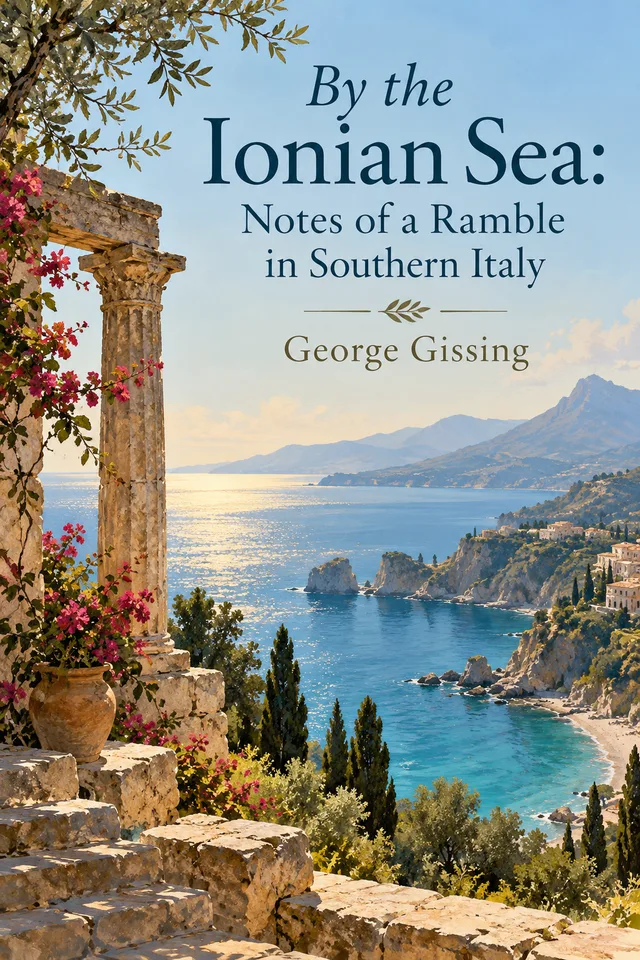
By the Ionian Sea: Notes of a Ramble in Southern Italy
BooksWhale-Ausgabe auf Englisch von George Gissing
Gissing travels through southern Italy, connecting coastal towns and ancient ruins with everyday encounters, illness, historical memory, and personal reflection.
- Vorschau
- Auszug aus dem vorbereiteten Text
- Formate
- Online-Reader, EPUB, PDF
- Zugriff
- Bibliotheks-Claim
Bucheinführung
By the Ionian Sea: Notes of a Ramble in Southern Italy
George Gissing’s journey through southern Italy follows places associated with the ancient Greek world while remaining attentive to contemporary streets, lodgings, landscapes, and conversations. Naples, Calabria, Taranto, and other stops become occasions for reflection on history and the experience of travel. The eighteen chapters of this English travel narrative combine literary recollection, close observation, and the practical uncertainties of an actual journey.
BooksWhale-Ausgabe
Wie diese Ausgabe vorbereitet wurde
Diese Ausgabe basiert auf einem gemeinfreien Text und wurde von BooksWhale für digitales Lesen vorbereitet.
Public-Domain-Grundlage
Warum diese Ausgabe geteilt werden kann
George Gissing died in 1903. This edition uses the original English text preserved by Project Gutenberg, excluding separate notes and later editorial material.
Vorschau lesen
Auszug aus dem vorbereiteten Text
Vorschau aus dem vorbereiteten Lesetext.
VorschaukapitelCHAPTER I — FROM NAPLESVorschau lesen
This is the third day of sirocco, heavy-clouded, sunless. All the colour has gone out of Naples; the streets are dusty and stifling. I long for the mountains and the sea.
To-morrow I shall leave by the Messina boat, which calls at Paola. It is now more than a twelvemonth since I began to think of Paola, and an image of the place has grown in my mind. I picture a little marina; a yellowish little town just above; and behind, rising grandly, the long range of mountains which guard the shore of Calabria. Paola has no special interest that I know of, but it is the nearest point on the coast to Cosenza, which has interest in abundance; by landing here I make a modestly adventurous beginning of my ramble in the South. At Paola foreigners are rare; one may count upon new impressions, and the journey over the hills will be delightful.
Were I to lend ear to the people with whom I am staying, here in the Chiatamone, I should either abandon my project altogether or set forth with dire misgivings. They are Neapolitans of the better class; that is to say, they have known losses, and talk of their former happiness, when they lived on the Chiaia and had everything handsome about them. The head of the family strikes me as a typical figure; he is an elderly man, with a fine head, a dignified presence, and a coldly courteous demeanour. By preference he speaks French, and his favourite subject is Paris. One observes in him something like disdain for his own country, which in his mind is associated only with falling fortunes and loss of self-respect. The cordial Italian note never sounds in his talk. The signora (also a little ashamed of her own language) excites herself about taxation—as well she may—and dwells with doleful vivacity on family troubles. Both are astonished at my eccentricity and hardiness in undertaking a solitary journey through the wild South. Their geographical notions are vague; they have barely heard of Cosenza or of Cotrone, and of Paola not at all; it would as soon occur to them to set out for Morocco as for Calabria. How shall I get along with people whose language is a barbarous dialect? Am I aware that the country is in great part pestilential?—la febbre! Has no one informed me that in autumn snows descend, and bury everything for months? It is useless to explain that I only intend to visit places easily accessible, that I shall travel mostly by railway, and that if disagreeable weather sets in I shall quickly return northwards. They look at me dubiously, and ask themselves (I am sure) whether I have not some more tangible motive than a lover of classical antiquity. It ends with a compliment to the enterprising spirit of the English race.
I have purchases to make, business to settle, and I must go hither and thither about the town. Sirocco, of course, dusks everything to cheerless grey, but under any sky it is dispiriting to note the changes in Naples. Lo sventramento (the disembowelling) goes on, and regions are transformed. It is a good thing, I suppose, that the broad Corso Umberto I. should cut a way through the old Pendino; but what a contrast between that native picturesqueness and the cosmopolitan vulgarity which has usurped its place! "Napoli se ne va!" I pass the Santa Lucia with downcast eyes, my memories of ten years ago striving against the dulness of to-day. The harbour, whence one used to start for Capri, is filled up; the sea has been driven to a hopeless distance beyond a wilderness of dust-heaps. They are going to make a long, straight embankment from the Castel dell'Ovo to the Great Port, and before long the Santa Lucia will be an ordinary street, shut in among huge houses, with no view at all. Ah, the nights that one lingered here, watching the crimson glow upon Vesuvius, tracing the dark line of the Sorrento promontory, or waiting for moonlight to cast its magic upon floating Capri! The odours remain; the stalls of sea-fruit are as yet undisturbed, and the jars of the water-sellers; women still comb and bind each other's hair by the wayside, and meals are cooked and eaten al fresco as of old. But one can see these things elsewhere, and Santa Lucia was unique. It has become squalid. In the grey light of this sad billowy sky, only its ancient foulness is manifest; there needs the golden sunlight to bring out a suggestion of its ancient charm.
VorschaukapitelCHAPTER II — PAOLAVorschau
I slept little, and was very early on deck, scanning by the light of dawn a mountainous coast. At sunrise I learnt that we were in sight of Paola; as day spread gloriously over earth and sky, the vessel hove to and prepared to land cargo. There, indeed, was the yellowish little town which I had so long pictured; it stood at a considerable height above the shore; harbour there was none at all, only a broad beach of shingle on which waves were breaking, and where a cluster of men, women and children stood gazing at the steamer. It gave me pleasure to find the place so small and primitive. In no hurry to land, I watched the unloading of merchandise (with a great deal of shouting and gesticulation) into boats which had rowed out for the purpose; speculated on the resources of Paola in the matter of food (for I was hungry); and at moments cast an eye towards the mountain barrier which it was probable I should cross to-day.
At last my portmanteau was dropped down on to the laden boat; I, as best I could, managed to follow it; and on the top of a pile of rope and empty flour-sacks we rolled landward. The surf was high; it cost much yelling, leaping, and splashing to gain the dry beach. Meanwhile, not without apprehension, I had eyed the group awaiting our arrival; that they had their eyes on me was obvious, and I knew enough of southern Italians to foresee my reception. I sprang into the midst of a clamorous conflict; half a dozen men were quarreling for possession of me. No sooner was my luggage on shore than they flung themselves upon it. By what force of authority I know not, one of the fellows triumphed; he turned to me with a satisfied smile, and—presented his wife.
"Mia sposa, signore!"
Wondering, and trying to look pleased, I saw the woman seize the portmanteau (a frightful weight), fling it on to her head, and march away at a good speed. The crowd and I followed to the dogana, close by, where as vigorous a search was made as I have ever had to undergo. I puzzled the people; my arrival was an unwonted thing, and they felt sure I was a trader of some sort. Dismissed under suspicion, I allowed the lady to whom I had been introduced to guide me townwards. Again she bore the portmanteau on her head, and evidently thought it a trifle, but as the climbing road lengthened, and as I myself began to perspire in the warm sunshine, I looked at my attendant with uncomfortable feelings. It was a long and winding way, but the woman continued to talk and laugh so cheerfully that I tried to forget her toil. At length we reached a cabin where the dazio (town dues) officer presented himself, and this conscientious person insisted on making a fresh examination of my baggage; again I explained myself, again I was eyed suspiciously; but he released me, and on we went. I had bidden my guide take me to the best inn; it was the Leone, a little place which looked from the outside like an ill-kept stable, but was decent enough within. The room into which they showed me had a delightful prospect. Deep beneath the window lay a wild, leafy garden, and lower on the hillside a lemon orchard shining with yellow fruit; beyond, the broad pebbly beach, far seen to north and south, with its white foam edging the blue expanse of sea. There I descried the steamer from which I had landed, just under way for Sicily. The beauty of this view, and the calm splendour of the early morning, put me into happiest mood. After little delay a tolerable breakfast was set before me, with a good rough wine; I ate and drank by the window, exulting in what I saw and all I hoped to see.
VorschaukapitelCHAPTER III — THE GRAVE OF ALARICVorschau
It would have been prudent to consult with my driver as to the inns of Cosenza. But, with a pardonable desire not to seem helpless in his hands, I had from the first directed him to the Due Lionetti, relying upon my guide-book. Even at Cosenza there is progress, and guide-books to little-known parts of Europe are easily allowed to fall out of date. On my arrival——
But, first of all, the dazio. This time it was a serious business; impossible to convince the rather surly officer that certain of the contents of my portmanteau were not for sale. What in the world was I doing with tanti libri? Of course I was a commercial traveller; ridiculous to pretend anything else. After much strain of courtesy, I clapped to my luggage, locked it up, and with a resolute face cried "Avanti!" And there was an end of it. In this case, as so often, I have no doubt that simple curiosity went for much in the man's pertinacious questioning. Of course the whole dazio business is ludicrous and contemptible; I scarce know a baser spectacle than that of uniformed officials groping in the poor little bundles of starved peasant women, mauling a handful of onions, or prodding with long irons a cartload of straw. Did any one ever compare the expenses with the results?
A glance shows the situation of Cosenza. The town is built on a steep hillside, above the point where two rivers, flowing from the valleys on either side, mingle their waters under one name, that of the Crati. We drove over a bridge which spans the united current, and entered a narrow street, climbing abruptly between houses so high and so close together as to make a gloom amid sunshine. It was four o'clock; I felt tired and half choked with dust; the thought of rest and a meal was very pleasant. As I searched for the sign of my inn, we suddenly drew up, midway in the dark street, before a darker portal, which seemed the entrance to some dirty warehouse. The driver jumped down—"Ecco l'albergo!"
I had seen a good many Italian hostelries, and nourished no unreasonable expectations. The Lion at Paola would have seemed to any untravelled Englishman a squalid and comfortless hole, incredible as a place of public entertainment; the Two Little Lions of Cosenza made a decidedly worse impression. Over sloppy stones, in an atmosphere heavy with indescribable stenches, I felt rather than saw my way to the foot of a stone staircase; this I ascended, and on the floor above found a dusky room, where tablecloths and an odour of frying oil afforded some suggestion of refreshment. My arrival interested nobody; with a good deal of trouble I persuaded an untidy fellow, who seemed to be a waiter, to come down with me and secure my luggage. More trouble before I could find a bedroom; hunting for keys, wandering up and down stone stairs and along pitch-black corridors, sounds of voices in quarrel. The room itself was utterly depressing—so bare, so grimy, so dark. Quickly I examined the bed, and was rewarded. It is the good point of Italian inns; be the house and the room howsoever sordid, the bed is almost invariably clean and dry and comfortable.
I ate, not amiss; I drank copiously to the memory of Alaric, and felt equal to any fortune. When night had fallen I walked a little about the scarce-lighted streets and came to an open place, dark and solitary and silent, where I could hear the voices of the two streams as they mingled below the hill. Presently I passed an open office of some kind, where a pleasant-looking man sat at a table writing; on an impulse I entered, and made bold to ask whether Cosenza had no better inn than the Due Lionetti. Great was this gentleman's courtesy; he laid down his pen, as if for ever, and gave himself wholly to my concerns. His discourse delighted me, so flowing were the phrases, so rounded the periods. Yes, there were other inns; one at the top of the town—the Vetere—in a very good position; and they doubtless excelled my own in modern comfort. As a matter of fact, it might be avowed that the Lionetti, from the point of view of the great centres of civilization, left something to be desired—something to be desired; but it was a good old inn, a reputable old inn, and probably on further acquaintance——
Inhaltsverzeichnis
In dieser Ausgabe
- 01CHAPTER I — FROM NAPLES
- 02CHAPTER II — PAOLA
- 03CHAPTER III — THE GRAVE OF ALARIC
- 04CHAPTER IV — TARANTO
- 05CHAPTER V — DULCE GALAESI FLUMEN
- 06CHAPTER VI — THE TABLE OF THE PALADINS
- 07CHAPTER VII — COTRONE
- 08CHAPTER VIII — FACES BY THE WAY
- 09CHAPTER IX — MY FRIEND THE DOCTOR
- 10CHAPTER X — CHILDREN OF THE SOIL
- 11CHAPTER XI — THE MOUNT OF REFUGE
- 12CHAPTER XII — CATANZARO
- 13CHAPTER XIII — THE BREEZY HEIGHT
- 14CHAPTER XIV — SQUILLACE
- 15CHAPTER XV — MISERIA
- 16CHAPTER XVI — CASSIODORUS
- 17CHAPTER XVII — THE GROTTA
- 18CHAPTER XVIII — REGGIO
Sprachverfügbarkeit
Andere Sprachen
Weitere Sprachausgaben sind noch nicht veröffentlicht. Sobald verfügbar, werden sie hier verlinkt.
Andere Sprache anfragen