Englisch Ausgabe
Literatur
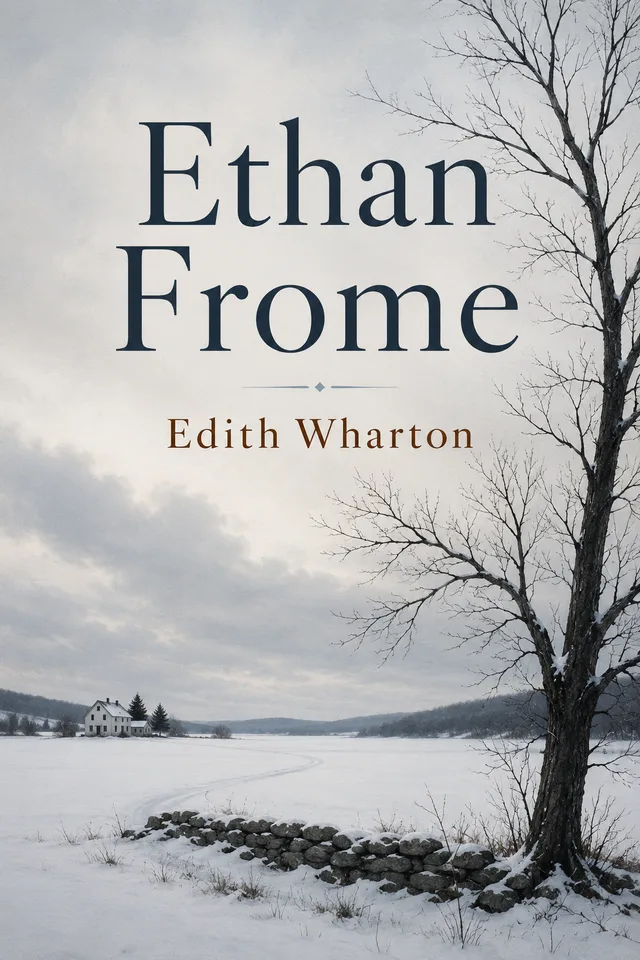
Ethan Frome
BooksWhale-Ausgabe auf Englisch von Edith Wharton
A stark New England tragedy of desire, silence, poverty, and irreversible choice.
- Vorschau
- Auszug aus dem vorbereiteten Text
- Formate
- Online-Reader, EPUB, PDF
- Zugriff
- Bibliotheks-Claim
Bucheinführung
Ethan Frome
Ethan Frome is Edith Wharton’s spare, wintry novel of frustrated love, social constraint, rural hardship, and tragic consequence. This English edition presents the original public-domain text for BooksWhale reading formats.
BooksWhale-Ausgabe
Wie diese Ausgabe vorbereitet wurde
Diese Ausgabe basiert auf einem gemeinfreien Text und wurde von BooksWhale für digitales Lesen vorbereitet.
Public-Domain-Grundlage
Warum diese Ausgabe geteilt werden kann
Edith Wharton died in 1937, and Ethan Frome was first published in 1911. These dates support the public-domain basis for this English original-language edition.
Vorschau lesen
Auszug aus dem vorbereiteten Text
Vorschau aus dem vorbereiteten Lesetext.
VorschaukapitelPart 1Vorschau lesen
Ethan Frome
By Edith Wharton
ETHAN FROME
I had the story, bit by bit, from various people, and, as generally happens in such cases, each time it was a different story.
If you know Starkfield, Massachusetts, you know the post-office. If you know the post-office you must have seen Ethan Frome drive up to it, drop the reins on his hollow-backed bay and drag himself across the brick pavement to the white colonnade; and you must have asked who he was.
It was there that, several years ago, I saw him for the first time; and the sight pulled me up sharp. Even then he was the most striking figure in Starkfield, though he was but the ruin of a man. It was not so much his great height that marked him, for the “natives” were easily singled out by their lank longitude from the stockier foreign breed: it was the careless powerful look he had, in spite of a lameness checking each step like the jerk of a chain. There was something bleak and unapproachable in his face, and he was so stiffened and grizzled that I took him for an old man and was surprised to hear that he was not more than fifty-two. I had this from Harmon Gow, who had driven the stage from Bettsbridge to Starkfield in pre-trolley days and knew the chronicle of all the families on his line.
“He’s looked that way ever since he had his smash-up; and that’s twenty-four years ago come next February,” Harmon threw out between reminiscent pauses.
The “smash-up” it was—I gathered from the same informant—which, besides drawing the red gash across Ethan Frome’s forehead, had so shortened and warped his right side that it cost him a visible effort to take the few steps from his buggy to the post-office window. He used to drive in from his farm every day at about noon, and as that was my own hour for fetching my mail I often passed him in the porch or stood beside him while we waited on the motions of the distributing hand behind the grating. I noticed that, though he came so punctually, he seldom received anything but a copy of the _Bettsbridge Eagle_, which he put without a glance into his sagging pocket. At intervals, however, the post-master would hand him an envelope addressed to Mrs. Zenobia—or Mrs. Zeena—Frome, and usually bearing conspicuously in the upper left-hand corner the address of some manufacturer of patent medicine and the name of his specific. These documents my neighbour would also pocket without a glance, as if too much used to them to wonder at their number and variety, and would then turn away with a silent nod to the post-master.
Every one in Starkfield knew him and gave him a greeting tempered to his own grave mien; but his taciturnity was respected and it was only on rare occasions that one of the older men of the place detained him for a word. When this happened he would listen quietly, his blue eyes on the speaker’s face, and answer in so low a tone that his words never reached me; then he would climb stiffly into his buggy, gather up the reins in his left hand and drive slowly away in the direction of his farm.
“It was a pretty bad smash-up?” I questioned Harmon, looking after Frome’s retreating figure, and thinking how gallantly his lean brown head, with its shock of light hair, must have sat on his strong shoulders before they were bent out of shape.
“Wust kind,” my informant assented. “More’n enough to kill most men. But the Fromes are tough. Ethan’ll likely touch a hundred.”
“Good God!” I exclaimed. At the moment Ethan Frome, after climbing to his seat, had leaned over to assure himself of the security of a wooden box—also with a druggist’s label on it—which he had placed in the back of the buggy, and I saw his face as it probably looked when he thought himself alone. “_That_ man touch a hundred? He looks as if he was dead and in hell now!”
VorschaukapitelPart 2Vorschau
Frome had been driving me over to the Flats for about a week when one morning I looked out of my window into a thick snow-fall. The height of the white waves massed against the garden-fence and along the wall of the church showed that the storm must have been going on all night, and that the drifts were likely to be heavy in the open. I thought it probable that my train would be delayed; but I had to be at the power-house for an hour or two that afternoon, and I decided, if Frome turned up, to push through to the Flats and wait there till my train came in. I don’t know why I put it in the conditional, however, for I never doubted that Frome would appear. He was not the kind of man to be turned from his business by any commotion of the elements; and at the appointed hour his sleigh glided up through the snow like a stage-apparition behind thickening veils of gauze.
I was getting to know him too well to express either wonder or gratitude at his keeping his appointment; but I exclaimed in surprise as I saw him turn his horse in a direction opposite to that of the Corbury road.
“The railroad’s blocked by a freight-train that got stuck in a drift below the Flats,” he explained, as we jogged off into the stinging whiteness.
“But look here—where are you taking me, then?”
“Straight to the Junction, by the shortest way,” he answered, pointing up School House Hill with his whip.
“To the Junction—in this storm? Why, it’s a good ten miles!”
“The bay’ll do it if you give him time. You said you had some business there this afternoon. I’ll see you get there.”
He said it so quietly that I could only answer: “You’re doing me the biggest kind of a favour.”
“That’s all right,” he rejoined.
Abreast of the schoolhouse the road forked, and we dipped down a lane to the left, between hemlock boughs bent inward to their trunks by the weight of the snow. I had often walked that way on Sundays, and knew that the solitary roof showing through bare branches near the bottom of the hill was that of Frome’s saw-mill. It looked exanimate enough, with its idle wheel looming above the black stream dashed with yellow-white spume, and its cluster of sheds sagging under their white load. Frome did not even turn his head as we drove by, and still in silence we began to mount the next slope. About a mile farther, on a road I had never travelled, we came to an orchard of starved apple-trees writhing over a hillside among outcroppings of slate that nuzzled up through the snow like animals pushing out their noses to breathe. Beyond the orchard lay a field or two, their boundaries lost under drifts; and above the fields, huddled against the white immensities of land and sky, one of those lonely New England farm-houses that make the landscape lonelier.
“That’s my place,” said Frome, with a sideway jerk of his lame elbow; and in the distress and oppression of the scene I did not know what to answer. The snow had ceased, and a flash of watery sunlight exposed the house on the slope above us in all its plaintive ugliness. The black wraith of a deciduous creeper flapped from the porch, and the thin wooden walls, under their worn coat of paint, seemed to shiver in the wind that had risen with the ceasing of the snow.
“The house was bigger in my father’s time: I had to take down the ‘L,’ a while back,” Frome continued, checking with a twitch of the left rein the bay’s evident intention of turning in through the broken-down gate.
I saw then that the unusually forlorn and stunted look of the house was partly due to the loss of what is known in New England as the “L”: that long deep-roofed adjunct usually built at right angles to the main house, and connecting it, by way of storerooms and tool-house, with the wood-shed and cow-barn. Whether because of its symbolic sense, the image it presents of a life linked with the soil, and enclosing in itself the chief sources of warmth and nourishment, or whether merely because of the consolatory thought that it enables the dwellers in that harsh climate to get to their morning’s work without facing the weather, it is certain that the “L” rather than the house itself seems to be the centre, the actual hearth-stone of the New England farm. Perhaps this connection of ideas, which had often occurred to me in my rambles about Starkfield, caused me to hear a wistful note in Frome’s words, and to see in the diminished dwelling the image of his own shrunken body.
VorschaukapitelPart 3Vorschau
When his wife first proposed that they should give Mattie an occasional evening out he had inwardly demurred at having to do the extra two miles to the village and back after his hard day on the farm; but not long afterward he had reached the point of wishing that Starkfield might give all its nights to revelry.
Mattie Silver had lived under his roof for a year, and from early morning till they met at supper he had frequent chances of seeing her; but no moments in her company were comparable to those when, her arm in his, and her light step flying to keep time with his long stride, they walked back through the night to the farm. He had taken to the girl from the first day, when he had driven over to the Flats to meet her, and she had smiled and waved to him from the train, crying out, “You must be Ethan!” as she jumped down with her bundles, while he reflected, looking over her slight person: “She don’t look much on housework, but she ain’t a fretter, anyhow.” But it was not only that the coming to his house of a bit of hopeful young life was like the lighting of a fire on a cold hearth. The girl was more than the bright serviceable creature he had thought her. She had an eye to see and an ear to hear: he could show her things and tell her things, and taste the bliss of feeling that all he imparted left long reverberations and echoes he could wake at will.
It was during their night walks back to the farm that he felt most intensely the sweetness of this communion. He had always been more sensitive than the people about him to the appeal of natural beauty. His unfinished studies had given form to this sensibility and even in his unhappiest moments field and sky spoke to him with a deep and powerful persuasion. But hitherto the emotion had remained in him as a silent ache, veiling with sadness the beauty that evoked it. He did not even know whether any one else in the world felt as he did, or whether he was the sole victim of this mournful privilege. Then he learned that one other spirit had trembled with the same touch of wonder: that at his side, living under his roof and eating his bread, was a creature to whom he could say: “That’s Orion down yonder; the big fellow to the right is Aldebaran, and the bunch of little ones—like bees swarming—they’re the Pleiades...” or whom he could hold entranced before a ledge of granite thrusting up through the fern while he unrolled the huge panorama of the ice age, and the long dim stretches of succeeding time. The fact that admiration for his learning mingled with Mattie’s wonder at what he taught was not the least part of his pleasure. And there were other sensations, less definable but more exquisite, which drew them together with a shock of silent joy: the cold red of sunset behind winter hills, the flight of cloud-flocks over slopes of golden stubble, or the intensely blue shadows of hemlocks on sunlit snow. When she said to him once: “It looks just as if it was painted!” it seemed to Ethan that the art of definition could go no farther, and that words had at last been found to utter his secret soul....
As he stood in the darkness outside the church these memories came back with the poignancy of vanished things. Watching Mattie whirl down the floor from hand to hand he wondered how he could ever have thought that his dull talk interested her. To him, who was never gay but in her presence, her gaiety seemed plain proof of indifference. The face she lifted to her dancers was the same which, when she saw him, always looked like a window that has caught the sunset. He even noticed two or three gestures which, in his fatuity, he had thought she kept for him: a way of throwing her head back when she was amused, as if to taste her laugh before she let it out, and a trick of sinking her lids slowly when anything charmed or moved her.
Inhaltsverzeichnis
In dieser Ausgabe
- 01Part 1
- 02Part 2
- 03Part 3
- 04Part 4
- 05Part 5
- 06Part 6
- 07Part 7
- 08Part 8
- 09Part 9
- 10Part 10
- 11Part 11
- 12Part 12
Sprachverfügbarkeit
Andere Sprachen
Weitere Sprachausgaben sind noch nicht veröffentlicht. Sobald verfügbar, werden sie hier verlinkt.
Andere Sprache anfragen