Englisch Ausgabe
Literatur
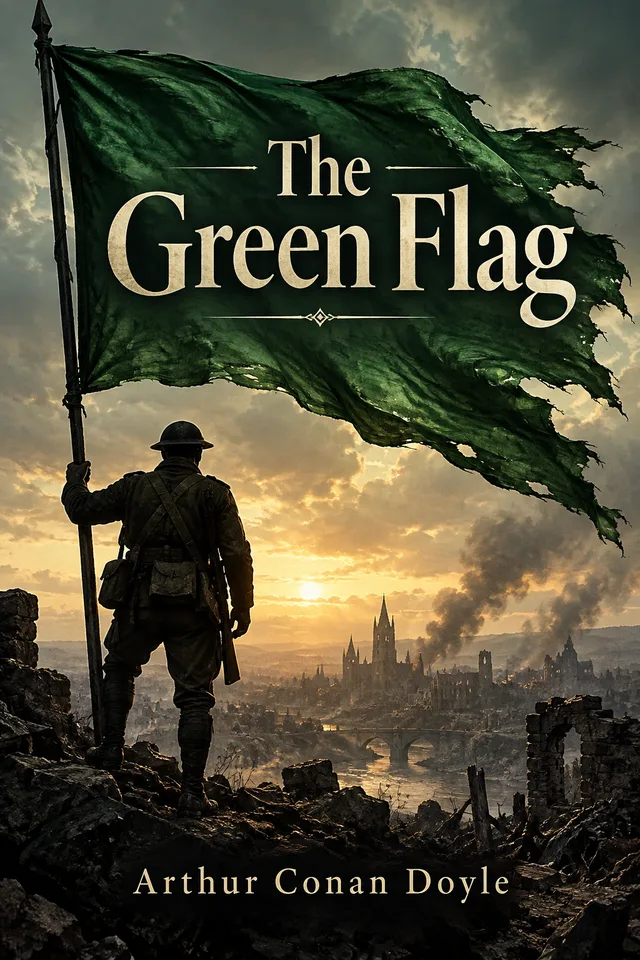
The Green Flag
BooksWhale-Ausgabe auf Englisch von Arthur Conan Doyle
Vivid adventure stories shaped by war, courage, loyalty, and the moral cost of conflict.
- Vorschau
- Auszug aus dem vorbereiteten Text
- Formate
- Online-Reader, EPUB, PDF
- Zugriff
- Bibliotheks-Claim
Bucheinführung
The Green Flag
Doyle places soldiers and adventurers in battlefields, borderlands, and moments of moral crisis, testing the distance between heroism and violence.
BooksWhale-Ausgabe
Wie diese Ausgabe vorbereitet wurde
Diese Ausgabe basiert auf einem gemeinfreien Text und wurde von BooksWhale für digitales Lesen vorbereitet.
Public-Domain-Grundlage
Warum diese Ausgabe geteilt werden kann
Arthur Conan Doyle died in 1930; this 1900 English original is public domain.
Vorschau lesen
Auszug aus dem vorbereiteten Text
Vorschau aus dem vorbereiteten Lesetext.
VorschaukapitelFull textVorschau lesen
The Green Flag
Arthur Conan Doyle
VorschaukapitelIVorschau
HOW THE GOVERNOR OF SAINT KITT’S CAME HOME.
When the great wars of the Spanish Succession had been brought to an end by the Treaty of Utrecht, the vast number of privateers which had been fitted out by the contending parties found their occupation gone. Some took to the more peaceful but less lucrative ways of ordinary commerce, others were absorbed into the fishing fleets, and a few of the more reckless hoisted the Jolly Rodger at the mizzen and the bloody flag at the main, declaring a private war upon their own account against the whole human race.
With mixed crews, recruited from every nation, they scoured the seas, disappearing occasionally to careen in some lonely inlet, or putting in for a debauch at some outlying port, where they dazzled the inhabitants by their lavishness, and horrified them by their brutalities.
On the Coromandel Coast, at Madagascar, in the African waters, and above all in the West Indian and American seas, the pirates were a constant menace. With an insolent luxury they would regulate their depredations by the comfort of the seasons, harrying New England in the summer, and dropping south again to the tropical islands in the winter.
They were the more to be dreaded because they had none of that discipline and restraint which made their predecessors, the Buccaneers, both formidable and respectable. These Ishmaels of the sea rendered an account to no man, and treated their prisoners according to the drunken whim of the moment. Flashes of grotesque generosity alternated with longer stretches of inconceivable ferocity, and the skipper who fell into their hands might find himself dismissed with his cargo, after serving as boon companion in some hideous debauch, or might sit at his cabin table with his own nose and his lips served up with pepper and salt in front of him. It took a stout seaman in those days to ply his calling in the Caribbean Gulf.
Such a man was Captain John Scarrow, of the ship Morning Star , and yet he breathed a long sigh of relief when he heard the splash of the falling anchor and swung at his moorings within a hundred yards of the guns of the citadel of Basseterre. St. Kitt’s was his final port of call, and early next morning his bowsprit would be pointed for Old England. He had had enough of those robber-haunted seas. Ever since he had left Maracaibo upon the Main, with his full lading of sugar and red pepper, he had winced at every topsail which glimmered over the violet edge of the tropical sea. He had coasted up the Windward Islands, touching here and there, and assailed continually by stories of villainy and outrage.
Captain Sharkey, of the twenty-gun pirate barque, Happy Delivery , had passed down the coast, and had littered it with gutted vessels and with murdered men. Dreadful anecdotes were current of his grim pleasantries and of his inflexible ferocity. From the Bahamas to the Main his coal-black barque, with the ambiguous name, had been freighted with death and many things which are worse than death. So nervous was Captain Scarrow, with his new full-rigged ship, and her full and valuable lading, that he struck out to the west as far as Bird’s Island to be out of the usual track of commerce. And yet even in those solitary waters he had been unable to shake off sinister traces of Captain Sharkey.
One morning they had raised a single skiff adrift upon the face of the ocean. Its only occupant was a delirious seaman, who yelled hoarsely as they hoisted him aboard, and showed a dried-up tongue like a black and wrinkled fungus at the back of his mouth. Water and nursing soon transformed him into the strongest and smartest sailor on the ship. He was from Marblehead, in New England, it seemed, and was the sole survivor of a schooner which had been scuttled by the dreadful Sharkey.
VorschaukapitelIIVorschau
THE DEALINGS OF CAPTAIN SHARKEY WITH STEPHEN CRADDOCK
Careening was a very necessary operation for the old pirate. On his superior speed he depended both for overhauling the trader and escaping the man-of-war. But it was impossible to retain his sailing qualities unless he periodically—once a year, at the least—cleared his vessel’s bottom from the long, trailing plants and crusting barnacles which gather so rapidly in the tropical seas. For this purpose he lightened his vessel, thrust her into some narrow inlet where she would be left high and dry at low water, fastened blocks and tackles to her masts to pull her over on to her bilge, and then scraped her thoroughly from rudder-post to cut-water.
During the weeks which were thus occupied the ship was, of course, defenceless; but, on the other hand, she was unapproachable by anything heavier than an empty hull, and the place for careening was chosen with an eye to secrecy, so that there was no great danger. So secure did the captains feel, that it was not uncommon for them, at such times, to leave their ships under a sufficient guard, and to start off in the long-boat, either upon a sporting expedition or, more frequently, upon a visit to some outlying town, where they burned the heads of the women by their swaggering gallantry, or broached pipes of wine in the market square, with a threat to pistol all who would not drink with them.
Sometimes they would even appear in cities of the size of Charleston, and walk the streets with their clattering side-arms—an open scandal to the whole law-abiding colony. Such visits were not always paid with impunity. It was one of them, for example, which provoked Lieutenant Maynard to hack off Blackbeard’s head, and to spear it upon the end of his bowsprit. But, as a rule, the pirate ruffled and bullied and drabbed without let or hindrance, until it was time for him to go back to his ship once more.
There was one pirate, however, who never crossed even the skirts of civilisation, and that was the sinister Sharkey, of the barque Happy Delivery . It may have been from his morose and solitary temper, or, as is more probable, that he knew that his name upon the coast was such that outraged humanity would, against all odds, have thrown themselves upon him, but never once did he show his face in a settlement.
When his ship was laid up he would leave her under the charge of Ned Galloway—her New England quartermaster—and would take long voyages in his boat, sometimes, it was said, for the purpose of burying his share of the plunder, and sometimes to shoot the wild oxen of Hispaniola, which, when dressed and barbecued, provided provisions for his next voyage. In the latter case the barque would come round to some pre-arranged spot to pick him up, and take on board what he had shot.
There had always been a hope in the islands that Sharkey might be taken on one of these occasions; and at last there came news to Kingston which seemed to justify an attempt upon him. It was brought by an elderly logwood-cutter who had fallen into the pirate’s hands, and in some freak of drunken benevolence had been allowed to get away with nothing worse than a slit nose and a drubbing. His account was recent and definite. The Happy Delivery was careening at Torbec on the south-west of Hispaniola. Sharkey, with four men, was buccaneering on the outlying island of La Vache. The blood of a hundred murdered crews was calling out for vengeance, and now at last it seemed as if it might not call in vain.
Sir Edward Compton, the high-nosed, red-faced Governor, sitting in solemn conclave with the commandant and the head of the council, was sorely puzzled in his mind as to how he should use this chance. There was no man-of-war nearer than Jamestown, and she was a clumsy old fly-boat, which could neither overhaul the pirate on the seas, nor reach her in a shallow inlet. There were forts and artillerymen both at Kingston and Port Royal, but no soldiers available for an expedition.
Inhaltsverzeichnis
In dieser Ausgabe
- 01Full text
- 02I
- 03II
- 04III
- 05I
- 06II
- 07III
- 08I had to confess that I had not.
Sprachverfügbarkeit
Andere Sprachen
Weitere Sprachausgaben sind noch nicht veröffentlicht. Sobald verfügbar, werden sie hier verlinkt.
Andere Sprache anfragen