Englisch Ausgabe
Geschichte
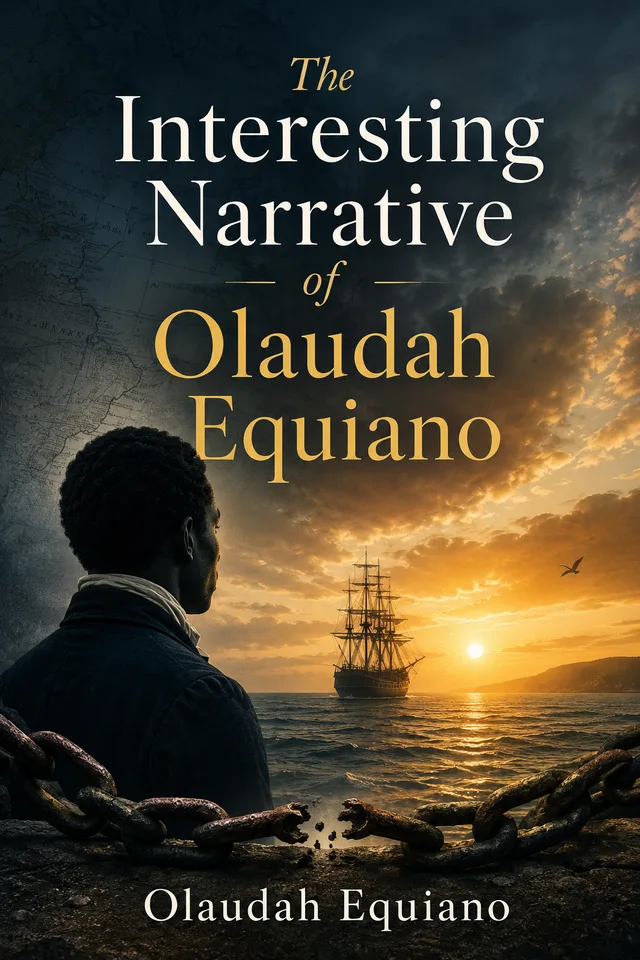
The Interesting Narrative of Olaudah Equiano
BooksWhale-Ausgabe auf Englisch von Olaudah Equiano
A major slave narrative tracing capture, Atlantic slavery, freedom, travel, faith, and abolition.
- Vorschau
- Auszug aus dem vorbereiteten Text
- Formate
- Online-Reader, EPUB, PDF
- Zugriff
- Bibliotheks-Claim
Bucheinführung
The Interesting Narrative of Olaudah Equiano
Olaudah Equiano’s narrative recounts childhood, enslavement, Atlantic voyages, labor, conversion, self-purchase, maritime travel, and abolitionist witness. It remains one of the most important first-person texts on slavery, empire, commerce, freedom, and Black authorship in the eighteenth century.
BooksWhale-Ausgabe
Wie diese Ausgabe vorbereitet wurde
Diese Ausgabe basiert auf einem gemeinfreien Text und wurde von BooksWhale für digitales Lesen vorbereitet.
Public-Domain-Grundlage
Warum diese Ausgabe geteilt werden kann
Olaudah Equiano died in 1797, and his narrative was first published in 1789. These dates support the public-domain basis for the English source text used in this edition.
Vorschau lesen
Auszug aus dem vorbereiteten Text
Vorschau aus dem vorbereiteten Lesetext.
VorschaukapitelThe Interesting Narrative of Olaudah EquianoVorschau lesen
The Interesting Narrative of Olaudah Equiano
VorschaukapitelCHAPTER I.Vorschau
_The author's account of his country, and their manners and
customs--Administration of justice--Embrenche--Marriage
ceremony, and public entertainments--Mode of
living--Dress--Manufactures
Buildings--Commerce--Agriculture--War and
religion--Superstition of the natives--Funeral ceremonies of
the priests or magicians--Curious mode of discovering
poison--Some hints concerning the origin of the author's
countrymen, with the opinions of different writers on that
subject._
I believe it is difficult for those who publish their own memoirs to
escape the imputation of vanity; nor is this the only disadvantage
under which they labour: it is also their misfortune, that what is
uncommon is rarely, if ever, believed, and what is obvious we are apt
to turn from with disgust, and to charge the writer with impertinence.
People generally think those memoirs only worthy to be read or
remembered which abound in great or striking events, those, in short,
which in a high degree excite either admiration or pity: all others
they consign to contempt and oblivion. It is therefore, I confess, not
a little hazardous in a private and obscure individual, and a stranger
too, thus to solicit the indulgent attention of the public; especially
when I own I offer here the history of neither a saint, a hero, nor a
tyrant. I believe there are few events in my life, which have not
happened to many: it is true the incidents of it are numerous; and,
did I consider myself an European, I might say my sufferings were
great: but when I compare my lot with that of most of my countrymen, I
regard myself as a _particular favourite of Heaven_, and acknowledge
the mercies of Providence in every occurrence of my life. If then the
following narrative does not appear sufficiently interesting to engage
general attention, let my motive be some excuse for its publication. I
am not so foolishly vain as to expect from it either immortality or
literary reputation. If it affords any satisfaction to my numerous
friends, at whose request it has been written, or in the smallest
degree promotes the interests of humanity, the ends for which it was
undertaken will be fully attained, and every wish of my heart
gratified. Let it therefore be remembered, that, in wishing to avoid
censure, I do not aspire to praise.
That part of Africa, known by the name of Guinea, to which the trade
for slaves is carried on, extends along the coast above 3400 miles,
from the Senegal to Angola, and includes a variety of kingdoms. Of
these the most considerable is the kingdom of Benen, both as to extent
and wealth, the richness and cultivation of the soil, the power of its
king, and the number and warlike disposition of the inhabitants. It is
situated nearly under the line, and extends along the coast about 170
miles, but runs back into the interior part of Africa to a distance
hitherto I believe unexplored by any traveller; and seems only
terminated at length by the empire of Abyssinia, near 1500 miles from
its beginning. This kingdom is divided into many provinces or
districts: in one of the most remote and fertile of which, called
Eboe, I was born, in the year 1745, in a charming fruitful vale, named
Essaka. The distance of this province from the capital of Benin and
the sea coast must be very considerable; for I had never heard of
white men or Europeans, nor of the sea: and our subjection to the king
of Benin was little more than nominal; for every transaction of the
government, as far as my slender observation extended, was conducted
by the chiefs or elders of the place. The manners and government of a
people who have little commerce with other countries are generally
very simple; and the history of what passes in one family or village
may serve as a specimen of a nation. My father was one of those elders
VorschaukapitelCHAP. II.Vorschau
_The author's birth and parentage--His being kidnapped with
his sister--Their separation--Surprise at meeting again--Are
finally separated--Account of the different places and
incidents the author met with till his arrival on the
coast--The effect the sight of a slave ship had on him--He
sails for the West Indies--Horrors of a slave ship--Arrives
at Barbadoes, where the cargo is sold and dispersed._
I hope the reader will not think I have trespassed on his
patience in introducing myself to him with some account of the manners
and customs of my country. They had been implanted in me with great
care, and made an impression on my mind, which time could not erase,
and which all the adversity and variety of fortune I have since
experienced served only to rivet and record; for, whether the love of
one's country be real or imaginary, or a lesson of reason, or an
instinct of nature, I still look back with pleasure on the first
scenes of my life, though that pleasure has been for the most part
mingled with sorrow.
I have already acquainted the reader with the time and place of my
birth. My father, besides many slaves, had a numerous family, of which
seven lived to grow up, including myself and a sister, who was the
only daughter. As I was the youngest of the sons, I became, of course,
the greatest favourite with my mother, and was always with her; and
she used to take particular pains to form my mind. I was trained up
from my earliest years in the art of war; my daily exercise was
shooting and throwing javelins; and my mother adorned me with emblems,
after the manner of our greatest warriors. In this way I grew up till
I was turned the age of eleven, when an end was put to my happiness in
the following manner:--Generally when the grown people in the
neighbourhood were gone far in the fields to labour, the children
assembled together in some of the neighbours' premises to play; and
commonly some of us used to get up a tree to look out for any
assailant, or kidnapper, that might come upon us; for they sometimes
took those opportunities of our parents' absence to attack and carry
off as many as they could seize. One day, as I was watching at the top
of a tree in our yard, I saw one of those people come into the yard of
our next neighbour but one, to kidnap, there being many stout young
people in it. Immediately on this I gave the alarm of the rogue, and
he was surrounded by the stoutest of them, who entangled him with
cords, so that he could not escape till some of the grown people came
and secured him. But alas! ere long it was my fate to be thus
attacked, and to be carried off, when none of the grown people were
nigh. One day, when all our people were gone out to their works as
usual, and only I and my dear sister were left to mind the house, two
men and a woman got over our walls, and in a moment seized us both,
and, without giving us time to cry out, or make resistance, they
stopped our mouths, and ran off with us into the nearest wood. Here
they tied our hands, and continued to carry us as far as they could,
till night came on, when we reached a small house, where the robbers
halted for refreshment, and spent the night. We were then unbound, but
were unable to take any food; and, being quite overpowered by fatigue
and grief, our only relief was some sleep, which allayed our
misfortune for a short time. The next morning we left the house, and
continued travelling all the day. For a long time we had kept the
Inhaltsverzeichnis
In dieser Ausgabe
- 01The Interesting Narrative of Olaudah Equiano
- 02CHAPTER I.
- 03CHAP. II.
- 04CHAP. III.
- 05CHAP. IV.
- 06CHAP. V.
- 07CHAP. VI.
- 08END OF THE FIRST VOLUME.
- 09VOLUME II
- 10CHAP. VII.
- 11CHAP. VIII.
- 12CHAP. IX
- 13CHAP. X.
- 14MISCELLANEOUS VERSES,
- 15CHAP. XI.
- 16'CHARLES IRVING.'
- 17CHAP. XII.
- 18GUSTAVUS VASSA.
- 19MATT. MACNAMARA.
- 20THOMAS WALLACE.
- 21J. HINSLOW,
- 22GEO. MARSH,
- 23W. PALMER.
- 24HUMBLY SHEWETH,
Sprachverfügbarkeit
Andere Sprachen
Weitere Sprachausgaben sind noch nicht veröffentlicht. Sobald verfügbar, werden sie hier verlinkt.
Andere Sprache anfragen