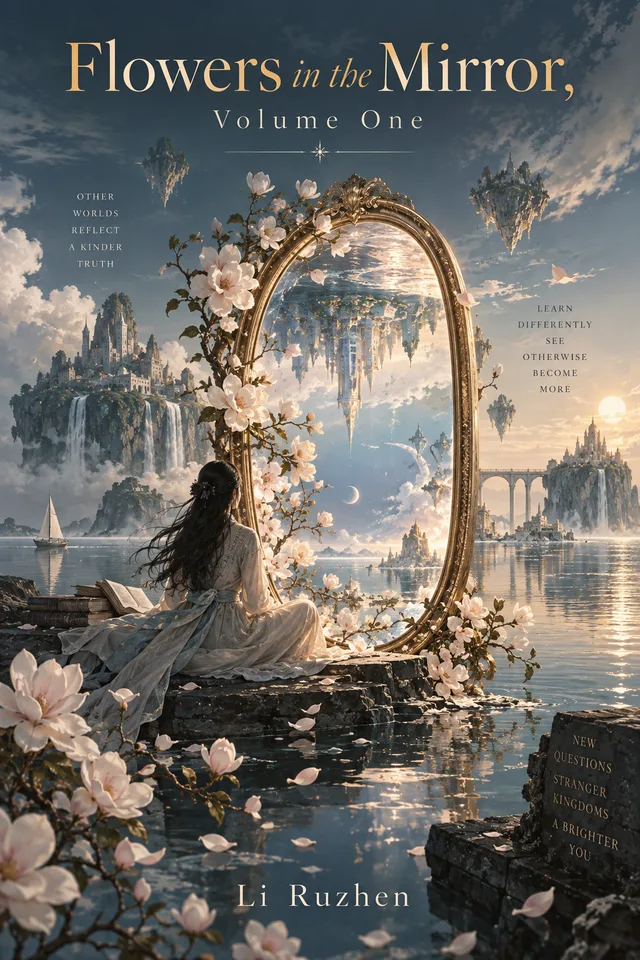
Englisch Ausgabe
Literatur
Flowers in the Mirror, Volume One
BooksWhale-Ausgabe auf Englisch von Li Ruzhen
Originaltitel: 镜花缘
A fantastical voyage through kingdoms where gender, language, learning, and customs are turned upside down.
- Vorschau
- Auszug aus dem vorbereiteten Text
- Formate
- Online-Reader, EPUB, PDF
- Zugriff
- Bibliotheks-Claim
Bucheinführung
Flowers in the Mirror, Volume One
Volume One travels through strange lands filled with reversed customs, literary games, and impossible encounters. Li Ruzhen uses fantasy and satire to question education, gender expectations, vanity, bureaucracy, and social habits.
BooksWhale-Ausgabe
Wie diese Ausgabe vorbereitet wurde
Diese Ausgabe basiert auf einem gemeinfreien Text und wurde von BooksWhale für digitales Lesen vorbereitet.
Public-Domain-Grundlage
Warum diese Ausgabe geteilt werden kann
Li Ruzhen died in 1830; the Chinese source is public domain. This edition is an authorized AI-assisted translation.
Vorschau lesen
Auszug aus dem vorbereiteten Text
Vorschau aus dem vorbereiteten Lesetext.
VorschaukapitelFull textVorschau lesen
Flowers in the Mirror, Volume One
Li Ruzhen
Flowers in the Mirror
Jing Hua Yuan, Volume 1
VorschaukapitelPrefaceVorschau
Flowers in the Mirror (Jinghua yuan), written by the Qing-dynasty polymath Li Ruzhen (c. 1763–1830), stands as one of the most imaginative works in the long tradition of Chinese classical fiction. Though often grouped with late-imperial novels of fantasy and adventure, it defies simple classification. It is at once an encyclopedic compendium of knowledge, a satire on social and political life, a meditation on gender and morality, and an exuberant dreamscape that carries the reader far beyond the boundaries of the ordinary world. Few works of its era combine such erudition with such playful invention.
The novel emerged during a period when the Qing empire was confronting profound intellectual currents: the rise of evidential scholarship, the tension between Confucian orthodoxy and heterodox learning, and a renewed interest in the exotic and the strange. Li Ruzhen—a linguist, astronomer, musician, and scholar-official—absorbed these influences and transformed them into literary art. His wide learning is evident everywhere in the text: from intricate discussions of botany, astronomy, and mechanics to the novel’s dazzling display of classical allusions, poetic forms, and phonological puzzles. Yet Li’s encyclopedic mind is never merely ornamental. Knowledge becomes a tool for critique, humor, and alternative possibility.
At the heart of Flowers in the Mirror lies its famous journey through a series of fantastical realms, beginning with the Country of Women and extending to lands where language, custom, and even human bodies follow rules entirely different from those of the familiar world. These imaginative episodes are not simply whimsical; they reveal Li Ruzhen’s sharp eye for social absurdity and his sympathy for those constrained by tradition. His inversion of gender roles—especially in the Country of Women—offers a satirical yet poignant reflection on the injustices faced by women in late-imperial society. Through fantasy, Li exposes the fragility of norms that are often taken as universal.
The novel’s narrative structure also departs from conventional forms. Rather than a tightly woven plot, Flowers in the Mirror unfolds like a series of interlocking scrolls, shifting effortlessly between travelogue, allegory, scholarly treatise, and poetic anthology. This fluidity mirrors the world Li sought to portray: a universe rich in complexity, where reason and imagination coexist, and where the boundaries between reality and illusion dissolve like reflections on a polished mirror.
Two centuries after its creation, Flowers in the Mirror remains both a literary treasure and a cultural curiosity. It invites modern readers to encounter the intellectual horizons of Qing China while contemplating questions that still resonate today—about knowledge, identity, gender, and the power of the imagination. In Li Ruzhen’s hands, fiction becomes a mirror not only of flowers but of the human condition itself, refracted through wit, wonder, and boundless creative spirit.
VorschaukapitelChapter 1Vorschau
The Female Kui Star Displays an Auspicious Sign in the Northern Dipper
The Old Mother of the West Bestows a Banquet at the Jade Pool
In Lady Cao’s Precepts for Women, it is said: “A woman has four virtues: first, womanly virtue; second, womanly speech; third, womanly appearance; fourth, womanly work.” These four are the essential moral pillars of womanhood and cannot be lacking. Why, then, do I begin this book with Ban Zhao’s Precepts for Women? Because although this work records trifles of the boudoir and the idle affections of maidens, yet, like the four virtues described by Lady Cao, there are countless examples to be found—women whose nature is not only of gold and jade, but whose hearts are of ice and snow. Without observing these precepts in daily life, without reverently upholding good admonitions, how could they reach such refinement? Should we—simply because the events are distant or the persons beautiful or plain—allow them all to fade away?
Therefore, by lamplight under the moon, in the long summers and deep winters, I dipped my brush playfully in ink and gathered these writings into a single volume. The virtuous are shown forth; the unworthy are held in disdain. Women have their roles as women; wives have their roles as wives. There is constancy in constancy, and change in change. Though the accounts seem trivial and minute, the tune concludes in righteousness; lascivious or foul words are entirely omitted. The strange and fantastic within arise from the banishment of the myriad flowers, which sets the story in motion. Read the opening chapter, and the outline becomes clear.
To begin: among the famous mountains of the world, aside from Kunlun where the Queen Mother dwells, there are three renowned sacred mountains in the seas: the first is Penglai, the second Fangzhang, the third Yingzhou. All are remote and difficult to reach, their heights extraordinary. In Records of the Grand Historian it is said that these three mountains are the gathering places of immortals. Later works, such as Records of the Unusual and Bowuzhi, speak at length of their abundant treasures and splendid scenery. Most delightful of all, they have flowers that never wither in any season, and grasses that remain evergreen through the eight festivals. As for immortal fruits, auspicious trees, fine grains, and blessed harvests—there is no end to the list.
On Penglai Mountain, there is a Cliff of Ill-Fate, and upon the cliff a Red Beauty Cave. Within the cave dwells an immortal lady who governs all the famous flowers of the world, the Mistress of the Hundred Flowers, who has cultivated here for countless years. On the day of the Queen Mother’s birthday—the third day of the third lunar month—she prepared to go and offer felicitations, when the Immortal of the Hundred Herbs, her close friend, arrived to summon her to the Grand Peach Banquet.
The Hundred Flowers Immortal summoned her attendant maidens to carry bottles of Hundred-Flower Wine, and invited the Immortals of the Hundred Fruits and the Hundred Grains to join. The four immortal ladies mounted clouds and headed west to Kunlun.
Halfway there, they saw auspicious clouds coiling on all sides and purple mist swirling everywhere—immortals from various caves, also on their way to the feast. Suddenly, from the Palace of the Northern Dipper burst ten thousand rays of crimson light, dazzling the eyes. From within stepped a star-lord, dancing out. Though dressed like the Kui Star deity, the face was that of a beautiful woman—brow like the moon, cheeks like blossoms. In her left hand she held a brush; in her right, a dipper. Surrounded by red radiance, she rode a rainbow cloud toward Kunlun.
The Immortal of the Hundred Grains said, “This star-lord appears in such form—she must be the Lady of the Kui Star. So the Kui Star has a wife—how rare!”
Inhaltsverzeichnis
In dieser Ausgabe
- 01Full text
- 02Preface
- 03Chapter 1
- 04Chapter 2
- 05Chapter 3
- 06Chapter 4
- 07Chapter 5
- 08Chapter 6
- 09Chapter 7
- 10Chapter 8
- 11Chapter 9
- 12Chapter 10
- 13Chapter 11
- 14Chapter 12
- 15Chapter 13
- 16Chapter 14
- 17Chapter 15
- 18Chapter 16
- 19Chapter 17
- 20Chapter 18
- 21Chapter 19
- 22Chapter 20
- 23Chapter 21
- 24Chapter 22
- 25Chapter 23
- 26Chapter 24
- 27Chapter 25
- 28About the Author
Sprachverfügbarkeit
Andere Sprachen
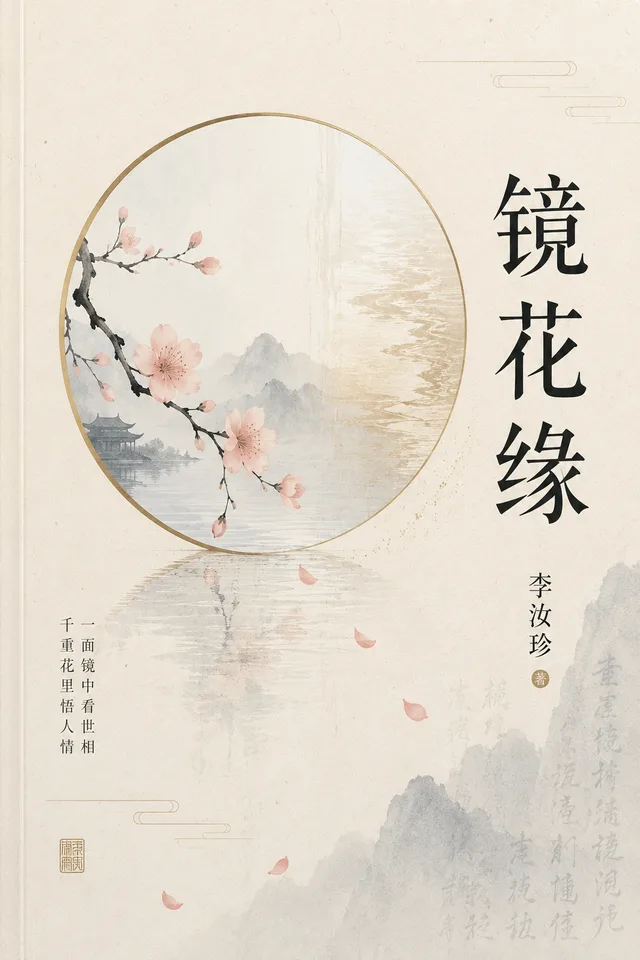
Chinesisch
Chinesisch Ausgabe
镜花缘
Li Ruzhen · Literatur
一部清代幻想讽刺小说,借海外奇境写才学、制度与世情。
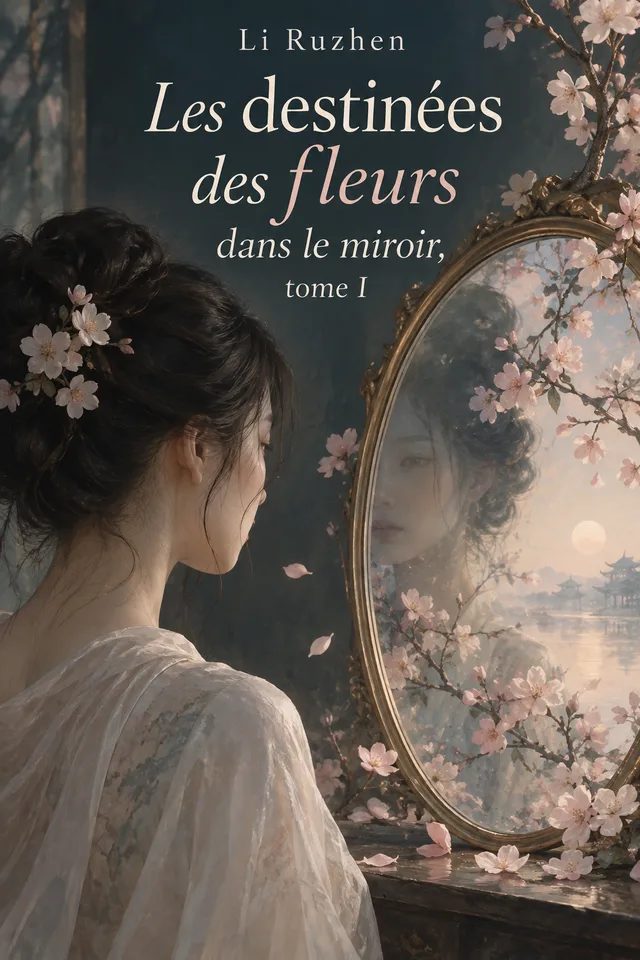
Französisch
Französisch Ausgabe
Les destinées des fleurs dans le miroir, tome I
Li Ruzhen · Literatur
Édition française de Les destinées des fleurs dans le miroir, tome I, en traduction propre de BooksWhale.