Englisch Ausgabe
Literatur
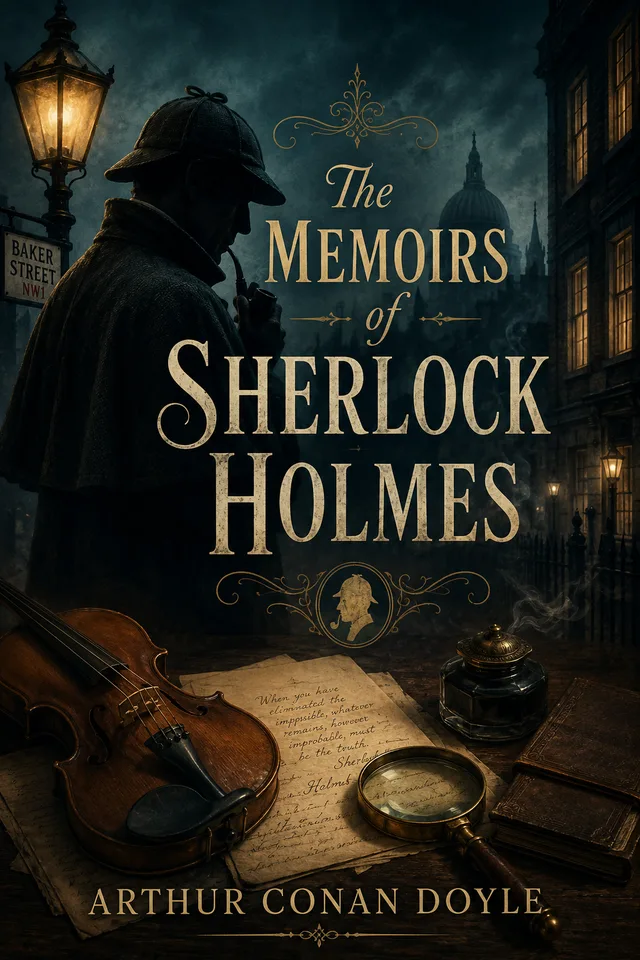
The Memoirs of Sherlock Holmes
BooksWhale-Ausgabe auf Englisch von Arthur Conan Doyle
Classic Sherlock Holmes stories of deduction, danger, disguise, and criminal puzzles.
- Vorschau
- Auszug aus dem vorbereiteten Text
- Formate
- Online-Reader, EPUB, PDF
- Zugriff
- Bibliotheks-Claim
Bucheinführung
The Memoirs of Sherlock Holmes
The Memoirs of Sherlock Holmes collects memorable cases featuring Sherlock Holmes and Dr. Watson, including mysteries of identity, revenge, and deduction. This English edition is prepared for clear digital reading and reference.
BooksWhale-Ausgabe
Wie diese Ausgabe vorbereitet wurde
Diese Ausgabe basiert auf einem gemeinfreien Text und wurde von BooksWhale für digitales Lesen vorbereitet.
Public-Domain-Grundlage
Warum diese Ausgabe geteilt werden kann
Arthur Conan Doyle died in 1930, and The Memoirs of Sherlock Holmes was first published in 1894. These dates support the public-domain basis for the English source text used in this edition.
Vorschau lesen
Auszug aus dem vorbereiteten Text
Vorschau aus dem vorbereiteten Lesetext.
VorschaukapitelFull textVorschau lesen
The Memoirs of Sherlock Holmes
Arthur Conan Doyle
VorschaukapitelI. Silver BlazeVorschau
I am afraid, Watson, that I shall have to go,” said Holmes, as we sat down together to our breakfast one morning.
“Go! Where to?”
“To Dartmoor; to King’s Pyland.”
I was not surprised. Indeed, my only wonder was that he had not already been mixed up in this extraordinary case, which was the one topic of conversation through the length and breadth of England. For a whole day my companion had rambled about the room with his chin upon his chest and his brows knitted, charging and recharging his pipe with the strongest black tobacco, and absolutely deaf to any of my questions or remarks. Fresh editions of every paper had been sent up by our news agent, only to be glanced over and tossed down into a corner. Yet, silent as he was, I knew perfectly well what it was over which he was brooding. There was but one problem before the public which could challenge his powers of analysis, and that was the singular disappearance of the favourite for the Wessex Cup, and the tragic murder of its trainer. When, therefore, he suddenly announced his intention of setting out for the scene of the drama it was only what I had both expected and hoped for.
“I should be most happy to go down with you if I should not be in the way,” said I.
“My dear Watson, you would confer a great favour upon me by coming. And I think that your time will not be misspent, for there are points about the case which promise to make it an absolutely unique one. We have, I think, just time to catch our train at Paddington, and I will go further into the matter upon our journey. You would oblige me by bringing with you your very excellent field-glass.”
And so it happened that an hour or so later I found myself in the corner of a first-class carriage flying along en route for Exeter, while Sherlock Holmes, with his sharp, eager face framed in his ear-flapped travelling-cap, dipped rapidly into the bundle of fresh papers which he had procured at Paddington. We had left Reading far behind us before he thrust the last one of them under the seat, and offered me his cigar-case.
“We are going well,” said he, looking out the window and glancing at his watch. “Our rate at present is fifty-three and a half miles an hour.”
“I have not observed the quarter-mile posts,” said I.
“Nor have I. But the telegraph posts upon this line are sixty yards apart, and the calculation is a simple one. I presume that you have looked into this matter of the murder of John Straker and the disappearance of Silver Blaze?”
“I have seen what the Telegraph and the Chronicle have to say.”
“It is one of those cases where the art of the reasoner should be used rather for the sifting of details than for the acquiring of fresh evidence. The tragedy has been so uncommon, so complete and of such personal importance to so many people, that we are suffering from a plethora of surmise, conjecture, and hypothesis. The difficulty is to detach the framework of fact—of absolute undeniable fact—from the embellishments of theorists and reporters. Then, having established ourselves upon this sound basis, it is our duty to see what inferences may be drawn and what are the special points upon which the whole mystery turns. On Tuesday evening I received telegrams from both Colonel Ross, the owner of the horse, and from Inspector Gregory, who is looking after the case, inviting my co-operation.”
“Tuesday evening!” I exclaimed. “And this is Thursday morning. Why didn’t you go down yesterday?”
“Because I made a blunder, my dear Watson—which is, I am afraid, a more common occurrence than any one would think who only knew me through your memoirs. The fact is that I could not believe it possible that the most remarkable horse in England could long remain concealed, especially in so sparsely inhabited a place as the north of Dartmoor. From hour to hour yesterday I expected to hear that he had been found, and that his abductor was the murderer of John Straker. When, however, another morning had come, and I found that beyond the arrest of young Fitzroy Simpson nothing had been done, I felt that it was time for me to take action. Yet in some ways I feel that yesterday has not been wasted.”
VorschaukapitelII. The Adventure of the Cardboard BoxVorschau
In choosing a few typical cases which illustrate the remarkable mental qualities of my friend, Sherlock Holmes, I have endeavoured, as far as possible, to select those which presented the minimum of sensationalism, while offering a fair field for his talents. It is, however, unfortunately impossible entirely to separate the sensational from the criminal, and a chronicler is left in the dilemma that he must either sacrifice details which are essential to his statement and so give a false impression of the problem, or he must use matter which chance, and not choice, has provided him with. With this short preface I shall turn to my notes of what proved to be a strange, though a peculiarly terrible, chain of events.
It was a blazing hot day in August. Baker Street was like an oven, and the glare of the sunlight upon the yellow brickwork of the house across the road was painful to the eye. It was hard to believe that these were the same walls which loomed so gloomily through the fogs of winter. Our blinds were half-drawn, and Holmes lay curled upon the sofa, reading and re-reading a letter which he had received by the morning post. For myself, my term of service in India had trained me to stand heat better than cold, and a thermometer at ninety was no hardship. But the morning paper was uninteresting. Parliament had risen. Everybody was out of town, and I yearned for the glades of the New Forest or the shingle of Southsea. A depleted bank account had caused me to postpone my holiday, and as to my companion, neither the country nor the sea presented the slightest attraction to him. He loved to lie in the very centre of five millions of people, with his filaments stretching out and running through them, responsive to every little rumour or suspicion of unsolved crime. Appreciation of nature found no place among his many gifts, and his only change was when he turned his mind from the evil-doer of the town to track down his brother of the country.
Finding that Holmes was too absorbed for conversation I had tossed aside the barren paper, and leaning back in my chair I fell into a brown study. Suddenly my companion’s voice broke in upon my thoughts:
“You are right, Watson,” said he. “It does seem a most preposterous way of settling a dispute.”
“Most preposterous!” I exclaimed, and then suddenly realizing how he had echoed the inmost thought of my soul, I sat up in my chair and stared at him in blank amazement.
“What is this, Holmes?” I cried. “This is beyond anything which I could have imagined.”
He laughed heartily at my perplexity.
“You remember,” he said, “that some little time ago when I read you the passage in one of Poe’s sketches in which a close reasoner follows the unspoken thoughts of his companion, you were inclined to treat the matter as a mere tour-de-force of the author. On my remarking that I was constantly in the habit of doing the same thing you expressed incredulity.”
“Oh, no!”
“Perhaps not with your tongue, my dear Watson, but certainly with your eyebrows. So when I saw you throw down your paper and enter upon a train of thought, I was very happy to have the opportunity of reading it off, and eventually of breaking into it, as a proof that I had been in rapport with you.”
But I was still far from satisfied. “In the example which you read to me,” said I, “the reasoner drew his conclusions from the actions of the man whom he observed. If I remember right, he stumbled over a heap of stones, looked up at the stars, and so on. But I have been seated quietly in my chair, and what clues can I have given you?”
“You do yourself an injustice. The features are given to man as the means by which he shall express his emotions, and yours are faithful servants.”
Inhaltsverzeichnis
In dieser Ausgabe
- 01Full text
- 02I. Silver Blaze
- 03II. The Adventure of the Cardboard Box
- 04III. The Yellow Face
- 05IV. The Stockbroker’s Clerk
- 06V. The “Gloria Scott”
- 07VI. The Musgrave Ritual
- 08VII. The Reigate Squires
- 09VIII. The Crooked Man
- 10IX. The Resident Patient
- 11X. The Greek Interpreter
- 12XI. The Naval Treaty
- 13XII. The Final Problem
Sprachverfügbarkeit
Andere Sprachen
Weitere Sprachausgaben sind noch nicht veröffentlicht. Sobald verfügbar, werden sie hier verlinkt.
Andere Sprache anfragen