Englisch Ausgabe
Literatur
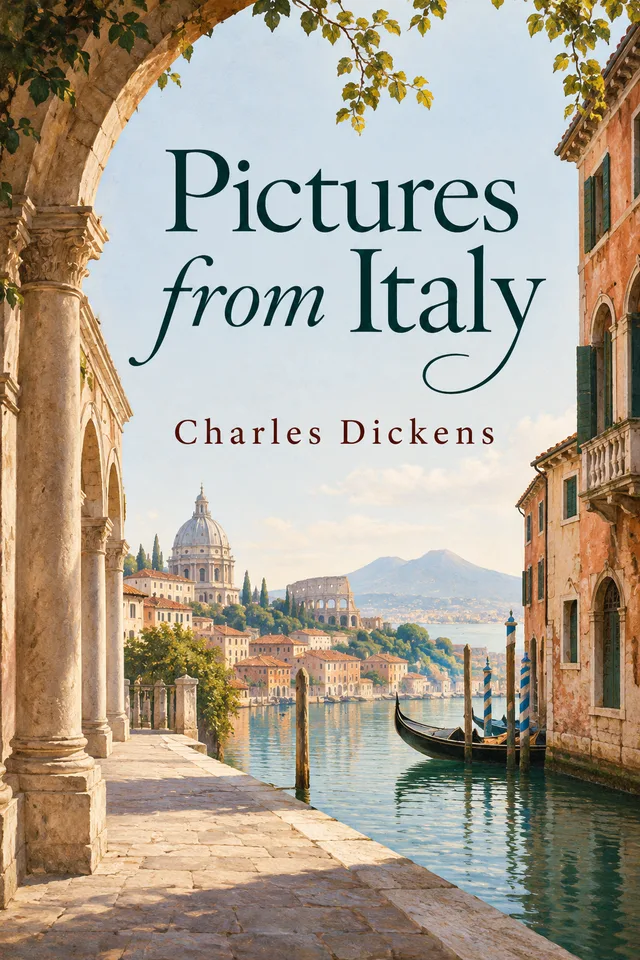
Pictures from Italy
BooksWhale-Ausgabe auf Englisch von Charles Dickens
Dickens follows the roads to Genoa, Venice, Rome and Naples, paying as much attention to street life as to monuments.
- Vorschau
- Auszug aus dem vorbereiteten Text
- Formate
- Online-Reader, EPUB, PDF
- Zugriff
- Bibliotheks-Claim
Bucheinführung
Pictures from Italy
The journey begins in France and continues through Genoa, Bologna, Ferrara and beyond. Dickens records what he sees from coaches, crowded streets and church interiors, stopping at places where anecdote can tell more than a guidebook. The account closes with a panorama that draws its impressions of Italian cities and their inhabitants together.
BooksWhale-Ausgabe
Wie diese Ausgabe vorbereitet wurde
Diese Ausgabe basiert auf einem gemeinfreien Text und wurde von BooksWhale für digitales Lesen vorbereitet.
Public-Domain-Grundlage
Warum diese Ausgabe geteilt werden kann
Charles Dickens died in 1870. This edition uses the historical English text of the work, published in 1846 and digitized by Project Gutenberg.
Vorschau lesen
Auszug aus dem vorbereiteten Text
Vorschau aus dem vorbereiteten Lesetext.
VorschaukapitelTHE READER’S PASSPORTVorschau lesen
If the readers of this volume will be so kind as to take their credentials for the different places which are the subject of its author’s reminiscences, from the Author himself, perhaps they may visit them, in fancy, the more agreeably, and with a better understanding of what they are to expect.
Many books have been written upon Italy, affording many means of studying the history of that interesting country, and the innumerable associations entwined about it. I make but little reference to that stock of information; not at all regarding it as a necessary consequence of my having had recourse to the storehouse for my own benefit, that I should reproduce its easily accessible contents before the eyes of my readers.
Neither will there be found, in these pages, any grave examination into the government or misgovernment of any portion of the country. No visitor of that beautiful land can fail to have a strong conviction on the subject; but as I chose when residing there, a Foreigner, to abstain from the discussion of any such questions with any order of Italians, so I would rather not enter on the inquiry now. During my twelve months’ occupation of a house at Genoa, I never found that authorities constitutionally jealous were distrustful of me; and I should be sorry to give them occasion to regret their free courtesy, either to myself or any of my countrymen.
There is, probably, not a famous Picture or Statue in all Italy, but could be easily buried under a mountain of printed paper devoted to dissertations on it. I do not, therefore, though an earnest admirer of Painting and Sculpture, expatiate at any length on famous Pictures and Statues.
This Book is a series of faint reflections—mere shadows in the water—of places to which the imaginations of most people are attracted in a greater or less degree, on which mine had dwelt for years, and which have some interest for all. The greater part of the descriptions were written on the spot, and sent home, from time to time, in private letters. I do not mention the circumstance as an excuse for any defects they may present, for it would be none; but as a guarantee to the Reader that they were at least penned in the fulness of the subject, and with the liveliest impressions of novelty and freshness.
If they have ever a fanciful and idle air, perhaps the reader will suppose them written in the shade of a Sunny Day, in the midst of the objects of which they treat, and will like them none the worse for having such influences of the country upon them.
I hope I am not likely to be misunderstood by Professors of the Roman Catholic faith, on account of anything contained in these pages. I have done my best, in one of my former productions, to do justice to them; and I trust, in this, they will do justice to me. When I mention any exhibition that impressed me as absurd or disagreeable, I do not seek to connect it, or recognise it as necessarily connected with, any essentials of their creed. When I treat of the ceremonies of the Holy Week, I merely treat of their effect, and do not challenge the good and learned Dr. Wiseman’s interpretation of their meaning. When I hint a dislike of nunneries for young girls who abjure the world before they have ever proved or known it; or doubt the ex officio sanctity of all Priests and Friars; I do no more than many conscientious Catholics both abroad and at home.
I have likened these Pictures to shadows in the water, and would fain hope that I have, nowhere, stirred the water so roughly, as to mar the shadows. I could never desire to be on better terms with all my friends than now, when distant mountains rise, once more, in my path. For I need not hesitate to avow, that, bent on correcting a brief mistake I made, not long ago, in disturbing the old relations between myself and my readers, and departing for a moment from my old pursuits, I am about to resume them, joyfully, in Switzerland; where during another year of absence, I can at once work out the themes I have now in my mind, without interruption: and while I keep my English audience within speaking distance, extend my knowledge of a noble country, inexpressibly attractive to me.
VorschaukapitelGOING THROUGH FRANCEVorschau
On a fine Sunday morning in the Midsummer time and weather of eighteen hundred and forty-four, it was, my good friend, when—don’t be alarmed; not when two travellers might have been observed slowly making their way over that picturesque and broken ground by which the first chapter of a Middle Aged novel is usually attained—but when an English travelling-carriage of considerable proportions, fresh from the shady halls of the Pantechnicon near Belgrave Square, London, was observed (by a very small French soldier; for I saw him look at it) to issue from the gate of the Hôtel Meurice in the Rue Rivoli at Paris.
I am no more bound to explain why the English family travelling by this carriage, inside and out, should be starting for Italy on a Sunday morning, of all good days in the week, than I am to assign a reason for all the little men in France being soldiers, and all the big men postilions; which is the invariable rule. But, they had some sort of reason for what they did, I have no doubt; and their reason for being there at all, was, as you know, that they were going to live in fair Genoa for a year; and that the head of the family purposed, in that space of time, to stroll about, wherever his restless humour carried him.
And it would have been small comfort to me to have explained to the population of Paris generally, that I was that Head and Chief; and not the radiant embodiment of good humour who sat beside me in the person of a French Courier—best of servants and most beaming of men! Truth to say, he looked a great deal more patriarchal than I, who, in the shadow of his portly presence, dwindled down to no account at all.
There was, of course, very little in the aspect of Paris—as we rattled near the dismal Morgue and over the Pont Neuf—to reproach us for our Sunday travelling. The wine-shops (every second house) were driving a roaring trade; awnings were spreading, and chairs and tables arranging, outside the cafés, preparatory to the eating of ices, and drinking of cool liquids, later in the day; shoe-blacks were busy on the bridges; shops were open; carts and waggons clattered to and fro; the narrow, up-hill, funnel-like streets across the River, were so many dense perspectives of crowd and bustle, parti-coloured nightcaps, tobacco-pipes, blouses, large boots, and shaggy heads of hair; nothing at that hour denoted a day of rest, unless it were the appearance, here and there, of a family pleasure-party, crammed into a bulky old lumbering cab; or of some contemplative holiday-maker in the freest and easiest dishabille, leaning out of a low garret window, watching the drying of his newly polished shoes on the little parapet outside (if a gentleman), or the airing of her stockings in the sun (if a lady), with calm anticipation.
Once clear of the never-to-be-forgotten-or-forgiven pavement which surrounds Paris, the first three days of travelling towards Marseilles are quiet and monotonous enough. To Sens. To Avallon. To Chalons. A sketch of one day’s proceedings is a sketch of all three; and here it is.
We have four horses, and one postilion, who has a very long whip, and drives his team, something like the Courier of Saint Petersburgh in the circle at Astley’s or Franconi’s: only he sits his own horse instead of standing on him. The immense jack-boots worn by these postilions, are sometimes a century or two old; and are so ludicrously disproportionate to the wearer’s foot, that the spur, which is put where his own heel comes, is generally halfway up the leg of the boots. The man often comes out of the stable-yard, with his whip in his hand and his shoes on, and brings out, in both hands, one boot at a time, which he plants on the ground by the side of his horse, with great gravity, until everything is ready. When it is—and oh Heaven! the noise they make about it!—he gets into the boots, shoes and all, or is hoisted into them by a couple of friends; adjusts the rope harness, embossed by the labours of innumerable pigeons in the stables; makes all the horses kick and plunge; cracks his whip like a madman; shouts ‘En route—Hi!’ and away we go. He is sure to have a contest with his horse before we have gone very far; and then he calls him a Thief, and a Brigand, and a Pig, and what not; and beats him about the head as if he were made of wood.
VorschaukapitelLYONS, THE RHONE, AND THE GOBLIN OF AVIGNONVorschau
Chalons is a fair resting-place, in right of its good inn on the bank of the river, and the little steamboats, gay with green and red paint, that come and go upon it: which make up a pleasant and refreshing scene, after the dusty roads. But, unless you would like to dwell on an enormous plain, with jagged rows of irregular poplars on it, that look in the distance like so many combs with broken teeth: and unless you would like to pass your life without the possibility of going up-hill, or going up anything but stairs: you would hardly approve of Chalons as a place of residence.
You would probably like it better, however, than Lyons: which you may reach, if you will, in one of the before-mentioned steamboats, in eight hours.
What a city Lyons is! Talk about people feeling, at certain unlucky times, as if they had tumbled from the clouds! Here is a whole town that is tumbled, anyhow, out of the sky; having been first caught up, like other stones that tumble down from that region, out of fens and barren places, dismal to behold! The two great streets through which the two great rivers dash, and all the little streets whose name is Legion, were scorching, blistering, and sweltering. The houses, high and vast, dirty to excess, rotten as old cheeses, and as thickly peopled. All up the hills that hem the city in, these houses swarm; and the mites inside were lolling out of the windows, and drying their ragged clothes on poles, and crawling in and out at the doors, and coming out to pant and gasp upon the pavement, and creeping in and out among huge piles and bales of fusty, musty, stifling goods; and living, or rather not dying till their time should come, in an exhausted receiver. Every manufacturing town, melted into one, would hardly convey an impression of Lyons as it presented itself to me: for all the undrained, unscavengered qualities of a foreign town, seemed grafted, there, upon the native miseries of a manufacturing one; and it bears such fruit as I would go some miles out of my way to avoid encountering again.
In the cool of the evening: or rather in the faded heat of the day: we went to see the Cathedral, where divers old women, and a few dogs, were engaged in contemplation. There was no difference, in point of cleanliness, between its stone pavement and that of the streets; and there was a wax saint, in a little box like a berth aboard ship, with a glass front to it, whom Madame Tussaud would have nothing to say to, on any terms, and which even Westminster Abbey might be ashamed of. If you would know all about the architecture of this church, or any other, its dates, dimensions, endowments, and history, is it not written in Mr. Murray’s Guide-Book, and may you not read it there, with thanks to him, as I did!
For this reason, I should abstain from mentioning the curious clock in Lyons Cathedral, if it were not for a small mistake I made, in connection with that piece of mechanism. The keeper of the church was very anxious it should be shown; partly for the honour of the establishment and the town; and partly, perhaps, because of his deriving a percentage from the additional consideration. However that may be, it was set in motion, and thereupon a host of little doors flew open, and innumerable little figures staggered out of them, and jerked themselves back again, with that special unsteadiness of purpose, and hitching in the gait, which usually attaches to figures that are moved by clock-work. Meanwhile, the Sacristan stood explaining these wonders, and pointing them out, severally, with a wand. There was a centre puppet of the Virgin Mary; and close to her, a small pigeon-hole, out of which another and a very ill-looking puppet made one of the most sudden plunges I ever saw accomplished: instantly flopping back again at sight of her, and banging his little door violently after him. Taking this to be emblematic of the victory over Sin and Death, and not at all unwilling to show that I perfectly understood the subject, in anticipation of the showman, I rashly said, ‘Aha! The Evil Spirit. To be sure. He is very soon disposed of.’ ‘Pardon, Monsieur,’ said the Sacristan, with a polite motion of his hand towards the little door, as if introducing somebody—‘The Angel Gabriel!’
Inhaltsverzeichnis
In dieser Ausgabe
- 01THE READER’S PASSPORT
- 02GOING THROUGH FRANCE
- 03LYONS, THE RHONE, AND THE GOBLIN OF AVIGNON
- 04AVIGNON TO GENOA
- 05GENOA AND ITS NEIGHBOURHOOD
- 06TO PARMA, MODENA, AND BOLOGNA
- 07THROUGH BOLOGNA AND FERRARA
- 08AN ITALIAN DREAM
- 09BY VERONA, MANTUA, AND MILAN, ACROSS THE PASS OF THE SIMPLON INTO SWITZERLAND
- 10TO ROME BY PISA AND SIENA
- 11ROME
- 12A RAPID DIORAMA
Sprachverfügbarkeit
Andere Sprachen
Weitere Sprachausgaben sind noch nicht veröffentlicht. Sobald verfügbar, werden sie hier verlinkt.
Andere Sprache anfragen