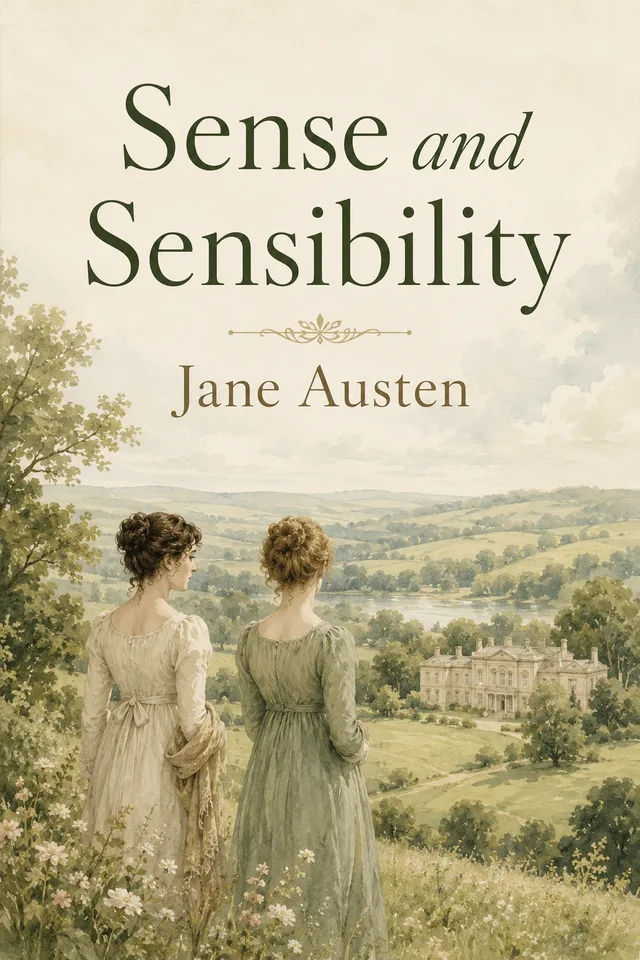
Englisch Ausgabe
Literatur
Sense and Sensibility
BooksWhale-Ausgabe auf Englisch von Jane Austen
Austen’s novel of sisters, feeling, restraint, money, marriage, and emotional education.
- Vorschau
- Auszug aus dem vorbereiteten Text
- Formate
- Online-Reader, EPUB, PDF
- Zugriff
- Bibliotheks-Claim
Bucheinführung
Sense and Sensibility
Sense and Sensibility follows Elinor and Marianne Dashwood as they navigate love, disappointment, inheritance, and social expectation. Austen contrasts self-command and romantic intensity without simply dismissing either, making sisterhood the novel’s emotional center.
BooksWhale-Ausgabe
Wie diese Ausgabe vorbereitet wurde
Diese Ausgabe basiert auf einem gemeinfreien Text und wurde von BooksWhale für digitales Lesen vorbereitet.
Public-Domain-Grundlage
Warum diese Ausgabe geteilt werden kann
Jane Austen died in 1817, and Sense and Sensibility was first published in 1811. These dates support the public-domain basis for this English original edition.
Vorschau lesen
Auszug aus dem vorbereiteten Text
Vorschau aus dem vorbereiteten Lesetext.
VorschaukapitelFull textVorschau lesen
Sense and Sensibility
by Jane Austen
VorschaukapitelChapter IVorschau
The family of Dashwood had long been settled in Sussex. Their estate was large, and their residence was at Norland Park, in the centre of their property, where, for many generations, they had lived in so respectable a manner as to engage the general good opinion of their surrounding acquaintance. The late owner of this estate was a single man, who lived to a very advanced age, and who for many years of his life, had a constant companion and housekeeper in his sister. But her death, which happened ten years before his own, produced a great alteration in his home; for to supply her loss, he invited and received into his house the family of his nephew Mr. Henry Dashwood, the legal inheritor of the Norland estate, and the person to whom he intended to bequeath it. In the society of his nephew and niece, and their children, the old Gentleman's days were comfortably spent. His attachment to them all increased. The constant attention of Mr. and Mrs. Henry Dashwood to his wishes, which proceeded not merely from interest, but from goodness of heart, gave him every degree of solid comfort which his age could receive; and the cheerfulness of the children added a relish to his existence.
By a former marriage, Mr. Henry Dashwood had one son: by his present lady, three daughters. The son, a steady respectable young man, was amply provided for by the fortune of his mother, which had been large, and half of which devolved on him on his coming of age. By his own marriage, likewise, which happened soon afterwards, he added to his wealth. To him therefore the succession to the Norland estate was not so really important as to his sisters; for their fortune, independent of what might arise to them from their father's inheriting that property, could be but small. Their mother had nothing, and their father only seven thousand pounds in his own disposal; for the remaining moiety of his first wife's fortune was also secured to her child, and he had only a life-interest in it.
The old gentleman died: his will was read, and like almost every other will, gave as much disappointment as pleasure. He was neither so unjust, nor so ungrateful, as to leave his estate from his nephew; but he left it to him on such terms as destroyed half the value of the bequest. Mr. Dashwood had wished for it more for the sake of his wife and daughters than for himself or his son; but to his son, and his son's son, a child of four years old, it was secured, in such a way, as to leave to himself no power of providing for those who were most dear to him, and who most needed a provision by any charge on the estate, or by any sale of its valuable woods. The whole was tied up for the benefit of this child, who, in occasional visits with his father and mother at Norland, had so far gained on the affections of his uncle, by such attractions as are by no means unusual in children of two or three years old; an imperfect articulation, an earnest desire of having his own way, many cunning tricks, and a great deal of noise, as to outweigh all the value of all the attention which, for years, he had received from his niece and her daughters. He meant not to be unkind, however, and, as a mark of his affection for the three girls, he left them a thousand pounds a-piece.
Mr. Dashwood's disappointment was, at first, severe; but his temper was cheerful and sanguine; and he might reasonably hope to live many years, and by living economically, lay by a considerable sum from the produce of an estate already large, and capable of almost immediate improvement. But the fortune, which had been so tardy in coming, was his only one twelvemonth. He survived his uncle no longer; and ten thousand pounds, including the late legacies, was all that remained for his widow and daughters.
VorschaukapitelChapter IIVorschau
Mrs. John Dashwood now installed herself mistress of Norland; and her mother and sisters-in-law were degraded to the condition of visitors. As such, however, they were treated by her with quiet civility; and by her husband with as much kindness as he could feel towards anybody beyond himself, his wife, and their child. He really pressed them, with some earnestness, to consider Norland as their home; and, as no plan appeared so eligible to Mrs. Dashwood as remaining there till she could accommodate herself with a house in the neighbourhood, his invitation was accepted.
A continuance in a place where everything reminded her of former delight, was exactly what suited her mind. In seasons of cheerfulness, no temper could be more cheerful than hers, or possess, in a greater degree, that sanguine expectation of happiness which is happiness itself. But in sorrow she must be equally carried away by her fancy, and as far beyond consolation as in pleasure she was beyond alloy.
Mrs. John Dashwood did not at all approve of what her husband intended to do for his sisters. To take three thousand pounds from the fortune of their dear little boy would be impoverishing him to the most dreadful degree. She begged him to think again on the subject. How could he answer it to himself to rob his child, and his only child too, of so large a sum? And what possible claim could the Miss Dashwoods, who were related to him only by half blood, which she considered as no relationship at all, have on his generosity to so large an amount. It was very well known that no affection was ever supposed to exist between the children of any man by different marriages; and why was he to ruin himself, and their poor little Harry, by giving away all his money to his half sisters?
"It was my father's last request to me," replied her husband, "that I should assist his widow and daughters."
"He did not know what he was talking of, I dare say; ten to one but he was light-headed at the time. Had he been in his right senses, he could not have thought of such a thing as begging you to give away half your fortune from your own child."
"He did not stipulate for any particular sum, my dear Fanny; he only requested me, in general terms, to assist them, and make their situation more comfortable than it was in his power to do. Perhaps it would have been as well if he had left it wholly to myself. He could hardly suppose I should neglect them. But as he required the promise, I could not do less than give it; at least I thought so at the time. The promise, therefore, was given, and must be performed. Something must be done for them whenever they leave Norland and settle in a new home."
"Well, then, let something be done for them; but that something need not be three thousand pounds. Consider," she added, "that when the money is once parted with, it never can return. Your sisters will marry, and it will be gone for ever. If, indeed, it could be restored to our poor little boy--"
"Why, to be sure," said her husband, very gravely, "that would make great difference. The time may come when Harry will regret that so large a sum was parted with. If he should have a numerous family, for instance, it would be a very convenient addition."
"To be sure it would."
"Perhaps, then, it would be better for all parties, if the sum were diminished one half. Five hundred pounds would be a prodigious increase to their fortunes!"
"Oh! beyond anything great! What brother on earth would do half so much for his sisters, even if really his sisters! And as it is--only half blood! But you have such a generous spirit!"
Inhaltsverzeichnis
In dieser Ausgabe
- 01Full text
- 02Chapter I
- 03Chapter II
- 04Chapter III
- 05Chapter IV
- 06Chapter V
- 07Chapter VI
- 08Chapter VII
- 09Chapter VIII
- 10Chapter IX
- 11Chapter X
- 12Chapter XI
- 13Chapter XII
- 14Chapter XIII
- 15Chapter XIV
- 16Chapter XV
- 17Chapter XVI
- 18Chapter XVII
- 19Chapter XVIII
- 20Chapter XIX
- 21Chapter XX
- 22Chapter XXI
- 23Chapter XXII
- 24Chapter XXIII
- 25Chapter XXIV
- 26Chapter XXV
- 27Chapter XXVI
- 28Chapter XXVII
- 29Chapter XXVIII
- 30Chapter XXIX
- 31Chapter XXX
- 32Chapter XXXI
- 33Chapter XXXII
- 34Chapter XXXIII
- 35Chapter XXXIV
- 36Chapter XXXV
- 37Chapter XXXVI
- 38Chapter XXXVII
- 39Chapter XXXVIII
- 40Chapter XXXIX
- 41Chapter XL
- 42Chapter XLI
- 43Chapter XLII
- 44Chapter XLIII
- 45Chapter XLIV
- 46Chapter XLV
- 47Chapter XLVI
- 48Chapter XLVII
- 49Chapter XLVIII
- 50Chapter XLIX
- 51Chapter L
Sprachverfügbarkeit
Andere Sprachen
Weitere Sprachausgaben sind noch nicht veröffentlicht. Sobald verfügbar, werden sie hier verlinkt.
Andere Sprache anfragen