Englisch Ausgabe
Literatur
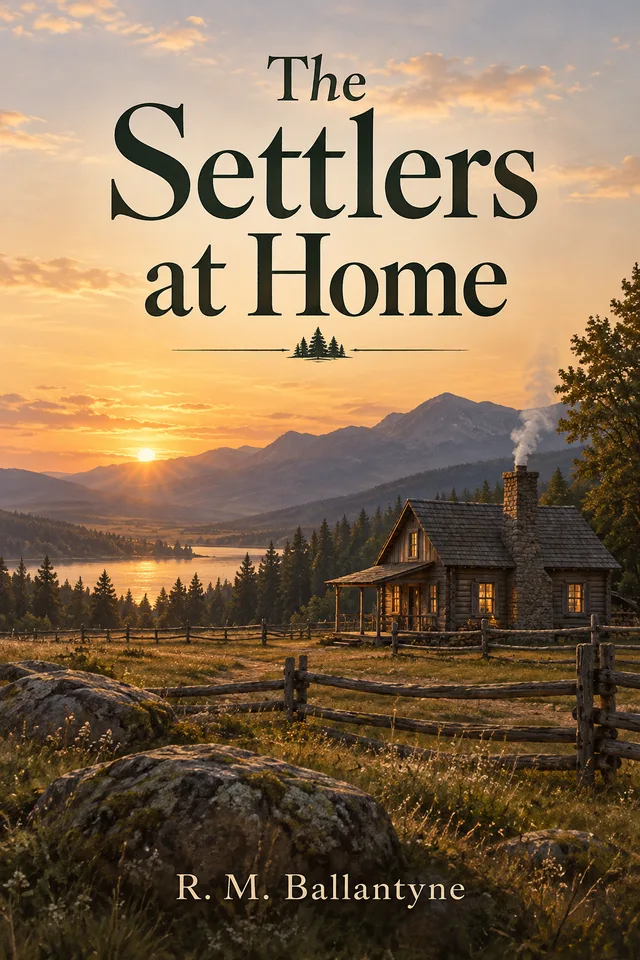
The Settlers at Home
BooksWhale-Ausgabe auf Englisch von R. M. Ballantyne
A family adventure of settlement, wilderness danger, resourcefulness, and courage under pressure.
- Vorschau
- Auszug aus dem vorbereiteten Text
- Formate
- Online-Reader, EPUB, PDF
- Zugriff
- Bibliotheks-Claim
Bucheinführung
The Settlers at Home
Ballantyne follows settlers facing isolation, scarce supplies, dangerous landscapes, and sudden threats, combining domestic resilience with frontier adventure.
BooksWhale-Ausgabe
Wie diese Ausgabe vorbereitet wurde
Diese Ausgabe basiert auf einem gemeinfreien Text und wurde von BooksWhale für digitales Lesen vorbereitet.
Public-Domain-Grundlage
Warum diese Ausgabe geteilt werden kann
R. M. Ballantyne died in 1894; this 1855 English original is public domain.
Vorschau lesen
Auszug aus dem vorbereiteten Text
Vorschau aus dem vorbereiteten Lesetext.
VorschaukapitelFull textVorschau lesen
The Settlers at Home
R. M. Ballantyne
VorschaukapitelChapter One.Vorschau
The Settlers at Home.
Two hundred years ago, the Isle of Axholme was one of the most remarkable places in England. It is not an island in the sea. It is a part of Lincolnshire—a piece of land hilly in the middle, and surrounded by rivers. The Trent runs on the east side of it; and some smaller rivers formerly flowed round the rest of it, joining the Humber to the north. These rivers carried down a great deal of mud with them to the Humber, and the tides of the Humber washed up a great deal of sea-sand into the mouths of the rivers; so that the waters could not for some time flow freely, and were at last prevented from flowing away at all: they sank into the ground, and made a swamp of it—a swamp of many miles round the hilly part of the Isle of Axholme.
This swamp was long a very dismal place. Fish, and water-birds, and rats inhabited it: and here and there stood the hut of a fowler; or a peat-stack raised by the people who lived on the hills round, and who obtained their fuel from the peat-lands in the swamp. There were also, sprinkled over the district, a few very small houses—cells belonging to the Abbey of Saint Mary, at York. To these cells some of the monks from Saint Mary’s had been fond of retiring, in old times, for meditation and prayer, and doing good in the district round; but when the soil became so swampy as to give them the ague as often as they paid a visit to these cells, the monks left off their practice of retiring hither; and their little dwellings stood empty, to be gradually overgrown with green moss and lank weeds, which no hand cleared away.
At last a Dutchman, having seen what wonders were done in his own country by good draining, thought he could render this district fit to be inhabited and cultivated; and he made a bargain with the king about it. After spending much money, and taking great pains, he succeeded. He drew the waters off into new channels, and kept them there by sluices, and by carefully watching the embankments he had raised. The land which was left dry was manured and cultivated, till, instead of a reedy and mossy swamp, there were fields of clover and of corn, and meadows of the finest grass, with cattle and sheep grazing in large numbers. The dwellings that were still standing were made into farm-houses, and new farmhouses were built. A church here, and a chapel there was cleaned, and warmed, and painted, and opened for worship; and good roads crossed the district into all the counties near.
Instead of being pleased with this change, the people of the country were angry and discontented. Those who lived near had been long accustomed to fishing and fowling in the swamp, without paying any rent, or having to ask anybody’s leave. They had no mind now to settle to the regular toilsome business of farming,—and to be under a landlord, to whom they must pay rent. Probably, too, they knew nothing about farming, and would have failed in it if they had tried. Thus far they were not to be blamed. But nothing can exceed the malignity with which they treated the tenants who did settle in the isle, and the spiteful spirit which they showed towards them, on every occasion.
These tenants were chiefly foreigners. There was a civil war in England at that time: and the Yorkshire and Lincolnshire people were so much engaged in fighting for King Charles or for the Parliament, that fewer persons were at liberty to undertake new farms than there would have been in a time of peace. When the Dutchman and his companions found that the English were not disposed to occupy the Levels (as the drained lands were called), they encouraged some of their own countrymen to come over. With them arrived some few Frenchmen, who had been driven from France into Holland, on account of their being Protestants. From first to last, there were about two hundred families, Dutch and French, settled in the Levels. Some were collected into a village, and had a chapel opened, where a pastor of their own performed service for them. Others were scattered over the district, living just where their occupations required them to settle.
VorschaukapitelChapter Two.Vorschau
Neighbourly Offices.
When Mrs Linacre was told in the evening of the arrival of the disagreeable neighbours who were in the marsh, she was sorry; but when she had gone round the premises with her husband at night, and found all safe, and no tokens of any intrusion, she was disposed to hope that the Redfurns would, this time, keep to their fishing and fowling, and make no disturbance. Oliver and Mildred crept down to the garden hedge at sunrise, and peeped through it, so as to see all that was doing in the carr, as the marsh was called. (In that part of the country, a carr means a morass.) After watching some time, they saw Stephen and Roger creep out from under the low brown tent. As the almost level sun shone full in their faces, they rubbed their eyes; then they stretched and yawned, and seemed to be trying hard to wake themselves thoroughly.
“They have been sound asleep, however,” observed Oliver to his sister; “and it is still so early, that I do not believe they have been abroad about mischief in the night. They would not have been awake yet if they had.”
“Look! There is a woman!” exclaimed Mildred. “Is that Nan?”
“Yes; that is Nan Redfurn,—Stephen’s wife. That is their great net that she has over her arm. They are going to draw the oval pond, I think. We can watch their sport nicely here. They cannot see an inch of us.”
“But we do not like that they should watch us,” said Mildred, drawing back. “We should not like to know that they were peeping at us from behind a hedge.”
“We should not mind it if we were not afraid of them,” replied Oliver. “It is because they plot mischief that we cannot bear their prying. We are not going to do them any mischief, you know; and they cannot mean to make any secret of what they are doing in the middle of the carr, with high ground all about it.” Satisfied by this, Mildred crouched down, with her arm about her brother’s neck, and saw the great net cast, and the pond almost emptied of its fish,—some few being kept for food, and the small fry—especially of the stickleback—being thrown into heaps, to be sold for manure.
“Will they come this way when they have done drawing the pond?” asked Mildred, in some fear, as she saw them moving about.
“I think they will sweep the shallow waters, there to the left, for more stickleback,” replied Oliver. “They will make up a load, to sell before the heat of the day, before they set about anything else.”
Oliver was right. All the three repaired to the shallow water, and stood among the reeds, so as to be half hidden. The children could see, however, that when little George came down the garden, shouting to them to come to breakfast, the strangers took heed to the child. They turned their heads for a moment towards the garden, and then spoke together and laughed.
“There, now!” cried Oliver, vexed: “that is all because we forgot to go to breakfast. So much for my not having a watch! Mother need not have sent George to make such a noise; but, if I had had a watch, he would not have come at all; and these people would not have been put in mind of us.”
“You will soon be able to have a watch now, like the boys in Holland,” said Mildred. “Your alabaster things will change away for a watch; will not they? But we might not have remembered breakfast, if you had had a watch.”
“We are forgetting it now,” said Oliver, catching up George and running to the house, followed by Mildred, who could not help feeling as if Roger was at her heels.
Inhaltsverzeichnis
In dieser Ausgabe
- 01Full text
- 02Chapter One.
- 03Chapter Two.
- 04Chapter Three.
- 05Chapter Four.
- 06Chapter Five.
- 07Chapter Six.
- 08Chapter Seven.
- 09Chapter Eight.
- 10Chapter Nine.
- 11Chapter Ten.
- 12Chapter Eleven.
- 13Chapter Twelve.
Sprachverfügbarkeit
Andere Sprachen
Weitere Sprachausgaben sind noch nicht veröffentlicht. Sobald verfügbar, werden sie hier verlinkt.
Andere Sprache anfragen