Englisch Ausgabe
Literatur
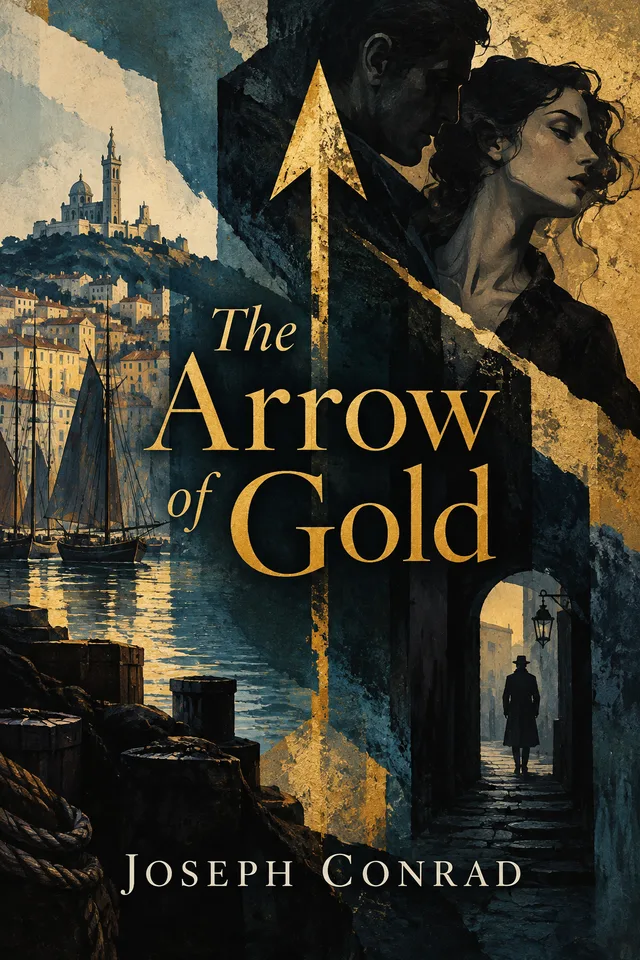
The Arrow of Gold
BooksWhale-Ausgabe auf Englisch von Joseph Conrad
A Marseille artist is drawn into a dangerous network of revolutionaries and smugglers.
- Vorschau
- Auszug aus dem vorbereiteten Text
- Formate
- Online-Reader, EPUB, PDF
- Zugriff
- Bibliotheks-Claim
Bucheinführung
The Arrow of Gold
Set amid the political conspiracies of the Mediterranean, Conrad’s novel follows a young painter whose attraction to the enigmatic Doña Rita entangles him in secret missions, competing loyalties, and the moral uncertainty of revolutionary politics.
BooksWhale-Ausgabe
Wie diese Ausgabe vorbereitet wurde
Diese Ausgabe basiert auf einem gemeinfreien Text und wurde von BooksWhale für digitales Lesen vorbereitet.
Public-Domain-Grundlage
Warum diese Ausgabe geteilt werden kann
Joseph Conrad died in 1924; the source work was first published in 1919. The source text is public domain under applicable life-plus-term and publication-date rules.
Vorschau lesen
Auszug aus dem vorbereiteten Text
Vorschau aus dem vorbereiteten Lesetext.
VorschaukapitelFull textVorschau lesen
The Arrow of Gold
Joseph Conrad
VorschaukapitelPART ONEVorschau
PART ONE
VorschaukapitelCHAPTER IVorschau
Certain streets have an atmosphere of their own, a sort of universal fame and the particular affection of their citizens. One of such streets is the Cannebière, and the jest: “If Paris had a Cannebière it would be a little Marseilles” is the jocular expression of municipal pride. I, too, I have been under the spell. For me it has been a street leading into the unknown.
There was a part of it where one could see as many as five big cafés in a resplendent row. That evening I strolled into one of them. It was by no means full. It looked deserted, in fact, festal and overlighted, but cheerful. The wonderful street was distinctly cold (it was an evening of carnival), I was very idle, and I was feeling a little lonely. So I went in and sat down.
The carnival time was drawing to an end. Everybody, high and low, was anxious to have the last fling. Companies of masks with linked arms and whooping like red Indians swept the streets in crazy rushes while gusts of cold mistral swayed the gas lights as far as the eye could reach. There was a touch of bedlam in all this.
Perhaps it was that which made me feel lonely, since I was neither masked, nor disguised, nor yelling, nor in any other way in harmony with the bedlam element of life. But I was not sad. I was merely in a state of sobriety. I had just returned from my second West Indies voyage. My eyes were still full of tropical splendour, my memory of my experiences, lawful and lawless, which had their charm and their thrill; for they had startled me a little and had amused me considerably. But they had left me untouched. Indeed they were other men’s adventures, not mine. Except for a little habit of responsibility which I had acquired they had not matured me. I was as young as before. Inconceivably young—still beautifully unthinking—infinitely receptive.
You may believe that I was not thinking of Don Carlos and his fight for a kingdom. Why should I? You don’t want to think of things which you meet every day in the newspapers and in conversation. I had paid some calls since my return and most of my acquaintance were legitimists and intensely interested in the events of the frontier of Spain, for political, religious, or romantic reasons. But I was not interested. Apparently I was not romantic enough. Or was it that I was even more romantic than all those good people? The affair seemed to me commonplace. That man was attending to his business of a Pretender.
On the front page of the illustrated paper I saw lying on a table near me, he looked picturesque enough, seated on a boulder, a big strong man with a square-cut beard, his hands resting on the hilt of a cavalry sabre—and all around him a landscape of savage mountains. He caught my eye on that spiritedly composed woodcut. (There were no inane snapshot-reproductions in those days.) It was the obvious romance for the use of royalists but it arrested my attention.
Just then some masks from outside invaded the café, dancing hand in hand in a single file led by a burly man with a cardboard nose. He gambolled in wildly and behind him twenty others perhaps, mostly Pierrots and Pierrettes holding each other by the hand and winding in and out between the chairs and tables: eyes shining in the holes of cardboard faces, breasts panting; but all preserving a mysterious silence.
They were people of the poorer sort (white calico with red spots, costumes), but amongst them there was a girl in a black dress sewn over with gold half moons, very high in the neck and very short in the skirt. Most of the ordinary clients of the café didn’t even look up from their games or papers. I, being alone and idle, stared abstractedly. The girl costumed as Night wore a small black velvet mask, what is called in French a “loup.” What made her daintiness join that obviously rough lot I can’t imagine. Her uncovered mouth and chin suggested refined prettiness.
Inhaltsverzeichnis
In dieser Ausgabe
- 01Full text
- 02PART ONE
- 03CHAPTER I
- 04CHAPTER II
- 05CHAPTER III
- 06PART TWO
- 07CHAPTER I
- 08CHAPTER II
- 09CHAPTER III
- 10CHAPTER IV
- 11PART THREE
- 12CHAPTER I
- 13CHAPTER II
- 14CHAPTER III
- 15CHAPTER IV
- 16PART FOUR
- 17CHAPTER I
- 18CHAPTER II
- 19CHAPTER III
- 20CHAPTER IV
- 21CHAPTER V
- 22PART FIVE
- 23CHAPTER I
- 24CHAPTER II
- 25CHAPTER III
- 26CHAPTER IV
- 27CHAPTER V
- 28CHAPTER VI
- 29CHAPTER VII
- 30CHAPTER VIII
- 31SECOND NOTE
Sprachverfügbarkeit
Andere Sprachen
Weitere Sprachausgaben sind noch nicht veröffentlicht. Sobald verfügbar, werden sie hier verlinkt.
Andere Sprache anfragen