Englisch Ausgabe
Literatur
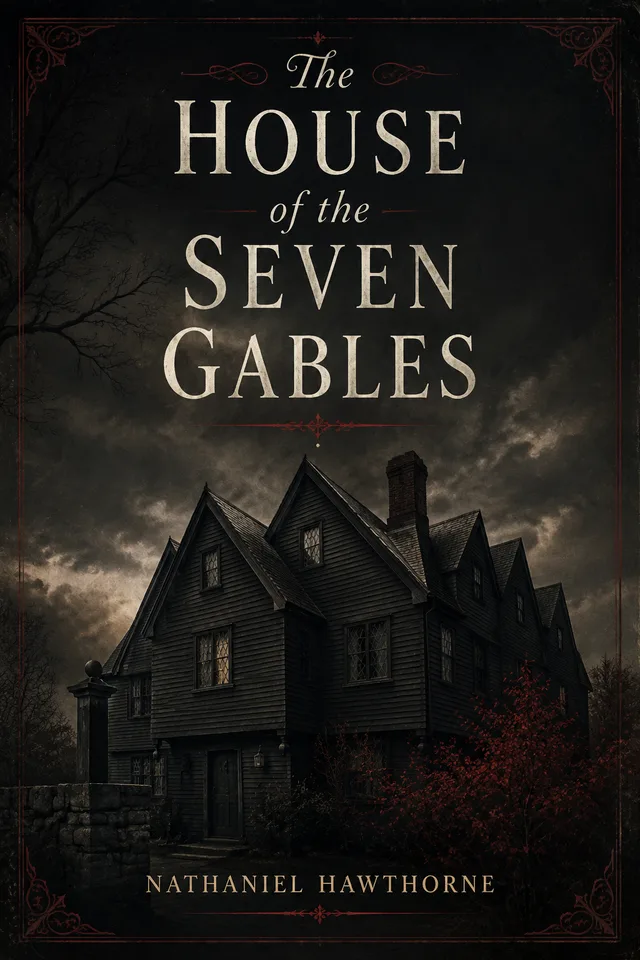
The House of the Seven Gables
BooksWhale-Ausgabe auf Englisch von Nathaniel Hawthorne
A haunted New England romance of family guilt, inheritance, secrecy, and moral renewal.
- Vorschau
- Auszug aus dem vorbereiteten Text
- Formate
- Online-Reader, EPUB, PDF
- Zugriff
- Bibliotheks-Claim
Bucheinführung
The House of the Seven Gables
The House of the Seven Gables is Nathaniel Hawthorne’s romance of an old family curse, hidden guilt, and the slow possibility of renewal. This English original-language edition presents the public-domain text for clean online reading and EPUB/PDF generation.
BooksWhale-Ausgabe
Wie diese Ausgabe vorbereitet wurde
Diese Ausgabe basiert auf einem gemeinfreien Text und wurde von BooksWhale für digitales Lesen vorbereitet.
Public-Domain-Grundlage
Warum diese Ausgabe geteilt werden kann
Nathaniel Hawthorne died in 1864, and The House of the Seven Gables was first published in 1851. These dates support the public-domain basis for this English original-language edition.
Vorschau lesen
Auszug aus dem vorbereiteten Text
Vorschau aus dem vorbereiteten Lesetext.
VorschaukapitelFull textVorschau lesen
The House of the Seven Gables
Nathaniel Hawthorne
VorschaukapitelAuthor’s PrefaceVorschau
When a writer calls his work a Romance, it need hardly be observed that he wishes to claim a certain latitude, both as to its fashion and material, which he would not have felt himself entitled to assume had he professed to be writing a Novel. The latter form of composition is presumed to aim at a very minute fidelity, not merely to the possible, but to the probable and ordinary course of man’s experience. The former—while, as a work of art, it must rigidly subject itself to laws, and while it sins unpardonably so far as it may swerve aside from the truth of the human heart—has fairly a right to present that truth under circumstances, to a great extent, of the writer’s own choosing or creation. If he think fit, also, he may so manage his atmospherical medium as to bring out or mellow the lights and deepen and enrich the shadows of the picture. He will be wise, no doubt, to make a very moderate use of the privileges here stated, and, especially, to mingle the Marvelous rather as a slight, delicate, and evanescent flavor, than as any portion of the actual substance of the dish offered to the public. He can hardly be said, however, to commit a literary crime even if he disregard this caution.
In the present work, the author has proposed to himself—but with what success, fortunately, it is not for him to judge—to keep undeviatingly within his immunities. The point of view in which this tale comes under the Romantic definition lies in the attempt to connect a bygone time with the very present that is flitting away from us. It is a legend prolonging itself, from an epoch now gray in the distance, down into our own broad daylight, and bringing along with it some of its legendary mist, which the reader, according to his pleasure, may either disregard, or allow it to float almost imperceptibly about the characters and events for the sake of a picturesque effect. The narrative, it may be, is woven of so humble a texture as to require this advantage, and, at the same time, to render it the more difficult of attainment.
Many writers lay very great stress upon some definite moral purpose, at which they profess to aim their works. Not to be deficient in this particular, the author has provided himself with a moral,—the truth, namely, that the wrong-doing of one generation lives into the successive ones, and, divesting itself of every temporary advantage, becomes a pure and uncontrollable mischief; and he would feel it a singular gratification if this romance might effectually convince mankind—or, indeed, any one man—of the folly of tumbling down an avalanche of ill-gotten gold, or real estate, on the heads of an unfortunate posterity, thereby to maim and crush them, until the accumulated mass shall be scattered abroad in its original atoms. In good faith, however, he is not sufficiently imaginative to flatter himself with the slightest hope of this kind. When romances do really teach anything, or produce any effective operation, it is usually through a far more subtile process than the ostensible one. The author has considered it hardly worth his while, therefore, relentlessly to impale the story with its moral as with an iron rod,—or, rather, as by sticking a pin through a butterfly,—thus at once depriving it of life, and causing it to stiffen in an ungainly and unnatural attitude. A high truth, indeed, fairly, finely, and skilfully wrought out, brightening at every step, and crowning the final development of a work of fiction, may add an artistic glory, but is never any truer, and seldom any more evident, at the last page than at the first.
The reader may perhaps choose to assign an actual locality to the imaginary events of this narrative. If permitted by the historical connection,—which, though slight, was essential to his plan,—the author would very willingly have avoided anything of this nature. Not to speak of other objections, it exposes the romance to an inflexible and exceedingly dangerous species of criticism, by bringing his fancy-pictures almost into positive contact with the realities of the moment. It has been no part of his object, however, to describe local manners, nor in any way to meddle with the characteristics of a community for whom he cherishes a proper respect and a natural regard. He trusts not to be considered as unpardonably offending by laying out a street that infringes upon nobody’s private rights, and appropriating a lot of land which had no visible owner, and building a house of materials long in use for constructing castles in the air. The personages of the tale—though they give themselves out to be of ancient stability and considerable prominence—are really of the author’s own making, or at all events, of his own mixing; their virtues can shed no lustre, nor their defects redound, in the remotest degree, to the discredit of the venerable town of which they profess to be inhabitants. He would be glad, therefore, if—especially in the quarter to which he alludes—the book may be read strictly as a Romance, having a great deal more to do with the clouds overhead than with any portion of the actual soil of the County of Essex.
VorschaukapitelI. The Old Pyncheon FamilyVorschau
Halfway down a by-street of one of our New England towns stands a rusty wooden house, with seven acutely peaked gables, facing towards various points of the compass, and a huge, clustered chimney in the midst. The street is Pyncheon Street; the house is the old Pyncheon House; and an elm-tree, of wide circumference, rooted before the door, is familiar to every town-born child by the title of the Pyncheon Elm. On my occasional visits to the town aforesaid, I seldom failed to turn down Pyncheon Street, for the sake of passing through the shadow of these two antiquities,—the great elm-tree and the weather-beaten edifice.
The aspect of the venerable mansion has always affected me like a human countenance, bearing the traces not merely of outward storm and sunshine, but expressive also, of the long lapse of mortal life, and accompanying vicissitudes that have passed within. Were these to be worthily recounted, they would form a narrative of no small interest and instruction, and possessing, moreover, a certain remarkable unity, which might almost seem the result of artistic arrangement. But the story would include a chain of events extending over the better part of two centuries, and, written out with reasonable amplitude, would fill a bigger folio volume, or a longer series of duodecimos, than could prudently be appropriated to the annals of all New England during a similar period. It consequently becomes imperative to make short work with most of the traditionary lore of which the old Pyncheon House, otherwise known as the House of the Seven Gables, has been the theme. With a brief sketch, therefore, of the circumstances amid which the foundation of the house was laid, and a rapid glimpse at its quaint exterior, as it grew black in the prevalent east wind,—pointing, too, here and there, at some spot of more verdant mossiness on its roof and walls,—we shall commence the real action of our tale at an epoch not very remote from the present day. Still, there will be a connection with the long past—a reference to forgotten events and personages, and to manners, feelings, and opinions, almost or wholly obsolete—which, if adequately translated to the reader, would serve to illustrate how much of old material goes to make up the freshest novelty of human life. Hence, too, might be drawn a weighty lesson from the little-regarded truth, that the act of the passing generation is the germ which may and must produce good or evil fruit in a far-distant time; that, together with the seed of the merely temporary crop, which mortals term expediency, they inevitably sow the acorns of a more enduring growth, which may darkly overshadow their posterity.
The House of the Seven Gables, antique as it now looks, was not the first habitation erected by civilized man on precisely the same spot of ground. Pyncheon Street formerly bore the humbler appellation of Maule’s Lane, from the name of the original occupant of the soil, before whose cottage-door it was a cow-path. A natural spring of soft and pleasant water—a rare treasure on the sea-girt peninsula where the Puritan settlement was made—had early induced Matthew Maule to build a hut, shaggy with thatch, at this point, although somewhat too remote from what was then the centre of the village. In the growth of the town, however, after some thirty or forty years, the site covered by this rude hovel had become exceedingly desirable in the eyes of a prominent and powerful personage, who asserted plausible claims to the proprietorship of this and a large adjacent tract of land, on the strength of a grant from the legislature. Colonel Pyncheon, the claimant, as we gather from whatever traits of him are preserved, was characterized by an iron energy of purpose. Matthew Maule, on the other hand, though an obscure man, was stubborn in the defence of what he considered his right; and, for several years, he succeeded in protecting the acre or two of earth which, with his own toil, he had hewn out of the primeval forest, to be his garden ground and homestead. No written record of this dispute is known to be in existence. Our acquaintance with the whole subject is derived chiefly from tradition. It would be bold, therefore, and possibly unjust, to venture a decisive opinion as to its merits; although it appears to have been at least a matter of doubt, whether Colonel Pyncheon’s claim were not unduly stretched, in order to make it cover the small metes and bounds of Matthew Maule. What greatly strengthens such a suspicion is the fact that this controversy between two ill-matched antagonists—at a period, moreover, laud it as we may, when personal influence had far more weight than now—remained for years undecided, and came to a close only with the death of the party occupying the disputed soil. The mode of his death, too, affects the mind differently, in our day, from what it did a century and a half ago. It was a death that blasted with strange horror the humble name of the dweller in the cottage, and made it seem almost a religious act to drive the plough over the little area of his habitation, and obliterate his place and memory from among men.
Inhaltsverzeichnis
In dieser Ausgabe
- 01Full text
- 02Author’s Preface
- 03I. The Old Pyncheon Family
- 04II. The Little Shop-Window
- 05III. The First Customer
- 06IV. A Day Behind the Counter
- 07V. May and November
- 08VI. Maule’s Well
- 09VII. The Guest
- 10VIII. The Pyncheon of To-day
- 11IX. Clifford and Phœbe
- 12X. The Pyncheon Garden
- 13XI. The Arched Window
- 14XII. The Daguerreotypist
- 15XIII. Alice Pyncheon
- 16XIV. Phœbe’s Good-Bye
- 17XV. The Scowl and Smile
- 18XVI. Clifford’s Chamber
- 19XVII. The Flight of Two Owls
- 20XVIII. Governor Pyncheon
- 21XIX. Alice’s Posies
- 22XX. The Flower of Eden
- 23XXI. The Departure
Sprachverfügbarkeit
Andere Sprachen
Weitere Sprachausgaben sind noch nicht veröffentlicht. Sobald verfügbar, werden sie hier verlinkt.
Andere Sprache anfragen