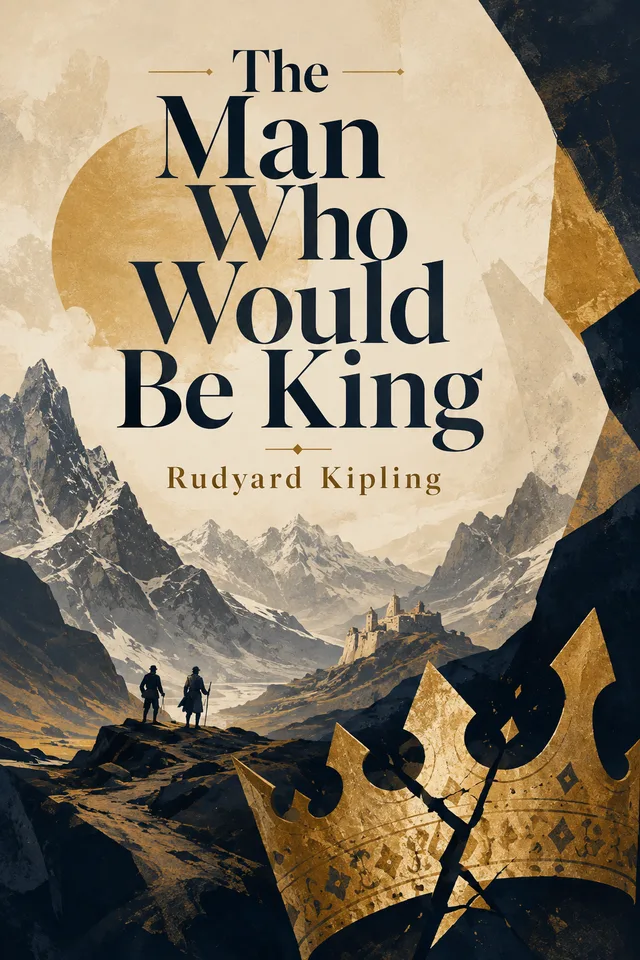
Englisch Ausgabe
Literatur
The Man Who Would Be King
BooksWhale-Ausgabe auf Englisch von Rudyard Kipling
A bold imperial adventure about two drifters, a remote kingdom, false divinity, ambition, and catastrophic overreach.
- Vorschau
- Auszug aus dem vorbereiteten Text
- Formate
- Online-Reader, EPUB, PDF
- Zugriff
- Bibliotheks-Claim
Bucheinführung
The Man Who Would Be King
The Man Who Would Be King follows Daniel Dravot and Peachey Carnehan as they leave British India to carve out a kingdom beyond the frontier. Kipling turns adventure narrative into a sharp study of charisma, imperial fantasy, brotherhood, deception, and the collapse of power built on myth.
BooksWhale-Ausgabe
Wie diese Ausgabe vorbereitet wurde
Diese Ausgabe basiert auf einem gemeinfreien Text und wurde von BooksWhale für digitales Lesen vorbereitet.
Public-Domain-Grundlage
Warum diese Ausgabe geteilt werden kann
Rudyard Kipling died in 1936, and The Man Who Would Be King was first published or composed in 1888; these dates support the public-domain basis for this edition.
Vorschau lesen
Auszug aus dem vorbereiteten Text
Vorschau aus dem vorbereiteten Lesetext.
VorschaukapitelFull textVorschau lesen
The Man Who Would Be King
Rudyard Kipling
VorschaukapitelTHE MAN WHO WOULDVorschau
THE MAN WHO WOULD
VorschaukapitelBE KINGVorschau
“Brother to a Prince and fellow to a beggar if he be found worthy.”
The Law, as quoted, lays down a fair conduct of life, and one not easy to follow. I have been fellow to a beggar again and again under circumstances which prevented either of us finding out whether the other was worthy. I have still to be brother to a Prince, though I once came near to kinship with what might have been a veritable King and was promised the reversion of a Kingdom—army, law-courts, revenue and policy all complete. But, to-day, I greatly fear that my King is dead, and if I want a crown I must go and hunt it for myself.
The beginning of everything was in a railway train upon the road to Mhow from Ajmir. There had been a deficit in the Budget, which necessitated travelling, not Second-class, which is only half as dear as First-class, but by Intermediate, which is very awful indeed. There are no cushions in the Intermediate class, and the population are either Intermediate, which is Eurasian, or native, which for a long night journey is nasty; or Loafer, which is amusing though intoxicated.
Inhaltsverzeichnis
In dieser Ausgabe
- 01Full text
- 02THE MAN WHO WOULD
- 03BE KING
- 04Intermediates do not patronize refreshment-rooms. They carry their food in bundles and pots, and buy sweets from the native sweetmeat-sellers, and drink the roadside water. That is why in the hot weather Intermediates are taken out of the carriages dead, and in all weathers are most properly looked down upon.
- 05My particular Intermediate happened to be empty till I reached Nasirabad, when a huge gentleman in shirt-sleeves entered, and, following the custom of Intermediates, passed the time of day. He was a wanderer and a vagabond like myself, but with an educated taste for whiskey. He told tales of things he had seen and done, of out-of-the-way corners of the Empire into which he had penetrated, and of adventures in which he risked his life for a few days’ food. “If India was filled with men like you and me, not knowing more than the crows where they’d get their next day’s rations, it isn’t seventy millions of revenue the land would be paying—it’s seven hundred million,” said he; and as I looked at his mouth and chin I was disposed to agree with him. We talked politics—the politics of Loaferdom that sees things from the underside where the lath and plaster is not smoothed off—and we talked postal arrangements because
- 06my friend wanted to send a telegram back from the next station to Ajmir, which is the turning-off place from the Bombay to the Mhow line as you travel westward. My friend had no money beyond eight annas which he wanted for dinner, and I had no money at all, owing to the hitch in the Budget before mentioned. Further, I was going into a wilderness where, though I should resume touch with the Treasury, there were no telegraph offices. I was, therefore, unable to help him in any way.
- 07Don’t try to run the Central India States just now as the correspondent of the Backwoodsman. There’s a real one knocking about here, and it might lead to trouble.”
- 08If the man with the beard had given me a rupee I should have kept it as a memento of a rather curious affair. But the consciousness of having done my duty was my only reward.
- 09Later on I reflected that two gentlemen like my friends could not do any good if they foregathered and personated correspondents of newspapers, and might, if they “stuck up” one of the little rat-trap states of Central India or Southern Rajputana, get themselves into serious difficulties. I therefore took some trouble to describe them as accurately as I could remember to people who would be interested in deporting them; and succeeded, so I was later informed, in having them headed back from the Degumber borders.
- 10disposal; tea-companies enter and elaborate their prospectuses with the office pens; secretaries of ball-committees clamor to have the glories of their last dance more fully expounded; strange ladies rustle in and say:—“I want a hundred lady’s cards printed at once, please,” which is manifestly part of an Editor’s duty; and every dissolute ruffian that ever tramped the Grand Trunk Road makes it his business to ask for employment as a proof-reader. And, all the time, the telephone-bell is ringing madly, and Kings are being killed on the Continent, and Empires are saying, “You’re another,” and Mister Gladstone is calling down brimstone upon the British Dominions, and the little black copy-boys are whining, “kaa-pi chayha-yeh” (copy wanted) like tired bees, and most of the paper is as blank as Modred’s shield.
- 11It was in that season, and a remarkably evil season, that the paper began running the last issue of the week on Saturday night, which is to say Sunday morning, after the custom of a London paper. This was a great convenience, for immediately after the paper was put to bed, the dawn would lower the thermometer from 96° to almost 84° for almost half an hour, and in that chill—you have no idea how cold is 84° on the grass until you begin to pray for it—a very tired man could set off to sleep ere the heat roused him.
- 12called for water. The thing that was keeping us back, whatever it was, would not come off, though the loo dropped and the last type was set, and the whole round earth stood still in the choking heat, with its finger on its lip, to wait the event. I drowsed, and wondered whether the telegraph was a blessing, and whether this dying man, or struggling people, was aware of the inconvenience the delay was causing. There was no special reason beyond the heat and worry to make tension, but, as the clock-hands crept up to three o’clock and the machines spun their fly-wheels two and three times to see that all was in order, before I said the word that would set them off, I could have shrieked aloud.
- 13I was not pleased, because I wished to go to sleep, not to squabble with loafers. “What do you want?” I asked.
- 14I led from the press-room to the stifling office with the maps on the walls, and the red-haired man rubbed his hands. “That’s something like,” said he. “This was the proper shop to come to. Now, Sir, let me introduce to you Brother Peachey Carnehan, that’s him, and Brother Daniel Dravot, that is me, and the less said about our professions the better, for we have been most things in our time. Soldier, sailor, compositor, photographer, proof-reader, street-preacher, and correspondents of the Backwoodsman when we thought the paper wanted one. Carnehan is sober, and so am I. Look at us first and see that’s sure. It will save you cutting into my talk. We’ll take one of your cigars apiece, and you shall see us light.” I watched the test. The men were absolutely sober, so I gave them each a tepid peg.
- 15I uncased the big thirty-two-miles-to-the-inch map of India, and two smaller Frontier maps, hauled down volume INF-KAN of the Encyclopædia Britannica, and the men consulted them.
- 16I handed him Wood on the Sources of the Oxus. Carnehan was deep in the Encyclopædia.
- 17I smoked while the men pored over Raverty, Wood, the maps and the Encyclopædia.
- 18i.e., to be Kings of Kafiristan.
- 19Daniel Dravot.
- 20I left them still poring over the maps and making notes on the back of the “Contrack.” “Be sure to come down to the Serai to-morrow,” were their parting words.
- 21I felt the butt of a Martini, and another and another.
- 22Carnehan leaned down and shook hands. Then the camels passed away along the dusty road, and I was left alone to wonder. My eye could detect no failure in the disguises. The scene in the Serai attested that they were complete to the native mind. There was just the chance, therefore, that Carnehan and Dravot would be able to wander through Afghanistan without detection. But, beyond, they would find death, certain and awful death.
- 23I passed over to the press-room, and went through just such a scene as I have already described. The nervous tension was stronger than it had been two years before, and I felt the heat more acutely. At three o’clock I cried, “Print off,” and turned to go, when there crept to my chair what was left of a man. He was bent into a circle, his head was sunk between his shoulders, and he moved his feet one over the other like a bear. I could hardly see whether he walked or crawled—this rag-wrapped, whining cripple who addressed me by name, crying that he was come back. “Can you give me a drink?” he whimpered. “For the Lord’s sake, give me a drink!”
- 24I went back to the office, the man following with groans of pain, and I turned up the lamp.
- 25I looked at him intently. Once before had I seen eyebrows that met over the nose in an inch-broad black band, but for the life of me I could not tell where.
- 26I was more than a little astonished, and expressed my feelings accordingly.
- 27I leaned forward and looked into his face as steadily as I could. He dropped one hand upon the table and I grasped it by the wrist. It was twisted like a bird’s claw, and upon the back was a ragged, red, diamond-shaped scar.
- 28Carnehan shakes hands with him and whirls his arms about, same as Dravot used, and very much surprised that Chief was, and strokes my eyebrows. Then Carnehan goes alone to the Chief, and asks him in dumb show if he had an enemy he hated. ‘I have,’ says the Chief. So Carnehan weeds out the pick of his men, and sets the two of the Army to show them drill and at the end of two weeks the men can manœuvre about as well as Volunteers. So he marches with the Chief to a great big plain on the top of a mountain, and the Chiefs men rushes into a village and takes it; we three Martinis firing into the brown of the enemy. So we took that village too, and I gives the Chief a rag from my coat and says, ‘Occupy till I come’: which was scriptural. By way of a reminder, when me and the Army was eighteen hundred yards away, I drops a bullet near him standing on the snow, and all the people falls flat on their faces. Then I sends a letter to Dravot, wherever he be by
- 29land or by sea.”
- 30I remember that there had once come to the office a blind man with a knotted twig and a piece of string which he wound round the twig according to some cypher of his own. He could, after the lapse of days or hours, repeat the sentence which he had reeled up. He had reduced the alphabet to eleven primitive sounds; and tried to teach me his method, but failed.
- 31chunk of amber that a man brought me. Call up all the priests and, here, take your crown.’
- 32It’s Gord’s Truth. I’ve known these long years that the Afghans knew up to the Fellow Craft Degree, but this is a miracle. A god and a Grand-Master of the Craft am I, and a Lodge in the Third Degree I will open, and we’ll raise the head priests and the Chiefs of the villages.’
- 33I’ve drilled the men and shown the people how to stack their oats better, and I’ve brought in those tinware rifles from Ghorband—but I know what you’re driving at. I take it Kings always feel oppressed that way.’
- 34I’ve been doing the work o’ two men, and you’ve been doing the work o’ three. Let’s lie off a bit, and see if we can get some better tobacco from Afghan country and run in some good liquor; but no women.’
- 35Dravot came out with his crown on his head, swinging his arms and stamping his feet, and looking more pleased than Punch.
- 36I was next to Dravot, and behind me was twenty men of the regular Army.
- 37I’m a dead man,’ says Billy Fish, and he throws himself down on the snow and begins to pray to his gods.
- 38I shuddered, for, in spite of defacements manifold, I recognized the head of the man of Marwar Junction. Carnehan rose to go. I attempted to stop him. He was not fit to walk abroad. “Let me take away the whiskey, and give me a little money,” he gasped. “I was a King once. I’ll go to the Deputy Commissioner and ask to set in the Poor-house till I get my health. No, thank you, I can’t wait till you get a carriage for me. I’ve urgent private affairs—in the south—at Marwar.”
- 39I waited to hear no more, but put the poor wretch into my carriage and drove him off to the nearest missionary for eventual transfer to the Asylum. He repeated the hymn twice while he was with me whom he did not in the least recognize, and I left him singing to the missionary.
Sprachverfügbarkeit
Andere Sprachen
Weitere Sprachausgaben sind noch nicht veröffentlicht. Sobald verfügbar, werden sie hier verlinkt.
Andere Sprache anfragen