Englisch Ausgabe
Literatur
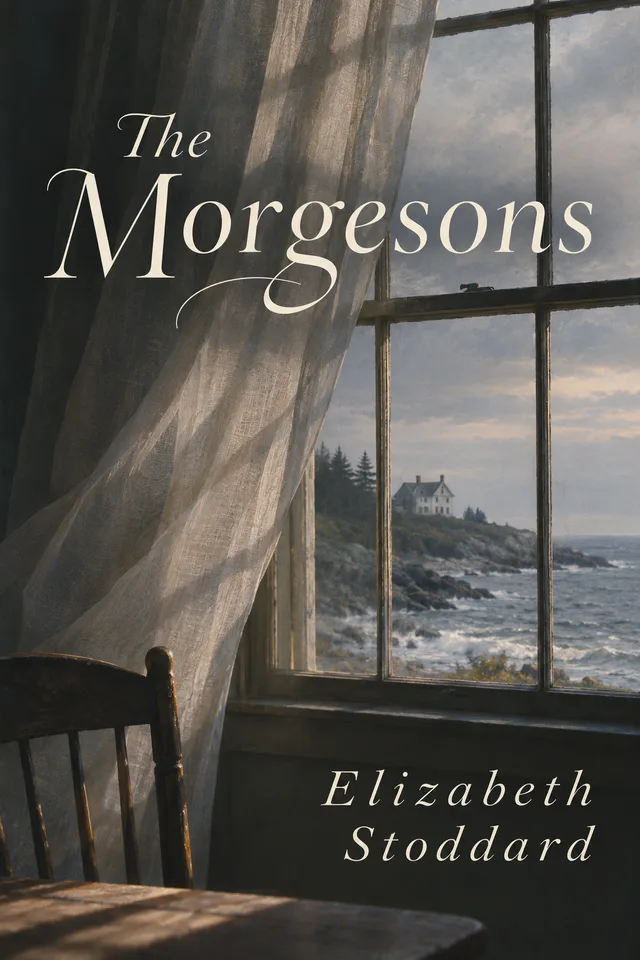
The Morgesons
BooksWhale-Ausgabe auf Englisch von Elizabeth Stoddard
Cassandra Morgeson recounts a New England childhood and the family loyalties, desires and losses that shape her adult choices.
- Vorschau
- Auszug aus dem vorbereiteten Text
- Formate
- Online-Reader, EPUB, PDF
- Zugriff
- Bibliotheks-Claim
Bucheinführung
The Morgesons
Cassandra is a sharp observer of her parents, her sister Veronica and the households in which she spends her youth. Visits, changes of home and encounters with the Somers family unsettle her sense of what she owes to others. The novel follows her evolving judgment through scenes of ordinary life that can turn suddenly toward grief or intimacy.
BooksWhale-Ausgabe
Wie diese Ausgabe vorbereitet wurde
Diese Ausgabe basiert auf einem gemeinfreien Text und wurde von BooksWhale für digitales Lesen vorbereitet.
Public-Domain-Grundlage
Warum diese Ausgabe geteilt werden kann
Elizabeth Stoddard died in 1902. This edition uses the historical English text of the work, published in 1862 and digitized by Project Gutenberg.
Vorschau lesen
Auszug aus dem vorbereiteten Text
Vorschau aus dem vorbereiteten Lesetext.
VorschaukapitelPREFACE.Vorschau lesen
I suppose it was environment that caused me to write these novels; but the mystery of it is, that when I left my native village I did not dream that imagination would lead me there again, for the simple annals of our village and domestic ways did not interest me; neither was I in the least studious. My years were passed in an attempt to have a good time, according to the desires and fancies of youth. Of literature and the literary life, I and my tribe knew nothing; we had not discovered "sermons in stones." Where then was the panorama of my stories and novels stored, that was unrolled in my new sphere? Of course, being moderately intelligent I read everything that came in my way, but merely for amusement. It had been laid up against me as a persistent fault, which was not profitable; I should peruse moral, and pious works, or take up sewing,—that interminable thing, "white seam," which filled the leisure moments of the right-minded. To the personnel of writers I gave little heed; it was the hero they created that charmed me, like Miss Porter's gallant Pole, Sobieski, or the ardent Ernest Maltravers, of Bulwer.
I had now come to live among those who made books, and were interested in all their material, for all was for the glory of the whole. Prefaces, notes, indexes, were unnoticed by me,—even Walter Scott's and Lord Byron's. I began to get glimpses of a profound ignorance, and did not like the position as an outside consideration. These mental productive adversities abased me. I was well enough in my way, but nothing was expected from me in their way, and when I beheld their ardor in composition, and its fine emulation, like "a sheep before her shearers," I was dumb. The environment pressed upon me, my pride was touched; my situation, though "tolerable, was not to be endured."
Fortunate or not, we were poor. It was not strange that I should marry, said those who knew the step I had taken; but that I should follow that old idyl; and accept the destiny of a garret and a crust with a poet, was incredible! Therefore, being apart from the diversions of society, I had many idle hours. One day when my husband was sitting at the receipt of customs, for he had obtained a modest appointment, I sat by a little desk, where my portfolio lay open. A pen was near, which I took up, and it began to write, wildly like "Planchette" upon her board, or like a kitten clutching a ball of yarn fearfully. But doing it again—I could not say why—my mind began upon a festival in my childhood, which my mother arranged for several poor old people at Thanksgiving. I finished the sketch in private, and gave it the title of "A Christmas Dinner," as one more modern. I put in occasional "fiblets" about the respectable guests, Mrs. Carver and Mrs. Chandler, and one dreadful little girl foisted upon me to entertain. It pleased the editor of Harper's Magazine, who accepted it, and sent me a check which would look wondrous small now. I wrote similar sketches, which were published in that magazine. Then I announced my intention of writing a "long story," and was told by him of the customs that he thought I "lacked the constructive faculty." I hope that I am writing an object lesson, either of learning how, or not learning how, to write.
I labored daily, when alone, for weeks; how many sheets of foolscap I covered, and dashed to earth, was never told. Since, by my "infinite pains and groans," I have been reminded of Barkis, in "David Copperfield," when he crawled out of his bed to get a guinea from his strong box for David's dinner. Naturally, I sent the story to Harper's Magazine, and it was curtly refused. My husband, moved by pity by my discouragement, sent it to Mr. Lowell, then editor of the Atlantic Monthly. In a few days I received a letter from him, which made me very happy. He accepted the story, and wrote me then, and afterwards, letters of advice and suggestion. I think he saw through my mind, its struggles, its ignorance, and its ambition. Also I got my guinea for my pains. The Atlantic Monthly sent me a hundred dollars. I doubt but for Mr. Lowell's interest and kindness I should ever have tried prose again. I owe a debt of gratitude to him which I shall always give to his noble memory.
VorschaukapitelCHAPTER I.Vorschau
"That child," said my aunt Mercy, looking at me with indigo-colored eyes, "is possessed."
When my aunt said this I was climbing a chest of drawers, by its knobs, in order to reach the book-shelves above it, where my favorite work, "The Northern Regions," was kept, together with "Baxter's Saints' Rest," and other volumes of that sort, belonging to my mother; and those my father bought for his own reading, and which I liked, though I only caught a glimpse of their meaning by strenuous study. To this day Sheridan's Comedies, Sterne's Sentimental Journey, and Captain Cook's Voyages are so mixed up in my remembrance that I am still uncertain whether it was Sterne who ate baked dog with Maria, or Sheridan who wept over a dead ass in the Sandwich Islands.
After I had made a dash at and captured my book, I seated myself with difficulty on the edge of the chest of drawers, and was soon lost in an Esquimaux hut. Presently, in crossing my feet, my shoes, which were large, dropped on the painted floor with a loud noise. I looked at my aunt; her regards were still fixed upon me, but they did not interfere with her occupation of knitting; neither did they interrupt her habit of chewing cloves, flagroot, or grains of rice. If these articles were not at hand, she chewed a small chip.
"Aunt Merce, poor Hepburn chewed his shoes, when he was in Davis's Straits."
"Mary, look at that child's stockings."
Mother raised her eyes from the Boston Recorder, and the article she had been absorbed in the proceedings of an Ecclesiastical Council, which had discussed (she read aloud to Aunt Merce) the conduct of Brother Thaddeus Turner, pastor of the Congregational Church of Hyena. Brother Thaddeus had spoken lightly of the difference between Sprinkling and Immersion, and had even called Hyena's Baptist minister "Brother." He was contumacious at first, was Brother Thaddeus, but Brother Boanerges from Andover finally floored him.
"Cassandra," said mother, presently, "come here."
I obeyed with reluctance, making a show of turning down a leaf.
"Child," she continued, and her eyes wandered over me dreamily, till they dropped on my stockings; "why will you waste so much time on unprofitable stories?"
"Mother, I hate good stories, all but the Shepherd of Salisbury Plain; I like that, because it makes me hungry to read about the roasted potatoes the shepherd had for breakfast and supper. Would it make me thankful if you only gave me potatoes without salt?"
"Not unless your heart is right before God."
"'The Lord my Shepherd is,'" sang Aunt Merce.
I put my hands over my ears, and looked defiantly round the room. Its walls are no longer standing, and the hands of its builders have crumbled to dust. Some mental accident impressed this picture on the purblind memory of childhood.
We were in mother's winter room. She was in a low, chintz-covered chair; Aunt Merce sat by the window, in a straight-backed chair, that rocked querulously, and likewise covered with chintz, of a red and yellow pattern. Before the lower half of the windows were curtains of red serge, which she rattled apart on their brass rods, whenever she heard a footstep, or the creak of a wheel in the road below. The walls were hung with white paper, through which ran thread-like stripes of green. A square of green and chocolate-colored English carpet covered the middle of the floor, and a row of straw chairs stood around it, on the bare, lead-colored boards. A huge bed, with a chintz top shaped like an elephant's back, was in one corner, and a six-legged mahogany table in another. One side of the room where the fireplace was set was paneled in wood; its fire had burned down in the shining Franklin stove, and broken brands were standing upright. The charred backlog still smoldered, its sap hissed and bubbled at each end.
VorschaukapitelCHAPTER II.Vorschau
At this time I was ten years old. We lived in a New England village, Surrey, which was situated on an inlet of a large bay that opened into the Atlantic. From the observatory of our house we could see how the inlet was pinched by the long claws of the land, which nearly enclosed it. Opposite the village, some ten miles across, a range of islands shut out the main waters of the bay. For miles on the outer side of the curving prongs of land stretched a rugged, desolate coast, indented with coves and creeks, lined with bowlders of granite half sunken in the sea, and edged by beaches overgrown with pale sedge, or covered with beds of seaweed. Nothing alive, except the gulls, abode on these solitary shores. No lighthouse stood on any point, to shake its long, warning light across the mariners' wake. Now and then a drowned man floated in among the sedge, or a small craft went to pieces on the rocks. When an easterly wind prevailed, the coast resounded with the bellowing sea, which brought us tidings from those inaccessible spots. We heard its roar as it leaped over the rocks on Gloster Point, and its long, unbroken wail when it rolled in on Whitefoot Beach. In mild weather, too, when our harbor was quiet, we still heard its whimper. Behind the village, the ground rose toward the north, where the horizon was bounded by woods of oak and pine, intersected by crooked roads, which led to towns and villages near us. The inland scenery was tame; no hill or dale broke its dull uniformity. Cornfields and meadows of red grass walled with gray stone, lay between the village and the border of the woods. Seaward it was enchanting—beautiful under the sun and moon and clouds. Our family had lived in Surrey for years. Probably some Puritan of the name of Morgeson had moved from an earlier settlement, and, appropriating a few acres in what was now its center, lived long enough upon them to see his sons and daughters married to the sons and daughters of similar settlers. So our name was in perpetuation, though none of our race ever made a mark in his circle, or attained a place among the great ones of his day. The family recipes for curing herbs and hams, and making cordials, were in better preservation than the memory of their makers. It is certain that they were not a progressive or changeable family. No tradition of any individuality remains concerning them. There was a confusion in the minds of the survivors of the various generations about the degree of their relationship to those who were buried, and whose names and ages simply were cut in the stones which headed their graves. The meum and tuum of blood were inextricably mixed; so they contented themselves with giving their children the old Christian names which were carved on the headstones, and which, in time, added a still more profound darkness to the anti-heraldic memory of the Morgesons. They had no knowledge of that treasure which so many of our New England families are boastful of—the Ancestor who came over in the Mayflower, or by himself, with a grant of land from Parliament. It was not known whether two or three brothers sailed together from the Old World and settled in the New. They had no portrait, nor curious chair, nor rusty weapon—no old Bible, nor drinking cup, nor remnant of brocade.
Morgeson—Born—Lived—Died—were all their archives. But there is a dignity in mere perpetuity, a strength in the narrowest affinities. This dignity and strength were theirs. They are still vital in our rural population. Occasionally something fine is their result; an aboriginal reappears to prove the plastic powers of nature.
My great-grandfather, Locke Morgeson, the old man whose head I saw bound in a red handkerchief, was the first noticeable man of the name. He was a scale of enthusiasms, ranging from the melancholy to the sarcastic. When I heard him talked of, it seemed to me that he was born under the influence of the sea, while the rest of the tribe inherited the character of the landscape. Comprehension of life, and comprehension of self, came too late for him to make either of value. The spirit of progress, however, which prompted his schemes benefited others. The most that could be said of him was that he had the rudiments of a Founder.
Inhaltsverzeichnis
In dieser Ausgabe
- 01PREFACE.
- 02CHAPTER I.
- 03CHAPTER II.
- 04CHAPTER III.
- 05CHAPTER IV.
- 06CHAPTER V.
- 07CHAPTER VI.
- 08CHAPTER VII.
- 09CHAPTER VIII.
- 10CHAPTER IX.
- 11CHAPTER X.
- 12CHAPTER XI.
- 13CHAPTER XII.
- 14CHAPTER XIII.
- 15CHAPTER XIV.
- 16CHAPTER XV.
- 17CHAPTER XVI.
- 18CHAPTER XVII.
- 19CHAPTER XVIII.
- 20CHAPTER XIX.
- 21CHAPTER XX.
- 22CHAPTER XXI.
- 23CHAPTER XXII.
- 24CHAPTER XXIII.
- 25CHAPTER XXIV.
- 26CHAPTER XXV.
- 27CHAPTER XXVI.
- 28CHAPTER XXVII.
- 29CHAPTER XXVIII.
- 30CHAPTER XXIX.
- 31CHAPTER XXX.
- 32CHAPTER XXXI.
- 33CHAPTER XXXII.
- 34CHAPTER XXXIII.
- 35CHAPTER XXXIV.
- 36CHAPTER XXXV.
- 37CHAPTER XXXVI.
- 38CHAPTER XXXVII.
- 39CHAPTER XXXVIII.
- 40CHAPTER XXXIX.
- 41CHAPTER XL.
- 42CHAPTER XLI.
Sprachverfügbarkeit
Andere Sprachen
Weitere Sprachausgaben sind noch nicht veröffentlicht. Sobald verfügbar, werden sie hier verlinkt.
Andere Sprache anfragen