Englisch Ausgabe
Literatur
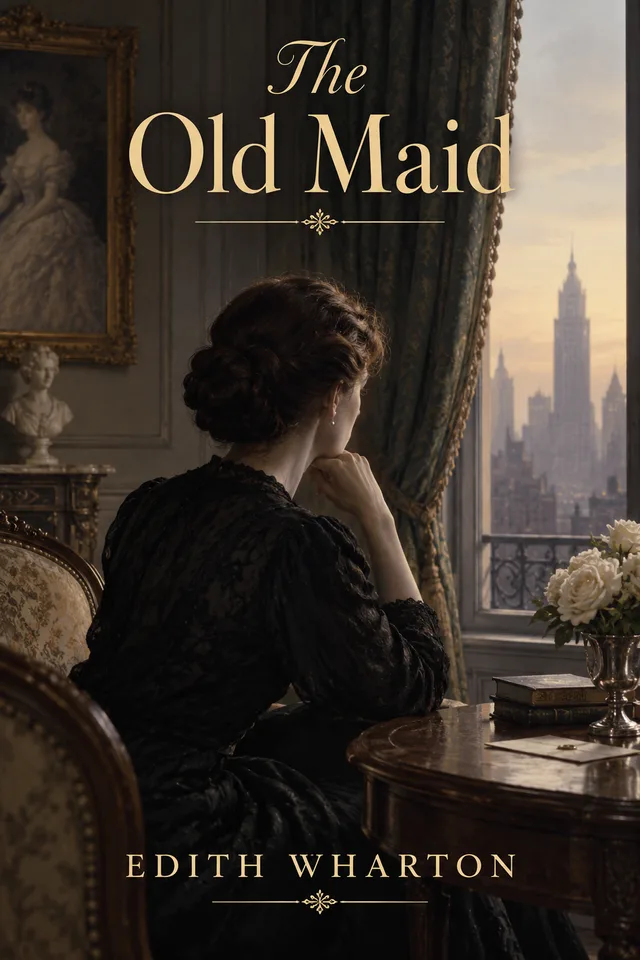
The Old Maid
BooksWhale-Ausgabe auf Englisch von Edith Wharton
Two cousins confront family secrecy, motherhood, respectability, and sacrifice.
- Vorschau
- Auszug aus dem vorbereiteten Text
- Formate
- Online-Reader, EPUB, PDF
- Zugriff
- Bibliotheks-Claim
Bucheinführung
The Old Maid
Set in old New York, Wharton exposes how class and reputation shape women’s choices after a hidden decision.
BooksWhale-Ausgabe
Wie diese Ausgabe vorbereitet wurde
Diese Ausgabe basiert auf einem gemeinfreien Text und wurde von BooksWhale für digitales Lesen vorbereitet.
Public-Domain-Grundlage
Warum diese Ausgabe geteilt werden kann
Edith Wharton died in 1937, and this english source text was published in 1924; it is public domain.
Vorschau lesen
Auszug aus dem vorbereiteten Text
Vorschau aus dem vorbereiteten Lesetext.
VorschaukapitelFull textVorschau lesen
The Old Maid
Edith Wharton
VorschaukapitelPART IVorschau
THE OLD MAID (The ’Fifties)
I
IN the old New York of the ’fifties a few families ruled, in simplicity and affluence. Of these were the Ralstons.
The sturdy English and the rubicund and heavier Dutch had mingled to produce a prosperous, prudent and yet lavish society. To “do things handsomely” had always been a fundamental principle in this cautious world, built up on the fortunes of bankers, India merchants, shipbuilders and ship-chandlers. Those well-fed slow-moving people, who seemed irritable and dyspeptic to European eyes only because the caprices of the climate had stripped them of superfluous flesh, and strung their nerves a little tighter, lived in a genteel monotony of which the surface was never stirred by the dumb dramas now and then enacted underground. Sensitive souls in those days were like muted key-boards, on which Fate played without a sound.
In this compact society, built of solidly welded blocks, one of the largest areas was filled by the Ralstons and their ramifications. The Ralstons were of middle-class English stock. They had not come to the colonies to die for a creed but to live for a bank-account. The result had been beyond their hopes, and their religion was tinged by their success. An edulcorated Church of England which, under the conciliatory name of the “Episcopal Church of the United States of America,” left out the coarser allusions in the Marriage Service, slid over the comminatory passages in the Athanasian Creed, and thought it more respectful to say “Our Father who” than “which” in the Lord’s Prayer, was exactly suited to the spirit of compromise whereon the Ralstons had built themselves up. There was in all the tribe the same instinctive recoil from new religions as from unaccounted-for people. Institutional to the core, they represented the conservative element that holds new societies together as seaplants bind the seashore.
Compared with the Ralstons, even such traditionalists as the Lovells, the Halseys or the Vandergraves appeared careless, indifferent to money, almost reckless in their impulses and indecisions. Old John Frederick Ralston, the stout founder of the race, had perceived the difference, and emphasized it to his son, Frederick John, in whom he had scented a faint leaning toward the untried and unprofitable.
“You let the Lannings and the Dagonets and the Spenders take risks and fly kites. It’s the county-family blood in ’em: we’ve nothing to do with that. Look how they’re petering out already—the men, I mean. Let your boys marry their girls, if you like (they’re wholesome and handsome); though I’d sooner see my grandsons take a Lovell or a Vandergrave, or any of our own kind. But don’t let your sons go mooning around after their young fellows, horse-racing, and running down south to those d——d Springs, and gambling at New Orleans, and all the rest of it. That’s how you’ll build up the family, and keep the weather out. The way we’ve always done it.”
Frederick John listened, obeyed, married a Halsey, and passively followed in his father’s steps. He belonged to the cautious generation of New York gentlemen who revered Hamilton and served Jefferson, who longed to lay out New York like Washington, and who laid it out instead like a gridiron, lest they should be thought “undemocratic” by people they secretly looked down upon. Shopkeepers to the marrow, they put in their windows the wares there was most demand for, keeping their private opinions for the back-shop, where through lack of use, they gradually lost substance and colour.
The fourth generation of Ralstons had nothing left in the way of convictions save an acute sense of honour in private and business matters; on the life of the community and the state they took their daily views from the newspapers, and the newspapers they already despised. The Ralstons had done little to shape the destiny of their country, except to finance the Cause when it had become safe to do so. They were related to many of the great men who had built the Republic; but no Ralston had so far committed himself as to be great. As old John Frederick said, it was safer to be satisfied with three per cent: they regarded heroism as a form of gambling. Yet by merely being so numerous and so similar they had come to have a weight in the community. People said: “The Ralstons” when they wished to invoke a precedent. This attribution of authority had gradually convinced the third generation of its collective importance, and the fourth, to which Delia Ralston’s husband belonged, had the ease and simplicity of a ruling class.
VorschaukapitelPART IIVorschau
VI
YOU could always have told, every one agreed afterward, that Charlotte Lovell was meant to be an old maid. Even before her illness it had been manifest: there was something prim about her in spite of her fiery hair. Lucky enough for her, poor girl, considering her wretched health in her youth: Mrs. James Ralston’s contemporaries, for instance, remembered Charlotte as a mere ghost, coughing her lungs out—that, of course, had been the reason for her breaking her engagement with Joe Ralston.
True, she had recovered very rapidly, in spite of the peculiar treatment she was given. The Lovells, as every one knew, couldn’t afford to send her to Italy; the previous experiment in Georgia had been unsuccessful; and so she was packed off to a farm-house on the Hudson—a little place on the James Ralstons’ property—where she lived for five or six years with an Irish servant-woman and a foundling baby. The story of the foundling was another queer episode in Charlotte’s history. From the time of her first illness, when she was only twenty-two or three, she had developed an almost morbid tenderness for children, especially for the children of the poor. It was said—Dr. Lanskell was understood to have said—that the baffled instinct of motherhood was peculiarly intense in cases where lung-disease prevented marriage. And so, when it was decided that Chatty must break her engagement to Joe Ralston and go to live in the country, the doctor had told her family that the only hope of saving her lay in not separating her entirely from her pauper children, but in letting her choose one of them, the youngest and most pitiable, and devote herself to its care. So the James Ralstons had lent her their little farm-house, and Mrs. Jim, with her extraordinary gift of taking things in at a glance, had at once arranged everything, and even pledged herself to look after the baby if Charlotte died.
Charlotte did not die. She lived to grow robust and middle-aged, energetic and even tyrannical. And as the transformation in her character took place she became more and more like the typical old maid: precise, methodical, absorbed in trifles, and attaching an exaggerated importance to the smallest social and domestic observances. Such was her reputation as a vigilant house-wife that, when poor Jim Ralston was killed by a fall from his horse, and left Delia, still young, with a boy and girl to bring up, it seemed perfectly natural that the heart-broken widow should take her cousin to live with her and share her task. But Delia Ralston never did things quite like other people. When she took Charlotte she took Charlotte’s foundling too: a dark-haired child with pale brown eyes, and the odd incisive manner of children who have lived too much with their elders. The little girl was called Tina Lovell: it was vaguely supposed that Charlotte had adopted her. She grew up on terms of affectionate equality with her young Ralston cousins, and almost as much so—it might be said—with the two women who mothered her. But, impelled by an instinct of imitation which no one took the trouble to correct, she always called Delia Ralston “Mamma,” and Charlotte Lovell “Aunt Chatty.” She was a brilliant and engaging creature, and people marvelled at poor Chatty’s luck in having chosen so interesting a specimen among her foundlings (for she was by this time supposed to have had a whole asylum-full to choose from).
The agreeable elderly bachelor, Sillerton Jackson, returning from a prolonged sojourn in Paris (where he was understood to have been made much of by the highest personages) was immensely struck by Tina’s charms when he saw her at her coming-out ball, and asked Delia’s permission to come some evening and dine alone with her and her young people. He complimented the widow on the rosy beauty of her own young Delia; but the mother’s keen eye perceived that all the while he was watching Tina, and after dinner he confided to the older ladies that there was something “very French” in the girl’s way of doing her hair, and that in the capital of all the Elegances she would have been pronounced extremely stylish.
Inhaltsverzeichnis
In dieser Ausgabe
- 01Full text
- 02PART I
- 03PART II
- 04THE END
Sprachverfügbarkeit
Andere Sprachen
Weitere Sprachausgaben sind noch nicht veröffentlicht. Sobald verfügbar, werden sie hier verlinkt.
Andere Sprache anfragen