Englisch Ausgabe
Geschichte
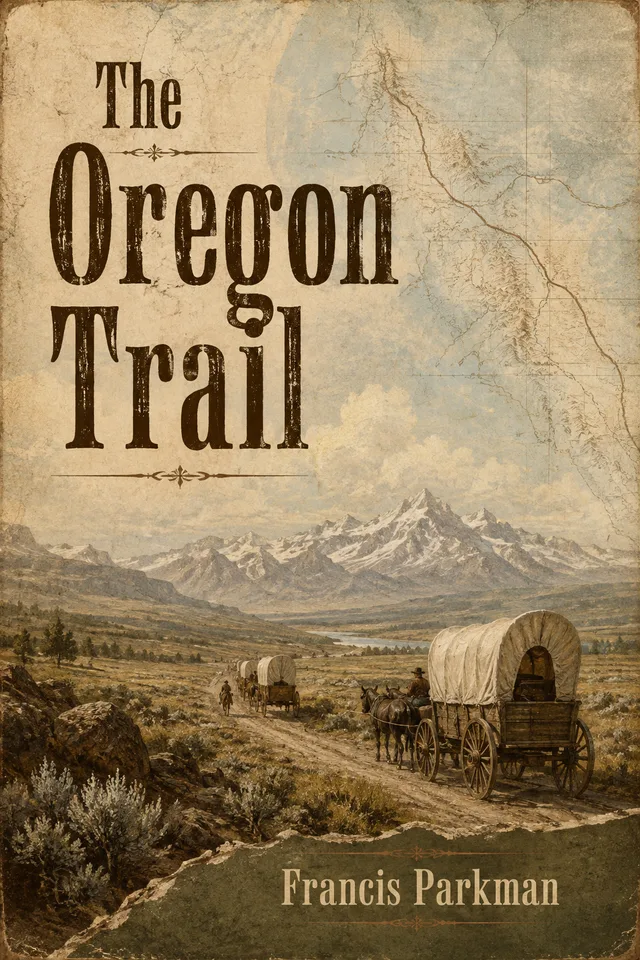
The Oregon Trail
BooksWhale-Ausgabe auf Englisch von Francis Parkman
A nineteenth-century travel narrative of the American West, the plains, frontier movement, and encounter.
- Vorschau
- Auszug aus dem vorbereiteten Text
- Formate
- Online-Reader, EPUB, PDF
- Zugriff
- Bibliotheks-Claim
Bucheinführung
The Oregon Trail
The Oregon Trail records Francis Parkman’s journey across the Great Plains in the 1840s. Its scenes of travel, camps, hunting, landscape, frontier hardship, and encounters with Native peoples make it a major document of American historical travel writing.
BooksWhale-Ausgabe
Wie diese Ausgabe vorbereitet wurde
Diese Ausgabe basiert auf einem gemeinfreien Text und wurde von BooksWhale für digitales Lesen vorbereitet.
Public-Domain-Grundlage
Warum diese Ausgabe geteilt werden kann
Francis Parkman died in 1893, and The Oregon Trail was first published in 1849; these dates support the public-domain basis for the original English text.
Vorschau lesen
Auszug aus dem vorbereiteten Text
Vorschau aus dem vorbereiteten Lesetext.
VorschaukapitelFull textVorschau lesen
The Oregon Trail
Francis Parkman
VorschaukapitelCHAPTER IVorschau
CHAPTER I
VorschaukapitelTHE FRONTIERVorschau
Last spring, 1846, was a busy season in the City of St. Louis. Not only were emigrants from every part of the country preparing for the journey to Oregon and California, but an unusual number of traders were making ready their wagons and outfits for Santa Fe. Many of the emigrants, especially of those bound for California, were persons of wealth and standing. The hotels were crowded, and the gunsmiths and saddlers were kept constantly at work in providing arms and equipments for the different parties of travelers. Almost every day steamboats were leaving the levee and passing up the Missouri, crowded with passengers on their way to the frontier.
In one of these, the Radnor, since snagged and lost, my friend and relative, Quincy A. Shaw, and myself, left St. Louis on the 28th of April, on a tour of curiosity and amusement to the Rocky Mountains. The boat was loaded until the water broke alternately over her guards. Her upper deck was covered with large weapons of a peculiar form, for the Santa Fe trade, and her hold was crammed with goods for the same destination. There were also the equipments and provisions of a party of Oregon emigrants, a band of mules and horses, piles of saddles and harness, and a multitude of nondescript articles, indispensable on the prairies. Almost hidden in this medley one might have seen a small French cart, of the sort very appropriately called a “mule-killer” beyond the frontiers, and not far distant a tent, together with a miscellaneous assortment of boxes and barrels. The whole equipage was far from prepossessing in its appearance; yet, such as it was, it was destined to a long and arduous journey, on which the persevering reader will accompany it.
The passengers on board the Radnor corresponded with her freight. In her cabin were Santa Fe traders, gamblers, speculators, and adventurers of various descriptions, and her steerage was crowded with Oregon emigrants, “mountain men,” negroes, and a party of Kansas Indians, who had been on a visit to St. Louis.
Thus laden, the boat struggled upward for seven or eight days against the rapid current of the Missouri, grating upon snags, and hanging for two or three hours at a time upon sand-bars. We entered the mouth of the Missouri in a drizzling rain, but the weather soon became clear, and showed distinctly the broad and turbid river, with its eddies, its sand-bars, its ragged islands, and forest-covered shores. The Missouri is constantly changing its course; wearing away its banks on one side, while it forms new ones on the other. Its channel is shifting continually. Islands are formed, and then washed away; and while the old forests on one side are undermined and swept off, a young growth springs up from the new soil upon the other. With all these changes, the water is so charged with mud and sand that it is perfectly opaque, and in a few minutes deposits a sediment an inch thick in the bottom of a tumbler. The river was now high; but when we descended in the autumn it was fallen very low, and all the secrets of its treacherous shallows were exposed to view. It was frightful to see the dead and broken trees, thick-set as a military abatis, firmly imbedded in the sand, and all pointing down stream, ready to impale any unhappy steamboat that at high water should pass over that dangerous ground.
In five or six days we began to see signs of the great western movement that was then taking place. Parties of emigrants, with their tents and wagons, would be encamped on open spots near the bank, on their way to the common rendezvous at Independence. On a rainy day, near sunset, we reached the landing of this place, which is situated some miles from the river, on the extreme frontier of Missouri. The scene was characteristic, for here were represented at one view the most remarkable features of this wild and enterprising region. On the muddy shore stood some thirty or forty dark slavish-looking Spaniards, gazing stupidly out from beneath their broad hats. They were attached to one of the Santa Fe companies, whose wagons were crowded together on the banks above. In the midst of these, crouching over a smoldering fire, was a group of Indians, belonging to a remote Mexican tribe. One or two French hunters from the mountains with their long hair and buckskin dresses, were looking at the boat; and seated on a log close at hand were three men, with rifles lying across their knees. The foremost of these, a tall, strong figure, with a clear blue eye and an open, intelligent face, might very well represent that race of restless and intrepid pioneers whose axes and rifles have opened a path from the Alleghenies to the western prairies. He was on his way to Oregon, probably a more congenial field to him than any that now remained on this side the great plains.
Inhaltsverzeichnis
In dieser Ausgabe
- 01Full text
- 02CHAPTER I
- 03THE FRONTIER
- 04CHAPTER II
- 05BREAKING THE ICE
- 06CHAPTER III
- 07FORT LEAVENWORTH
- 08CHAPTER IV
- 09“JUMPING OFF”
- 10CHAPTER V
- 11“THE BIG BLUE”
- 12CHAPTER VI
- 13THE PLATTE AND THE DESERT
- 14MARY ELLIS
- 15DIED MAY 7TH, 1845.
- 16CHAPTER VII
- 17THE BUFFALO
- 18CHAPTER VIII
- 19TAKING FRENCH LEAVE
- 20CHAPTER IX
- 21SCENES AT FORT LARAMIE
- 22CHAPTER X
- 23THE WAR PARTIES
- 24CHAPTER XI
- 25SCENES AT THE CAMP
- 26CHAPTER XII
- 27ILL LUCK
- 28CHAPTER XIII
- 29HUNTING INDIANS
- 30CHAPTER XIV
- 31THE OGALLALLA VILLAGE
- 32CHAPTER XV
- 33THE HUNTING CAMP
- 34CHAPTER XVI
- 35THE TRAPPERS
- 36CHAPTER XVII
- 37THE BLACK HILLS
- 38CHAPTER XVIII
- 39A MOUNTAIN HUNT
- 40CHAPTER XIX
- 41PASSAGE OF THE MOUNTAINS
- 42CHAPTER XX
- 43THE LONELY JOURNEY
- 44CHAPTER XXI
- 45THE PUEBLO AND BENT’S FORT
- 46CHAPTER XXII
- 47TETE ROUGE, THE VOLUNTEER
- 48CHAPTER XXIII
- 49INDIAN ALARMS
- 50CHAPTER XXIV
- 51THE CHASE
- 52CHAPTER XXV
- 53THE BUFFALO CAMP
- 54CHAPTER XXVI
- 55DOWN THE ARKANSAS
- 56CHAPTER XXVII
- 57THE SETTLEMENTS
Sprachverfügbarkeit
Andere Sprachen
Weitere Sprachausgaben sind noch nicht veröffentlicht. Sobald verfügbar, werden sie hier verlinkt.
Andere Sprache anfragen