Englisch Ausgabe
Literatur
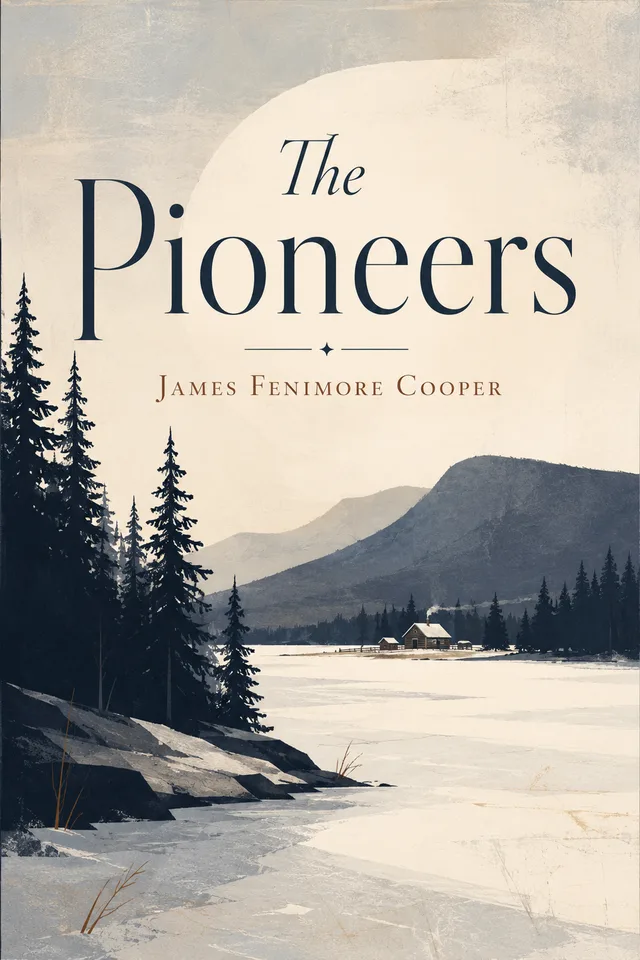
The Pioneers
BooksWhale-Ausgabe auf Englisch von James Fenimore Cooper
Cooper’s frontier novel follows Templeton, Judge Temple, Natty Bumppo, and conflicts over land, law, settlement, and wilderness.
- Vorschau
- Auszug aus dem vorbereiteten Text
- Formate
- Online-Reader, EPUB, PDF
- Zugriff
- Bibliotheks-Claim
Bucheinführung
The Pioneers
The Pioneers opens James Fenimore Cooper’s Leatherstocking world through the settlement of Templeton, where older frontier ways meet courts, property claims, logging, hunting, and new American ambition. Natty Bumppo’s presence gives the novel its lasting tension between wilderness knowledge and expanding civilization.
BooksWhale-Ausgabe
Wie diese Ausgabe vorbereitet wurde
Diese Ausgabe basiert auf einem gemeinfreien Text und wurde von BooksWhale für digitales Lesen vorbereitet.
Public-Domain-Grundlage
Warum diese Ausgabe geteilt werden kann
Author died in 1851; original text first published in 1823. These dates support the public-domain basis for this original-language edition.
Vorschau lesen
Auszug aus dem vorbereiteten Text
Vorschau aus dem vorbereiteten Lesetext.
VorschaukapitelFull textVorschau lesen
The Pioneers
Or, The Sources of the Susquehanna
A Descriptive Tale
By J. Fenimore Cooper
As this work professes, in its title-page, to be a descriptive tale, they who will take the trouble to read it may be glad to know how much of its contents is literal fact, and how much is intended to represent a general picture. The author is very sensible that, had he confined himself to the latter, always the most effective, as it is the most valuable, mode of conveying knowledge of this nature, he would have made a far better book. But in commencing to describe scenes, and perhaps he may add characters, that were so familiar to his own youth, there was a constant temptation to delineate that which he had known, rather than that which he might have imagined. This rigid adhesion to truth, an indispensable requisite in history and travels, destroys the charm of fiction; for all that is necessary to be conveyed to the mind by the latter had better be done by delineations of principles, and of
characters in their classes, than by a too fastidious attention to originals.
New York having but one county of Otsego, and the Susquehanna but one proper source, there can be no mistake as to the site of the tale. The history of this district of country, so far as it is connected with civilized men, is soon told.
Otsego, in common with most of the interior of the province of New York, was included in the county of Albany previously to the war of the separation. It then became, in a subsequent division of territory, a
Vorschaukapitelpart of Montgomery; and finally, having obtained a sufficient populationVorschau
of its own, it was set apart as a county by itself shortly after the peace of 1783. It lies among those low spurs of the Alleghanies which cover the midland counties of New York, and it is a little east of a meridional line drawn through the centre of the State. As the waters of New York flow either southerly into the Atlantic or northerly into Ontario and its outlet, Otsego Lake, being the source of the Susquehanna, is of necessity among its highest lands. The face of the country, the climate as it was found by the whites, and the manners of the settlers, are described with a minuteness for which the author has no other apology than the force of his own recollections.
Otsego is said to be a word compounded of Ot, a place of meeting, and Sego, or Sago, the ordinary term of salutation used by the Indians of this region. There is a tradition which says that the neighboring tribes were accustomed to meet on the banks of the lake to make their treaties, and otherwise to strengthen their alliances, and which refers the name to this practice. As the Indian agent of New York had a log dwelling at the foot of the lake, however, it is not impossible that the appellation grew out of the meetings that were held at his council fires; the war drove off the agent, in common with the other officers of the crown; and his rude dwelling was soon abandoned. The author remembers it, a few years later, reduced to the humble office of a smoke-house.
In 1779 an expedition was sent against the hostile Indians, who dwelt about a hundred miles west of Otsego, on the banks of the Cayuga. The whole country was then a wilderness, and it was necessary to transport the baggage of the troops by means of the rivers--a devious but practicable route. One brigade ascended the Mohawk until it reached the point nearest to the sources of the Susquehanna, whence it cut a lane through the forest to the head of the Otsego. The boats and baggage were carried over this “portage,” and the troops proceeded to the other extremity of the lake, where they disembarked and encamped. The Susquehanna, a narrow though rapid stream at its source, was much filled with “flood wood,” or fallen trees; and the troops adopted a novel expedient to facilitate their passage. The Otsego is about nine miles in length, varying in breadth from half a mile to a mile and a half. The
water is of great depth, limpid, and supplied from a thousand springs. At its foot the banks are rather less than thirty feet high the remainder of its margin being in mountains, intervals, and points. The outlet, or the Susquehanna, flows through a gorge in the low banks just mentioned, which may have a width of two hundred feet. This gorge was dammed and the waters of the lake collected: the Susquehanna was converted into a rill.
When all was ready the troops embarked, the damn was knocked away, the Otsego poured out its torrent, and the boats went merrily down with the current.
General James Clinton, the brother of George Clinton, then governor of New York, and the father of De Witt Clinton, who died governor of the same State in 1827, commanded the brigade employed on this duty. During the stay of the troops at the foot of the Otsego a soldier was shot for desertion. The grave of this unfortunate man was the first place of human interment that the author ever beheld, as the smoke-house was the first ruin! The swivel alluded to in this work was buried and abandoned by the troops on this occasion, and it was subsequently found in digging the cellars of the authors paternal residence.
Soon after the close of the war, Washington, accompanied by many distinguished men, visited the scene of this tale, it is said with a view to examine the facilities for opening a communication by water with other points of the country. He stayed but a few hours.
Vorschaukapitelbook will probably ever give any of its readers. He is quite aware ofVorschau
its numerous faults, some of which he has endeavored to repair in this edition; but as he has--in intention, at least--done his full share in amusing the world, he trusts to its good-nature for overlooking this attempt to please himself.
“See, Winter comes, to rule the varied years, Sullen and sad, with all his rising train; Vapors, and clouds, and storms.”--Thomson.
Near the centre of the State of New York lies an extensive district of country whose surface is a succession of hills and dales, or, to speak with greater deference to geographical definitions, of mountains and valleys. It is among these hills that the Delaware takes its rise; and flowing from the limpid lakes and thousand springs of this region the numerous sources of the Susquehanna meander through the valleys until, uniting their streams, they form one of the proudest rivers of the United States. The mountains are generally arable to the tops, although instances are not wanting where the sides are jutted with rocks that aid greatly in giving to the country that romantic and picturesque character which it so eminently possesses. The vales are narrow, rich, and cultivated, with a stream uniformly winding through each. Beautiful and thriving villages are found interspersed along the margins of the small
lakes, or situated at those points of the streams which are favorable for manufacturing; and neat and comfortable farms, with every indication of wealth about them, are scattered profusely through the vales, and even to the mountain tops. Roads diverge in every direction from the even and graceful bottoms of the valleys to the most rugged and intricate passes of the hills. Academies and minor edifices of learning meet the eye of the stranger at every few miles as he winds his way through this uneven territory, and places for the worship of God abound with that frequency which characterize a moral and reflecting people, and with that variety of exterior and canonical government which flows from unfettered liberty of conscience. In short, the whole district is hourly exhibiting how much can be done, in even a rugged country and with a severe climate, under the dominion of mild laws, and where every
man feels a direct interest in the prosperity of a commonwealth of which he knows himself to form a part. The expedients of the pioneers who first broke ground in the settlement of this country are succeeded by the permanent improvements of the yeoman who intends to leave his remains to moulder under the sod which he tills, or perhaps of the son, who, born in the land, piously wishes to linger around the grave of his father. Only forty years * have passed since this territory was a wilderness.
* Our tale begins in 1793, about seven years after the commencement of one of the earliest of those settlements which have conduced to effect that magical change in the power and condition of the State to which we have alluded.
Very soon after the establishment of the independence of the States by the peace of 1783, the enterprise of their citizens was directed to a development of the natural advantages of their widely extended dominions. Before the war of the Revolution, the inhabited parts of the colony of New York were limited to less than a tenth of its possessions, A narrow belt of country, extending for a short distance on either side of the Hudson, with a similar occupation of fifty miles on the banks of the Mohawk, together with the islands of Nassau and Staten, and a few insulated settlements on chosen land along the margins of streams, composed the country, which was then inhabited by less than two hundred thousand souls. Within the short period we have mentioned, the population has spread itself over five degrees of latitude and seven of longitude, and has swelled to a million and a half of inhabitants, who
Inhaltsverzeichnis
In dieser Ausgabe
- 01Full text
- 02part of Montgomery; and finally, having obtained a sufficient population
- 03book will probably ever give any of its readers. He is quite aware of
- 04part of his form was to be discovered through his overdress, but a face
- 05part of a settler's life with which he was not familiar. Under his
- 06part continued unbending; observant, it is true, but it was the kind
- 07part into a tacit acknowledgment of the superficial nature of his
- 08book.”
- 09part; says nothing, while the church folks practyse all kinds of ways,
- 10part of the settlement; and the regular constable of the township had
Sprachverfügbarkeit
Andere Sprachen
Weitere Sprachausgaben sind noch nicht veröffentlicht. Sobald verfügbar, werden sie hier verlinkt.
Andere Sprache anfragen