Englisch Ausgabe
Literatur
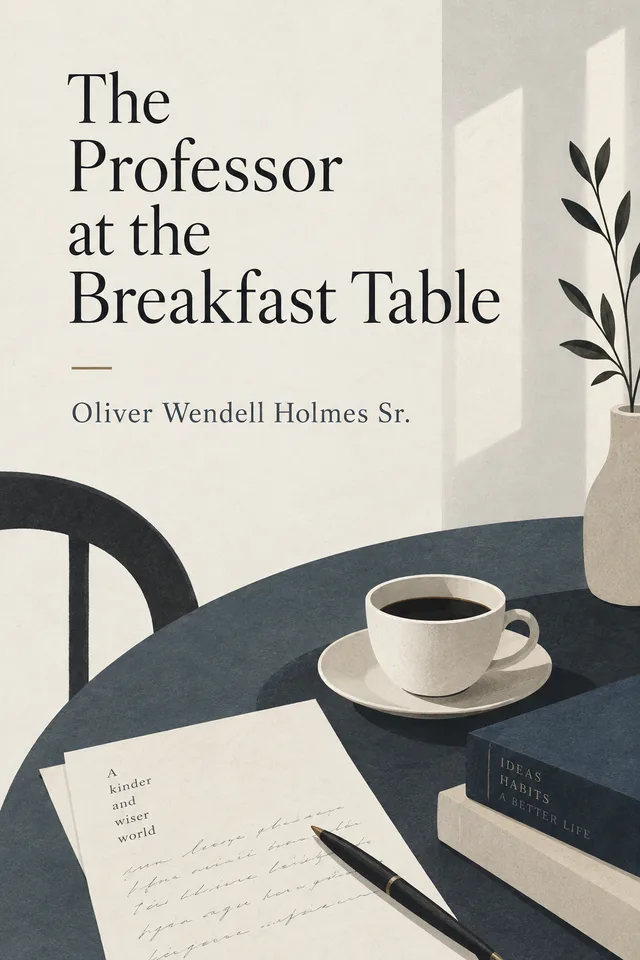
The Professor at the Breakfast Table
BooksWhale-Ausgabe auf Englisch von Oliver Wendell Holmes Sr.
Essays, anecdotes, and philosophical reflections unfold around an imaginary breakfast table, where ordinary conversation opens onto mind, memory, and society.
- Vorschau
- Auszug aus dem vorbereiteten Text
- Formate
- Online-Reader, EPUB, PDF
- Zugriff
- Bibliotheks-Claim
Bucheinführung
The Professor at the Breakfast Table
Oliver Wendell Holmes Sr.’s The Professor at the Breakfast Table brings a physician, a schoolmaster, a young woman, an invalid, and other memorable figures into a loose series of conversations and meditations. Holmes moves easily from physiology and education to friendship, religion, humor, and the habits of thought, creating an intimate nineteenth-century book that is part essay collection, part social portrait, and part philosophical salon.
BooksWhale-Ausgabe
Wie diese Ausgabe vorbereitet wurde
Diese Ausgabe basiert auf einem gemeinfreien Text und wurde von BooksWhale für digitales Lesen vorbereitet.
Public-Domain-Grundlage
Warum diese Ausgabe geteilt werden kann
Oliver Wendell Holmes Sr. died in 1894 and the original English work was published in 1859; these dates support its public-domain status.
Vorschau lesen
Auszug aus dem vorbereiteten Text
Vorschau aus dem vorbereiteten Lesetext.
VorschaukapitelFull textVorschau lesen
The Professor at the Breakfast Table
Oliver Wendell Holmes Sr.
VorschaukapitelPREFACE TO REVISED EDITION.Vorschau
The reader of to-day will not forget, I trust, that it is nearly a quarter of a century since these papers were written. Statements which were true then are not necessarily true now. Thus, the speed of the trotting horse has been so much developed that the record of the year when the fastest time to that date was given must be very considerably altered, as may be seen by referring to a note on page 49 of the “Autocrat.” No doubt many other statements and opinions might be more or less modified if I were writing today instead of having written before the war, when the world and I were both more than a score of years younger.
These papers followed close upon the track of the “Autocrat.” They had to endure the trial to which all second comers are subjected, which is a formidable ordeal for the least as well as the greatest. Paradise Regained and the Second Part of Faust are examples which are enough to warn every one who has made a jingle fair hit with his arrow of the danger of missing when he looses “his fellow of the selfsame flight.”
There is good reason why it should be so. The first juice that runs of itself from the grapes comes from the heart of the fruit, and tastes of the pulp only; when the grapes are squeezed in the press the flow betrays the flavor of the skin. If there is any freshness in the original idea of the work, if there is any individuality in the method or style of a new author, or of an old author on a new track, it will have lost much of its first effect when repeated. Still, there have not been wanting readers who have preferred this second series of papers to the first. The new papers were more aggressive than the earlier ones, and for that reason found a heartier welcome in some quarters, and met with a sharper antagonism in others. It amuses me to look back on some of the attacks they called forth. Opinions which do not excite the faintest show of temper at this time from those who do not accept them were treated as if they were the utterances of a nihilist incendiary. It required the exercise of some forbearance not to recriminate.
How a stray sentence, a popular saying, the maxim of some wise man, a line accidentally fallen upon and remembered, will sometimes help one when he is all ready to be vexed or indignant! One day, in the time when I was young or youngish, I happened to open a small copy of “Tom Jones,” and glance at the title-page. There was one of those little engravings opposite, which bore the familiar name of “T. Uwins,” as I remember it, and under it the words “Mr. Partridge bore all this patiently.” How many times, when, after rough usage from ill-mannered critics, my own vocabulary of vituperation was simmering in such a lively way that it threatened to boil and lift its lid and so boil over, those words have calmed the small internal effervescence! There is very little in them and very little of them; and so there is not much in a linchpin considered by itself, but it often keeps a wheel from coming off and prevents what might be a catastrophe. The chief trouble in offering such papers as these to the readers of to-day is that their heresies have become so familiar among intelligent people that they have too commonplace an aspect. All the lighthouses and land-marks of belief bear so differently from the way in which they presented themselves when these papers were written that it is hard to recognize that we and our fellow-passengers are still in the same old vessel sailing the same unfathomable sea and bound to the same as yet unseen harbor.
VorschaukapitelPREFACE TO THE NEW EDITIONVorschau
After a time the writer has cooled down from his excitement,--has got over his apprehensions, is pleased to find that his book is still read, and that he must write a new Preface. He comes smiling to his task. How many things have explained themselves in the ten or twenty or thirty years since he came before his untried public in those almost plaintive paragraphs in which he introduced himself to his readers,--for the Preface writer, no matter how fierce a combatant he may prove, comes on to the stage with his shield on his right arm and his sword in his left hand.
The Professor at the Breakfast-Table came out in the “Atlantic Monthly” and introduced itself without any formal Preface. A quarter of a century later the Preface of 1882, which the reader has just had laid before him, was written. There is no mark of worry, I think, in that. Old opponents had come up and shaken hands with the author they had attacked or denounced. Newspapers which had warned their subscribers against him were glad to get him as a contributor to their columns. A great change had come over the community with reference to their beliefs. Christian believers were united as never before in the feeling that, after all, their common object was to elevate the moral and religious standard of humanity. But within the special compartments of the great Christian fold the marks of division have pronounced themselves in the most unmistakable manner. As an example we may take the lines of cleavage which have shown themselves in the two great churches, the Congregational and the Presbyterian, and the very distinct fissure which is manifest in the transplanted Anglican church of this country. Recent circumstances have brought out the fact of the great change in the dogmatic communities which has been going on silently but surely. The licensing of a missionary, the transfer of a Professor from one department to another, the election of a Bishop,--each of these movements furnishes evidence that there is no such thing as an air-tight reservoir of doctrinal finalities.
The folding-doors are wide open to every Protestant to enter all the privileged precincts and private apartments of the various exclusive religious organizations. We may demand the credentials of every creed and catechise all the catechisms. So we may discuss the gravest questions unblamed over our morning coffee-cups or our evening tea-cups. There is no rest for the Protestant until he gives up his legendary anthropology and all its dogmatic dependencies.
It is only incidentally, however, that the Professor at the Breakfast-Table handles matters which are the subjects of religious controversy. The reader who is sensitive about having his fixed beliefs dealt with as if they were open to question had better skip the pages which look as if they would disturb his complacency. “Faith” is the most precious of possessions, and it dislikes being meddled with. It means, of course, self-trust,--that is, a belief in the value of our own opinion of a doctrine, of a church, of a religion, of a Being, a belief quite independent of any evidence that we can bring to convince a jury of our fellow beings. Its roots are thus inextricably entangled with those of self-love and bleed as mandrakes were said to, when pulled up as weeds. Some persons may even at this late day take offence at a few opinions expressed in the following pages, but most of these passages will be read without loss of temper by those who disagree with them, and by-and-by they may be found too timid and conservative for intelligent readers, if they are still read by any.
BEVERLY FARM, MASS., June 18, 1891. O. W. H.
Inhaltsverzeichnis
In dieser Ausgabe
- 01Full text
- 02PREFACE TO REVISED EDITION.
- 03PREFACE TO THE NEW EDITION
- 04THE PROFESSOR AT THE BREAKFAST-TABLE.
- 05I
- 06DE SAUTY
- 07AN ELECTRO-CHEMICAL ECLOGUE.
- 08PROFESSOR.
- 09BLUE-NOSE.
- 10II
- 11THE BOYS.
- 12III
- 13THE OPENING OF THE PIANO.
- 14IV
- 15ON TUESDAY NEXT WILL BE PRESENTED THE AFFECTING SCENE CALLED
- 16THE SURPRISE-PARTY
- 17OR
- 18THE OVERCOME FAMILY;
- 19WITH THE FOLLOWING STRONG CAST OF CHARACTERS.
- 20THE CROOKED FOOTPATH
- 21V
- 22A MOTHER'S SECRET.
- 23VI
- 24THE TWO STREAMS.
- 25VII
- 26ROBINSON OF LEYDEN.
- 27VIII
- 28SAINT ANTHONY THE REFORMER.
- 29HIS TEMPTATION.
- 30IX
- 31MIDSUMMER.
- 32X
- 33IRIS, HER BOOK
- 34X
- 35THE BOOK OF THE THREE MAIDEN SISTERS.
- 36UNDER THE VIOLETS.
- 37XI
- 38HYMN OF TRUST.
- 39XII
- 40ALL TRESPASSERS ARE WARNED OFF THESE GROUNDS!
- 41A SUN-DAY HYMN.
Sprachverfügbarkeit
Andere Sprachen
Weitere Sprachausgaben sind noch nicht veröffentlicht. Sobald verfügbar, werden sie hier verlinkt.
Andere Sprache anfragen