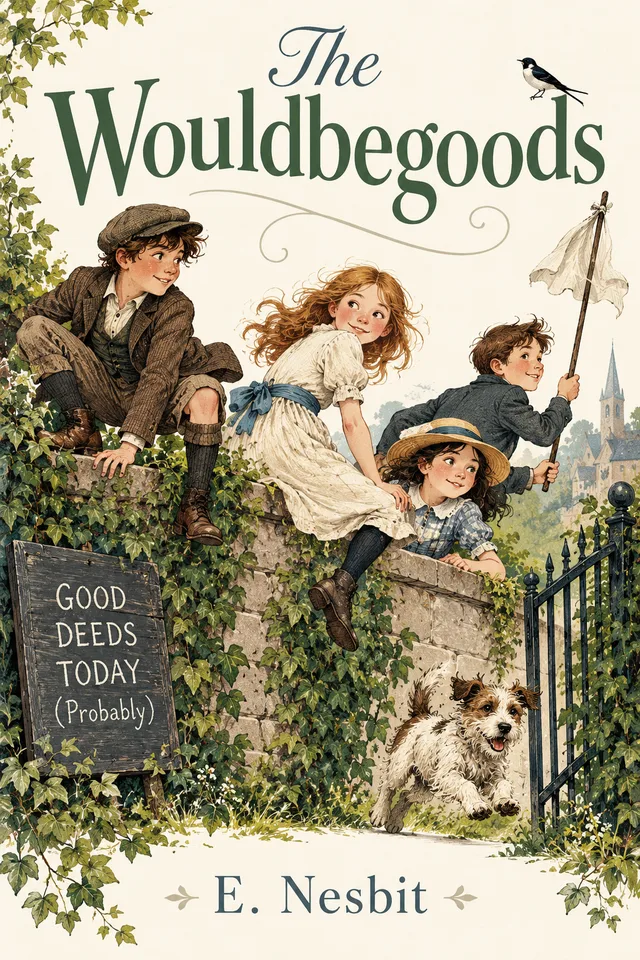
Englisch Ausgabe
Literatur
The Wouldbegoods
BooksWhale-Ausgabe auf Englisch von E. Nesbit
A well-meaning child gang turns good intentions into comic calamities.
- Vorschau
- Auszug aus dem vorbereiteten Text
- Formate
- Online-Reader, EPUB, PDF
- Zugriff
- Bibliotheks-Claim
Bucheinführung
The Wouldbegoods
The Bastable children decide that doing good will make them admirable, but rescues, charitable schemes, and secret plans repeatedly upset the adults around them. E. Nesbit combines lively dialogue with a sharp, affectionate portrait of family life and childhood imagination.
BooksWhale-Ausgabe
Wie diese Ausgabe vorbereitet wurde
Diese Ausgabe basiert auf einem gemeinfreien Text und wurde von BooksWhale für digitales Lesen vorbereitet.
Public-Domain-Grundlage
Warum diese Ausgabe geteilt werden kann
E. Nesbit died in 1924; the source work was first published in 1901. The source text is public domain under applicable life-plus-term and publication-date rules.
Vorschau lesen
Auszug aus dem vorbereiteten Text
Vorschau aus dem vorbereiteten Lesetext.
VorschaukapitelFull textVorschau lesen
The Wouldbegoods
E. Nesbit
VorschaukapitelCHAPTER 1. THE JUNGLEVorschau
Children are like jam: all very well in the proper place, but you can’t stand them all over the shop—eh, what?’
These were the dreadful words of our Indian uncle. They made us feel very young and angry; and yet we could not be comforted by calling him names to ourselves, as you do when nasty grown-ups say nasty things, because he is not nasty, but quite the exact opposite when not irritated. And we could not think it ungentlemanly of him to say we were like jam, because, as Alice says, jam is very nice indeed—only not on furniture and improper places like that. My father said, ‘Perhaps they had better go to boarding-school.’ And that was awful, because we know Father disapproves of boarding-schools. And he looked at us and said, ‘I am ashamed of them, sir!’
Your lot is indeed a dark and terrible one when your father is ashamed of you. And we all knew this, so that we felt in our chests just as if we had swallowed a hard-boiled egg whole. At least, this is what Oswald felt, and Father said once that Oswald, as the eldest, was the representative of the family, so, of course, the others felt the same.
And then everybody said nothing for a short time. At last Father said—
‘You may go—but remember—’
The words that followed I am not going to tell you. It is no use telling you what you know before—as they do in schools. And you must all have had such words said to you many times. We went away when it was over. The girls cried, and we boys got out books and began to read, so that nobody should think we cared. But we felt it deeply in our interior hearts, especially Oswald, who is the eldest and the representative of the family.
We felt it all the more because we had not really meant to do anything wrong. We only thought perhaps the grown-ups would not be quite pleased if they knew, and that is quite different. Besides, we meant to put all the things back in their proper places when we had done with them before anyone found out about it. But I must not anticipate (that means telling the end of the story before the beginning. I tell you this because it is so sickening to have words you don’t know in a story, and to be told to look it up in the dicker).
We are the Bastables—Oswald, Dora, Dicky, Alice, Noel, and H. O. If you want to know why we call our youngest brother H. O. you can jolly well read The Treasure Seekers and find out. We were the Treasure Seekers, and we sought it high and low, and quite regularly, because we particularly wanted to find it. And at last we did not find it, but we were found by a good, kind Indian uncle, who helped Father with his business, so that Father was able to take us all to live in a jolly big red house on Blackheath, instead of in the Lewisham Road, where we lived when we were only poor but honest Treasure Seekers. When we were poor but honest we always used to think that if only Father had plenty of business, and we did not have to go short of pocket money and wear shabby clothes (I don’t mind this myself, but the girls do), we should be happy and very, very good.
And when we were taken to the beautiful big Blackheath house we thought now all would be well, because it was a house with vineries and pineries, and gas and water, and shrubberies and stabling, and replete with every modern convenience, like it says in Dyer & Hilton’s list of Eligible House Property. I read all about it, and I have copied the words quite right.
VorschaukapitelCHAPTER 2. THE WOULDBEGOODSVorschau
When we were sent down into the country to learn to be good we felt it was rather good business, because we knew our being sent there was really only to get us out of the way for a little while, and we knew right enough that it wasn’t a punishment, though Mrs Blake said it was, because we had been punished thoroughly for taking the stuffed animals out and making a jungle on the lawn with them, and the garden hose. And you cannot be punished twice for the same offence. This is the English law; at least I think so. And at any rate no one would punish you three times, and we had had the Malacca cane and the solitary confinement; and the uncle had kindly explained to us that all ill-feeling between him and us was wiped out entirely by the bread and water we had endured. And what with the bread and water and being prisoners, and not being able to tame any mice in our prisons, I quite feel that we had suffered it up thoroughly, and now we could start fair.
I think myself that descriptions of places are generally dull, but I have sometimes thought that was because the authors do not tell you what you truly want to know. However, dull or not, here goes—because you won’t understand anything unless I tell you what the place was like.
The Moat House was the one we went to stay at. There has been a house there since Saxon times. It is a manor, and a manor goes on having a house on it whatever happens. The Moat House was burnt down once or twice in ancient centuries—I don’t remember which—but they always built a new one, and Cromwell’s soldiers smashed it about, but it was patched up again. It is a very odd house: the front door opens straight into the dining-room, and there are red curtains and a black-and-white marble floor like a chess-board, and there is a secret staircase, only it is not secret now—only rather rickety. It is not very big, but there is a watery moat all round it with a brick bridge that leads to the front door. Then, on the other side of the moat there is the farm, with barns and oast houses and stables, or things like that. And the other way the garden lawn goes on till it comes to the churchyard. The churchyard is not divided from the garden at all except by a little grass bank. In the front of the house there is more garden, and the big fruit garden is at the back.
The man the house belongs to likes new houses, so he built a big one with conservatories and a stable with a clock in a turret on the top, and he left the Moat House. And Albert’s uncle took it, and my father was to come down sometimes from Saturday to Monday, and Albert’s uncle was to live with us all the time, and he would be writing a book, and we were not to bother him, but he would give an eye to us. I hope all this is plain. I have said it as short as I can.
We got down rather late, but there was still light enough to see the big bell hanging at the top of the house. The rope belonging to it went right down the house, through our bedroom to the dining-room. H. O. saw the rope and pulled it while he was washing his hands for supper, and Dicky and I let him, and the bell tolled solemnly. Father shouted to him not to, and we went down to supper.
But presently there were many feet trampling on the gravel, and Father went out to see. When he came back he said—‘The whole village, or half of it, has come up to see why the bell rang. It’s only rung for fire or burglars. Why can’t you kids let things alone?’
Inhaltsverzeichnis
In dieser Ausgabe
- 01Full text
- 02CHAPTER 1. THE JUNGLE
- 03CHAPTER 2. THE WOULDBEGOODS
- 04CHAPTER 3. BILL’S TOMBSTONE
- 05CHAPTER 4. THE TOWER OF MYSTERY
- 06CHAPTER 5. THE WATERWORKS
- 07CHAPTER 6. THE CIRCUS
- 08CHAPTER 7. BEING BEAVERS; OR, THE YOUNG EXPLORERS (ARCTIC OR OTHERWISE)
- 09CHAPTER 8. THE HIGH-BORN BABE
- 10CHAPTER 9. HUNTING THE FOX
- 11CHAPTER 10. THE SALE OF ANTIQUITIES
- 12CHAPTER 11. THE BENEVOLENT BAR
- 13CHAPTER 12. THE CANTERBURY PILGRIMS
- 14CHAPTER 13. THE DRAGON’S TEETH; OR, ARMY-SEED
- 15CHAPTER 14. ALBERT’S UNCLE’s GRANDMOTHER; OR, THE LONG-LOST
Sprachverfügbarkeit
Andere Sprachen
Weitere Sprachausgaben sind noch nicht veröffentlicht. Sobald verfügbar, werden sie hier verlinkt.
Andere Sprache anfragen