Englisch Ausgabe
Literatur
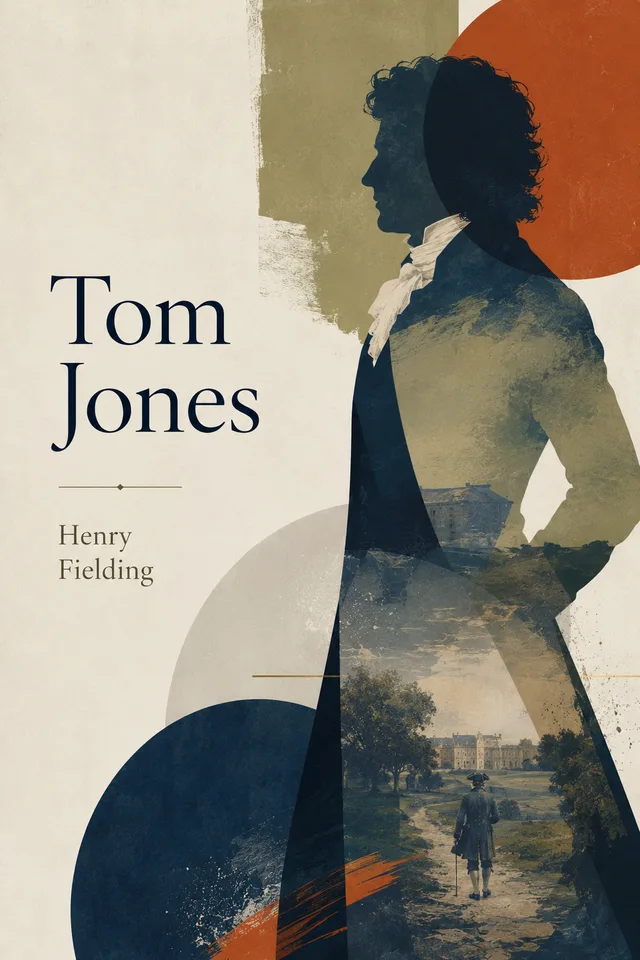
Tom Jones
BooksWhale-Ausgabe auf Englisch von Henry Fielding
Originaltitel: The History of Tom Jones, a Foundling
A comic English novel of youth, love, mistaken judgment, and social satire.
- Vorschau
- Auszug aus dem vorbereiteten Text
- Formate
- Online-Reader, EPUB, PDF
- Zugriff
- Bibliotheks-Claim
Bucheinführung
Tom Jones
Tom Jones follows a generous but impulsive young man through romance, exile, temptation, and comic misunderstanding. Fielding’s novel is one of the great achievements of eighteenth-century fiction.
BooksWhale-Ausgabe
Wie diese Ausgabe vorbereitet wurde
Diese Ausgabe basiert auf einem gemeinfreien Text und wurde von BooksWhale für digitales Lesen vorbereitet.
Public-Domain-Grundlage
Warum diese Ausgabe geteilt werden kann
Henry Fielding died in 1754, and Tom Jones was first published in 1749; these dates support the public-domain basis for this English edition.
Vorschau lesen
Auszug aus dem vorbereiteten Text
Vorschau aus dem vorbereiteten Lesetext.
VorschaukapitelFull textVorschau lesen
The History of Tom Jones, a Foundling
By Henry Fielding
VorschaukapitelDEDICATIONVorschau
To the Honourable
GEORGE LYTTLETON, ESQ;
One of the Lords Commissioners of the Treasury.
Sir,
Notwithstanding your constant refusal, when I have asked leave to prefix your name to this dedication, I must still insist on my right to desire your protection of this work.
To you, Sir, it is owing that this history was ever begun. It was by your desire that I first thought of such a composition. So many years have since past, that you may have, perhaps, forgotten this circumstance: but your desires are to me in the nature of commands; and the impression of them is never to be erased from my memory.
Again, Sir, without your assistance this history had never been completed. Be not startled at the assertion. I do not intend to draw on you the suspicion of being a romance writer. I mean no more than that I partly owe to you my existence during great part of the time which I have employed in composing it: another matter which it may be necessary to remind you of; since there are certain actions of which you are apt to be extremely forgetful; but of these I hope I shall always have a better memory than yourself.
Lastly, It is owing to you that the history appears what it now is. If there be in this work, as some have been pleased to say, a stronger picture of a truly benevolent mind than is to be found in any other, who that knows you, and a particular acquaintance of yours, will doubt whence that benevolence hath been copied? The world will not, I believe, make me the compliment of thinking I took it from myself. I care not: this they shall own, that the two persons from whom I have taken it, that is to say, two of the best and worthiest men in the world, are strongly and zealously my friends. I might be contented with this, and yet my vanity will add a third to the number; and him one of the greatest and noblest, not only in his rank, but in every public and private virtue. But here, whilst my gratitude for the princely benefactions of the Duke of Bedford bursts from my heart, you must forgive my reminding you that it was you who first recommended me to the notice of my benefactor.
And what are your objections to the allowance of the honour which I have sollicited? Why, you have commended the book so warmly, that you should be ashamed of reading your name before the dedication. Indeed, sir, if the book itself doth not make you ashamed of your commendations, nothing that I can here write will, or ought. I am not to give up my right to your protection and patronage, because you have commended my book: for though I acknowledge so many obligations to you, I do not add this to the number; in which friendship, I am convinced, hath so little share: since that can neither biass your judgment, nor pervert your integrity. An enemy may at any time obtain your commendation by only deserving it; and the utmost which the faults of your friends can hope for, is your silence; or, perhaps, if too severely accused, your gentle palliation.
In short, sir, I suspect, that your dislike of public praise is your true objection to granting my request. I have observed that you have, in common with my two other friends, an unwillingness to hear the least mention of your own virtues; that, as a great poet says of one of you, (he might justly have said it of all three), you
Do good by stealth, and blush to find it fame.
If men of this disposition are as careful to shun applause, as others are to escape censure, how just must be your apprehension of your character falling into my hands; since what would not a man have reason to dread, if attacked by an author who had received from him injuries equal to my obligations to you!
VorschaukapitelBOOK I. — CONTAINING AS MUCH OF THE BIRTH OF THE FOUNDLING AS IS NECESSARY OR PROPER TO ACQUAINT THE READER WITH IN THE BEGINNING OF THIS HISTORY.Vorschau
BOOK I. — CONTAINING AS MUCH OF THE BIRTH OF THE FOUNDLING AS IS NECESSARY OR PROPER TO ACQUAINT THE READER WITH IN THE BEGINNING OF THIS HISTORY.
Inhaltsverzeichnis
In dieser Ausgabe
- 01Full text
- 02DEDICATION
- 03BOOK I. — CONTAINING AS MUCH OF THE BIRTH OF THE FOUNDLING AS IS NECESSARY OR PROPER TO ACQUAINT THE READER WITH IN THE BEGINNING OF THIS HISTORY.
- 04Chapter i. — The introduction to the work, or bill of fare to the feast.
- 05Chapter ii. — A short description of squire Allworthy, and a fuller account of Miss Bridget Allworthy, his sister.
- 06Chapter iii. — An odd accident which befel Mr Allworthy at his return home. The decent behaviour of Mrs Deborah Wilkins, with some proper animadversions on bastards.
- 07Chapter iv. — The reader's neck brought into danger by a description; his escape; and the great condescension of Miss Bridget Allworthy.
- 08Chapter v. — Containing a few common matters, with a very uncommon observation upon them.
- 09Chapter vi. — Mrs Deborah is introduced into the parish with a simile. A short account of Jenny Jones, with the difficulties and discouragements which may attend young women in the pursuit of learning.
- 10Chapter vii. — Containing such grave matter, that the reader cannot laugh once through the whole chapter, unless peradventure he should laugh at the author.
- 11Chapter viii. — A dialogue between Mesdames Bridget and Deborah; containing more amusement, but less instruction, than the former.
- 12Chapter ix. — Containing matters which will surprize the reader.
- 13Chapter x. — The hospitality of Allworthy; with a short sketch of the characters of two brothers, a doctor and a captain, who were entertained by that gentleman.
- 14Chapter xi. — Containing many rules, and some examples, concerning falling in love: descriptions of beauty, and other more prudential inducements to matrimony.
- 15Chapter xii. — Containing what the reader may, perhaps, expect to find in it.
- 16Chapter xiii. — Which concludes the first book; with an instance of ingratitude, which, we hope, will appear unnatural.
- 17BOOK II. — CONTAINING SCENES OF MATRIMONIAL FELICITY IN DIFFERENT DEGREES OF LIFE; AND VARIOUS OTHER TRANSACTIONS DURING THE FIRST TWO YEARS AFTER THE MARRIAGE BETWEEN CAPTAIN BLIFIL AND MISS BRIDGET ALLWORTHY.
- 18Chapter i. — Showing what kind of a history this is; what it is like, and what it is not like.
- 19Chapter ii. — Religious cautions against showing too much favour to bastards; and a great discovery made by Mrs Deborah Wilkins.
- 20Chapter iii. — The description of a domestic government founded upon rules directly contrary to those of Aristotle.
- 21Chapter iv. — Containing one of the most bloody battles, or rather duels, that were ever recorded in domestic history.
- 22Chapter v. — Containing much matter to exercise the judgment and reflection of the reader.
- 23Chapter vi. — The trial of Partridge, the schoolmaster, for incontinency; the evidence of his wife; a short reflection on the wisdom of our law; with other grave matters, which those will like best who understand them most.
- 24Chapter vii. — A short sketch of that felicity which prudent couples may extract from hatred: with a short apology for those people who overlook imperfections in their friends.
- 25Chapter viii. — A receipt to regain the lost affections of a wife, which hath never been known to fail in the most desperate cases.
- 26Chapter ix. — A proof of the infallibility of the foregoing receipt, in the lamentations of the widow; with other suitable decorations of death, such as physicians, &c., and an epitaph in the true stile.
- 27BOOK III. — CONTAINING THE MOST MEMORABLE TRANSACTIONS WHICH PASSED IN THE FAMILY OF MR ALLWORTHY, FROM THE TIME WHEN TOMMY JONES ARRIVED AT THE AGE OF FOURTEEN, TILL HE ATTAINED THE AGE OF NINETEEN. IN THIS BOOK THE READER MAY PICK UP SOME HINTS CONCERNING THE EDUCATION OF CHILDREN.
- 28Chapter i. — Containing little or nothing.
- 29Chapter ii. — The heroe of this great history appears with very bad omens. A little tale of so LOW a kind that some may think it not worth their notice. A word or two concerning a squire, and more relating to a gamekeeper and a schoolmaster.
- 30Chapter iii. — The character of Mr Square the philosopher, and of Mr Thwackum the divine; with a dispute concerning----
- 31Chapter iv. — Containing a necessary apology for the author; and a childish incident, which perhaps requires an apology likewise.
- 32Chapter v. — The opinions of the divine and the philosopher concerning the two boys; with some reasons for their opinions, and other matters.
- 33Chapter vi. — Containing a better reason still for the before-mentioned opinions.
- 34Chapter vii. — In which the author himself makes his appearance on the stage.
- 35Chapter viii. — A childish incident, in which, however, is seen a good-natured disposition in Tom Jones.
- 36Chapter ix. — Containing an incident of a more heinous kind, with the comments of Thwackum and Square.
- 37Chapter x. — In which Master Blifil and Jones appear in different lights.
- 38BOOK IV. — CONTAINING THE TIME OF A YEAR.
- 39Chapter i. — Containing five pages of paper.
- 40Chapter ii. — A short hint of what we can do in the sublime, and a description of Miss Sophia Western.
- 41Chapter iii. — Wherein the history goes back to commemorate a trifling incident that happened some years since; but which, trifling as it was, had some future consequences.
- 42Chapter iv. — Containing such very deep and grave matters, that some readers, perhaps, may not relish it.
- 43Chapter v. — Containing matter accommodated to every taste.
- 44Chapter vi. — An apology for the insensibility of Mr Jones to all the charms of the lovely Sophia; in which possibly we may, in a considerable degree, lower his character in the estimation of those men of wit and gallantry who approve the heroes in most of our modern comedies.
- 45Chapter vii. — Being the shortest chapter in this book.
- 46Chapter viii. — A battle sung by the muse in the Homerican style, and which none but the classical reader can taste.
- 47Chapter ix. — Containing matter of no very peaceable colour.
- 48Chapter x. — A story told by Mr Supple, the curate. The penetration of Squire Western. His great love for his daughter, and the return to it made by her.
- 49Chapter xi. — The narrow escape of Molly Seagrim, with some observations for which we have been forced to dive pretty deep into nature.
- 50Chapter xii. — Containing much clearer matters; but which flowed from the same fountain with those in the preceding chapter.
- 51Chapter xiii. — A dreadful accident which befel Sophia. The gallant behaviour of Jones, and the more dreadful consequence of that behaviour to the young lady; with a short digression in favour of the female sex.
- 52Chapter xiv. — The arrival of a surgeon.--His operations, and a long dialogue between Sophia and her maid.
- 53BOOK V. — CONTAINING A PORTION OF TIME SOMEWHAT LONGER THAN HALF A YEAR.
- 54Chapter i. — Of the SERIOUS in writing, and for what purpose it is introduced.
- 55Chapter ii. — In which Mr Jones receives many friendly visits during his confinement; with some fine touches of the passion of love, scarce visible to the naked eye.
- 56Chapter iii. — Which all who have no heart will think to contain much ado about nothing.
- 57Chapter iv. — A little chapter, in which is contained a little incident.
- 58Chapter v. — A very long chapter, containing a very great incident.
- 59Chapter vi. — By comparing which with the former, the reader may possibly correct some abuse which he hath formerly been guilty of in the application of the word love.
- 60Chapter vii. — In which Mr Allworthy appears on a sick-bed.
- 61Chapter viii. — Containing matter rather natural than pleasing.
- 62Chapter ix. — Which, among other things, may serve as a comment on that saying of Aeschines, that “drunkenness shows the mind of a man, as a mirrour reflects his person.”
- 63Chapter x. — Showing the truth of many observations of Ovid, and of other more grave writers, who have proved beyond contradiction, that wine is often the forerunner of incontinency.
- 64Chapter xi. — In which a simile in Mr Pope's period of a mile introduces as bloody a battle as can possibly be fought without the assistance of steel or cold iron.
- 65Chapter xii. — In which is seen a more moving spectacle than all the blood in the bodies of Thwackum and Blifil, and of twenty other such, is capable of producing.
- 66BOOK VI. — CONTAINING ABOUT THREE WEEKS.
- 67Chapter i. — Of love.
- 68Chapter ii. — The character of Mrs Western. Her great learning and knowledge of the world, and an instance of the deep penetration which she derived from those advantages.
- 69Chapter iii. — Containing two defiances to the critics.
- 70Chapter iv. — Containing sundry curious matters.
- 71Chapter v. — In which is related what passed between Sophia and her aunt.
- 72Chapter vi. — Containing a dialogue between Sophia and Mrs Honour, which may a little relieve those tender affections which the foregoing scene may have raised in the mind of a good-natured reader.
- 73Chapter vii. — A picture of formal courtship in miniature, as it always ought to be drawn, and a scene of a tenderer kind painted at full length.
- 74Chapter viii. — The meeting between Jones and Sophia.
- 75Chapter ix. — Being of a much more tempestuous kind than the former.
- 76Chapter x. — In which Mr Western visits Mr Allworthy.
- 77Chapter xi. — A short chapter; but which contains sufficient matter to affect the good-natured reader.
- 78Chapter xii. — Containing love-letters, &c.
- 79Chapter xiii. — The behaviour of Sophia on the present occasion; which none of her sex will blame, who are capable of behaving in the same manner. And the discussion of a knotty point in the court of conscience.
- 80Chapter xiv. — A short chapter, containing a short dialogue between Squire Western and his sister.
- 81BOOK VII. — CONTAINING THREE DAYS.
- 82Chapter i. — A comparison between the world and the stage.
- 83Chapter ii. — Containing a conversation which Mr Jones had with himself.
- 84Chapter iii. — Containing several dialogues.
- 85Chapter iv. — A picture of a country gentlewoman taken from the life.
- 86Chapter v. — The generous behaviour of Sophia towards her aunt.
- 87Chapter vi. — Containing great variety of matter.
- 88Chapter vii. — A strange resolution of Sophia, and a more strange stratagem of Mrs Honour.
- 89Chapter viii. — Containing scenes of altercation, of no very uncommon kind.
- 90Chapter ix. — The wise demeanour of Mr Western in the character of a magistrate. A hint to justices of peace, concerning the necessary qualifications of a clerk; with extraordinary instances of paternal madness and filial affection.
- 91Chapter x. — Containing several matters, natural enough perhaps, but low.
- 92Chapter xi. — The adventure of a company of soldiers.
- 93Chapter xii. — The adventure of a company of officers.
- 94Chapter xiii. — Containing the great address of the landlady, the great learning of a surgeon, and the solid skill in casuistry of the worthy lieutenant.
- 95Chapter xiv. — A most dreadful chapter indeed; and which few readers ought to venture upon in an evening, especially when alone.
- 96Chapter xv. — The conclusion of the foregoing adventure.
- 97BOOK VIII. — CONTAINING ABOUT TWO DAYS.
- 98Chapter i. — A wonderful long chapter concerning the marvellous; being much the longest of all our introductory chapters.
- 99Chapter ii. — In which the landlady pays a visit to Mr Jones.
- 100Chapter iii. — In which the surgeon makes his second appearance.
- 101Chapter iv. — In which is introduced one of the pleasantest barbers that was ever recorded in history, the barber of Bagdad, or he in Don Quixote, not excepted.
- 102Chapter v. — A dialogue between Mr Jones and the barber.
- 103Chapter vi. — In which more of the talents of Mr Benjamin will appear, as well as who this extraordinary person was.
- 104Chapter vii. — Containing better reasons than any which have yet appeared for the conduct of Partridge; an apology for the weakness of Jones; and some further anecdotes concerning my landlady.
- 105Chapter viii. — Jones arrives at Gloucester, and goes to the Bell; the character of that house, and of a petty-fogger which he there meets with.
- 106Chapter ix. — Containing several dialogues between Jones and Partridge, concerning love, cold, hunger, and other matters; with the lucky and narrow escape of Partridge, as he was on the very brink of making a fatal discovery to his friend.
- 107Chapter x. — In which our travellers meet with a very extraordinary adventure.
- 108Chapter xi. — In which the Man of the Hill begins to relate his history.
- 109Chapter xii. — In which the Man of the Hill continues his history.
- 110Chapter xiii. — In which the foregoing story is farther continued.
- 111Chapter xiv. — In which the Man of the Hill concludes his history.
- 112Chapter xv. — A brief history of Europe; and a curious discourse between Mr Jones and the Man of the Hill.
- 113BOOK IX. — CONTAINING TWELVE HOURS.
- 114Chapter i. — Of those who lawfully may, and of those who may not, write such histories as this.
- 115Chapter ii. — Containing a very surprizing adventure indeed, which Mr Jones met with in his walk with the Man of the Hill.
- 116Chapter iii. — The arrival of Mr Jones with his lady at the inn; with a very full description of the battle of Upton.
- 117Chapter iv. — In which the arrival of a man of war puts a final end to hostilities, and causes the conclusion of a firm and lasting peace between all parties.
- 118Chapter v. — An apology for all heroes who have good stomachs, with a description of a battle of the amorous kind.
- 119Chapter vi. — A friendly conversation in the kitchen, which had a very common, though not very friendly, conclusion.
- 120Chapter vii. — Containing a fuller account of Mrs Waters, and by what means she came into that distressful situation from which she was rescued by Jones.
- 121BOOK X. — IN WHICH THE HISTORY GOES FORWARD ABOUT TWELVE HOURS.
- 122Chapter i. — Containing instructions very necessary to be perused by modern critics.
- 123Chapter ii. — Containing the arrival of an Irish gentleman, with very extraordinary adventures which ensued at the inn.
- 124Chapter iii. — A dialogue between the landlady and Susan the chamber-maid, proper to be read by all inn-keepers and their servants; with the arrival, and affable behaviour of a beautiful young lady; which may teach persons of condition how they may acquire the love of the whole world.
- 125Chapter iv. — Containing infallible nostrums for procuring universal disesteem and hatred.
- 126Chapter v. — Showing who the amiable lady, and her unamiable maid, were.
- 127Chapter vi. — Containing, among other things, the ingenuity of Partridge, the madness of Jones, and the folly of Fitzpatrick.
- 128Chapter vii. — In which are concluded the adventures that happened at the inn at Upton.
- 129Chapter viii. — In which the history goes backward.
- 130Chapter ix. — The escape of Sophia.
- 131BOOK XI. — CONTAINING ABOUT THREE DAYS.
- 132Chapter i. — A crust for the critics.
- 133Chapter ii. — The adventures which Sophia met with after her leaving Upton.
- 134Chapter iii. — A very short chapter, in which however is a sun, a moon, a star, and an angel.
- 135Chapter iv. — The history of Mrs Fitzpatrick.
- 136Chapter v. — In which the history of Mrs Fitzpatrick is continued.
- 137Chapter vi. — In which the mistake of the landlord throws Sophia into a dreadful consternation.
- 138Chapter vii. — In which Mrs Fitzpatrick concludes her history.
- 139Chapter viii. — A dreadful alarm in the inn, with the arrival of an unexpected friend of Mrs Fitzpatrick.
- 140Chapter ix. — The morning introduced in some pretty writing. A stagecoach. The civility of chambermaids. The heroic temper of Sophia. Her generosity. The return to it. The departure of the company, and their arrival at London; with some remarks for the use of travellers.
- 141Chapter x. — Containing a hint or two concerning virtue, and a few more concerning suspicion.
- 142BOOK XII. — CONTAINING THE SAME INDIVIDUAL TIME WITH THE FORMER.
- 143Chapter i. — Showing what is to be deemed plagiarism in a modern author, and what is to be considered as lawful prize.
- 144Chapter ii. — In which, though the squire doth not find his daughter, something is found which puts an end to his pursuit.
- 145Chapter iii. — The departure of Jones from Upton, with what passed between him and Partridge on the road.
- 146Chapter iv. — The adventure of a beggar-man.
- 147Chapter v. — Containing more adventures which Mr Jones and his companion met on the road.
- 148Chapter vi. — From which it may be inferred that the best things are liable to be misunderstood and misinterpreted.
- 149Chapter vii. — Containing a remark or two of our own and many more of the good company assembled in the kitchen.
- 150Chapter viii. — In which fortune seems to have been in a better humour with Jones than we have hitherto seen her.
- 151Chapter ix. — Containing little more than a few odd observations.
- 152Chapter x. — In which Mr Jones and Mr Dowling drink a bottle together.
- 153Chapter xi. — The disasters which befel Jones on his departure for Coventry; with the sage remarks of Partridge.
- 154Chapter xii. — Relates that Mr Jones continued his journey, contrary to the advice of Partridge, with what happened on that occasion.
- 155Chapter xiii. — A dialogue between Jones and Partridge.
- 156Chapter xiv. — What happened to Mr Jones in his journey from St Albans.
- 157BOOK XIII. — CONTAINING THE SPACE OF TWELVE DAYS.
- 158Chapter i. — An Invocation.
- 159Chapter ii. — What befel Mr Jones on his arrival in London.
- 160Chapter iii. — A project of Mrs Fitzpatrick, and her visit to Lady Bellaston.
- 161Chapter iv. — Which consists of visiting.
- 162Chapter v. — An adventure which happened to Mr Jones at his lodgings, with some account of a young gentleman who lodged there, and of the mistress of the house, and her two daughters.
- 163Chapter vi. — What arrived while the company were at breakfast, with some hints concerning the government of daughters.
- 164Chapter vii. — Containing the whole humours of a masquerade.
- 165Chapter viii. — Containing a scene of distress, which will appear very extraordinary to most of our readers.
- 166Chapter ix. — Which treats of matters of a very different kind from those in the preceding chapter.
- 167Chapter x. — A chapter which, though short, may draw tears from some eyes.
- 168Chapter xi. — In which the reader will be surprized.
- 169Chapter xii. — In which the thirteenth book is concluded.
- 170BOOK XIV. — CONTAINING TWO DAYS.
- 171Chapter i. — An essay to prove that an author will write the better for having some knowledge of the subject on which he writes.
- 172Chapter ii. — Containing letters and other matters which attend amours.
- 173Chapter iii. — Containing various matters.
- 174Chapter iv. — Which we hope will be very attentively perused by young people of both sexes.
- 175Chapter v. — A short account of the history of Mrs Miller.
- 176Chapter vi. — Containing a scene which we doubt not will affect all our readers.
- 177Chapter vii. — The interview between Mr Jones and Mr Nightingale.
- 178Chapter viii. — What passed between Jones and old Mr Nightingale; with the arrival of a person not yet mentioned in this history.
- 179Chapter ix. — Containing strange matters.
- 180Chapter x. — A short chapter, which concludes the book.
- 181BOOK XV. — IN WHICH THE HISTORY ADVANCES ABOUT TWO DAYS.
- 182Chapter i. — Too short to need a preface.
- 183Chapter ii. — In which is opened a very black design against Sophia.
- 184Chapter iii. — A further explanation of the foregoing design.
- 185Chapter iv. — By which it will appear how dangerous an advocate a lady is when she applies her eloquence to an ill purpose.
- 186Chapter v. — Containing some matters which may affect, and others which may surprize, the reader.
- 187Chapter vi. — By what means the squire came to discover his daughter.
- 188Chapter vii. — In which various misfortunes befel poor Jones.
- 189Chapter viii. — Short and sweet.
- 190Chapter ix. — Containing love-letters of several sorts.
- 191Chapter x. — Consisting partly of facts, and partly of observations upon them.
- 192Chapter xi. — Containing curious, but not unprecedented matter.
- 193Chapter xii. — A discovery made by Partridge.
- 194BOOK XVI. — CONTAINING THE SPACE OF FIVE DAYS.
- 195Chapter i. — Of prologues.
- 196Chapter ii. — A whimsical adventure which befel the squire, with the distressed situation of Sophia.
- 197Chapter iii. — What happened to Sophia during her confinement.
- 198Chapter iv. — In which Sophia is delivered from her confinement.
- 199Chapter v. — In which Jones receives a letter from Sophia, and goes to a play with Mrs Miller and Partridge.
- 200Chapter vi. — In which the history is obliged to look back.
- 201Chapter vii. — In which Mr Western pays a visit to his sister, in company with Mr Blifil.
- 202Chapter viii. — Schemes of Lady Bellaston for the ruin of Jones.
- 203Chapter ix. — In which Jones pays a visit to Mrs Fitzpatrick.
- 204Chapter x. — The consequence of the preceding visit.
- 205BOOK XVII. — CONTAINING THREE DAYS.
- 206Chapter i. — Containing a portion of introductory writing.
- 207Chapter ii. — The generous and grateful behaviour of Mrs Miller.
- 208Chapter iii. — The arrival of Mr Western, with some matters concerning the paternal authority.
- 209Chapter iv. — An extraordinary scene between Sophia and her aunt.
- 210Chapter v. — Mrs Miller and Mr Nightingale visit Jones in the prison.
- 211Chapter vi. — In which Mrs Miller pays a visit to Sophia.
- 212Chapter vii. — A pathetic scene between Mr Allworthy and Mrs Miller.
- 213Chapter viii. — Containing various matters.
- 214Chapter ix. — What happened to Mr Jones in the prison.
- 215BOOK XVIII. — CONTAINING ABOUT SIX DAYS.
- 216Chapter i. — A farewel to the reader.
- 217Chapter ii. — Containing a very tragical incident.
- 218Chapter iii. — Allworthy visits old Nightingale; with a strange discovery that he made on that occasion.
- 219Chapter iv. — Containing two letters in very different stiles.
- 220Chapter v. — In which the history is continued.
- 221Chapter vi. — In which the history is farther continued
- 222Chapter vii. — Continuation of the history.
- 223Chapter viii. — Further continuation.
- 224Chapter ix. — A further continuation.
- 225Chapter x. — Wherein the history begins to draw towards a conclusion.
- 226Chapter xi. — The history draws nearer to a conclusion.
- 227Chapter xii. — Approaching still nearer to the end.
- 228Chapter the last. — In which the history is concluded.
Sprachverfügbarkeit
Andere Sprachen
Weitere Sprachausgaben sind noch nicht veröffentlicht. Sobald verfügbar, werden sie hier verlinkt.
Andere Sprache anfragen