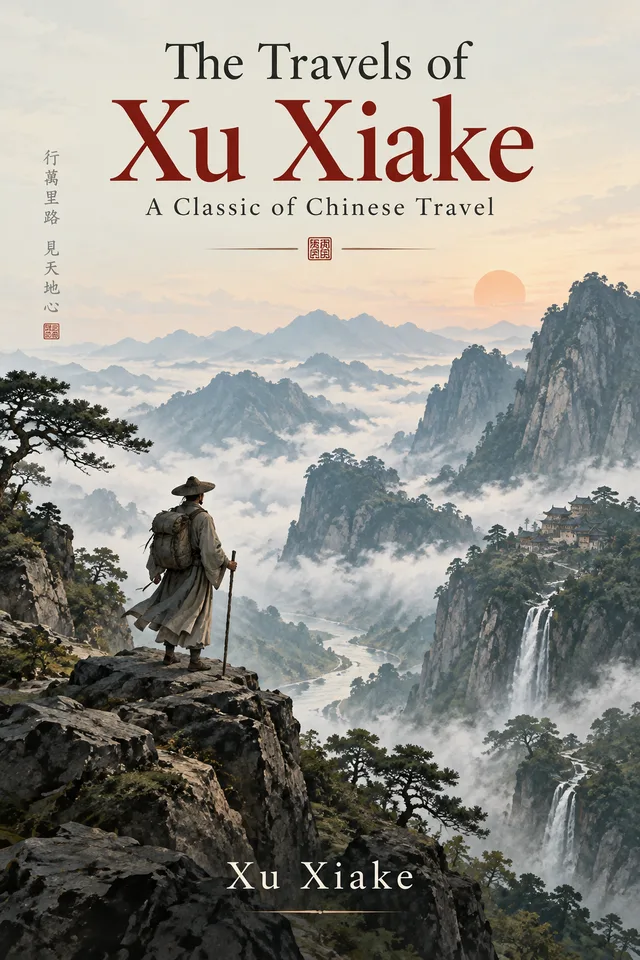
Englisch Ausgabe
Geschichte
The Travels of Xu Xiake: A Classic of Chinese Travel
BooksWhale-Ausgabe auf Englisch von 徐霞客
Originaltitel: 徐霞客游记
A journey across China’s mountains, rivers, caves, roads, and changing landscapes.
- Vorschau
- Auszug aus dem vorbereiteten Text
- Formate
- Online-Reader, EPUB, PDF
- Zugriff
- Bibliotheks-Claim
Bucheinführung
The Travels of Xu Xiake: A Classic of Chinese Travel
Xu Xiake records close observations of terrain, waterways, geology, local communities, temples, and travel conditions. This English edition presents his curiosity as both geographic investigation and literary adventure.
BooksWhale-Ausgabe
Wie diese Ausgabe vorbereitet wurde
Diese Ausgabe basiert auf einem gemeinfreien Text und wurde von BooksWhale für digitales Lesen vorbereitet.
Public-Domain-Grundlage
Warum diese Ausgabe geteilt werden kann
Xu Xiake died in 1641 and the Chinese source text is public domain; this edition is an AI-assisted, BooksWhale translation.
Vorschau lesen
Auszug aus dem vorbereiteten Text
Vorschau aus dem vorbereiteten Lesetext.
VorschaukapitelFull textVorschau lesen
The Travels of Xu Xiake: A Classic of Chinese Travel
Xu Xiake
VorschaukapitelDiary of a Journey to Mount Yandang — Part 1Vorschau
On the ninth day of the fourth month, I took leave of Mount Tiantai, and on the tenth reached Huangyan County. The sun was already setting. Leaving by the southern gate, I walked thirty li and lodged at Ba’ao.
On the eleventh, after twenty li, I climbed Panshan Ridge. From afar I saw the peaks of Mount Yandang thrusting like lotus blossoms into the blue sky, one after another seeming to press upon one’s brows. After another twenty li, I ate at Dajing Station. Crossing a stream to the south, I saw on the western peak a few rounded rocks. My servants thought they were two wandering monks, while I suspected that they might be Old Monk Rock, though they did not quite resemble it. Five li farther on, after passing Zhangjialou, I finally saw the true appearance of Old Monk Rock: robed in a monk’s cassock, bald-headed, and standing upright with lifelike realism, about a hundred feet high. Beside it was a small child bending forward behind him, previously hidden by the old monk.
Two li beyond Zhangjialou, halfway up the mountain, I found Shiliang Cave. The entrance faced east. Before it, a bridge-like rock slanted down from the summit to the ground, like a flying rainbow drooping from the sky. From a crack beside the stone bridge, I climbed step by step along stone stairs. Above, the space opened wide and spacious. After sitting there for a while, I descended.
From the foothills on the right I crossed Xiegong Ridge, forded a mountain stream, and followed it westward toward Lingfeng. As soon as I rounded the mountainside, sheer cliffs rose on both sides and stretched across the sky. Lofty, precipitous peaks crowded and overlapped in disorder: some seemed cut by knives, some like clusters of flowers, some like upright bamboo shoots, some like erect lingzhi fungi, some like standing brushes, and some like tilted headscarves. Some cave mouths resembled rolled-up curtains; some pools were as green as clear indigo. Twin Phoenix Peaks and the Five Elders Peaks stood shoulder to shoulder like paired wings.
After a little more than one li I reached Lingfeng Temple. From beside the temple I climbed to Lingfeng Cave. Lingfeng itself is hollow within and stands alone behind the temple, with a crevice at the side through which one may enter. Following several dozen stone steps through the crevice, I reached the top of the hollow. Deep inside was a broad circular platform containing many statues of arhats. I sat admiring the scenery until dusk, then returned to the temple.
On the twelfth, after eating, I descended from the foot of the mountain to the right of Lingfeng in search of Bixiao Cave. Retracing my route, I reached the foot of Xiegong Ridge. Going south past Xiangyan for five li, I came to the road leading to Jingming Temple. Entering the mountains in search of Water-Curtain Valley, I found two cliffs enclosing a gorge, with water drifting down from the tops of the cliffs.
Leaving Water-Curtain Valley and going another five li, I came to Lingyan Temple. Sheer cliffs enclosed it on all four sides, brushing the sky and cleaving the earth. Winding inward, one seemed to enter an entirely different and vast world. The temple stood within, facing south, with Pingxia Cliff behind it. The top of Pingxia Cliff was level and purple in color, rising several hundred zhang, its breadth proportionate to its height.
At the southern end of Pingxia Cliff, Zhanqi Peak stood on the left and Tianzhu Peak on the right. On the right side of Pingxia Cliff, between it and Tianzhu Peak, the first wonder is Dragon-Nose Water. The cave from which the water issues extends upward through a crevice in the rock, resembling Lingfeng Cave but smaller. The stones inside are all yellowish purple, except at the fissure, where a streak of rock is blue and red, lustrous in color and somewhat shaped like a dragon’s scales and claws. This streak runs continuously from the roof to the floor of the cave, and its hanging end resembles a dragon’s nose. At the tip of the nose is a hole large enough to admit a finger; water drips from it into a stone basin. This is the foremost marvel on the right side of Pingxia Cliff.
VorschaukapitelDiary of a Journey to Mount Huang — Part 1Vorschau
On the second day of the second month, I descended from Baiyue Mountain. After ten li, I followed the foot of the mountain westward and reached Nanxi Bridge. Crossing the main stream, I followed another stream northward close along the mountain foot.
After another ten li, the mountains on both sides rose steeply and closed in like a gate, constraining the stream. Crossing the pass and descending, I entered a broad expanse of open fields. After twenty li came Zhukeng. From there I took a small path up Tiger Ridge. The road was extremely steep. Ten li brought me to the top of the ridge, and five more took me over and down to its foot.
Looking far northward, I could see the clustered peaks of Mount Huang, seemingly close enough to bend down and pick up. Three li farther was Gulou’ao. The stream there was very broad and swollen, with no bridge. Planks were laid here and there across its entire width, and fording it was extremely difficult. Two li farther on, I lodged at Gaoqiao.
On the third, I traveled together with woodcutters for a long time, crossing two successive ridges. We descended and climbed again, then crossed another ridge. Both were extremely steep and together were called the Twin Ridges.
After fifteen li we passed Jiangcun. Twenty li farther brought us to Tangkou, where the streams from Xiangxi and the hot springs flow out of the mountains. Turning inward toward the mountains, we followed a stream gradually upward, while snow nearly covered our feet.
After five li we reached Xiangfu Temple. The hot spring lay just across the stream, so we all stripped off our clothes and jumped into the hot pool. In front, the pool faced the stream; behind, it pressed against a rock wall. Three sides were built with stone, while an overhanging rock curved above like a bridge.
The hot water was three feet deep. The congealed cold air had not yet dispersed, yet steam rose warmly from the pool, and bubbles gurgled upward from the bottom. The warm vapor itself possessed a faint fragrance.
Huang Zhenfu thought this spring inferior to the one at Panshan, because Tangkou and Jiaocun lay on major routes and too many people of every sort came to bathe there.
After bathing we returned to the temple. The monk Huiyin led us toward Lotus Hermitage. Treading through accumulated snow, we followed the ravine upward. The stream bent three times, then plunged into a deep pool called White Dragon Pool. Higher up, water gathered among the rocks at a place called Cinnabar Well. Beside the well were projecting rocks called the “Medicine Mortar” and the “Medicine Kettle.”
Following the twists of the stream, we passed among peaks rising all around, with trees and rocks screening and revealing one another. After traveling in this way we saw a hermitage. The monk Yinyin had gone elsewhere, so we could not enter the worship hall. Its incense burner and racks for bell and drum were all made from natural old tree roots.
We then returned to Xiangfu Temple for the night.
On the fourth, I sat quietly all day, listening to the sound of snow sliding down.
On the fifth, heavy clouds covered the sky and the weather was very bad. I forced myself to remain in bed until noon. Huiyin said Ciguang Temple was nearby and ordered his disciple to guide me.
Passing the hot pool, I looked up and saw a cliff with a perilous little path hanging halfway up it, while springs poured down on both sides like white silk. I immediately began climbing there. The springs gleamed white, mist filled the air, and clouds swirled about the front and back of my robe.
Soon I turned to the right and saw a hermitage built entirely of thatch above and below. The sounds of bell and chime and curling incense smoke seemed to emerge through the rocks. This was Ciguang Temple, formerly called Cinnabar Hermitage.
Inhaltsverzeichnis
In dieser Ausgabe
- 01Full text
- 02Diary of a Journey to Mount Yandang — Part 1
- 03Diary of a Journey to Mount Huang — Part 1
- 04Diary of a Journey to Mount Huang — Part 2
- 05Diary of a Journey to Mount Yandang — Part 2
Sprachverfügbarkeit
Andere Sprachen
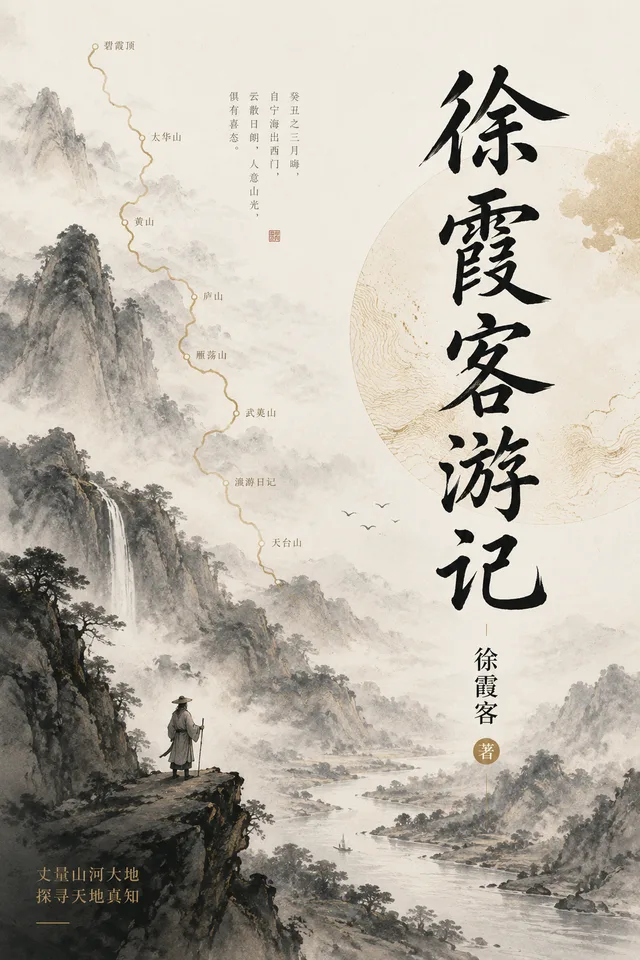
Chinesisch
Chinesisch Ausgabe
徐霞客游记
徐霞客 · Geschichte
徐霞客山川行旅、地理观察、水文记录与自然书写的中文原文经典。
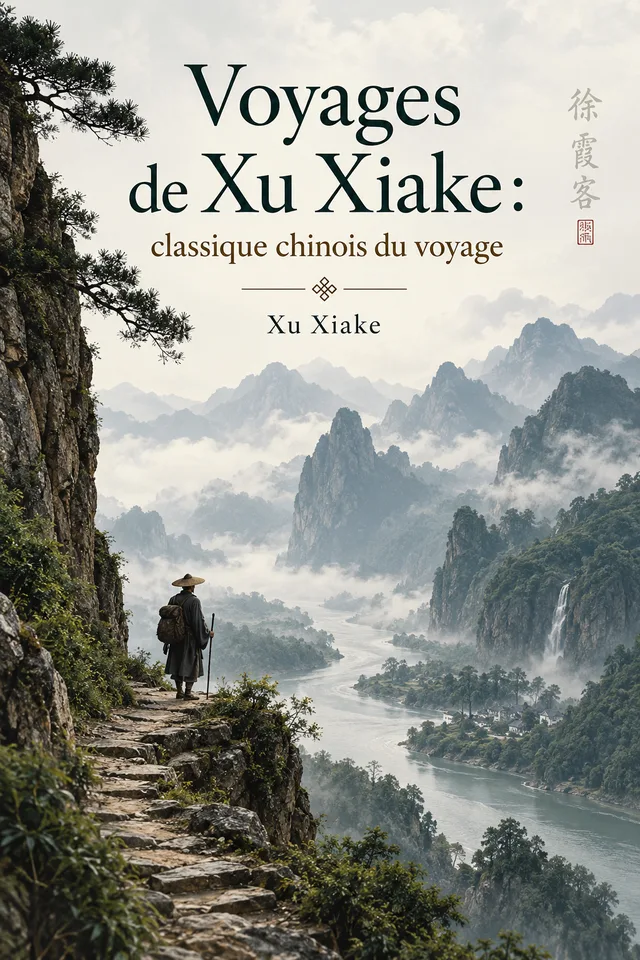
Französisch
Französisch Ausgabe
Voyages de Xu Xiake : classique chinois du voyage
徐霞客 · Geschichte
Les carnets d’un grand voyageur chinois, attentif aux montagnes, aux rivières, aux grottes et aux sociétés locales.
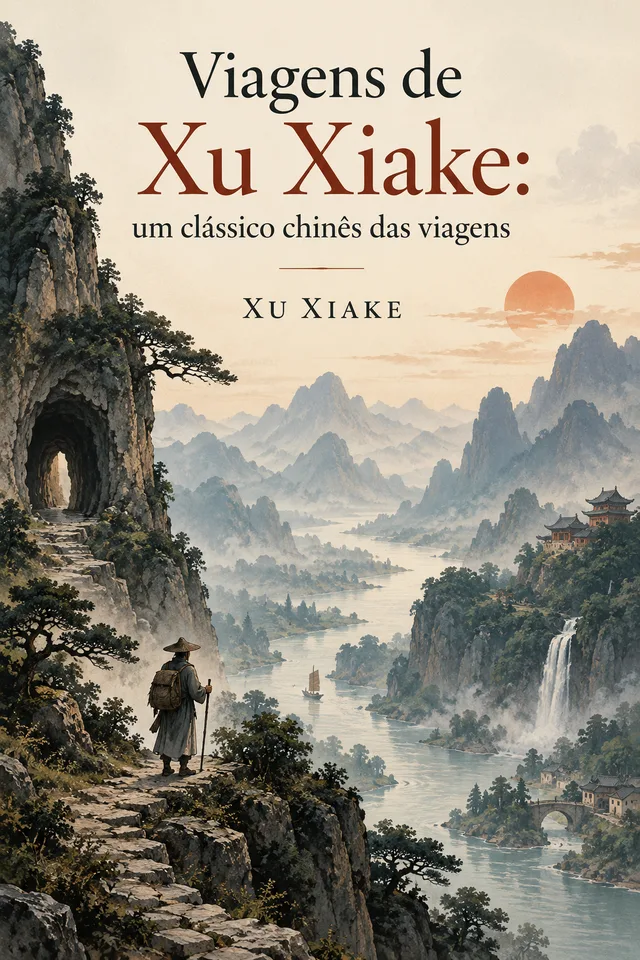
Portugiesisch
Portugiesisch Ausgabe
Viagens de Xu Xiake: um clássico chinês das viagens
徐霞客 · Geschichte
montanhas, rios, cavernas, geografia, templos e comunidades descritos por um grande viajante chinês.