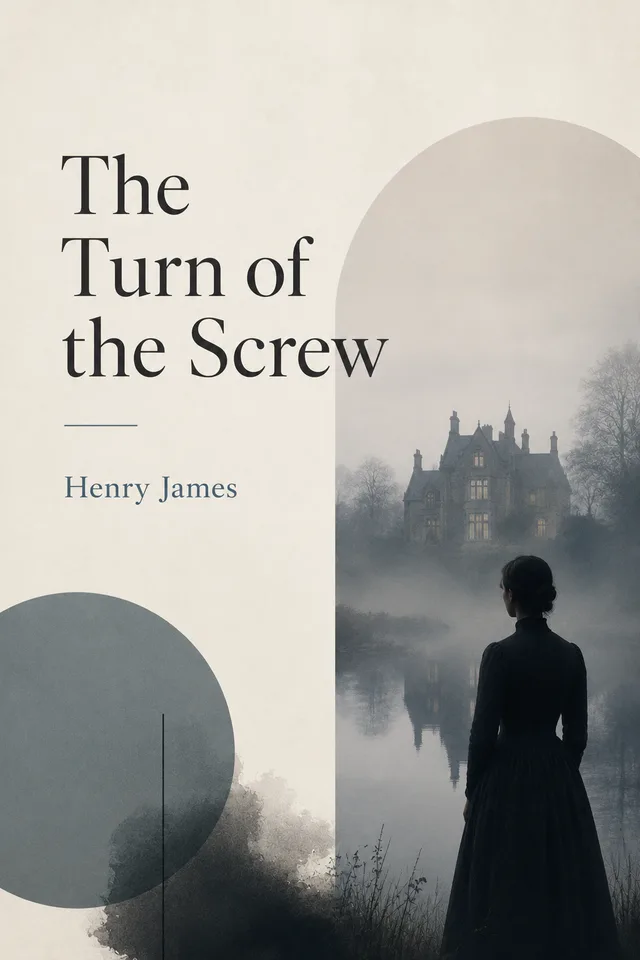
Englisch Ausgabe
Literatur
The Turn of the Screw
BooksWhale-Ausgabe auf Englisch von Henry James
A haunted and ambiguous novella of fear, perception, childhood, and psychological pressure.
- Vorschau
- Auszug aus dem vorbereiteten Text
- Formate
- Online-Reader, EPUB, PDF
- Zugriff
- Bibliotheks-Claim
Bucheinführung
The Turn of the Screw
The Turn of the Screw follows a governess whose care for two children becomes entangled with apparent apparitions and mounting uncertainty. Henry James turns ghost story conventions into a study of interpretation and dread.
BooksWhale-Ausgabe
Wie diese Ausgabe vorbereitet wurde
Diese Ausgabe basiert auf einem gemeinfreien Text und wurde von BooksWhale für digitales Lesen vorbereitet.
Public-Domain-Grundlage
Warum diese Ausgabe geteilt werden kann
Henry James died in 1916, and The Turn of the Screw was first published in 1898; these dates support the public-domain basis for this English edition.
Vorschau lesen
Auszug aus dem vorbereiteten Text
Vorschau aus dem vorbereiteten Lesetext.
VorschaukapitelFull textVorschau lesen
The Turn of the Screw
Henry James
VorschaukapitelThe Turn of the ScrewVorschau
The story had held us, round the fire, sufficiently breathless, but except the obvious remark that it was gruesome, as, on Christmas Eve in an old house, a strange tale should essentially be, I remember no comment uttered till somebody happened to say that it was the only case he had met in which such a visitation had fallen on a child. The case, I may mention, was that of an apparition in just such an old house as had gathered us for the occasion—an appearance, of a dreadful kind, to a little boy sleeping in the room with his mother and waking her up in the terror of it; waking her not to dissipate his dread and soothe him to sleep again, but to encounter also, herself, before she had succeeded in doing so, the same sight that had shaken him. It was this observation that drew from Douglas—not immediately, but later in the evening—a reply that had the interesting consequence to which I call attention. Someone else told a story not particularly effective, which I saw he was not following. This I took for a sign that he had himself something to produce and that we should only have to wait. We waited in fact till two nights later; but that same evening, before we scattered, he brought out what was in his mind.
“I quite agree—in regard to Griffin’s ghost, or whatever it was—that its appearing first to the little boy, at so tender an age, adds a particular touch. But it’s not the first occurrence of its charming kind that I know to have involved a child. If the child gives the effect another turn of the screw, what do you say to two children—?”
“We say, of course,” somebody exclaimed, “that they give two turns! Also that we want to hear about them.”
I can see Douglas there before the fire, to which he had got up to present his back, looking down at his interlocutor with his hands in his pockets. “Nobody but me, till now, has ever heard. It’s quite too horrible.” This, naturally, was declared by several voices to give the thing the utmost price, and our friend, with quiet art, prepared his triumph by turning his eyes over the rest of us and going on: “It’s beyond everything. Nothing at all that I know touches it.”
“For sheer terror?” I remember asking.
He seemed to say it was not so simple as that; to be really at a loss how to qualify it. He passed his hand over his eyes, made a little wincing grimace. “For dreadful—dreadfulness!”
“Oh, how delicious!” cried one of the women.
He took no notice of her; he looked at me, but as if, instead of me, he saw what he spoke of. “For general uncanny ugliness and horror and pain.”
“Well then,” I said, “just sit right down and begin.”
He turned round to the fire, gave a kick to a log, watched it an instant. Then as he faced us again: “I can’t begin. I shall have to send to town.” There was a unanimous groan at this, and much reproach; after which, in his preoccupied way, he explained. “The story’s written. It’s in a locked drawer—it has not been out for years. I could write to my man and enclose the key; he could send down the packet as he finds it.” It was to me in particular that he appeared to propound this—appeared almost to appeal for aid not to hesitate. He had broken a thickness of ice, the formation of many a winter; had had his reasons for a long silence. The others resented postponement, but it was just his scruples that charmed me. I adjured him to write by the first post and to agree with us for an early hearing; then I asked him if the experience in question had been his own. To this his answer was prompt. “Oh, thank God, no!”
VorschaukapitelIVorschau
I remember the whole beginning as a succession of flights and drops, a little seesaw of the right throbs and the wrong. After rising, in town, to meet his appeal, I had at all events a couple of very bad days—found myself doubtful again, felt indeed sure I had made a mistake. In this state of mind I spent the long hours of bumping, swinging coach that carried me to the stopping place at which I was to be met by a vehicle from the house. This convenience, I was told, had been ordered, and I found, toward the close of the June afternoon, a commodious fly in waiting for me. Driving at that hour, on a lovely day, through a country to which the summer sweetness seemed to offer me a friendly welcome, my fortitude mounted afresh and, as we turned into the avenue, encountered a reprieve that was probably but a proof of the point to which it had sunk. I suppose I had expected, or had dreaded, something so melancholy that what greeted me was a good surprise. I remember as a most pleasant impression the broad, clear front, its open windows and fresh curtains and the pair of maids looking out; I remember the lawn and the bright flowers and the crunch of my wheels on the gravel and the clustered treetops over which the rooks circled and cawed in the golden sky. The scene had a greatness that made it a different affair from my own scant home, and there immediately appeared at the door, with a little girl in her hand, a civil person who dropped me as decent a curtsy as if I had been the mistress or a distinguished visitor. I had received in Harley Street a narrower notion of the place, and that, as I recalled it, made me think the proprietor still more of a gentleman, suggested that what I was to enjoy might be something beyond his promise.
I had no drop again till the next day, for I was carried triumphantly through the following hours by my introduction to the younger of my pupils. The little girl who accompanied Mrs. Grose appeared to me on the spot a creature so charming as to make it a great fortune to have to do with her. She was the most beautiful child I had ever seen, and I afterward wondered that my employer had not told me more of her. I slept little that night—I was too much excited; and this astonished me too, I recollect, remained with me, adding to my sense of the liberality with which I was treated. The large, impressive room, one of the best in the house, the great state bed, as I almost felt it, the full, figured draperies, the long glasses in which, for the first time, I could see myself from head to foot, all struck me—like the extraordinary charm of my small charge—as so many things thrown in. It was thrown in as well, from the first moment, that I should get on with Mrs. Grose in a relation over which, on my way, in the coach, I fear I had rather brooded. The only thing indeed that in this early outlook might have made me shrink again was the clear circumstance of her being so glad to see me. I perceived within half an hour that she was so glad—stout, simple, plain, clean, wholesome woman—as to be positively on her guard against showing it too much. I wondered even then a little why she should wish not to show it, and that, with reflection, with suspicion, might of course have made me uneasy.
But it was a comfort that there could be no uneasiness in a connection with anything so beatific as the radiant image of my little girl, the vision of whose angelic beauty had probably more than anything else to do with the restlessness that, before morning, made me several times rise and wander about my room to take in the whole picture and prospect; to watch, from my open window, the faint summer dawn, to look at such portions of the rest of the house as I could catch, and to listen, while, in the fading dusk, the first birds began to twitter, for the possible recurrence of a sound or two, less natural and not without, but within, that I had fancied I heard. There had been a moment when I believed I recognized, faint and far, the cry of a child; there had been another when I found myself just consciously starting as at the passage, before my door, of a light footstep. But these fancies were not marked enough not to be thrown off, and it is only in the light, or the gloom, I should rather say, of other and subsequent matters that they now come back to me. To watch, teach, “form” little Flora would too evidently be the making of a happy and useful life. It had been agreed between us downstairs that after this first occasion I should have her as a matter of course at night, her small white bed being already arranged, to that end, in my room. What I had undertaken was the whole care of her, and she had remained, just this last time, with Mrs. Grose only as an effect of our consideration for my inevitable strangeness and her natural timidity. In spite of this timidity—which the child herself, in the oddest way in the world, had been perfectly frank and brave about, allowing it, without a sign of uncomfortable consciousness, with the deep, sweet serenity indeed of one of Raphael’s holy infants, to be discussed, to be imputed to her, and to determine us—I feel quite sure she would presently like me. It was part of what I already liked Mrs. Grose herself for, the pleasure I could see her feel in my admiration and wonder as I sat at supper with four tall candles and with my pupil, in a high chair and a bib, brightly facing me, between them, over bread and milk. There were naturally things that in Flora’s presence could pass between us only as prodigious and gratified looks, obscure and roundabout allusions.
Inhaltsverzeichnis
In dieser Ausgabe
- 01Full text
- 02The Turn of the Screw
- 03I
- 04II
- 05III
- 06IV
- 07V
- 08VI
- 09VII
- 10VIII
- 11IX
- 12X
- 13XI
- 14XII
- 15XIII
- 16XIV
- 17XV
- 18XVI
- 19XVII
- 20XVIII
- 21XIX
- 22XX
- 23XXI
- 24XXII
- 25XXIII
- 26XXIV
Sprachverfügbarkeit
Andere Sprachen
Weitere Sprachausgaben sind noch nicht veröffentlicht. Sobald verfügbar, werden sie hier verlinkt.
Andere Sprache anfragen