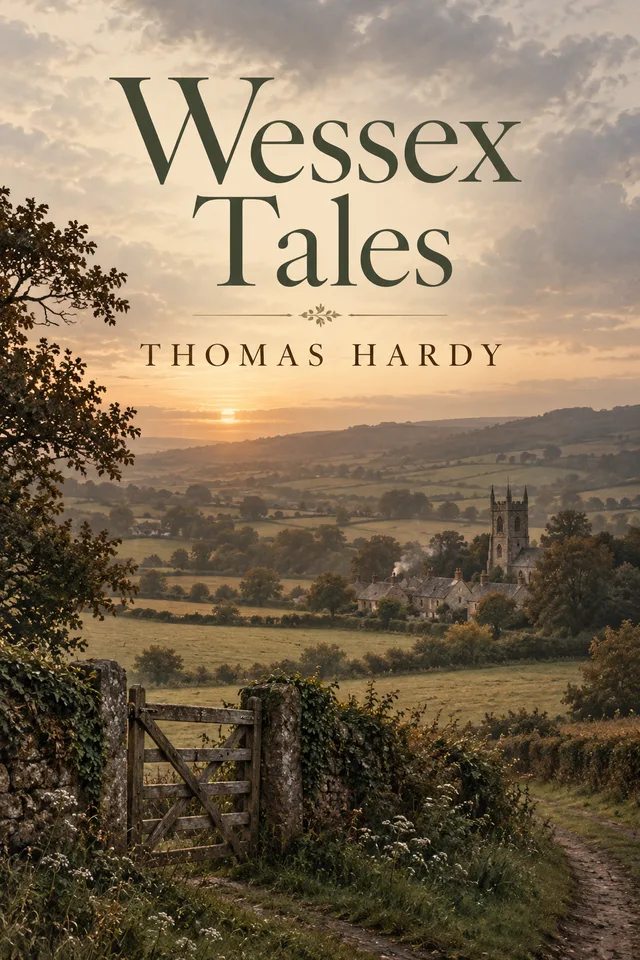
Englisch Ausgabe
Literatur
Wessex Tales
BooksWhale-Ausgabe auf Englisch von Thomas Hardy
Five stories of rural desire, class, coincidence, moral pressure, and social custom.
- Vorschau
- Auszug aus dem vorbereiteten Text
- Formate
- Online-Reader, EPUB, PDF
- Zugriff
- Bibliotheks-Claim
Bucheinführung
Wessex Tales
Hardy sets human longing against village gossip, inherited class, chance encounters, and the indifferent rhythms of the countryside.
BooksWhale-Ausgabe
Wie diese Ausgabe vorbereitet wurde
Diese Ausgabe basiert auf einem gemeinfreien Text und wurde von BooksWhale für digitales Lesen vorbereitet.
Public-Domain-Grundlage
Warum diese Ausgabe geteilt werden kann
Thomas Hardy died in 1928, and this english source text was published in 1888; it is public domain.
Vorschau lesen
Auszug aus dem vorbereiteten Text
Vorschau aus dem vorbereiteten Lesetext.
VorschaukapitelFull textVorschau lesen
Wessex Tales
Thomas Hardy
Credits: David Price
Contents
VorschaukapitelPREFACEVorschau
An apology is perhaps needed for the neglect of contrast which is shown by presenting two consecutive stories of hangmen in such a small collection as the following. But in the neighbourhood of county-towns tales of executions used to form a large proportion of the local traditions; and though never personally acquainted with any chief operator at such scenes, the writer of these pages had as a boy the privilege of being on speaking terms with a man who applied for the office, and who sank into an incurable melancholy because he failed to get it, some slight mitigation of his grief being to dwell upon striking episodes in the lives of those happier ones who had held it with success and renown. His tale of disappointment used to cause some wonder why his ambition should have taken such an unfortunate form, but its nobleness was never questioned. In those days, too, there was still living an old woman who, for the cure of some eating disease, had been taken in her youth to have her ‘blood turned’ by a convict’s corpse, in the manner described in ‘The Withered Arm.’
Since writing this story some years ago I have been reminded by an aged friend who knew ‘Rhoda Brook’ that, in relating her dream, my forgetfulness has weakened the facts out of which the tale grew. In reality it was while lying down on a hot afternoon that the incubus oppressed her and she flung it off, with the results upon the body of the original as described. To my mind the occurrence of such a vision in the daytime is more impressive than if it had happened in a midnight dream. Readers are therefore asked to correct the misrelation, which affords an instance of how our imperfect memories insensibly formalize the fresh originality of living fact—from whose shape they slowly depart, as machine-made castings depart by degrees from the sharp hand-work of the mould.
I may add that the first story in the series turns upon a physical possibility that may attach to women of imaginative temperament, and that is well supported by the experiences of medical men and other observers of such manifestations.
T. H.
April 1896.
AN IMAGINATIVE WOMAN
When William Marchmill had finished his inquiries for lodgings at a well-known watering-place in Upper Wessex, he returned to the hotel to find his wife. She, with the children, had rambled along the shore, and Marchmill followed in the direction indicated by the military-looking hall-porter
‘By Jove, how far you’ve gone! I am quite out of breath,’ Marchmill said, rather impatiently, when he came up with his wife, who was reading as she walked, the three children being considerably further ahead with the nurse.
Mrs. Marchmill started out of the reverie into which the book had thrown her. ‘Yes,’ she said, ‘you’ve been such a long time. I was tired of staying in that dreary hotel. But I am sorry if you have wanted me, Will?’
‘Well, I have had trouble to suit myself. When you see the airy and comfortable rooms heard of, you find they are stuffy and uncomfortable. Will you come and see if what I’ve fixed on will do? There is not much room, I am afraid; hut I can light on nothing better. The town is rather full.’
The pair left the children and nurse to continue their ramble, and went back together.
In age well-balanced, in personal appearance fairly matched, and in domestic requirements conformable, in temper this couple differed, though even here they did not often clash, he being equable, if not lymphatic, and she decidedly nervous and sanguine. It was to their tastes and fancies, those smallest, greatest particulars, that no common denominator could be applied. Marchmill considered his wife’s likes and inclinations somewhat silly; she considered his sordid and material. The husband’s business was that of a gunmaker in a thriving city northwards, and his soul was in that business always; the lady was best characterized by that superannuated phrase of elegance ‘a votary of the muse.’ An impressionable, palpitating creature was Ella, shrinking humanely from detailed knowledge of her husband’s trade whenever she reflected that everything he manufactured had for its purpose the destruction of life. She could only recover her equanimity by assuring herself that some, at least, of his weapons were sooner or later used for the extermination of horrid vermin and animals almost as cruel to their inferiors in species as human beings were to theirs.
VorschaukapitelCHAPTER I—A LORN MILKMAIDVorschau
It was an eighty-cow dairy, and the troop of milkers, regular and supernumerary, were all at work; for, though the time of year was as yet but early April, the feed lay entirely in water-meadows, and the cows were ‘in full pail.’ The hour was about six in the evening, and three-fourths of the large, red, rectangular animals having been finished off, there was opportunity for a little conversation.
‘He do bring home his bride to-morrow, I hear. They’ve come as far as Anglebury to-day.’
The voice seemed to proceed from the belly of the cow called Cherry, but the speaker was a milking-woman, whose face was buried in the flank of that motionless beast.
‘Hav’ anybody seen her?’ said another.
There was a negative response from the first. ‘Though they say she’s a rosy-cheeked, tisty-tosty little body enough,’ she added; and as the milkmaid spoke she turned her face so that she could glance past her cow’s tail to the other side of the barton, where a thin, fading woman of thirty milked somewhat apart from the rest.
‘Years younger than he, they say,’ continued the second, with also a glance of reflectiveness in the same direction.
‘How old do you call him, then?’
‘Thirty or so.’
‘More like forty,’ broke in an old milkman near, in a long white pinafore or ‘wropper,’ and with the brim of his hat tied down, so that he looked like a woman. ‘’A was born before our Great Weir was builded, and I hadn’t man’s wages when I laved water there.’
The discussion waxed so warm that the purr of the milk-streams became jerky, till a voice from another cow’s belly cried with authority, ‘Now then, what the Turk do it matter to us about Farmer Lodge’s age, or Farmer Lodge’s new mis’ess? I shall have to pay him nine pound a year for the rent of every one of these milchers, whatever his age or hers. Get on with your work, or ’twill be dark afore we have done. The evening is pinking in a’ready.’ This speaker was the dairyman himself; by whom the milkmaids and men were employed.
Nothing more was said publicly about Farmer Lodge’s wedding, but the first woman murmured under her cow to her next neighbour, ‘’Tis hard for she,’ signifying the thin worn milkmaid aforesaid.
‘O no,’ said the second. ‘He ha’n’t spoke to Rhoda Brook for years.’
When the milking was done they washed their pails and hung them on a many-forked stand made of the peeled limb of an oak-tree, set upright in the earth, and resembling a colossal antlered horn. The majority then dispersed in various directions homeward. The thin woman who had not spoken was joined by a boy of twelve or thereabout, and the twain went away up the field also.
Their course lay apart from that of the others, to a lonely spot high above the water-meads, and not far from the border of Egdon Heath, whose dark countenance was visible in the distance as they drew nigh to their home.
‘They’ve just been saying down in barton that your father brings his young wife home from Anglebury to-morrow,’ the woman observed. ‘I shall want to send you for a few things to market, and you’ll be pretty sure to meet ’em.’
‘Yes, mother,’ said the boy. ‘Is father married then?’
‘Yes . . . You can give her a look, and tell me what’s she’s like, if you do see her.’
‘Yes, mother.’
‘If she’s dark or fair, and if she’s tall—as tall as I. And if she seems like a woman who has ever worked for a living, or one that has been always well off, and has never done anything, and shows marks of the lady on her, as I expect she do.’
Inhaltsverzeichnis
In dieser Ausgabe
- 01Full text
- 02PREFACE
- 03CHAPTER I—A LORN MILKMAID
- 04CHAPTER II—THE YOUNG WIFE
- 05CHAPTER III—A VISION
- 06CHAPTER IV—A SUGGESTION
- 07CHAPTER V—CONJUROR TRENDLE
- 08CHAPTER VI—A SECOND ATTEMPT
- 09CHAPTER VII—A RIDE
- 10CHAPTER VIII—A WATER-SIDE HERMIT
- 11CHAPTER IX—A RENCOUNTER
- 12CHAPTER I
- 13CHAPTER II
- 14CHAPTER III
- 15CHAPTER IV
- 16CHAPTER V
- 17CHAPTER VI
- 18CHAPTER VII
- 19CHAPTER VIII
- 20CHAPTER IX
- 21CHAPTER I
- 22CHAPTER II
- 23CHAPTER III
- 24CHAPTER IV
- 25CHAPTER V
- 26CHAPTER I—HOW HIS COLD WAS CURED
- 27CHAPTER II—HOW HE SAW TWO OTHER MEN
- 28CHAPTER III—THE MYSTERIOUS GREATCOAT
- 29CHAPTER IV—AT THE TIME OF THE NEW MOON
- 30CHAPTER V—HOW THEY WENT TO LULSTEAD COVE
- 31CHAPTER VI—THE GREAT SEARCH AT NETHER-MOYNTON
- 32CHAPTER VII—THE WALK TO WARM’ELL CROSS AND AFTERWARDS
Sprachverfügbarkeit
Andere Sprachen
Weitere Sprachausgaben sind noch nicht veröffentlicht. Sobald verfügbar, werden sie hier verlinkt.
Andere Sprache anfragen