英語 エディション
文学
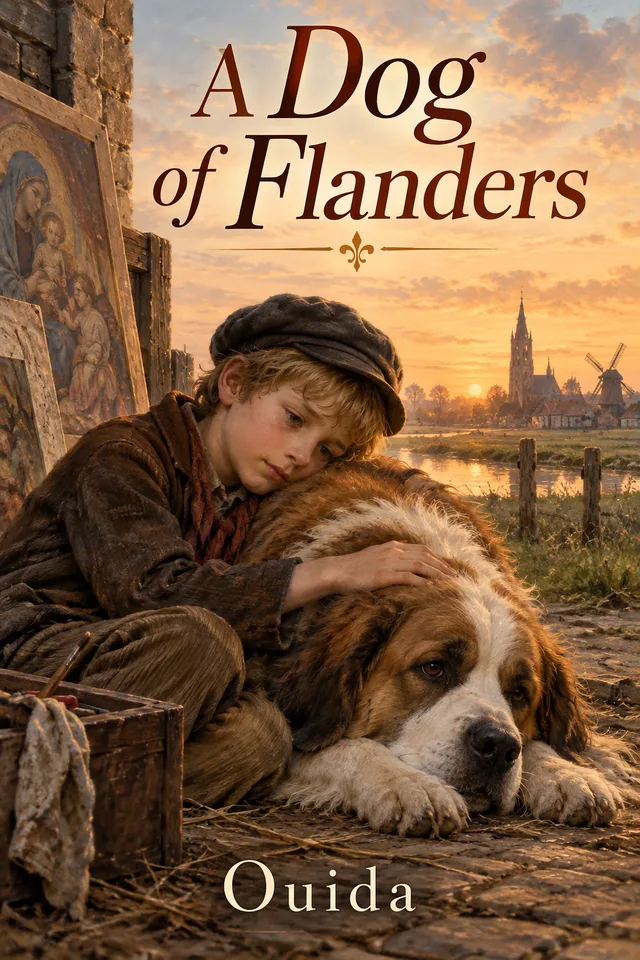
A Dog of Flanders
英語 BooksWhale エディション · Ouida
A moving children’s classic about poverty, loyalty, art, and a boy’s devoted dog.
- プレビュー
- 準備済みテキストからの抜粋
- 形式
- オンラインリーダー, EPUB, PDF
- アクセス
- ライブラリ claim
本の紹介
A Dog of Flanders
Nello and Patrasche endure hardship in the Flemish countryside, where poverty and prejudice oppose the boy’s love of art.
BooksWhale エディション
このエディションの準備
このエディションはパブリックドメイン本文に基づき、BooksWhale がデジタル読書向けに準備しました。
パブリックドメイン根拠
このエディションを共有できる理由
Ouida died in 1908, and this english source text was published in 1872; it is public domain.
プレビューを読む
準備済みテキストからの抜粋
準備済み読書テキストから選んだプレビューです。
プレビュー章Full textプレビューを読む
A Dog of Flanders
Ouida
プレビュー章Part 1プレビュー
(Óuida)
Nello and Patrasche were left all alone in the world.
They were friends in a friendship closer than brotherhood. Nello was a little Ardennois—Patrasche was a big Fleming. They were both of the same age by length of years, yet one was still young, and the other was already old. They had dwelt together almost all their days: both were orphaned and destitute, and owed their lives to the same hand. It had been the beginning of the tie between them, their first bond of sympathy; and it had strengthened day by day, and had grown with their growth, firm and indissoluble, until they loved one another very greatly. Their home was a little hut on the edge of a little village—a Flemish village a league from Antwerp, set amidst flat breadths of pasture and corn-lands, with long lines of poplars and of alders bending in the breeze on the edge of the great canal which ran through it. It had about a score of houses and homesteads, with shutters of bright green or sky-blue, and roofs rose-red or black and white, and walls white-washed until they shone in the sun like snow. In the centre of the village stood a windmill, placed on a little moss-grown slope: it was a landmark to all the level country round. It had once been painted scarlet, sails and all, but that had been in its infancy, half a century or more earlier, when it had ground wheat for the soldiers of Napoleon; and it was now a ruddy brown, tanned by wind and weather. It went queerly by fits and starts, as though rheumatic and stiff in the joints from age, but it served the whole neighborhood, which would have thought it almost as impious to carry grain elsewhere as to attend any other religious service than the mass that was performed at the altar of the little old gray church, with its conical steeple, which stood opposite to it, and whose single bell rang morning, noon, and night with that strange, subdued, hollow sadness which every bell that hangs in the Low Countries seems to gain as an integral part of its melody.
Within sound of the little melancholy clock almost from their birth upward, they had dwelt together, Nello and Patrasche, in the little hut on the edge of the village, with the cathedral spire of Antwerp rising in the north-east, beyond the great green plain of seeding grass and spreading corn that stretched away from them like a tideless, changeless sea. It was the hut of a very old man, of a very poor man—of old Jehan Daas, who in his time had been a soldier, and who remembered the wars that had trampled the country as oxen tread down the furrows, and who had brought from his service nothing except a wound, which had made him a cripple.
When old Jehan Daas had reached his full eighty, his daughter had died in the Ardennes, hard by Stavelot, and had left him in legacy her two-year-old son. The old man could ill contrive to support himself, but he took up the additional burden uncomplainingly, and it soon became welcome and precious to him. Little Nello—-which was but a pet diminutive for Nicolas—throve with him, and the old man and the little child lived in the poor little hut contentedly.
It was a very humble little mud-hut indeed, but it was clean and white as a sea-shell, and stood in a small plot of garden-ground that yielded beans and herbs and pumpkins. They were very poor, terribly poor—many a day they had nothing at all to eat. They never by any chance had enough: to have had enough to eat would have been to have reached paradise at once. But the old man was very gentle and good to the boy, and the boy was a beautiful, innocent, truthful, tender-hearted creature; and they were happy on a crust and a few leaves of cabbage, and asked no more of earth or heaven; save indeed that Patrasche should be always with them, since without Patrasche where would they have been?
プレビュー章Part 2プレビュー
So then, when Patrasche arose, himself again, strong, big, gaunt, powerful, his great wistful eyes had a gentle astonishment in them that there were no curses to rouse him and no blows to drive him; and his heart awakened to a mighty love, which never wavered once in its fidelity whilst life abode with him.
But Patrasche, being a dog, was grateful. Patrasche lay pondering long with grave, tender, musing brown eyes, watching the movements of his friends.
Now, the old soldier, Jehan Daas, could do nothing for his living but limp about a little with a small cart, with which he carried daily the milk-cans of those happier neighbors who owned cattle away into the town of Antwerp. The villagers gave him the employment a little out of charity—more because it suited them well to send their milk into the town by so honest a carrier, and bide at home themselves to look after their gardens, their cows, their poultry, or their little fields. But it was becoming hard work for the old man. He was eighty-three, and Antwerp was a good league off, or more.
Patrasche watched the milk-cans come and go that one day when he had got well and was lying in the sun with the wreath of marguerites round his tawny neck.
The next morning, Patrasche, before the old man had touched the cart, arose and walked to it and placed himself betwixt its handles, and testified as plainly as dumb show could do his desire and his ability to work in return for the bread of charity that he had eaten. Jehan Daas resisted long, for the old man was one of those who thought it a foul shame to bind dogs to labor for which Nature never formed them. But Patrasche would not be gainsaid: finding they did not harness him, he tried to draw the cart onward with his teeth.
At length Jehan Daas gave way, vanquished by the persistence and the gratitude of this creature whom he had succored. He fashioned his cart so that Patrasche could run in it, and this he did every morning of his life thenceforward.
When the winter came, Jehan Daas thanked the blessed fortune that had brought him to the dying dog in the ditch that fair-day of Louvain; for he was very old, and he grew feebler with each year, and he would ill have known how to pull his load of milk-cans over the snows and through the deep ruts in the mud if it had not been for the strength and the industry of the animal he had befriended. As for Patrasche, it seemed heaven to him. After the frightful burdens that his old master had compelled him to strain under, at the call of the whip at every step, it seemed nothing to him but amusement to step out with this little light green cart, with its bright brass cans, by the side of the gentle old man who always paid him with a tender caress and with a kindly word. Besides, his work was over by three or four in the day, and after that time he was free to do as he would—to stretch himself, to sleep in the sun, to wander in the fields, to romp with the young child, or to play with his fellow-dogs. Patrasche was very happy.
Fortunately for his peace, his former owner was killed in a drunken brawl at the Kermesse of Mechlin, and so sought not after him nor disturbed him in his new and well-loved home.
{Illustration}
{Illustration}
A few years later, old Jehan Daas, who had always been a cripple, became so paralyzed with rheumatism that it was impossible for him to go out with the cart any more. Then little Nello, being now grown to his sixth year of age, and knowing the town well from having accompanied his grandfather so many times, took his place beside the cart, and sold the milk and received the coins in exchange, and brought them back to their respective owners with a pretty grace and seriousness which charmed all who beheld him.
目次
このエディションの内容
- 01Full text
- 02Part 1
- 03Part 2
- 04Part 3
- 05Part 4
- 06Part 5
- 07Part 6
- 08Part 7
- 09Part 8