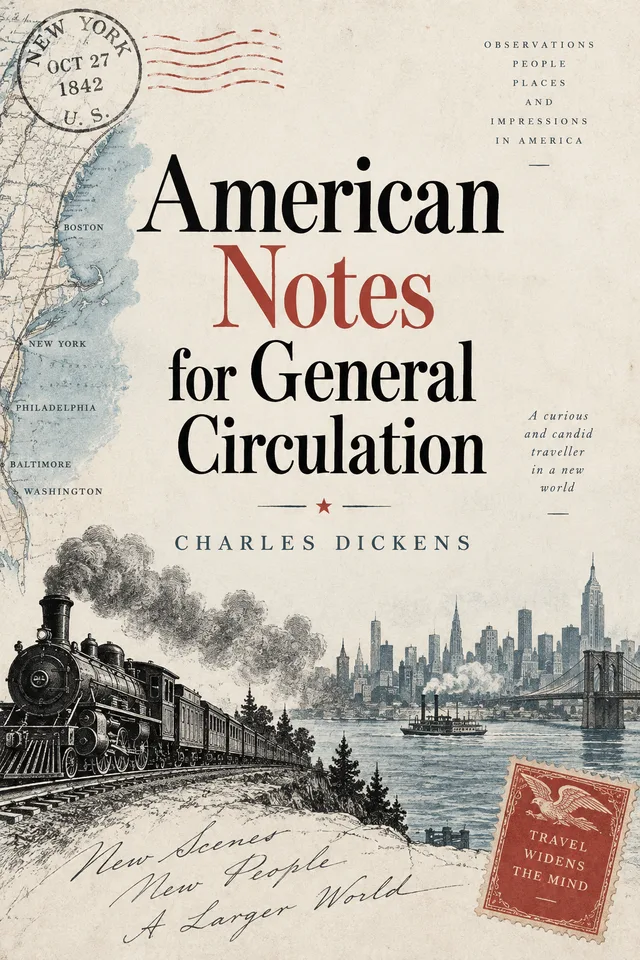
英語 エディション
歴史
American Notes for General Circulation
英語 BooksWhale エディション · Charles Dickens
原題: American Notes
Dickens’s observant travel account of American cities, institutions, prisons, schools, railways, and public manners.
- プレビュー
- 準備済みテキストからの抜粋
- 形式
- オンラインリーダー, EPUB, PDF
- アクセス
- ライブラリ claim
本の紹介
American Notes for General Circulation
American Notes records Dickens’s impressions of the United States and Canada, moving from travel scenes to pointed reflections on slavery, prisons, education, journalism, and democratic society.
BooksWhale エディション
このエディションの準備
このエディションはパブリックドメイン本文に基づき、BooksWhale がデジタル読書向けに準備しました。
パブリックドメイン根拠
このエディションを共有できる理由
Charles Dickens died in 1870; this English travel book was first published in 1842 and is public domain.
プレビューを読む
準備済みテキストからの抜粋
準備済み読書テキストから選んだプレビューです。
プレビュー章Full textプレビューを読む
American Notes for General Circulation
Charles Dickens
プレビュー章CHAPTER I GOING AWAYプレビュー
I shall never forget the one-fourth serious and three-fourths comical astonishment, with which, on the morning of the third of January eighteen-hundred-and-forty-two, I opened the door of, and put my head into, a ‘state-room’ on board the Britannia steam-packet, twelve hundred tons burthen per register, bound for Halifax and Boston, and carrying Her Majesty’s mails.
That this state-room had been specially engaged for ‘Charles Dickens, Esquire, and Lady,’ was rendered sufficiently clear even to my scared intellect by a very small manuscript, announcing the fact, which was pinned on a very flat quilt, covering a very thin mattress, spread like a surgical plaster on a most inaccessible shelf. But that this was the state-room concerning which Charles Dickens, Esquire, and Lady, had held daily and nightly conferences for at least four months preceding: that this could by any possibility be that small snug chamber of the imagination, which Charles Dickens, Esquire, with the spirit of prophecy strong upon him, had always foretold would contain at least one little sofa, and which his lady, with a modest yet most magnificent sense of its limited dimensions, had from the first opined would not hold more than two enormous portmanteaus in some odd corner out of sight (portmanteaus which could now no more be got in at the door, not to say stowed away, than a giraffe could be persuaded or forced into a flower-pot): that this utterly impracticable, thoroughly hopeless, and profoundly preposterous box, had the remotest reference to, or connection with, those chaste and pretty, not to say gorgeous little bowers, sketched by a masterly hand, in the highly varnished lithographic plan hanging up in the agent’s counting-house in the city of London: that this room of state, in short, could be anything but a pleasant fiction and cheerful jest of the captain’s, invented and put in practice for the better relish and enjoyment of the real state-room presently to be disclosed:—these were truths which I really could not, for the moment, bring my mind at all to bear upon or comprehend. And I sat down upon a kind of horsehair slab, or perch, of which there were two within; and looked, without any expression of countenance whatever, at some friends who had come on board with us, and who were crushing their faces into all manner of shapes by endeavouring to squeeze them through the small doorway.
We had experienced a pretty smart shock before coming below, which, but that we were the most sanguine people living, might have prepared us for the worst. The imaginative artist to whom I have already made allusion, has depicted in the same great work, a chamber of almost interminable perspective, furnished, as Mr. Robins would say, in a style of more than Eastern splendour, and filled (but not inconveniently so) with groups of ladies and gentlemen, in the very highest state of enjoyment and vivacity. Before descending into the bowels of the ship, we had passed from the deck into a long narrow apartment, not unlike a gigantic hearse with windows in the sides; having at the upper end a melancholy stove, at which three or four chilly stewards were warming their hands; while on either side, extending down its whole dreary length, was a long, long table, over each of which a rack, fixed to the low roof, and stuck full of drinking-glasses and cruet-stands, hinted dismally at rolling seas and heavy weather. I had not at that time seen the ideal presentment of this chamber which has since gratified me so much, but I observed that one of our friends who had made the arrangements for our voyage, turned pale on entering, retreated on the friend behind him, smote his forehead involuntarily, and said below his breath, ‘Impossible! it cannot be!’ or words to that effect. He recovered himself however by a great effort, and after a preparatory cough or two, cried, with a ghastly smile which is still before me, looking at the same time round the walls, ‘Ha! the breakfast-room, steward—eh?’ We all foresaw what the answer must be: we knew the agony he suffered. He had often spoken of the saloon; had taken in and lived upon the pictorial idea; had usually given us to understand, at home, that to form a just conception of it, it would be necessary to multiply the size and furniture of an ordinary drawing-room by seven, and then fall short of the reality. When the man in reply avowed the truth; the blunt, remorseless, naked truth; ‘This is the saloon, sir’—he actually reeled beneath the blow.
プレビュー章CHAPTER II THE PASSAGE OUTプレビュー
We all dined together that day; and a rather formidable party we were: no fewer than eighty-six strong. The vessel being pretty deep in the water, with all her coals on board and so many passengers, and the weather being calm and quiet, there was but little motion; so that before the dinner was half over, even those passengers who were most distrustful of themselves plucked up amazingly; and those who in the morning had returned to the universal question, ‘Are you a good sailor?’ a very decided negative, now either parried the inquiry with the evasive reply, ‘Oh! I suppose I’m no worse than anybody else;’ or, reckless of all moral obligations, answered boldly ‘Yes:’ and with some irritation too, as though they would add, ‘I should like to know what you see in me, sir, particularly, to justify suspicion!’
Notwithstanding this high tone of courage and confidence, I could not but observe that very few remained long over their wine; and that everybody had an unusual love of the open air; and that the favourite and most coveted seats were invariably those nearest to the door. The tea-table, too, was by no means as well attended as the dinner-table; and there was less whist-playing than might have been expected. Still, with the exception of one lady, who had retired with some precipitation at dinner-time, immediately after being assisted to the finest cut of a very yellow boiled leg of mutton with very green capers, there were no invalids as yet; and walking, and smoking, and drinking of brandy-and-water (but always in the open air), went on with unabated spirit, until eleven o’clock or thereabouts, when ‘turning in’—no sailor of seven hours’ experience talks of going to bed—became the order of the night. The perpetual tramp of boot-heels on the decks gave place to a heavy silence, and the whole human freight was stowed away below, excepting a very few stragglers, like myself, who were probably, like me, afraid to go there.
To one unaccustomed to such scenes, this is a very striking time on shipboard. Afterwards, and when its novelty had long worn off, it never ceased to have a peculiar interest and charm for me. The gloom through which the great black mass holds its direct and certain course; the rushing water, plainly heard, but dimly seen; the broad, white, glistening track, that follows in the vessel’s wake; the men on the look-out forward, who would be scarcely visible against the dark sky, but for their blotting out some score of glistening stars; the helmsman at the wheel, with the illuminated card before him, shining, a speck of light amidst the darkness, like something sentient and of Divine intelligence; the melancholy sighing of the wind through block, and rope, and chain; the gleaming forth of light from every crevice, nook, and tiny piece of glass about the decks, as though the ship were filled with fire in hiding, ready to burst through any outlet, wild with its resistless power of death and ruin. At first, too, and even when the hour, and all the objects it exalts, have come to be familiar, it is difficult, alone and thoughtful, to hold them to their proper shapes and forms. They change with the wandering fancy; assume the semblance of things left far away; put on the well-remembered aspect of favourite places dearly loved; and even people them with shadows. Streets, houses, rooms; figures so like their usual occupants, that they have startled me by their reality, which far exceeded, as it seemed to me, all power of mine to conjure up the absent; have, many and many a time, at such an hour, grown suddenly out of objects with whose real look, and use, and purpose, I was as well acquainted as with my own two hands.
My own two hands, and feet likewise, being very cold, however, on this particular occasion, I crept below at midnight. It was not exactly comfortable below. It was decidedly close; and it was impossible to be unconscious of the presence of that extraordinary compound of strange smells, which is to be found nowhere but on board ship, and which is such a subtle perfume that it seems to enter at every pore of the skin, and whisper of the hold. Two passengers’ wives (one of them my own) lay already in silent agonies on the sofa; and one lady’s maid (my lady’s) was a mere bundle on the floor, execrating her destiny, and pounding her curl-papers among the stray boxes. Everything sloped the wrong way: which in itself was an aggravation scarcely to be borne. I had left the door open, a moment before, in the bosom of a gentle declivity, and, when I turned to shut it, it was on the summit of a lofty eminence. Now every plank and timber creaked, as if the ship were made of wicker-work; and now crackled, like an enormous fire of the driest possible twigs. There was nothing for it but bed; so I went to bed.
目次
このエディションの内容
- 01Full text
- 02CHAPTER I GOING AWAY
- 03CHAPTER II THE PASSAGE OUT
- 04I looked at him doubtfully, and returned, ‘No; I would rather have it in this private room. I like it very much.’
- 05CHAPTER III BOSTON
- 06* * * * * *
- 07CHAPTER IV AN AMERICAN RAILROAD. LOWELL AND ITS FACTORY SYSTEM
- 08CHAPTER V WORCESTER. THE CONNECTICUT RIVER. HARTFORD. NEW HAVEN. TO NEW YORK
- 09CHAPTER VI NEW YORK
- 10CHAPTER VII PHILADELPHIA, AND ITS SOLITARY PRISON
- 11CHAPTER VIII WASHINGTON. THE LEGISLATURE. AND THE PRESIDENT’S HOUSE
- 12CHAPTER IX A NIGHT STEAMER ON THE POTOMAC RIVER. VIRGINIA ROAD, AND A BLACK DRIVER. RICHMOND. BALTIMORE. THE HARRISBURG MAIL, AND A GLIMPSE OF THE CITY. A CANAL BOAT
- 13Black Driver (still to the horses). ‘Jiddy! Jiddy!’
- 14CHAPTER X SOME FURTHER ACCOUNT OF THE CANAL BOAT, ITS DOMESTIC ECONOMY, AND ITS PASSENGERS. JOURNEY TO PITTSBURG ACROSS THE ALLEGHANY MOUNTAINS. PITTSBURG
- 15CHAPTER XI FROM PITTSBURG TO CINCINNATI IN A WESTERN STEAMBOAT. CINCINNATI
- 16CHAPTER XII FROM CINCINNATI TO LOUISVILLE IN ANOTHER WESTERN STEAMBOAT; AND FROM LOUISVILLE TO ST. LOUIS IN ANOTHER. ST. LOUIS
- 17CHAPTER XIII A JAUNT TO THE LOOKING-GLASS PRAIRIE AND BACK
- 18CHAPTER XIV RETURN TO CINCINNATI. A STAGE-COACH RIDE FROM THAT CITY TO COLUMBUS, AND THENCE TO SANDUSKY. SO, BY LAKE ERIE, TO THE FALLS OF NIAGARA
- 19CHAPTER XV IN CANADA; TORONTO; KINGSTON; MONTREAL; QUEBEC; ST. JOHN’S. IN THE UNITED STATES AGAIN; LEBANON; THE SHAKER VILLAGE; WEST POINT
- 20CHAPTER XVI THE PASSAGE HOME
- 21CHAPTER XVII SLAVERY
- 22CHAPTER XVIII CONCLUDING REMARKS
- 23THE END
- 24POSTSCRIPT