英語 エディション
文学
Dombey and Son
英語 BooksWhale エディション · Charles Dickens
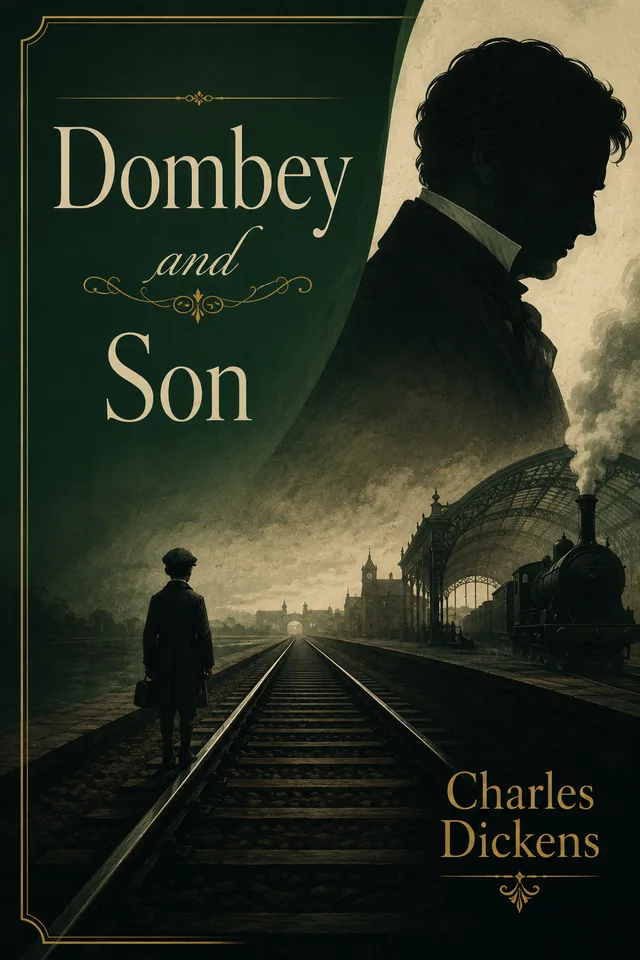
A mature Dickens novel about pride, commerce, family neglect, railways, childhood, and emotional awakening.
- プレビュー
- 準備済みテキストからの抜粋
- 形式
- オンラインリーダー, EPUB, PDF
- アクセス
- ライブラリ claim
本の紹介
Dombey and Son
Dombey and Son studies a merchant father who values lineage and business more than affection. Around Florence, Paul, Edith, Carker, and the expanding railway age, Dickens builds a powerful story of family damage, money, modernity, gender, and moral reckoning.
BooksWhale エディション
このエディションの準備
このエディションはパブリックドメイン本文に基づき、BooksWhale がデジタル読書向けに準備しました。
パブリックドメイン根拠
このエディションを共有できる理由
Charles Dickens died in 1870, and Dombey and Son was first published in 1846-1848; these dates support the public-domain basis for the original English text.
プレビューを読む
準備済みテキストからの抜粋
準備済み読書テキストから選んだプレビューです。
プレビュー章Full textプレビューを読む
Dombey and Son
Charles Dickens
プレビュー章CHAPTER I. Dombey and Sonプレビュー
Dombey sat in the corner of the darkened room in the great arm-chair by the bedside, and Son lay tucked up warm in a little basket bedstead, carefully disposed on a low settee immediately in front of the fire and close to it, as if his constitution were analogous to that of a muffin, and it was essential to toast him brown while he was very new.
Dombey was about eight-and-forty years of age. Son about eight-and-forty minutes. Dombey was rather bald, rather red, and though a handsome well-made man, too stern and pompous in appearance, to be prepossessing. Son was very bald, and very red, and though (of course) an undeniably fine infant, somewhat crushed and spotty in his general effect, as yet. On the brow of Dombey, Time and his brother Care had set some marks, as on a tree that was to come down in good time—remorseless twins they are for striding through their human forests, notching as they go—while the countenance of Son was crossed with a thousand little creases, which the same deceitful Time would take delight in smoothing out and wearing away with the flat part of his scythe, as a preparation of the surface for his deeper operations.
Dombey, exulting in the long-looked-for event, jingled and jingled the heavy gold watch-chain that depended from below his trim blue coat, whereof the buttons sparkled phosphorescently in the feeble rays of the distant fire. Son, with his little fists curled up and clenched, seemed, in his feeble way, to be squaring at existence for having come upon him so unexpectedly.
“The House will once again, Mrs Dombey,” said Mr Dombey, “be not only in name but in fact Dombey and Son;” and he added, in a tone of luxurious satisfaction, with his eyes half-closed as if he were reading the name in a device of flowers, and inhaling their fragrance at the same time; “Dom-bey and Son!”
The words had such a softening influence, that he appended a term of endearment to Mrs Dombey’s name (though not without some hesitation, as being a man but little used to that form of address): and said, “Mrs Dombey, my—my dear.”
A transient flush of faint surprise overspread the sick lady’s face as she raised her eyes towards him.
“He will be christened Paul, my—Mrs Dombey—of course.”
She feebly echoed, “Of course,” or rather expressed it by the motion of her lips, and closed her eyes again.
“His father’s name, Mrs Dombey, and his grandfather’s! I wish his grandfather were alive this day! There is some inconvenience in the necessity of writing Junior,” said Mr Dombey, making a fictitious autograph on his knee; “but it is merely of a private and personal complexion. It doesn’t enter into the correspondence of the House. Its signature remains the same.” And again he said “Dombey and Son,” in exactly the same tone as before.
Those three words conveyed the one idea of Mr Dombey’s life. The earth was made for Dombey and Son to trade in, and the sun and moon were made to give them light. Rivers and seas were formed to float their ships; rainbows gave them promise of fair weather; winds blew for or against their enterprises; stars and planets circled in their orbits, to preserve inviolate a system of which they were the centre. Common abbreviations took new meanings in his eyes, and had sole reference to them. A. D. had no concern with Anno Domini, but stood for anno Dombei—and Son.
He had risen, as his father had before him, in the course of life and death, from Son to Dombey, and for nearly twenty years had been the sole representative of the Firm. Of those years he had been married, ten—married, as some said, to a lady with no heart to give him; whose happiness was in the past, and who was content to bind her broken spirit to the dutiful and meek endurance of the present. Such idle talk was little likely to reach the ears of Mr Dombey, whom it nearly concerned; and probably no one in the world would have received it with such utter incredulity as he, if it had reached him. Dombey and Son had often dealt in hides, but never in hearts. They left that fancy ware to boys and girls, and boarding-schools and books. Mr Dombey would have reasoned: That a matrimonial alliance with himself _must_, in the nature of things, be gratifying and honourable to any woman of common sense. That the hope of giving birth to a new partner in such a House, could not fail to awaken a glorious and stirring ambition in the breast of the least ambitious of her sex. That Mrs Dombey had entered on that social contract of matrimony: almost necessarily part of a genteel and wealthy station, even without reference to the perpetuation of family Firms: with her eyes fully open to these advantages. That Mrs Dombey had had daily practical knowledge of his position in society. That Mrs Dombey had always sat at the head of his table, and done the honours of his house in a remarkably lady-like and becoming manner. That Mrs Dombey must have been happy. That she couldn’t help it.
プレビュー章CHAPTER II. In which Timely Provision is made for an Emergency that will sometimes arise in the best-regulated Families.プレビュー
I shall never cease to congratulate myself,” said Mrs Chick,” on having said, when I little thought what was in store for us,—really as if I was inspired by something,—that I forgave poor dear Fanny everything. Whatever happens, that must always be a comfort to me!”
Mrs Chick made this impressive observation in the drawing-room, after having descended thither from the inspection of the mantua-makers upstairs, who were busy on the family mourning. She delivered it for the behoof of Mr Chick, who was a stout bald gentleman, with a very large face, and his hands continually in his pockets, and who had a tendency in his nature to whistle and hum tunes, which, sensible of the indecorum of such sounds in a house of grief, he was at some pains to repress at present.
“Don’t you over-exert yourself, Loo,” said Mr Chick, “or you’ll be laid up with spasms, I see. Right tol loor rul! Bless my soul, I forgot! We’re here one day and gone the next!”
Mrs Chick contented herself with a glance of reproof, and then proceeded with the thread of her discourse.
“I am sure,” she said, “I hope this heart-rending occurrence will be a warning to all of us, to accustom ourselves to rouse ourselves, and to make efforts in time where they’re required of us. There’s a moral in everything, if we would only avail ourselves of it. It will be our own faults if we lose sight of this one.”
Mr Chick invaded the grave silence which ensued on this remark with the singularly inappropriate air of “A cobbler there was;” and checking himself, in some confusion, observed, that it was undoubtedly our own faults if we didn’t improve such melancholy occasions as the present.
“Which might be better improved, I should think, Mr C.,” retorted his helpmate, after a short pause, “than by the introduction, either of the college hornpipe, or the equally unmeaning and unfeeling remark of rump-te-iddity, bow-wow-wow!”—which Mr Chick had indeed indulged in, under his breath, and which Mrs Chick repeated in a tone of withering scorn.
“Merely habit, my dear,” pleaded Mr Chick.
“Nonsense! Habit!” returned his wife. “If you’re a rational being, don’t make such ridiculous excuses. Habit! If I was to get a habit (as you call it) of walking on the ceiling, like the flies, I should hear enough of it, I daresay.”
It appeared so probable that such a habit might be attended with some degree of notoriety, that Mr Chick didn’t venture to dispute the position.
“Bow-wow-wow!” repeated Mrs Chick with an emphasis of blighting contempt on the last syllable. “More like a professional singer with the hydrophobia, than a man in your station of life!”
“How’s the Baby, Loo?” asked Mr Chick: to change the subject.
“What Baby do you mean?” answered Mrs Chick.
“The poor bereaved little baby,” said Mr Chick. “I don’t know of any other, my dear.”
“You don’t know of any other,” retorted Mrs Chick. “More shame for you, I was going to say.”
Mr Chick looked astonished.
“I am sure the morning I have had, with that dining-room downstairs, one mass of babies, no one in their senses would believe.”
“One mass of babies!” repeated Mr Chick, staring with an alarmed expression about him.
“It would have occurred to most men,” said Mrs Chick, “that poor dear Fanny being no more,—those words of mine will always be a balm and comfort to me,” here she dried her eyes; “it becomes necessary to provide a Nurse.”
“Oh! Ah!” said Mr Chick. “Toor-ru!—such is life, I mean. I hope you are suited, my dear.”
“Indeed I am not,” said Mrs Chick; “nor likely to be, so far as I can see, and in the meantime the poor child seems likely to be starved to death. Paul is so very particular—naturally so, of course, having set his whole heart on this one boy—and there are so many objections to everybody that offers, that I don’t see, myself, the least chance of an arrangement. Meanwhile, of course, the child is—”
目次
このエディションの内容
- 01Full text
- 02CHAPTER I. Dombey and Son
- 03CHAPTER II. In which Timely Provision is made for an Emergency that will sometimes arise in the best-regulated Families.
- 04CHAPTER III. In which Mr Dombey, as a Man and a Father, is seen at the Head of the Home-Department
- 05CHAPTER IV. In which some more First Appearances are made on the Stage of these Adventures
- 06CHAPTER V. Paul’s Progress and Christening
- 07CHAPTER VI. Paul’s Second Deprivation
- 08CHAPTER VII. A Bird’s-eye Glimpse of Miss Tox’s Dwelling-place: also of the State of Miss Tox’s Affections
- 09CHAPTER VIII. Paul’s Further Progress, Growth and Character
- 10CHAPTER IX. In which the Wooden Midshipman gets into Trouble
- 11CHAPTER X. Containing the Sequel of the Midshipman’s Disaster
- 12CHAPTER XI. Paul’s Introduction to a New Scene
- 13CHAPTER XII. Paul’s Education
- 14CHAPTER XIII. Shipping Intelligence and Office Business
- 15CHAPTER XIV. Paul grows more and more Old-fashioned, and goes Home for the Holidays
- 16CHAPTER XV. Amazing Artfulness of Captain Cuttle, and a new Pursuit for Walter Gay
- 17CHAPTER XVI. What the Waves were always saying
- 18CHAPTER XVII. Captain Cuttle does a little Business for the Young People
- 19CHAPTER XVIII. Father and Daughter
- 20CHAPTER XIX. Walter goes away
- 21CHAPTER XX. Mr Dombey goes upon a Journey
- 22CHAPTER XXI. New Faces
- 23CHAPTER XXII. A Trifle of Management by Mr Carker the Manager
- 24CHAPTER XXIII. Florence solitary, and the Midshipman mysterious
- 25CHAPTER XXIV. The Study of a Loving Heart
- 26CHAPTER XXV. Strange News of Uncle Sol
- 27CHAPTER XXVI. Shadows of the Past and Future
- 28CHAPTER XXVII. Deeper Shadows
- 29CHAPTER XXVIII. Alterations
- 30CHAPTER XXIX. The Opening of the Eyes of Mrs Chick
- 31CHAPTER XXX. The interval before the Marriage
- 32CHAPTER XXXI. The Wedding
- 33CHAPTER XXXII. The Wooden Midshipman goes to Pieces
- 34CHAPTER XXXIII. Contrasts
- 35CHAPTER XXXIV. Another Mother and Daughter
- 36CHAPTER XXXV. The Happy Pair
- 37CHAPTER XXXVI. Housewarming
- 38CHAPTER XXXVII. More Warnings than One
- 39CHAPTER XXXVIII. Miss Tox improves an Old Acquaintance
- 40CHAPTER XXXIX. Further Adventures of Captain Edward Cuttle, Mariner
- 41CHAPTER XL. Domestic Relations
- 42CHAPTER XLI. New Voices in the Waves
- 43CHAPTER XLII. Confidential and Accidental
- 44CHAPTER XLIII. The Watches of the Night
- 45CHAPTER XLIV. A Separation
- 46CHAPTER XLV. The Trusty Agent
- 47CHAPTER XLVI. Recognizant and Reflective
- 48CHAPTER XLVII. The Thunderbolt
- 49CHAPTER XLVIII. The Flight of Florence
- 50CHAPTER XLIX. The Midshipman makes a Discovery
- 51CHAPTER L. Mr Toots’s Complaint
- 52CHAPTER LI. Mr Dombey and the World
- 53CHAPTER LII. Secret Intelligence
- 54CHAPTER LIII. More Intelligence
- 55CHAPTER LIV. The Fugitives
- 56CHAPTER LV. Rob the Grinder loses his Place
- 57CHAPTER LVI. Several People delighted, and the Game Chicken disgusted
- 58CHAPTER LVII. Another Wedding
- 59CHAPTER LVIII. After a Lapse
- 60CHAPTER LIX. Retribution
- 61CHAPTER LX. Chiefly Matrimonial
- 62“MR AND MRS TOOTS!”
- 63CHAPTER LXI. Relenting
- 64CHAPTER LXII. Final
- 65PREFACE OF 1848
- 66PREFACE OF 1867