英語 エディション
科学
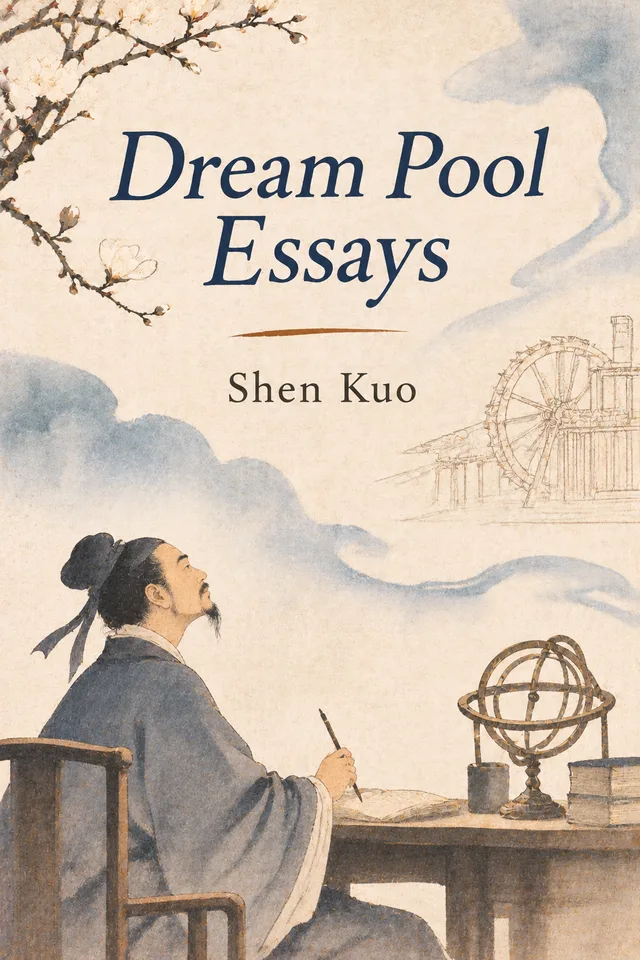
Dream Pool Essays
英語 BooksWhale エディション · Shen Kuo
原題: 梦溪笔谈
Shen Kuo records Song dynasty observations on astronomy, medicine, government, painting and the inventions of artisans.
- プレビュー
- 準備済みテキストからの抜粋
- 形式
- オンラインリーダー, EPUB, PDF
- アクセス
- ライブラリ claim
本の紹介
Dream Pool Essays
Shen Kuo moves from the calculation of celestial patterns and musical pitch to the work of officials, painters and artisans. His short entries preserve observations, historical anecdotes and accounts of unfamiliar phenomena. The English edition includes the main essays, the three volumes of supplementary notes and the eleven additional notes in the supplied manuscript.
BooksWhale エディション
このエディションの準備
このエディションは BooksWhale が準備した AI 支援・人間確認済み翻訳で、読みやすさ、書式、一貫性を確認しています。
パブリックドメイン根拠
このエディションを共有できる理由
The historical Chinese text by Shen Kuo is in the public domain. This English translation was commissioned for this edition and has been reviewed by the commissioning editor.
プレビューを読む
準備済みテキストからの抜粋
準備済み読書テキストから選んだプレビューです。
プレビュー章Preface to Dream Pool Essaysプレビューを読む
After leaving office, I retired to the mountains and forests, living in seclusion and rarely venturing out. I ceased all contact with my friends. Whenever I recalled the conversations I had once enjoyed with them, I would occasionally take up my brush and record one or two matters, feeling as though I were speaking with them face to face. In this way, I passed my days in solitude and desolation. My only companions with whom I could communicate were my writing brush and inkstone, so I called this work Brush Conversations.
I dared not privately record imperial edicts, major affairs of state, or matters concerning the imperial court and government offices. As for the praise and criticism circulating among scholar-officials of the time, I did not wish to write about them, even when they concerned admirable deeds. This was not merely because I was reluctant to speak ill of others.
What I recorded consisted only of casual conversations and amusing observations made among mountains and fields or beneath the shade of trees, matters having nothing to do with anyone's personal interests or welfare. As for the sayings and conversations of ordinary people in villages and towns, however, I included virtually everything. Some accounts came from hearsay, and I cannot guarantee that they are entirely free from omissions or errors.
Such material may be considered rather humble as a subject of conversation. It is enough to regard these writings as things I happened to set down without any particular intention.
プレビュー章Anecdotes and Historical Practicesプレビュー
When the emperor personally performed the suburban sacrifice to Heaven, the ceremonial documents for both the suburban sacrifice and the ancestral temple sacrifice contained the words, "We respectfully present the seasonal offerings."
The emperor first visited Jingling Palace to make offerings, a ceremony called the "Morning Offering." He then proceeded to the Imperial Ancestral Temple for the "Morning Feast," and only afterward went to the southern suburbs to sacrifice to Heaven.
When I was compiling the Regulations for Suburban Sacrifices, I participated in discussions concerning these ceremonies and frequently questioned whether this order was appropriate. If precedence signified greater honor, the sacrifice to Heaven should not follow that at the ancestral temple. If the final position signified greater honor, then the visit to Jingling Palace should not precede the ancestral temple ceremony.
Upon examining the origins of this arrangement, I discovered that there was probably a reason for it.
According to Tang dynasty precedent, whenever sacrifices were offered to Heaven, offerings were also made to the various spirits. Envoys were dispatched to announce these sacrifices, but the emperor personally performed the ceremonies only at Taiqing Palace and the Imperial Ancestral Temple.
The ceremonial documents and prayers all stated, "On such-and-such a day of such-and-such a month, a sacrifice will be performed at such-and-such a place. We dare not fail to announce it."
The documents for Taiqing Palace and the Imperial Ancestral Temple were called "Formal Announcements," while those for other places were called "Sacrificial Announcements." Only the sacrifice to Heaven in the southern suburbs was called the "Principal Sacrifice."
In the ninth year of the Tianbao era, an imperial edict declared: "The word 'announce' implies a superior informing an inferior. Henceforth, the ceremony at Taiqing Palace shall be called the 'Morning Offering,' and the ceremony at the Imperial Ancestral Temple shall be called the 'Morning Feast.'"
From that time onward, the designation "Formal Announcement" disappeared, while the ceremonial documents used at other locations came to refer to the rites as "Principal Sacrifices."
The ceremonial throne used in the principal audience hall was made of fragrant wood and decorated with gold. It had four legs, rounded corners, and a slightly recessed front, over which woven rattan was stretched.
Whenever the emperor traveled in procession, an elderly eunuch carried this throne while riding on horseback. It was called the "Imperial Headpiece."
Behind the imperial carriage was a canopy with a curved top, called a lang. Embroidered fans stood on either side, and together they were known as the "Fan Canopy."
All these objects were made of woven and embroidered fabrics, sometimes incorporating gold thread. They corresponded to the ornate canopies of antiquity.
During the Tang dynasty, the Hanlin Academy was located within the imperial forbidden gardens, where the emperor spent his leisure hours. The Jade Hall, Chengming Hall, and Golden Luan Hall were all situated there.
Everyone serving in this institution, from academicians to craftsmen, artists, and various administrative officials, was called a "Hanlin," just as there are now Hanlin medical officers and Hanlin attendants awaiting imperial orders.
Only the Hanlin Tea and Wine Office was referred to simply as the "Hanlin Office." This was probably the result of an omission in terminology perpetuated through long usage.
According to Tang dynasty regulations, officials from the chancellor downward were not formally summoned by imperial announcement when first appointed. Only academicians received such summons.
This was probably because the Academicians' Institute was located within the forbidden gardens, and no one could enter without being summoned by a palace official. For this reason, an additional side entrance was established outside the institute's gate, since the institute communicated directly with the forbidden gardens.
The northern gate of the Academicians' Institute was opened because the institute lay south of the Bathing Hall, making it convenient for academicians to respond to imperial summons.
Today, when a Hanlin academician is first appointed, he enters through Donghua Gate, dismounts beneath Left Chengtian Gate, and waits to be summoned. Officials from the Academicians' Institute then escort him, one walking ahead and another behind, from Left Chengtian Gate to the institute's entrance.
プレビュー章Investigations and Correctionsプレビュー
The shi in the expression junshi is the name of one of the five traditional units of weight.
One shi originally weighed 120 jin.
Later generations used shi as another name for one hu, a unit of capacity. This practice had already begun during the Han dynasty.
Thus there was the saying, "A man may drink one shi of wine without becoming disorderly."
In antiquity, the strength required to draw a bow or operate a crossbow was measured in jun and shi.
Today, one shi is defined by the weight of one hu of polished rice.
The standard weight is ninety-two and a half jin per shi, equivalent to 341 jin on the Han dynasty scale.
Among today's soldiers, some can operate crossbows rated at nine shi.
Calculating the force required, this is equivalent to twenty-five ancient shi.
Compared with the warriors of the ancient state of Wei, one such soldier possesses the strength of more than two men.
Some soldiers can draw bows rated at three shi, equivalent to thirty-four ancient jun.
Compared with the bow used by Yan Gao, one such archer possesses the strength of more than five men.
These accomplishments are the result of military training in recent years.
In thrusting, striking, mounted archery, and other martial skills, our soldiers have mastered techniques from both the peoples beyond the frontiers and the Chinese states.
Weapons and armor have reached the highest levels of craftsmanship known in ancient or modern times.
The flourishing state of our military preparedness is unmatched by earlier ages.
In the Summons of the Soul in the Songs of Chu, the lines frequently end with the character xie, whose pronunciation is indicated by the traditional spelling su-ge.
Among the peoples living in Kuizhou, the Three Gorges, the regions around the lakes of Hunan and Hubei, Jiangling, and Dongting Lake, the final syllable of certain taboo expressions and incantations is still pronounced xie.
This is an ancient custom of the people of Chu.
It corresponds to the Sanskrit expression svāhā, rendered in Chinese by three characters.
The first character is pronounced according to sang-ge, the second according to wu-ke, and the third with a departing tone.
When the three syllables are pronounced together, they resemble the Chinese character xie.
When a concave burning mirror is used to observe objects, the resulting images are inverted.
This is because there is an intervening point of obstruction between the object and the mirror.
Mathematicians call this principle the "method of crossing," just as the pivot of an oar serves as the intervening point when a person rows a boat.
Consider a hawk flying through the air.
Its ordinary shadow moves in the same direction as the bird.
But if light falls upon the hawk and then passes through a small hole in a window, the image moves in the opposite direction from the hawk's flight.
If the hawk flies east, its image moves west; if it flies west, its image moves east.
Likewise, when light from a tower outside passes through a small opening in a window, the image of the tower appears upside down.
The principle is the same as that of the burning mirror.
The reflecting surface of a burning mirror is concave.
If one places a finger close to the surface, an upright image appears.
As the finger is gradually moved away, the image disappears.
When it is moved farther still, an inverted image appears in the mirror.
The point beyond which the finger can no longer be seen acts like the small hole in a window, the pivot of a boat's oar, or the narrow waist of an hourglass-shaped drum.
All these constitute an intervening point.
The movements of the object and its image on opposite sides of this point are reversed, just as the ends of an oar move in opposite directions.
Thus, when one raises a hand, its image moves downward; when one lowers the hand, the image moves upward.
目次
このエディションの内容
- 01Preface to Dream Pool Essays
- 02Anecdotes and Historical Practices
- 03Investigations and Corrections
- 04Musical Pitch and Harmony
- 05Celestial Patterns and Numerical Principles
- 06Human Affairs
- 07Government Administration
- 08Ingenuity and Resourcefulness
- 09Literature and the Arts
- 10Calligraphy and Painting
- 11Techniques and Inventions
- 12Instruments and Implements
- 13Marvels and Wonders
- 14Unusual Events and Diseases
- 15Errors and Misconceptions
- 16Satire and Humorous Anecdotes
- 17Miscellaneous Notes, Part One
- 18Miscellaneous Notes, Part Two
- 19Discussions of Medicines
- 20Supplementary Notes to Dream Pool Essays, Volume One
- 21Established Practices
- 22Investigations and Corrections
- 23Musical Pitch and Harmony
- 24Supplementary Notes to Dream Pool Essays, Volume Two
- 25Celestial Patterns and Numerical Principles
- 26Government Administration
- 27Ingenuity and Resourcefulness
- 28Literature and the Arts
- 29Instruments and Implements
- 30Supplementary Notes to Dream Pool Essays, Volume Three
- 31Unusual Events
- 32Miscellaneous Notes
- 33Discussions of Medicines
- 34Eleven Additional Notes