英語 エディション
文学
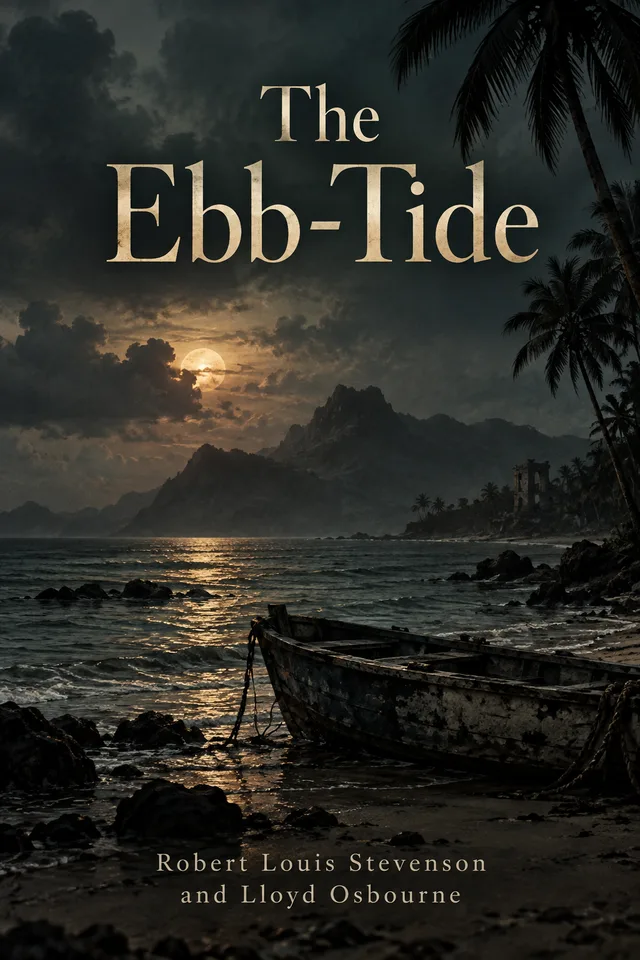
The Ebb-Tide
英語 BooksWhale エディション · Robert Louis Stevenson and Lloyd Osbourne
A dark South Seas adventure about desperation, deception, disease, and moral collapse.
- プレビュー
- 準備済みテキストからの抜粋
- 形式
- オンラインリーダー, EPUB, PDF
- アクセス
- ライブラリ claim
本の紹介
The Ebb-Tide
Four damaged men pursue a fortune at sea, but a Pacific voyage becomes a test of greed, fear, conscience, and survival.
BooksWhale エディション
このエディションの準備
このエディションはパブリックドメイン本文に基づき、BooksWhale がデジタル読書向けに準備しました。
パブリックドメイン根拠
このエディションを共有できる理由
Robert Louis Stevenson died in 1894 and Lloyd Osbourne in 1947; this 1894 original is public domain.
プレビューを読む
準備済みテキストからの抜粋
準備済み読書テキストから選んだプレビューです。
プレビュー章Full textプレビューを読む
The Ebb-Tide
Robert Louis Stevenson and Lloyd Osbourne
プレビュー章Chapter 1. NIGHT ON THE BEACHプレビュー
Throughout the island world of the Pacific, scattered men of many European races and from almost every grade of society carry activity and disseminate disease. Some prosper, some vegetate. Some have mounted the steps of thrones and owned islands and navies. Others again must marry for a livelihood; a strapping, merry, chocolate-coloured dame supports them in sheer idleness; and, dressed like natives, but still retaining some foreign element of gait or attitude, still perhaps with some relic (such as a single eye-glass) of the officer and gentleman, they sprawl in palm-leaf verandahs and entertain an island audience with memoirs of the music-hall. And there are still others, less pliable, less capable, less fortunate, perhaps less base, who continue, even in these isles of plenty, to lack bread.
At the far end of the town of Papeete, three such men were seated on the beach under a purao tree.
It was late. Long ago the band had broken up and marched musically home, a motley troop of men and women, merchant clerks and navy officers, dancing in its wake, arms about waist and crowned with garlands. Long ago darkness and silence had gone from house to house about the tiny pagan city. Only the street lamps shone on, making a glow-worm halo in the umbrageous alleys or drawing a tremulous image on the waters of the port. A sound of snoring ran among the piles of lumber by the Government pier. It was wafted ashore from the graceful clipper-bottomed schooners, where they lay moored close in like dinghies, and their crews were stretched upon the deck under the open sky or huddled in a rude tent amidst the disorder of merchandise.
But the men under the purao had no thought of sleep. The same temperature in England would have passed without remark in summer; but it was bitter cold for the South Seas. Inanimate nature knew it, and the bottle of cocoanut oil stood frozen in every bird-cage house about the island; and the men knew it, and shivered. They wore flimsy cotton clothes, the same they had sweated in by day and run the gauntlet of the tropic showers; and to complete their evil case, they had no breakfast to mention, less dinner, and no supper at all.
In the telling South Sea phrase, these three men were ON THE BEACH. Common calamity had brought them acquainted, as the three most miserable English-speaking creatures in Tahiti; and beyond their misery, they knew next to nothing of each other, not even their true names. For each had made a long apprenticeship in going downward; and each, at some stage of the descent, had been shamed into the adoption of an alias. And yet not one of them had figured in a court of justice; two were men of kindly virtues; and one, as he sat and shivered under the purao, had a tattered Virgil in his pocket.
Certainly, if money could have been raised upon the book, Robert Herrick would long ago have sacrificed that last possession; but the demand for literature, which is so marked a feature in some parts of the South Seas, extends not so far as the dead tongues; and the Virgil, which he could not exchange against a meal, had often consoled him in his hunger. He would study it, as he lay with tightened belt on the floor of the old calaboose, seeking favourite passages and finding new ones only less beautiful because they lacked the consecration of remembrance. Or he would pause on random country walks; sit on the path side, gazing over the sea on the mountains of Eimeo; and dip into the Aeneid, seeking sortes. And if the oracle (as is the way of oracles) replied with no very certain nor encouraging voice, visions of England at least would throng upon the exile's memory: the busy schoolroom, the green playing-fields, holidays at home, and the perennial roar of London, and the fireside, and the white head of his father. For it is the destiny of those grave, restrained and classic writers, with whom we make enforced and often painful acquaintanceship at school, to pass into the blood and become native in the memory; so that a phrase of Virgil speaks not so much of Mantua or Augustus, but of English places and the student's own irrevocable youth.
プレビュー章Chapter 2. MORNING ON THE BEACH—THE THREE LETTERSプレビュー
The clouds were all fled, the beauty of the tropic day was spread upon Papeete; and the wall of breaking seas upon the reef, and the palms upon the islet, already trembled in the heat. A French man-of-war was going out, homeward bound; she lay in the middle distance of the port, an ant heap for activity. In the night a schooner had come in, and now lay far out, hard by the passage; and the yellow flag, the emblem of pestilence, flew on her. From up the coast, a long procession of canoes headed round the point and towards the market, bright as a scarf with the many-coloured clothing of the natives and the piles of fruit. But not even the beauty and the welcome warmth of the morning, not even these naval movements, so interesting to sailors and to idlers, could engage the attention of the outcasts. They were still cold at heart, their mouths sour from the want of steep, their steps rambling from the lack of food; and they strung like lame geese along the beach in a disheartened silence. It was towards the town they moved; towards the town whence smoke arose, where happier folk were breakfasting; and as they went, their hungry eyes were upon all sides, but they were only scouting for a meal.
A small and dingy schooner lay snug against the quay, with which it was connected by a plank. On the forward deck, under a spot of awning, five Kanakas who made up the crew, were squatted round a basin of fried feis, and drinking coffee from tin mugs.
'Eight bells: knock off for breakfast!' cried the captain with a miserable heartiness. 'Never tried this craft before; positively my first appearance; guess I'll draw a bumper house.'
He came close up to where the plank rested on the grassy quay; turned his back upon the schooner, and began to whistle that lively air, 'The Irish Washerwoman.' It caught the ears of the Kanaka seamen like a preconcerted signal; with one accord they looked up from their meal and crowded to the ship's side, fei in hand and munching as they looked. Even as a poor brown Pyrenean bear dances in the streets of English towns under his master's baton; even so, but with how much more of spirit and precision, the captain footed it in time to his own whistling, and his long morning shadow capered beyond him on the grass. The Kanakas smiled on the performance; Herrick looked on heavy-eyed, hunger for the moment conquering all sense of shame; and a little farther off, but still hard by, the clerk was torn by the seven devils of the influenza.
The captain stopped suddenly, appeared to perceive his audience for the first time, and represented the part of a man surprised in his private hour of pleasure.
'Hello!' said he.
The Kanakas clapped hands and called upon him to go on.
'No, SIR!' said the captain. 'No eat, no dance. Savvy?'
'Poor old man!' returned one of the crew. 'Him no eat?'
'Lord, no!' said the captain. 'Like-um too much eat. No got.'
'All right. Me got,' said the sailor; 'you tome here. Plenty toffee, plenty fei. Nutha man him tome too.'
'I guess we'll drop right in,' observed the captain; and he and his companions hastened up the plank. They were welcomed on board with the shaking of hands; place was made for them about the basin; a sticky demijohn of molasses was added to the feast in honour of company, and an accordion brought from the forecastle and significantly laid by the performer's side.
'Ariana,' said he lightly, touching the instrument as he spoke; and he fell to on a long savoury fei, made an end of it, raised his mug of coffee, and nodded across at the spokesman of the crew. 'Here's your health, old man; you're a credit to the South Pacific,' said he.
目次
このエディションの内容
- 01Full text
- 02Chapter 1. NIGHT ON THE BEACH
- 03Chapter 2. MORNING ON THE BEACH—THE THREE LETTERS
- 04Chapter 3. THE OLD CALABOOSE—DESTINY AT THE DOOR
- 05Chapter 4. THE YELLOW FLAG
- 06Chapter 5. THE CARGO OF CHAMPAGNE
- 07Chapter 6. THE PARTNERS
- 08Part II
- 09Chapter 7. THE PEARL-FISHER
- 10Chapter 8. BETTER ACQUAINTANCE
- 11Chapter 9. THE DINNER PARTY
- 12Chapter 10. THE OPEN DOOR
- 13Chapter 11. DAVID AND GOLIATH
- 14Chapter 12. TAIL-PIECE