英語 エディション
教育
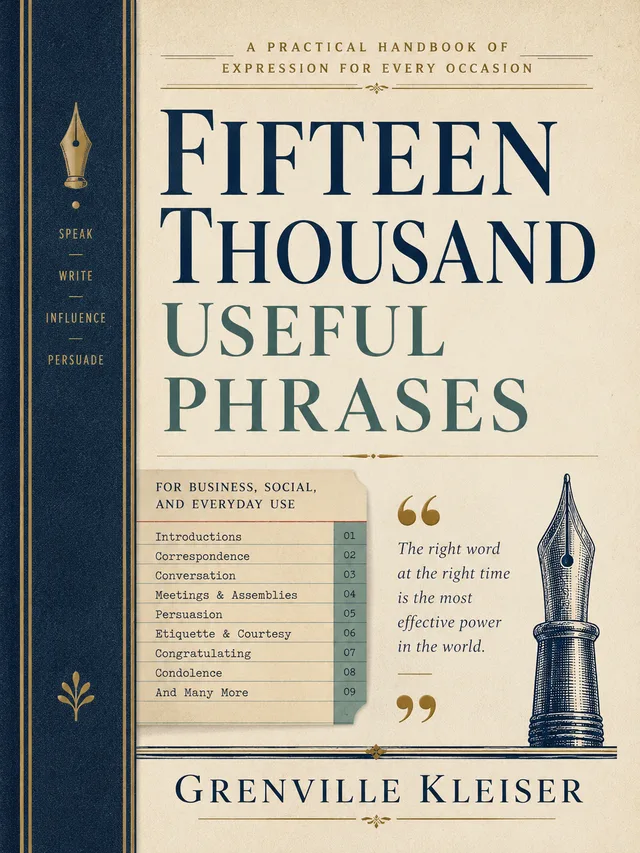
Fifteen Thousand Useful Phrases
英語 BooksWhale エディション · Grenville Kleiser
A practical treasury of English phrases for style, vocabulary, speech, and composition.
- プレビュー
- 準備済みテキストからの抜粋
- 形式
- オンラインリーダー, EPUB, PDF
- アクセス
- ライブラリ claim
本の紹介
Fifteen Thousand Useful Phrases
Fifteen Thousand Useful Phrases is a language builder arranged for readers who want more precise expression. Its value is practical: it gathers phrases for rhetoric, description, argument, and public speaking, making it useful for writers and learners.
BooksWhale エディション
このエディションの準備
このエディションはパブリックドメイン本文に基づき、BooksWhale がデジタル読書向けに準備しました。
パブリックドメイン根拠
このエディションを共有できる理由
Grenville Kleiser died in 1953, and Fifteen Thousand Useful Phrases was published in the early twentieth century. The selected public-domain source text should be confirmed before final publication.
プレビューを読む
準備済みテキストからの抜粋
準備済み読書テキストから選んだプレビューです。
プレビュー章Full textプレビューを読む
Fifteen Thousand Useful Phrases
Grenville Kleiser
プレビュー章INTRODUCTIONプレビュー
The most powerful and the most perfect expression of thought and feeling
through the medium of oral language must be traced to the mastery of
words. Nothing is better suited to lead speakers and readers of English
into an easy control of this language than the command of the phrase that
perfectly expresses the thought. Every speaker's aim is to be heard and understood. A clear, crisp articulation holds an audience as by the spell of some irresistible power. The choice word, the correct phrase, are
instruments that may reach the heart, and awake the soul if they fall upon
the ear in melodious cadence; but if the utterance be harsh and discordant
they fail to interest, fall upon deaf ears, and are as barren as seed sown
on fallow ground. In language, nothing conduces so emphatically to the
harmony of sounds as perfect phrasing--that is, the emphasizing of the
relation of clause to clause, and of sentence to sentence by the
systematic grouping of words. The phrase consists usually of a few words which denote a single idea that forms a separate part of a sentence. In
this respect it differs from the clause, which is a short sentence that
forms a distinct part of a composition, paragraph, or discourse. Correct
phrasing is regulated by rests, such rests as do not break the continuity
of a thought or the progress of the sense.
GRENVILLE KLEISER, who has devoted years of his diligent life to imparting
the art of correct expression in speech and writing, has provided many
aids for those who would know not merely what to say, but how to say it. He has taught also what the great HOLMES taught, that language is a temple
in which the human soul is enshrined, and that it grows out of life--out
of its joys and its sorrows, its burdens and its necessities. To him, as
well as to the writer, the deep strong voice of man and the low sweet
voice of woman are never heard at finer advantage than in the earnest but
mellow tones of familiar speech. In the present volume Mr. Kleiser
furnishes an additional and an exceptional aid for those who would have a
mint of phrases at their command from which to draw when in need of the
golden mean for expressing thought. Few indeed are the books fitted to-day
for the purpose of imparting this knowledge, yet two centuries ago
phrase-books were esteemed as supplements to the dictionaries, and have
not by any manner of means lost their value. The guide to familiar
quotations, the index to similes, the grammars, the readers, the
machine-made letter-writer of mechanically perfect letters of
congratulation or condolence--none are sententious enough to supply the
need. By the compilation of this praxis, Mr. Kleiser has not only supplied
it, but has furnished a means for the increase of one's vocabulary by
practical methods. There are thousands of persons who may profit by the
systematic study of such a book as this if they will familiarize
themselves with the author's purpose by a careful reading of the
preliminary pages of his book. To speak in public pleasingly and readily
and to read well are accomplishments acquired only after many days, weeks
even, of practise.
Foreigners sometimes reproach us for the asperity and discordance of our
speech, and in general, this reproach is just, for there are many persons
who do scanty justice to the vowel-elements of our language. Although these elements constitute its music they are continually mistreated. We flirt with and pirouette around them constantly. If it were not so, English would be found full of beauty and harmony of sound. Familiar with the maxim, "Take care of the vowels and the consonants will take care of
themselves,"--a maxim that when put into practise has frequently led to
the breaking-down of vowel values--the writer feels that the common custom
プレビュー章FRANK H. VIZETELLY.プレビュー
FRANK H. VIZETELLY.
目次
このエディションの内容
- 01Full text
- 02INTRODUCTION
- 03FRANK H. VIZETELLY.
- 04HOW TO USE THIS BOOK
- 05PLAN OF STUDY
- 06I. USEFUL PHRASES
- 07II. SIGNIFICANT PHRASES
- 08III. FELICITOUS PHRASES
- 09IV. IMPRESSIVE PHRASES
- 10V. PREPOSITIONAL PHRASES
- 11VI. BUSINESS PHRASES
- 12VII. LITERARY EXPRESSIONS
- 13VIII. STRIKING SIMILES
- 14IX. CONVERSATIONAL PHRASES
- 15X. PUBLIC SPEAKING PHRASES
- 16XI. MISCELLANEOUS PHRASES
- 17GRENVILLE KLEISER.
- 18SECTION I
- 19USEFUL PHRASES
- 20A
- 21B
- 22C
- 23D
- 24E
- 25F
- 26G
- 27H
- 28I
- 29J
- 30K
- 31L
- 32M
- 33N
- 34O
- 35P
- 36Q
- 37R
- 38S
- 39T
- 40U
- 41V
- 42W
- 43Y
- 44Z
- 45SECTION II
- 46SIGNIFICANT PHRASES
- 47A
- 48B
- 49C
- 50D
- 51E
- 52F
- 53G
- 54H
- 55I
- 56J
- 57K
- 58L
- 59M
- 60N
- 61O
- 62P
- 63Q
- 64R
- 65S
- 66T
- 67U
- 68V
- 69W
- 70Y
- 71Z
- 72SECTION III
- 73FELICITOUS PHRASES
- 74A
- 75B
- 76C
- 77D
- 78E
- 79F
- 80G
- 81H
- 82I
- 83J
- 84K
- 85L
- 86M
- 87N
- 88O
- 89P
- 90Q
- 91R
- 92S
- 93T
- 94U
- 95V
- 96W
- 97SECTION IV
- 98IMPRESSIVE PHRASES
- 99A
- 100B
- 101C
- 102D
- 103E
- 104F
- 105G
- 106H
- 107I
- 108J
- 109K
- 110L
- 111M
- 112N
- 113O
- 114P
- 115Q
- 116R
- 117S
- 118T
- 119U
- 120V
- 121W
- 122SECTION V
- 123PREPOSITIONAL PHRASES
- 124A
- 125B
- 126C
- 127D
- 128E
- 129F
- 130G
- 131H
- 132I
- 133J
- 134K
- 135L
- 136M
- 137N
- 138O
- 139P
- 140Q
- 141R
- 142S
- 143T
- 144U
- 145V
- 146W
- 147Z
- 148A
- 149B
- 150C
- 151D
- 152E
- 153F
- 154G
- 155H
- 156I
- 157L
- 158M
- 159N
- 160O
- 161R
- 162S
- 163T
- 164U
- 165V
- 166W
- 167A
- 168B
- 169C
- 170D
- 171E
- 172F
- 173G
- 174H
- 175I
- 176K
- 177L
- 178M
- 179N
- 180O
- 181P
- 182Q
- 183R
- 184S
- 185T
- 186U
- 187V
- 188W
- 189A
- 190B
- 191C
- 192D
- 193E
- 194F
- 195G
- 196H
- 197I
- 198K
- 199L
- 200M
- 201Q
- 202R
- 203S
- 204T
- 205U
- 206V
- 207W
- 208A
- 209B
- 210C
- 211D
- 212E
- 213F
- 214G
- 215H
- 216I
- 217L
- 218O
- 219R
- 220S
- 221T
- 222U
- 223V
- 224W
- 225Y
- 226A
- 227B
- 228C
- 229D
- 230E
- 231F
- 232G
- 233I
- 234K
- 235L
- 236M
- 237O
- 238P
- 239Q
- 240R
- 241S
- 242T
- 243U
- 244V
- 245W
- 246SECTION VI
- 247BUSINESS PHRASES
- 248A
- 249B
- 250C
- 251D
- 252E
- 253F
- 254H
- 255I
- 256J
- 257K
- 258L
- 259M
- 260O
- 261P
- 262R
- 263S
- 264T
- 265U
- 266W
- 267Y
- 268SECTION VII
- 269LITERARY EXPRESSIONS
- 270A
- 271B
- 272C
- 273D
- 274E
- 275F
- 276G
- 277H
- 278I
- 279J
- 280K
- 281L
- 282M
- 283N
- 284O
- 285P
- 286Q
- 287R
- 288S
- 289T
- 290U
- 291V
- 292W
- 293Y
- 294SECTION VIII
- 295STRIKING SIMILES
- 296A
- 297B
- 298C
- 299D
- 300E
- 301F
- 302G
- 303H
- 304I
- 305J
- 306K
- 307L
- 308M
- 309N
- 310O
- 311P
- 312Q
- 313R
- 314S
- 315T
- 316U
- 317V
- 318W
- 319Y
- 320SECTION IX
- 321CONVERSATIONAL PHRASES
- 322A
- 323B
- 324C
- 325D
- 326E
- 327F
- 328G
- 329H
- 330I
- 331J
- 332L
- 333M
- 334N
- 335O
- 336P
- 337Q
- 338R
- 339S
- 340T
- 341U
- 342V
- 343W
- 344Y
- 345SECTION X
- 346PUBLIC SPEAKING PHRASES
- 347A
- 348B
- 349C
- 350D
- 351E
- 352F
- 353G
- 354H
- 355I
- 356J
- 357L
- 358M
- 359N
- 360O
- 361P
- 362R
- 363S
- 364T
- 365U
- 366V
- 367W
- 368Y
- 369SECTION XI
- 370MISCELLANEOUS PHRASES
- 371A
- 372B
- 373C
- 374D
- 375E
- 376F
- 377G
- 378H
- 379I
- 380J
- 381K
- 382L
- 383M
- 384N
- 385O
- 386P
- 387Q
- 388R
- 389S
- 390T
- 391U
- 392V
- 393W
- 394Y
- 395Z