英語 エディション
文学
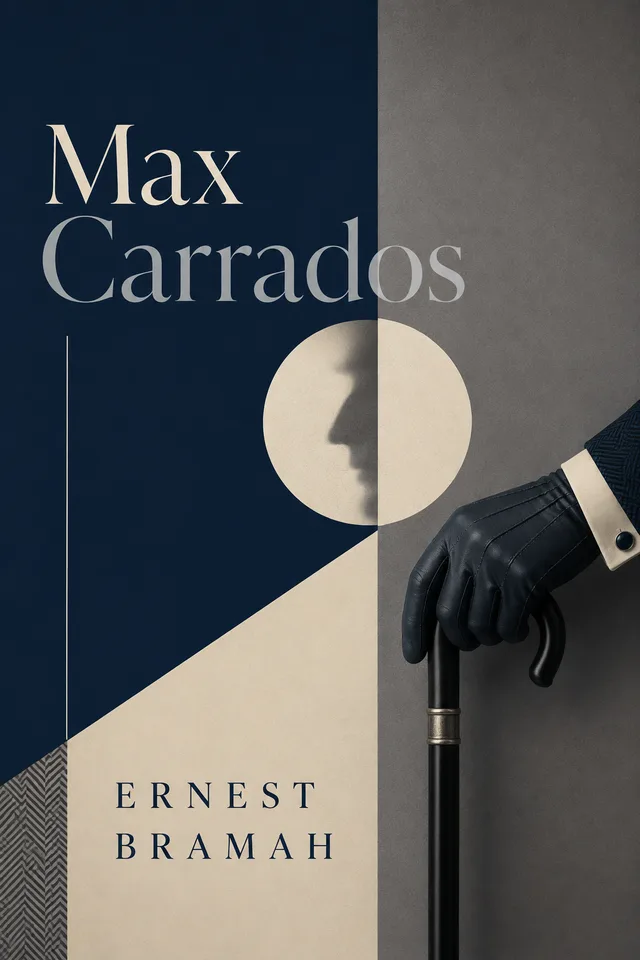
Max Carrados
英語 BooksWhale エディション · Ernest Bramah
A clever detective-story collection centered on Max Carrados, a blind sleuth with extraordinary perception.
- プレビュー
- 準備済みテキストからの抜粋
- 形式
- オンラインリーダー, EPUB, PDF
- アクセス
- ライブラリ claim
本の紹介
Max Carrados
Max Carrados gathers Ernest Bramah’s inventive detective stories featuring a blind investigator whose observation, memory, and reasoning rival the great sleuths of classic crime fiction. This original English edition is suited to readers of mystery, deduction, and Edwardian short stories.
BooksWhale エディション
このエディションの準備
このエディションはパブリックドメイン本文に基づき、BooksWhale がデジタル読書向けに準備しました。
パブリックドメイン根拠
このエディションを共有できる理由
Ernest Bramah died in 1942, and Max Carrados was first published in 1914; these dates support the public-domain basis for this original English detective collection.
プレビューを読む
準備済みテキストからの抜粋
準備済み読書テキストから選んだプレビューです。
プレビュー章Part 1プレビューを読む
Max Carrados
Ernest Bramah
MAX CARRADOS
THE COIN OF DIONYSIUS
It was eight o'clock at night and raining, scarcely a time when a business so limited in its clientele as that of a coin dealer could hope to attract any customer, but a light was still showing in the small shop that bore over its window the name of Baxter, and in the even smaller office at the back the proprietor himself sat reading the latest _Pall Mall_. His enterprise seemed to be justified, for presently the door bell gave its announcement, and throwing down his paper Mr Baxter went forward.
As a matter of fact the dealer had been expecting someone and his manner as he passed into the shop was unmistakably suggestive of a caller of importance. But at the first glance towards his visitor the excess of deference melted out of his bearing, leaving the urbane, self-possessed shopman in the presence of the casual customer.
"Mr Baxter, I think?" said the latter. He had laid aside his dripping umbrella and was unbuttoning overcoat and coat to reach an inner pocket. "You hardly remember me, I suppose? Mr Carlyle--two years ago I took up a case for you----"
"To be sure. Mr Carlyle, the private detective----"
"Inquiry agent," corrected Mr Carlyle precisely.
"Well," smiled Mr Baxter, "for that matter I am a coin dealer and not an antiquarian or a numismatist. Is there anything in that way that I can do for you?"
"Yes," replied his visitor; "it is my turn to consult you." He had taken a small wash-leather bag from the inner pocket and now turned something carefully out upon the counter. "What can you tell me about that?"
The dealer gave the coin a moment's scrutiny.
"There is no question about this," he replied. "It is a Sicilian tetradrachm of Dionysius."
"Yes, I know that--I have it on the label out of the cabinet. I can tell you further that it's supposed to be one that Lord Seastoke gave two hundred and fifty pounds for at the Brice sale in '94."
"It seems to me that you can tell me more about it than I can tell you," remarked Mr Baxter. "What is it that you really want to know?"
"I want to know," replied Mr Carlyle, "whether it is genuine or not."
"Has any doubt been cast upon it?"
"Certain circumstances raised a suspicion--that is all."
The dealer took another look at the tetradrachm through his magnifying glass, holding it by the edge with the careful touch of an expert. Then he shook his head slowly in a confession of ignorance.
"Of course I could make a guess----"
"No, don't," interrupted Mr Carlyle hastily. "An arrest hangs on it and nothing short of certainty is any good to me."
"Is that so, Mr Carlyle?" said Mr Baxter, with increased interest. "Well, to be quite candid, the thing is out of my line. Now if it was a rare Saxon penny or a doubtful noble I'd stake my reputation on my opinion, but I do very little in the classical series."
Mr Carlyle did not attempt to conceal his disappointment as he returned the coin to the bag and replaced the bag in the inner pocket.
"I had been relying on you," he grumbled reproachfully. "Where on earth am I to go now?"
"There is always the British Museum."
"Ah, to be sure, thanks. But will anyone who can tell me be there now?"
"Now? No fear!" replied Mr Baxter. "Go round in the morning----"
"But I must know to-night," explained the visitor, reduced to despair again. "To-morrow will be too late for the purpose."
Mr Baxter did not hold out much encouragement in the circumstances.
"You can scarcely expect to find anyone at business now," he remarked. "I should have been gone these two hours myself only I happened to have an appointment with an American millionaire who fixed his own time." Something indistinguishable from a wink slid off Mr Baxter's right eye. "Offmunson he's called, and a bright young pedigree-hunter has traced his descent from Offa, King of Mercia. So he--quite naturally--wants a set of Offas as a sort of collateral proof."
プレビュー章Part 2プレビュー
Mr Carlyle's groping hand sought and found a chair, on to which he dropped blankly. His eyes were unable to detach themselves for a single moment from the very ordinary spectacle of Mr Carrados's mildly benevolent face, while the sterilized ghost of his now forgotten amusement still lingered about his features.
"Good heavens!" he managed to articulate, "how do you know?"
"Isn't that what you wanted of me?" asked Carrados suavely.
"Don't humbug, Max," said Carlyle severely. "This is no joke." An undefined mistrust of his own powers suddenly possessed him in the presence of this mystery. "How do you come to know of Nina Brun and Lord Seastoke?"
"You are a detective, Louis," replied Carrados. "How does one know these things? By using one's eyes and putting two and two together."
Carlyle groaned and flung out an arm petulantly.
"Is it all bunkum, Max? Do you really see all the time--though that doesn't go very far towards explaining it."
"Like Vidal, I see very well--at close quarters," replied Carrados, lightly running a forefinger along the inscription on the tetradrachm. "For longer range I keep another pair of eyes. Would you like to test them?"
Mr Carlyle's assent was not very gracious; it was, in fact, faintly sulky. He was suffering the annoyance of feeling distinctly unimpressive in his own department; but he was also curious.
"The bell is just behind you, if you don't mind," said his host. "Parkinson will appear. You might take note of him while he is in."
The man who had admitted Mr Carlyle proved to be Parkinson.
"This gentleman is Mr Carlyle, Parkinson," explained Carrados the moment the man entered. "You will remember him for the future?"
Parkinson's apologetic eye swept the visitor from head to foot, but so lightly and swiftly that it conveyed to that gentleman the comparison of being very deftly dusted.
"I will endeavour to do so, sir," replied Parkinson, turning again to his master.
"I shall be at home to Mr Carlyle whenever he calls. That is all."
"Very well, sir."
"Now, Louis," remarked Mr Carrados briskly, when the door had closed again, "you have had a good opportunity of studying Parkinson. What is he like?"
"In what way?"
"I mean as a matter of description. I am a blind man--I haven't seen my servant for twelve years--what idea can you give me of him? I asked you to notice."
"I know you did, but your Parkinson is the sort of man who has very little about him to describe. He is the embodiment of the ordinary. His height is about average----"
"Five feet nine," murmured Carrados. "Slightly above the mean."
"Scarcely noticeably so. Clean-shaven. Medium brown hair. No particularly marked features. Dark eyes. Good teeth."
"False," interposed Carrados. "The teeth--not the statement."
"Possibly," admitted Mr Carlyle. "I am not a dental expert and I had no opportunity of examining Mr Parkinson's mouth in detail. But what is the drift of all this?"
"His clothes?"
"Oh, just the ordinary evening dress of a valet. There is not much room for variety in that."
"You noticed, in fact, nothing special by which Parkinson could be identified?"
"Well, he wore an unusually broad gold ring on the little finger of the left hand."
"But that is removable. And yet Parkinson has an ineradicable mole--a small one, I admit--on his chin. And you a human sleuth-hound. Oh, Louis!"
"At all events," retorted Carlyle, writhing a little under this good-humoured satire, although it was easy enough to see in it Carrados's affectionate intention--"at all events, I dare say I can give as good a description of Parkinson as he can give of me."
"That is what we are going to test. Ring the bell again."
"Seriously?"
"Quite. I am trying my eyes against yours. If I can't give you fifty out of a hundred I'll renounce my private detectorial ambition for ever."
プレビュー章Part 3プレビュー
"That is what you are going to find out, Louis?" suggested Carrados.
"It is what I am being paid for finding out," admitted Mr Carlyle frankly. "But so far we are just where the inquest left it, and, between ourselves, I candidly can't see an inch in front of my face in the matter."
"Nor can I," said the blind man, with a rather wry smile. "Never mind.
The engine-driver is your client, of course?"
"Yes," admitted Carlyle. "But how the deuce did you know?"
"Let us say that your sympathies are enlisted on his behalf. The jury were inclined to exonerate the signalman, weren't they? What has the company done with your man?"
"Both are suspended. Hutchins, the driver, hears that he may probably be given charge of a lavatory at one of the stations. He is a decent, bluff, short-spoken old chap, with his heart in his work. Just now you'll find him at his worst--bitter and suspicious. The thought of swabbing down a lavatory and taking pennies all day is poisoning him."
"Naturally. Well, there we have honest Hutchins: taciturn, a little touchy perhaps, grown grey in the service of the company, and manifesting quite a bulldog-like devotion to his favourite 538."
"Why, that actually was the number of his engine--how do you know it?" demanded Carlyle sharply.
"It was mentioned two or three times at the inquest, Louis," replied Carrados mildly.
"And you remembered--with no reason to?"
"You can generally trust a blind man's memory, especially if he has taken the trouble to develop it."
"Then you will remember that Hutchins did not make a very good impression at the time. He was surly and irritable under the ordeal. I want you to see the case from all sides."
"He called the signalman--Mead--a 'lying young dog,' across the room, I believe. Now, Mead, what is he like? You have seen him, of course?"
"Yes. He does not impress me favourably. He is glib, ingratiating, and distinctly 'greasy.' He has a ready answer for everything almost before the question is out of your mouth. He has thought of everything."
"And now you are going to tell me something, Louis," said Carrados encouragingly.
Mr Carlyle laughed a little to cover an involuntary movement of surprise.
"There is a suggestive line that was not touched at the inquiries," he admitted. "Hutchins has been a saving man all his life, and he has received good wages. Among his class he is regarded as wealthy. I daresay that he has five hundred pounds in the bank. He is a widower with one daughter, a very nice-mannered girl of about twenty. Mead is a young man, and he and the girl are sweethearts--have been informally engaged for some time. But old Hutchins would not hear of it; he seems to have taken a dislike to the signalman from the first and latterly he had forbidden him to come to his house or his daughter to speak to him."
"Excellent, Louis," cried Carrados in great delight. "We shall clear your man in a blaze of red and green lights yet and hang the glib, 'greasy' signalman from his own signal-post."
"It is a significant fact, seriously?"
"It is absolutely convincing."
"It may have been a slip, a mental lapse on Mead's part which he discovered the moment it was too late, and then, being too cowardly to admit his fault, and having so much at stake, he took care to make detection impossible. It may have been that, but my idea is rather that probably it was neither quite pure accident nor pure design. I can imagine Mead meanly pluming himself over the fact that the life of this man who stands in his way, and whom he must cordially dislike, lies in his power. I can imagine the idea becoming an obsession as he dwells on it. A dozen times with his hand on the lever he lets his mind explore the possibilities of a moment's defection. Then one day he pulls the signal off in sheer bravado--and hastily puts it at danger again. He may have done it once or he may have done it oftener before he was caught in a fatal moment of irresolution. The chances are about even that the engine-driver would be killed. In any case he would be disgraced, for it is easier on the face of it to believe that a man might run past a danger signal in absentmindedness, without noticing it, than that a man should pull off a signal and replace it without being conscious of his actions."
目次
このエディションの内容
- 01Part 1
- 02Part 2
- 03Part 3
- 04Part 4
- 05Part 5
- 06Part 6
- 07Part 7
- 08Part 8
- 09Part 9
- 10Part 10
- 11Part 11
- 12Part 12
- 13Part 13
- 14Part 14
- 15Part 15
- 16Part 16
- 17Part 17
- 18Part 18
- 19Part 19
- 20Part 20
- 21Part 21
- 22Part 22
- 23Part 23