英語 エディション
文学
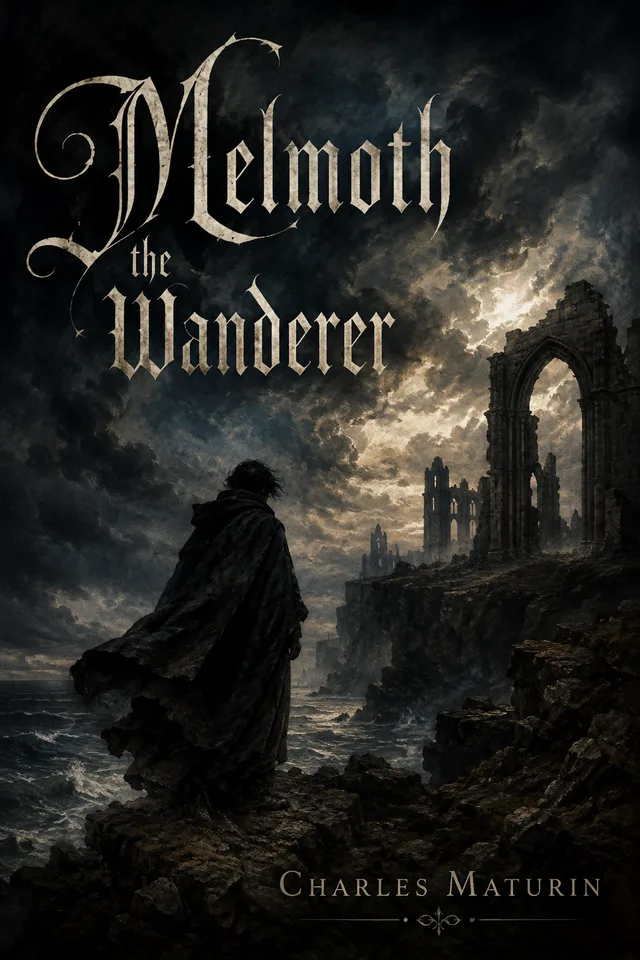
Melmoth the Wanderer
英語 BooksWhale エディション · Charles Maturin
A dark Gothic labyrinth of temptation, imprisonment, wandering, and a soul-selling bargain.
- プレビュー
- 準備済みテキストからの抜粋
- 形式
- オンラインリーダー, EPUB, PDF
- アクセス
- ライブラリ claim
本の紹介
Melmoth the Wanderer
Melmoth the Wanderer follows the legend of a doomed wanderer who offers desperate people escape at a terrible spiritual price. Maturin builds a nested Gothic structure of manuscripts, prisons, monasteries, madness, persecution, and metaphysical terror.
BooksWhale エディション
このエディションの準備
このエディションはパブリックドメイン本文に基づき、BooksWhale がデジタル読書向けに準備しました。
パブリックドメイン根拠
このエディションを共有できる理由
Charles Maturin died in 1824, and Melmoth the Wanderer was first published or composed in 1820; these dates support the public-domain basis for this edition.
プレビューを読む
準備済みテキストからの抜粋
準備済み読書テキストから選んだプレビューです。
プレビュー章Part 1プレビューを読む
Melmoth the Wanderer
Charles Robert Maturin
1820.
TO THE MOST NOBLE THE MARCHIONESS OF ABERCORN, This Romance Is, by her Ladyship’s permission, Respectfully inscribed by THE AUTHOR.
PREFACE.
The hint of this Romance (or Tale) was taken from a passage in one of my Sermons, which (as it is to be presumed very few have read) I shall here take the liberty to quote. The passage is this.
“At this moment is there one of us present, however we may have departed from the Lord, disobeyed his will, and disregarded his word--is there one of us who would, at this moment, accept all that man could bestow, or earth afford, to resign the hope of his salvation?--No, there is not one--not such a fool on earth, were the enemy of mankind to traverse it with the offer!”
This passage suggested the idea of “Melmoth the Wanderer.” The Reader will find that idea developed in the following pages, with what power or success _he_ is to decide.
The “Spaniard’s Tale” has been censured by a friend to whom I read it, as containing too much attempt at the revivification of the horrors of Radcliffe-Romance, of the persecutions of convents, and the terrors of the Inquisition.
I defended myself, by trying to point out to my friend, that I had made the misery of conventual life depend less on the startling adventures one meets with in romances, than on that irritating series of petty torments which constitutes the misery of life in general, and which, amid the tideless stagnation of monastic existence, solitude gives its inmates leisure to invent, and power combined with malignity, the full disposition to practise. I trust this defence will operate more on the conviction of the Reader, than it did on that of my friend.
For the rest of the Romance, there are some parts of it which I have borrowed from real life.
The story of John Sandal and Elinor Mortimer is founded in fact.
The original from which the Wife of Walberg is imperfectly sketched is a living woman, and _long may she live_.
I cannot again appear before the public in so unseemly a character as that of a writer of romances, without regretting the necessity that compels me to it. Did my profession furnish me with the means of subsistence, I should hold myself culpable indeed in having recourse to any other, but--am I allowed the choice?
Dublin, } 31st August 1820. }
CHAPTER I.
Alive again? Then show me where he is; I’ll give a thousand pounds to look upon him.
SHAKESPEARE.
In the autumn of 1816, John Melmoth, a student in Trinity College, Dublin, quitted it to attend a dying uncle on whom his hopes for independence chiefly rested. John was the orphan son of a younger brother, whose small property scarce could pay John’s college expences;
but the uncle was rich, unmarried, and old; and John, from his infancy, had been brought up to look on him with that mingled sensation of awe, and of the wish, without the means to conciliate, (that sensation at once attractive and repulsive), with which we regard a being who (as nurse, domestic, and parent have tutored us to believe) holds the very threads of our existence in his hands, and may prolong or snap them when he pleases.
On receiving this summons, John set immediately out to attend his uncle.
The beauty of the country through which he travelled (it was the county Wicklow) could not prevent his mind from dwelling on many painful thoughts, some borrowed from the past, and more from the future. His uncle’s caprice and moroseness,--the strange reports concerning the cause of the secluded life he had led for many years,--his own dependent state,--fell like blows fast and heavy on his mind. He roused himself to repel them,--sat up in the mail, in which he was a solitary passenger,--looked out on the prospect,--consulted his watch;--then he thought they receded for a moment,--but there was nothing to fill their place, and he was forced to invite them back for company. When the mind is thus active in calling over invaders, no wonder the conquest is soon completed. As the carriage drew near the Lodge, (the name of old Melmoth’s seat), John’s heart grew heavier every moment.
プレビュー章Part 2プレビュー
“But then his honor has had _a cool_ since,” said a man who was quietly swallowing the spirits that John had refused. At these words the Sybil who sat in the chimney corner slowly drew her pipe from her mouth, and turned towards the party: The oracular movements of a Pythoness on her tripod never excited more awe, or impressed for the moment a deeper silence. “It’s not _here_,” said she, pressing her withered finger on her wrinkled forehead, “nor _here_,--nor _here_;” and she extended her hand to the foreheads of those who were near her, who all bowed as if they were receiving a benediction, but had immediate recourse to the spirits afterwards, as if to ensure its effects.--“It’s all _here_--it’s all _about the heart_;” and as she spoke she spread and pressed her fingers on her hollow bosom with a force of action that thrilled her hearers.--“It’s all _here_,” she added, repeating the action, (probably excited by the effect she had produced), and then sunk on her seat, resumed her pipe, and spoke no more. At this moment of involuntary awe on the part of John, and of terrified silence on that of the rest, an unusual sound was heard in the house, and the whole company started as if a musket had been discharged among them:--it was the unwonted sound of old Melmoth’s bell. His domestics were so few, and so constantly near him, that the sound of his bell startled them as much as if he had been ringing the knell for his own interment. “He used always to _rap down_ for me,” said the old housekeeper, hurrying out of the kitchen; “he said pulling the bells wore out the ropes.”
The sound of the bell produced its full effect. The housekeeper rushed into the room, followed by a number of women, (the Irish præficæ), all ready to prescribe for the dying or weep for the dead,--all clapping their hard hands, or wiping their dry eyes. These hags all surrounded the bed; and to witness their loud, wild, and desperate grief, their cries of “Oh! he’s going, his honor’s going, his honor’s going,” one would have imagined their lives were bound up in his, like those of the wives in the story of Sinbad the Sailor, who were to be interred alive with their deceased husbands.
Four of them wrung their hands and howled round the bed, while one, with all the adroitness of a Mrs Quickly, felt his honor’s feet, and “upward and upward,” and “all was cold as any stone.”
Old Melmoth withdrew his feet from the grasp of the hag,--counted with his keen eye (keen amid the approaching dimness of death) the number assembled round his bed,--raised himself on his sharp elbow, and pushing away the housekeeper, (who attempted to settle his nightcap, that had been shoved on one side in the struggle, and gave his haggard, dying face, a kind of grotesque fierceness), bellowed out in tones that made the company start,--“What the devil brought ye all here?” The question scattered the whole party for a moment; but rallying instantly, they communed among themselves in whispers, and frequently using the sign of the cross, muttered “The devil,--Christ save us, the devil in his mouth the first word he spoke.” “Aye,” roared the invalid, “and the devil in my eye the first sight I see.” “Where,--where?” cried the terrified housekeeper, clinging close to the invalid in her terror, and half-hiding herself in the blanket, which she snatched without mercy from his struggling and exposed limbs. “There, there,” he repeated, (during the battle of the blanket), pointing to the huddled and terrified women, who stood aghast at hearing themselves arointed as the very demons they came to banish. “Oh! Lord keep your honor’s head,” said the housekeeper in a more soothing tone, when her fright was over; “and sure your honor knows them all, is’n’t _her_ name,--and _her_ name,--and _her_ name,”--and she pointed respectively to each of them, adding their names, which we shall spare the English reader the torture of reciting, (as a proof of our lenity, adding the last only, Cotchleen O’Mulligan), “Ye lie, ye b----h,” growled old Melmoth;
プレビュー章Part 3プレビュー
Old Melmoth at this moment seemed to be in a deep stupor; his eyes lost that little expression they had before, and his hands, that had convulsively been catching at the blankets, let go their short and quivering grasp, and lay extended on the bed like the claws of some bird that had died of hunger,--so meagre, so yellow, so spread. John, unaccustomed to the sight of death, believed this to be only a sign that he was going to sleep; and, urged by an impulse for which he did not attempt to account to himself, caught up the miserable light, and once more ventured into the forbidden room,--the _blue chamber_ of the dwelling. The motion roused the dying man;--he sat bolt upright in his bed. This John could not see, for he was now in the closet; but he heard the groan, or rather the choaked and guggling rattle of the throat, that announces the horrible conflict between muscular and mental convulsion.
He started, turned away; but, as he turned away, he thought he saw the eyes of the portrait, on which his own was fixed, _move_, and hurried back to his uncle’s bedside.
Old Melmoth died in the course of that night, and died as he had lived, in a kind of avaricious delirium. John could not have imagined a scene so horrible as his last hours presented. He cursed and blasphemed about three half-pence, missing, as he said, some weeks before, in an account of change with his groom, about hay to a starved horse that he kept.
Then he grasped John’s hand, and asked him to give him the sacrament. “If I send to the clergyman, he will charge me something for it, which I cannot pay,--I cannot. They say I am rich,--look at this blanket;--but I would not mind that, if I could save my soul.” And, raving, he added, “Indeed, Doctor, I am a very poor man. I never troubled a clergyman before, and all I want is, that you will grant me two trifling requests, very little matters in your way,--save my soul, and (whispering) make interest to get me a parish coffin,--I have not enough left to bury me.
I always told every one I was poor, but the more I told them so, the less they believed me.”
John, greatly shocked, retired from the bed-side, and sat down in a distant corner of the room. The women were again in the room, which was very dark. Melmoth was silent from exhaustion, and there was a death-like pause for some time. At this moment John saw the door open, and a figure appear at it, who looked round the room, and then quietly and deliberately retired, but not before John had discovered in his face the living original of the portrait. His first impulse was to utter an exclamation of terror, but his breath felt stopped. He was then rising to pursue the figure, but a moment’s reflection checked him. What could be more absurd, than to be alarmed or amazed at a resemblance between a living man and the portrait of a dead one! The likeness was doubtless strong enough to strike him even in that darkened room, but it was doubtless only a likeness; and though it might be imposing enough to terrify an old man of gloomy and retired habits, and with a broken constitution, John resolved it should not produce the same effect on him.
But while he was applauding himself for this resolution, the door opened, and the figure appeared at it, beckoning and nodding to him, with a familiarity somewhat terrifying. John now started up, determined to pursue it; but the pursuit was stopped by the weak but shrill cries of his uncle, who was struggling at once with the agonies of death and his housekeeper. The poor woman, anxious for her master’s reputation and her own, was trying to put on him a clean shirt and nightcap, and Melmoth, who had just sensation enough to perceive they were taking something from him, continued exclaiming feebly, “They are robbing me,--robbing me in my last moments,--robbing a dying man. John, won’t you assist me,--I shall die a beggar; they are taking my last shirt,--I shall die a beggar.”--And the miser died.
目次
このエディションの内容
- 01Part 1
- 02Part 2
- 03Part 3
- 04Part 4
- 05Part 5
- 06Part 6
- 07Part 7
- 08Part 8
- 09Part 9
- 10Part 10
- 11Part 11
- 12Part 12
- 13Part 13
- 14Part 14
- 15Part 15
- 16Part 16
- 17Part 17
- 18Part 18
- 19Part 19
- 20Part 20
- 21Part 21
- 22Part 22
- 23Part 23
- 24Part 24
- 25Part 25
- 26Part 26
- 27Part 27
- 28Part 28
- 29Part 29
- 30Part 30
- 31Part 31
- 32Part 32
- 33Part 33
- 34Part 34
- 35Part 35
- 36Part 36
- 37Part 37
- 38Part 38
- 39Part 39
- 40Part 40
- 41Part 41
- 42Part 42
- 43Part 43
- 44Part 44
- 45Part 45
- 46Part 46
- 47Part 47
- 48Part 48
- 49Part 49
- 50Part 50
- 51Part 51
- 52Part 52
- 53Part 53
- 54Part 54
- 55Part 55
- 56Part 56
- 57Part 57
- 58Part 58
- 59Part 59
- 60Part 60
- 61Part 61
- 62Part 62
- 63Part 63
- 64Part 64
- 65Part 65
- 66Part 66
- 67Part 67
- 68Part 68
- 69Part 69
- 70Part 70
- 71Part 71
- 72Part 72
- 73Part 73
- 74Part 74
- 75Part 75
- 76Part 76
- 77Part 77
- 78Part 78