英語 エディション
文学
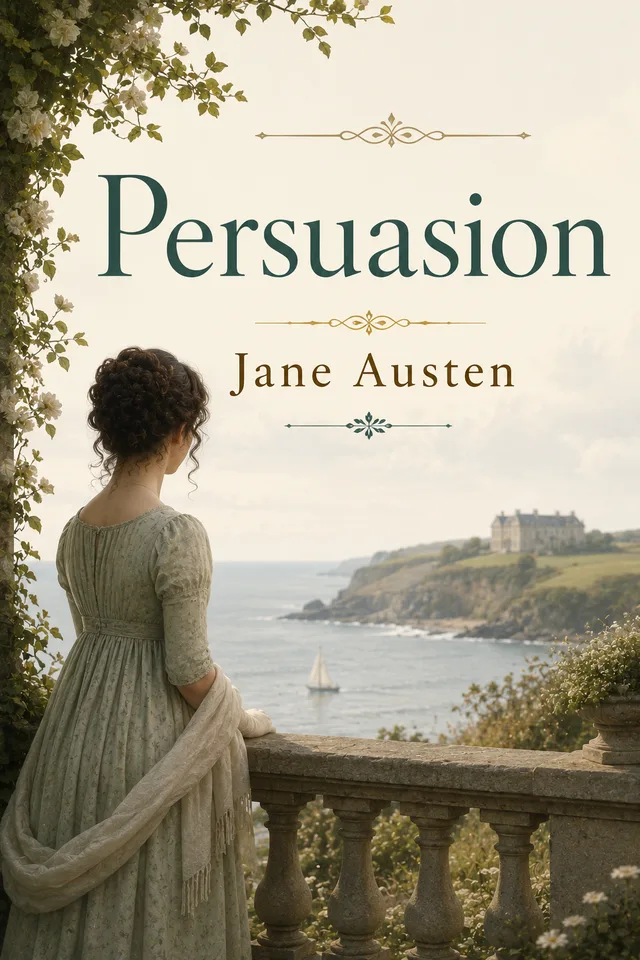
Persuasion
英語 BooksWhale エディション · Jane Austen
A mature Austen novel about regret, constancy, social pressure, and second chances.
- プレビュー
- 準備済みテキストからの抜粋
- 形式
- オンラインリーダー, EPUB, PDF
- アクセス
- ライブラリ claim
本の紹介
Persuasion
Persuasion follows Anne Elliot as an old attachment returns after years of separation and regret. Austen’s final completed novel is quieter and more reflective than her earlier comedies, with a deep feeling for memory and emotional endurance.
BooksWhale エディション
このエディションの準備
このエディションはパブリックドメイン本文に基づき、BooksWhale がデジタル読書向けに準備しました。
パブリックドメイン根拠
このエディションを共有できる理由
Jane Austen died in 1817, and Persuasion was first published in 1817; these dates support the public-domain basis for this English edition.
プレビューを読む
準備済みテキストからの抜粋
準備済み読書テキストから選んだプレビューです。
プレビュー章Full textプレビューを読む
Persuasion
Jane Austen
プレビュー章CHAPTER I.プレビュー
Sir Walter Elliot, of Kellynch Hall, in Somersetshire, was a man who, for his own amusement, never took up any book but the Baronetage; there he found occupation for an idle hour, and consolation in a distressed one; there his faculties were roused into admiration and respect, by contemplating the limited remnant of the earliest patents; there any unwelcome sensations, arising from domestic affairs changed naturally into pity and contempt as he turned over the almost endless creations of the last century; and there, if every other leaf were powerless, he could read his own history with an interest which never failed. This was the page at which the favourite volume always opened:
“ELLIOT OF KELLYNCH HALL.
“Walter Elliot, born March 1, 1760, married, July 15, 1784, Elizabeth, daughter of James Stevenson, Esq. of South Park, in the county of Gloucester, by which lady (who died 1800) he has issue Elizabeth, born June 1, 1785; Anne, born August 9, 1787; a still-born son, November 5, 1789; Mary, born November 20, 1791.”
Precisely such had the paragraph originally stood from the printer’s hands; but Sir Walter had improved it by adding, for the information of himself and his family, these words, after the date of Mary’s birth—“Married, December 16, 1810, Charles, son and heir of Charles Musgrove, Esq. of Uppercross, in the county of Somerset,” and by inserting most accurately the day of the month on which he had lost his wife.
Then followed the history and rise of the ancient and respectable family, in the usual terms; how it had been first settled in Cheshire; how mentioned in Dugdale, serving the office of high sheriff, representing a borough in three successive parliaments, exertions of loyalty, and dignity of baronet, in the first year of Charles II, with all the Marys and Elizabeths they had married; forming altogether two handsome duodecimo pages, and concluding with the arms and motto:—“Principal seat, Kellynch Hall, in the county of Somerset,” and Sir Walter’s handwriting again in this finale:—
“Heir presumptive, William Walter Elliot, Esq., great grandson of the second Sir Walter.”
Vanity was the beginning and the end of Sir Walter Elliot’s character; vanity of person and of situation. He had been remarkably handsome in his youth; and, at fifty-four, was still a very fine man. Few women could think more of their personal appearance than he did, nor could the valet of any new made lord be more delighted with the place he held in society. He considered the blessing of beauty as inferior only to the blessing of a baronetcy; and the Sir Walter Elliot, who united these gifts, was the constant object of his warmest respect and devotion.
His good looks and his rank had one fair claim on his attachment; since to them he must have owed a wife of very superior character to any thing deserved by his own. Lady Elliot had been an excellent woman, sensible and amiable; whose judgement and conduct, if they might be pardoned the youthful infatuation which made her Lady Elliot, had never required indulgence afterwards. She had humoured, or softened, or concealed his failings, and promoted his real respectability for seventeen years; and though not the very happiest being in the world herself, had found enough in her duties, her friends, and her children, to attach her to life, and make it no matter of indifference to her when she was called on to quit them. Three girls, the two eldest sixteen and fourteen, was an awful legacy for a mother to bequeath, an awful charge rather, to confide to the authority and guidance of a conceited, silly father. She had, however, one very intimate friend, a sensible, deserving woman, who had been brought, by strong attachment to herself, to settle close by her, in the village of Kellynch; and on her kindness and advice, Lady Elliot mainly relied for the best help and maintenance of the good principles and instruction which she had been anxiously giving her daughters.
プレビュー章CHAPTER II.プレビュー
Mr Shepherd, a civil, cautious lawyer, who, whatever might be his hold or his views on Sir Walter, would rather have the disagreeable prompted by anybody else, excused himself from offering the slightest hint, and only begged leave to recommend an implicit reference to the excellent judgement of Lady Russell, from whose known good sense he fully expected to have just such resolute measures advised as he meant to see finally adopted.
Lady Russell was most anxiously zealous on the subject, and gave it much serious consideration. She was a woman rather of sound than of quick abilities, whose difficulties in coming to any decision in this instance were great, from the opposition of two leading principles. She was of strict integrity herself, with a delicate sense of honour; but she was as desirous of saving Sir Walter’s feelings, as solicitous for the credit of the family, as aristocratic in her ideas of what was due to them, as anybody of sense and honesty could well be. She was a benevolent, charitable, good woman, and capable of strong attachments, most correct in her conduct, strict in her notions of decorum, and with manners that were held a standard of good-breeding. She had a cultivated mind, and was, generally speaking, rational and consistent—but she had prejudices on the side of ancestry; she had a value for rank and consequence, which blinded her a little to the faults of those who possessed them. Herself the widow of only a knight, she gave the dignity of a baronet all its due; and Sir Walter, independent of his claims as an old acquaintance, an attentive neighbour, an obliging landlord, the husband of her very dear friend, the father of Anne and her sisters, was, as being Sir Walter, in her apprehension, entitled to a great deal of compassion and consideration under his present difficulties.
They must retrench; that did not admit of a doubt. But she was very anxious to have it done with the least possible pain to him and Elizabeth. She drew up plans of economy, she made exact calculations, and she did what nobody else thought of doing: she consulted Anne, who never seemed considered by the others as having any interest in the question. She consulted, and in a degree was influenced by her in marking out the scheme of retrenchment which was at last submitted to Sir Walter. Every emendation of Anne’s had been on the side of honesty against importance. She wanted more vigorous measures, a more complete reformation, a quicker release from debt, a much higher tone of indifference for everything but justice and equity.
“If we can persuade your father to all this,” said Lady Russell, looking over her paper, “much may be done. If he will adopt these regulations, in seven years he will be clear; and I hope we may be able to convince him and Elizabeth, that Kellynch Hall has a respectability in itself which cannot be affected by these reductions; and that the true dignity of Sir Walter Elliot will be very far from lessened in the eyes of sensible people, by acting like a man of principle. What will he be doing, in fact, but what very many of our first families have done, or ought to do? There will be nothing singular in his case; and it is singularity which often makes the worst part of our suffering, as it always does of our conduct. I have great hope of prevailing. We must be serious and decided; for after all, the person who has contracted debts must pay them; and though a great deal is due to the feelings of the gentleman, and the head of a house, like your father, there is still more due to the character of an honest man.”
This was the principle on which Anne wanted her father to be proceeding, his friends to be urging him. She considered it as an act of indispensable duty to clear away the claims of creditors with all the expedition which the most comprehensive retrenchments could secure, and saw no dignity in anything short of it. She wanted it to be prescribed, and felt as a duty. She rated Lady Russell’s influence highly; and as to the severe degree of self-denial which her own conscience prompted, she believed there might be little more difficulty in persuading them to a complete, than to half a reformation. Her knowledge of her father and Elizabeth inclined her to think that the sacrifice of one pair of horses would be hardly less painful than of both, and so on, through the whole list of Lady Russell’s too gentle reductions.
目次
このエディションの内容
- 01Full text
- 02CHAPTER I.
- 03CHAPTER II.
- 04CHAPTER III.
- 05CHAPTER IV.
- 06CHAPTER V.
- 07CHAPTER VI.
- 08CHAPTER VII.
- 09CHAPTER VIII.
- 10CHAPTER IX.
- 11CHAPTER X.
- 12CHAPTER XI.
- 13CHAPTER XII.
- 14CHAPTER XIII.
- 15CHAPTER XIV.
- 16CHAPTER XV.
- 17CHAPTER XVI.
- 18CHAPTER XVII.
- 19CHAPTER XVIII.
- 20CHAPTER XIX.
- 21CHAPTER XX.
- 22CHAPTER XXI.
- 23CHAPTER XXII.
- 24CHAPTER XXIII.
- 25CHAPTER XXIV.