英語 エディション
哲学
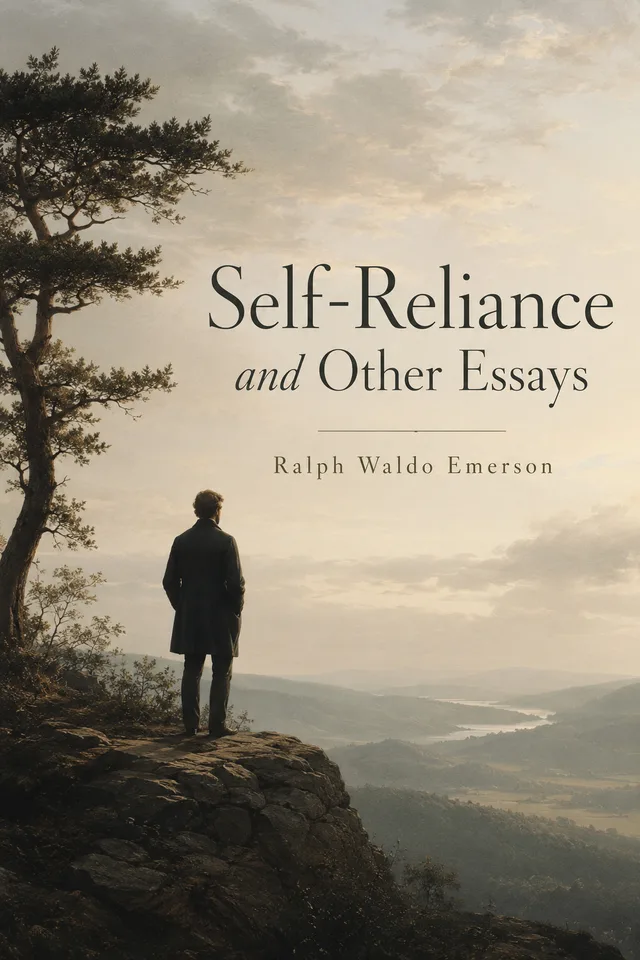
Self-Reliance and Other Essays
英語 BooksWhale エディション · Ralph Waldo Emerson
American transcendentalist essays on self-culture, independence, moral courage, nature, society, and individual thought.
- プレビュー
- 準備済みテキストからの抜粋
- 形式
- オンラインリーダー, EPUB, PDF
- アクセス
- ライブラリ claim
本の紹介
Self-Reliance and Other Essays
Self-Reliance and Other Essays is a carefully selected public-domain philosophy work by Ralph Waldo Emerson. American transcendentalist essays on self-culture, independence, moral courage, nature, society, and individual thought. This BooksWhale edition is prepared for readers looking for classic works with clean metadata, searchable titles, and reliable publication context.
BooksWhale エディション
このエディションの準備
このエディションはパブリックドメイン本文に基づき、BooksWhale がデジタル読書向けに準備しました。
パブリックドメイン根拠
このエディションを共有できる理由
Self-Reliance and Other Essays was first published in 1841. The selected edition uses public-domain text suitable for BooksWhale publication, with any translation source limited to public-domain material.
プレビューを読む
準備済みテキストからの抜粋
準備済み読書テキストから選んだプレビューです。
プレビュー章Full textプレビューを読む
Self-Reliance and Other Essays
Ralph Waldo Emerson
I. HISTORY II. SELF-RELIANCE III. COMPENSATION IV. SPIRITUAL LAWS V. LOVE VI. FRIENDSHIP VII. PRUDENCE VIII. HEROISM IX. THE OVER-SOUL X. CIRCLES XI. INTELLECT XII. ART
Next Volume
I. HISTORY
There is no great and no small To the Soul that maketh all: And where it cometh, all things are And it cometh everywhere.
I am owner of the sphere, Of the seven stars and the solar year, Of Cæsar’s hand, and Plato’s brain, Of Lord Christ’s heart, and Shakspeare’s strain.
プレビュー章HISTORYプレビュー
There is one mind common to all individual men. Every man is an inlet to the same and to all of the same. He that is once admitted to the right of reason is made a freeman of the whole estate. What Plato has thought, he may think; what a saint has felt, he may feel; what at any time has befallen any man, he can understand. Who hath access to this universal mind is a party to all that is or can be done, for this is the only and sovereign agent.
Of the works of this mind history is the record. Its genius is illustrated by the entire series of days. Man is explicable by nothing less than all his history. Without hurry, without rest, the human spirit goes forth from the beginning to embody every faculty, every thought, every emotion, which belongs to it, in appropriate events. But the thought is always prior to the fact; all the facts of history preexist in the mind as laws. Each law in turn is made by circumstances predominant, and the limits of nature give power to but one at a time. A man is the whole encyclopaedia of facts. The creation of a thousand forests is in one acorn, and Egypt, Greece, Rome, Gaul, Britain, America, lie folded already in the first man. Epoch after epoch, camp, kingdom, empire, republic, democracy, are merely the application of his manifold spirit to the manifold world.
This human mind wrote history, and this must read it. The Sphinx must solve her own riddle. If the whole of history is in one man, it is all to be explained from individual experience. There is a relation between the hours of our life and the centuries of time. As the air I breathe is drawn from the great repositories of nature, as the light on my book is yielded by a star a hundred millions of miles distant, as the poise of my body depends on the equilibrium of centrifugal and centripetal forces, so the hours should be instructed by the ages and the ages explained by the hours. Of the universal mind each individual man is one more incarnation. All its properties consist in him. Each new fact in his private experience flashes a light on what great bodies of men have done, and the crises of his life refer to national crises. Every revolution was first a thought in one man’s mind, and when the same thought occurs to another man, it is the key to that era. Every reform was once a private opinion, and when it shall be a private opinion again it will solve the problem of the age. The fact narrated must correspond to something in me to be credible or intelligible. We, as we read, must become Greeks, Romans, Turks, priest and king, martyr and executioner; must fasten these images to some reality in our secret experience, or we shall learn nothing rightly. What befell Asdrubal or Cæsar Borgia is as much an illustration of the mind’s powers and depravations as what has befallen us. Each new law and political movement has meaning for you. Stand before each of its tablets and say, ‘Under this mask did my Proteus nature hide itself.’ This remedies the defect of our too great nearness to ourselves. This throws our actions into perspective; and as crabs, goats, scorpions, the balance and the waterpot lose their meanness when hung as signs in the zodiac, so I can see my own vices without heat in the distant persons of Solomon, Alcibiades, and Catiline.
It is the universal nature which gives worth to particular men and things. Human life, as containing this, is mysterious and inviolable, and we hedge it round with penalties and laws. All laws derive hence their ultimate reason; all express more or less distinctly some command of this supreme, illimitable essence. Property also holds of the soul, covers great spiritual facts, and instinctively we at first hold to it with swords and laws and wide and complex combinations. The obscure consciousness of this fact is the light of all our day, the claim of claims; the plea for education, for justice, for charity; the foundation of friendship and love and of the heroism and grandeur which belong to acts of self-reliance. It is remarkable that involuntarily we always read as superior beings. Universal history, the poets, the romancers, do not in their stateliest pictures,—in the sacerdotal, the imperial palaces, in the triumphs of will or of genius,—anywhere lose our ear, anywhere make us feel that we intrude, that this is for better men; but rather is it true that in their grandest strokes we feel most at home. All that Shakspeare says of the king, yonder slip of a boy that reads in the corner feels to be true of himself. We sympathize in the great moments of history, in the great discoveries, the great resistances, the great prosperities of men;—because there law was enacted, the sea was searched, the land was found, or the blow was struck, _for us_, as we ourselves in that place would have done or applauded.
プレビュー章SELF-RELIANCEプレビュー
I read the other day some verses written by an eminent painter which were original and not conventional. The soul always hears an admonition in such lines, let the subject be what it may. The sentiment they instil is of more value than any thought they may contain. To believe your own thought, to believe that what is true for you in your private heart is true for all men,—that is genius. Speak your latent conviction, and it shall be the universal sense; for the inmost in due time becomes the outmost, and our first thought is rendered back to us by the trumpets of the Last Judgment. Familiar as the voice of the mind is to each, the highest merit we ascribe to Moses, Plato and Milton is that they set at naught books and traditions, and spoke not what men, but what _they_ thought. A man should learn to detect and watch that gleam of light which flashes across his mind from within, more than the lustre of the firmament of bards and sages. Yet he dismisses without notice his thought, because it is his. In every work of genius we recognize our own rejected thoughts; they come back to us with a certain alienated majesty. Great works of art have no more affecting lesson for us than this. They teach us to abide by our spontaneous impression with good-humored inflexibility then most when the whole cry of voices is on the other side. Else to-morrow a stranger will say with masterly good sense precisely what we have thought and felt all the time, and we shall be forced to take with shame our own opinion from another.
There is a time in every man’s education when he arrives at the conviction that envy is ignorance; that imitation is suicide; that he must take himself for better for worse as his portion; that though the wide universe is full of good, no kernel of nourishing corn can come to him but through his toil bestowed on that plot of ground which is given to him to till. The power which resides in him is new in nature, and none but he knows what that is which he can do, nor does he know until he has tried. Not for nothing one face, one character, one fact, makes much impression on him, and another none. This sculpture in the memory is not without preestablished harmony. The eye was placed where one ray should fall, that it might testify of that particular ray. We but half express ourselves, and are ashamed of that divine idea which each of us represents. It may be safely trusted as proportionate and of good issues, so it be faithfully imparted, but God will not have his work made manifest by cowards. A man is relieved and gay when he has put his heart into his work and done his best; but what he has said or done otherwise shall give him no peace. It is a deliverance which does not deliver. In the attempt his genius deserts him; no muse befriends; no invention, no hope.
Trust thyself: every heart vibrates to that iron string. Accept the place the divine providence has found for you, the society of your contemporaries, the connection of events. Great men have always done so, and confided themselves childlike to the genius of their age, betraying their perception that the absolutely trustworthy was seated at their heart, working through their hands, predominating in all their being. And we are now men, and must accept in the highest mind the same transcendent destiny; and not minors and invalids in a protected corner, not cowards fleeing before a revolution, but guides, redeemers and benefactors, obeying the Almighty effort and advancing on Chaos and the Dark.
What pretty oracles nature yields us on this text in the face and behavior of children, babes, and even brutes! That divided and rebel mind, that distrust of a sentiment because our arithmetic has computed the strength and means opposed to our purpose, these have not. Their mind being whole, their eye is as yet unconquered, and when we look in their faces we are disconcerted. Infancy conforms to nobody; all conform to it; so that one babe commonly makes four or five out of the adults who prattle and play to it. So God has armed youth and puberty and manhood no less with its own piquancy and charm, and made it enviable and gracious and its claims not to be put by, if it will stand by itself. Do not think the youth has no force, because he cannot speak to you and me. Hark! in the next room his voice is sufficiently clear and emphatic. It seems he knows how to speak to his contemporaries. Bashful or bold then, he will know how to make us seniors very unnecessary.
目次
このエディションの内容
- 01Full text
- 02HISTORY
- 03SELF-RELIANCE
- 04COMPENSATION
- 05SPIRITUAL LAWS
- 06LOVE
- 07FRIENDSHIP
- 08DEAR FRIEND,
- 09PRUDENCE
- 10HEROISM
- 11THE OVER-SOUL
- 12CIRCLES
- 13INTELLECT
- 14ART