英語 エディション
文学
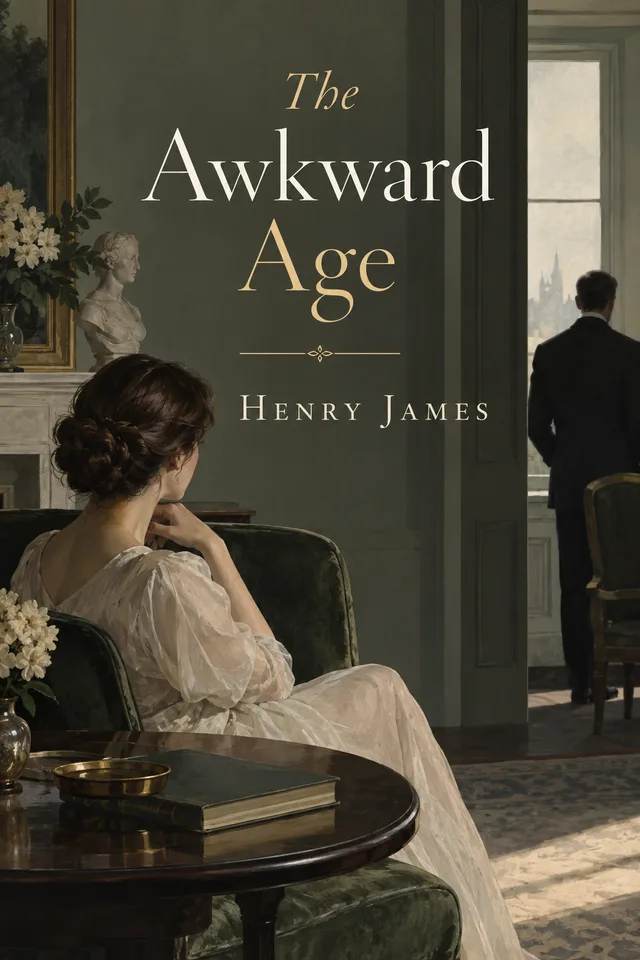
The Awkward Age
英語 BooksWhale エディション · Henry James
A drawing-room drama of youth, marriage, and the social rules that adults prefer not to name.
- プレビュー
- 準備済みテキストからの抜粋
- 形式
- オンラインリーダー, EPUB, PDF
- アクセス
- ライブラリ claim
本の紹介
The Awkward Age
Henry James turns a London gathering into a precise study of conversation, withheld knowledge, and the uneasy passage from protected girlhood into adult society.
BooksWhale エディション
このエディションの準備
このエディションはパブリックドメイン本文に基づき、BooksWhale がデジタル読書向けに準備しました。
パブリックドメイン根拠
このエディションを共有できる理由
The original work is public domain under applicable copyright-term rules; the source text belongs to the public domain in the relevant publication and author-term jurisdictions.
プレビューを読む
準備済みテキストからの抜粋
準備済み読書テキストから選んだプレビューです。
プレビュー章Full textプレビューを読む
The Awkward Age
By Henry James
プレビュー章PREFACEプレビュー
I recall with perfect ease the idea in which “The Awkward Age” had its origin, but re-perusal gives me pause in respect to naming it. This composition, as it stands, makes, to my vision—and will have made perhaps still more to that of its readers—so considerable a mass beside the germ sunk in it and still possibly distinguishable, that I am half-moved to leave my small secret undivulged. I shall encounter, I think, in the course of this copious commentary, no better example, and none on behalf of which I shall venture to invite more interest, of the quite incalculable tendency of a mere grain of subject-matter to expand and develop and cover the ground when conditions happen to favour it. I say all, surely, when I speak of the thing as planned, in perfect good faith, for brevity, for levity, for simplicity, for jocosity, in fine, and for an accommodating irony. I invoked, for my protection, the spirit of the lightest comedy, but “The Awkward Age” was to belong, in the event, to a group of productions, here re-introduced, which have in common, to their author’s eyes, the endearing sign that they asserted in each case an unforeseen principle of growth. They were projected as small things, yet had finally to be provided for as comparative monsters. That is my own title for them, though I should perhaps resent it if applied by another critic—above all in the case of the piece before us, the careful measure of which I have just freshly taken. The result of this consideration has been in the first place to render sharp for me again the interest of the whole process thus illustrated, and in the second quite to place me on unexpectedly good terms with the work itself. As I scan my list I encounter none the “history” of which embodies a greater number of curious truths—or of truths at least by which I find contemplation more enlivened. The thing done and dismissed has ever, at the best, for the ambitious workman, a trick of looking dead, if not buried, so that he almost throbs with ecstasy when, on an anxious review, the flush of life reappears. It is verily on recognising that flush on a whole side of “The Awkward Age” that I brand it all, but ever so tenderly, as monstrous—which is but my way of noting the QUANTITY of finish it stows away. Since I speak so undauntedly, when need is, of the value of composition, I shall not beat about the bush to claim for these pages the maximum of that advantage. If such a feat be possible in this field as really taking a lesson from one’s own adventure I feel I have now not failed of it—to so much more demonstration of my profit than I can hope to carry through do I find myself urged. Thus it is that, still with a remnant of self-respect, or at least of sanity, one may turn to complacency, one may linger with pride. Let my pride provoke a frown till I justify it; which—though with more matters to be noted here than I have room for I shall accordingly proceed to do.
Yet I must first make a brave face, no doubt, and present in its native humility my scant but quite ponderable germ. The seed sprouted in that vast nursery of sharp appeals and concrete images which calls itself, for blest convenience, London; it fell even into the order of the minor “social phenomena” with which, as fruit for the observer, that mightiest of the trees of suggestion bristles. It was not, no doubt, a fine purple peach, but it might pass for a round ripe plum, the note one had inevitably had to take of the difference made in certain friendly houses and for certain flourishing mothers by the sometimes dreaded, often delayed, but never fully arrested coming to the forefront of some vague slip of a daughter. For such mild revolutions as these not, to one’s imagination, to remain mild one had had, I dare say, to be infinitely addicted to “noticing”; under the rule of that secret vice or that unfair advantage, at any rate, the “sitting downstairs,” from a given date, of the merciless maiden previously perched aloft could easily be felt as a crisis. This crisis, and the sense for it in those whom it most concerns, has to confess itself courageously the prime propulsive force of “The Awkward Age.” Such a matter might well make a scant show for a “thick book,” and no thick book, but just a quite charmingly thin one, was in fact originally dreamt of. For its proposed scale the little idea seemed happy—happy, that is, above all in having come very straight; but its proposed scale was the limit of a small square canvas. One had been present again and again at the exhibition I refer to—which is what I mean by the “coming straight” of this particular London impression; yet one was (and through fallibilities that after all had their sweetness, so that one would on the whole rather have kept them than parted with them) still capable of so false a measurement. When I think indeed of those of my many false measurements that have resulted, after much anguish, in decent symmetries, I find the whole case, I profess, a theme for the philosopher. The little ideas one wouldn’t have treated save for the design of keeping them small, the developed situations that one would never with malice prepense have undertaken, the long stories that had thoroughly meant to be short, the short subjects that had underhandedly plotted to be long, the hypocrisy of modest beginnings, the audacity of misplaced middles, the triumph of intentions never entertained—with these patches, as I look about, I see my experience paved: an experience to which nothing is wanting save, I confess, some grasp of its final lesson.
プレビュー章HENRY JAMES.プレビュー
HENRY JAMES.
目次
このエディションの内容
- 01Full text
- 02PREFACE
- 03HENRY JAMES.
- 04THE AWKWARD AGE
- 05BOOK FIRST. LADY JULIA
- 06I
- 07II
- 08III
- 09BOOK SECOND. LITTLE AGGIE
- 10II
- 11III
- 12IV
- 13V
- 14VI
- 15BOOK THIRD. MR. LONGDON
- 16II
- 17III
- 18BOOK FOURTH. MR. CASHMORE
- 19II
- 20III
- 21BOOK FIFTH. THE DUCHESS
- 22II
- 23III
- 24IV
- 25V
- 26BOOK SIXTH. MRS. BROOK
- 27II
- 28III
- 29BOOK SEVENTH. MITCHY
- 30II
- 31III
- 32BOOK EIGHTH. TISHY GRENDON
- 33I
- 34Mild as it was, however, Nanda missed the pleasantry. “Mr. Grendon’s not here.”
- 35II
- 36III
- 37IV
- 38BOOK NINTH. VANDERBANK
- 39I
- 40II
- 41III
- 42IV
- 43BOOK TENTH. NANDA
- 44I
- 45II
- 46III
- 47IV