英語 エディション
文学
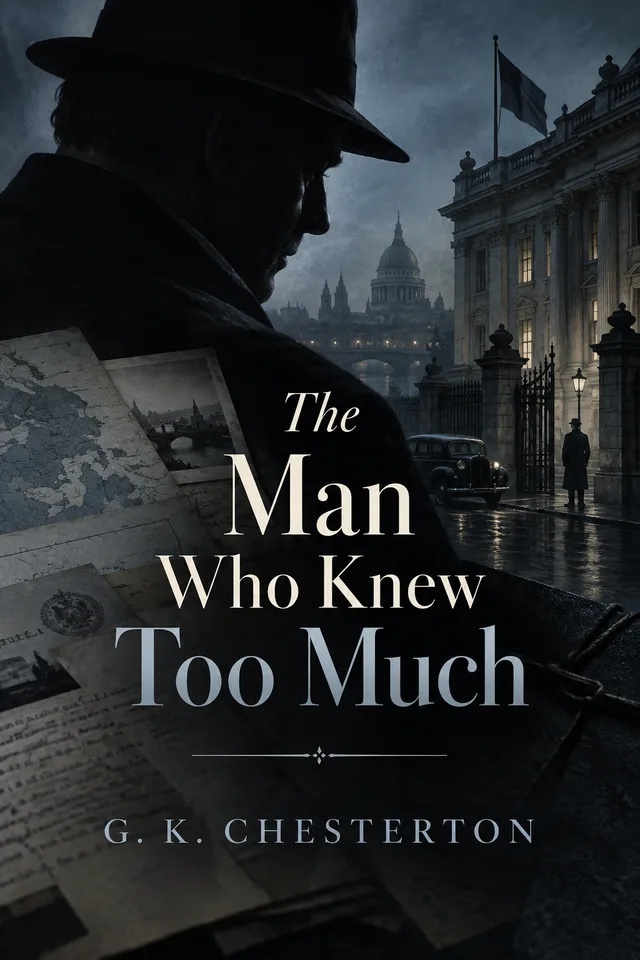
The Man Who Knew Too Much
英語 BooksWhale エディション · G. K. Chesterton
Political mysteries of espionage, hidden power, diplomacy, and moral uncertainty.
- プレビュー
- 準備済みテキストからの抜粋
- 形式
- オンラインリーダー, EPUB, PDF
- アクセス
- ライブラリ claim
本の紹介
The Man Who Knew Too Much
Horne Fisher understands the secrets behind political crimes, but knowledge does not always produce justice.
BooksWhale エディション
このエディションの準備
このエディションはパブリックドメイン本文に基づき、BooksWhale がデジタル読書向けに準備しました。
パブリックドメイン根拠
このエディションを共有できる理由
The source text is public domain; G. K. Chesterton died in 1936 and the work dates from 1922.
プレビューを読む
準備済みテキストからの抜粋
準備済み読書テキストから選んだプレビューです。
プレビュー章Full textプレビューを読む
The Man Who Knew Too Much
G. K. Chesterton
プレビュー章I. THE FACE IN THE TARGETプレビュー
Harold March, the rising reviewer and social critic, was walking vigorously across a great tableland of moors and commons, the horizon of which was fringed with the far-off woods of the famous estate of Torwood Park. He was a good-looking young man in tweeds, with very pale curly hair and pale clear eyes. Walking in wind and sun in the very landscape of liberty, he was still young enough to remember his politics and not merely try to forget them. For his errand at Torwood Park was a political one; it was the place of appointment named by no less a person than the Chancellor of the Exchequer, Sir Howard Horne, then introducing his so-called Socialist budget, and prepared to expound it in an interview with so promising a penman. Harold March was the sort of man who knows everything about politics, and nothing about politicians. He also knew a great deal about art, letters, philosophy, and general culture; about almost everything, indeed, except the world he was living in.
Abruptly, in the middle of those sunny and windy flats, he came upon a sort of cleft almost narrow enough to be called a crack in the land. It was just large enough to be the water-course for a small stream which vanished at intervals under green tunnels of undergrowth, as if in a dwarfish forest. Indeed, he had an odd feeling as if he were a giant looking over the valley of the pygmies. When he dropped into the hollow, however, the impression was lost; the rocky banks, though hardly above the height of a cottage, hung over and had the profile of a precipice. As he began to wander down the course of the stream, in idle but romantic curiosity, and saw the water shining in short strips between the great gray boulders and bushes as soft as great green mosses, he fell into quite an opposite vein of fantasy. It was rather as if the earth had opened and swallowed him into a sort of underworld of dreams. And when he became conscious of a human figure dark against the silver stream, sitting on a large boulder and looking rather like a large bird, it was perhaps with some of the premonitions proper to a man who meets the strangest friendship of his life.
The man was apparently fishing; or at least was fixed in a fisherman’s attitude with more than a fisherman’s immobility. March was able to examine the man almost as if he had been a statue for some minutes before the statue spoke. He was a tall, fair man, cadaverous, and a little lackadaisical, with heavy eyelids and a highbridged nose. When his face was shaded with his wide white hat, his light mustache and lithe figure gave him a look of youth. But the Panama lay on the moss beside him; and the spectator could see that his brow was prematurely bald; and this, combined with a certain hollowness about the eyes, had an air of headwork and even headache. But the most curious thing about him, realized after a short scrutiny, was that, though he looked like a fisherman, he was not fishing.
He was holding, instead of a rod, something that might have been a landing-net which some fishermen use, but which was much more like the ordinary toy net which children carry, and which they generally use indifferently for shrimps or butterflies. He was dipping this into the water at intervals, gravely regarding its harvest of weed or mud, and emptying it out again.
“No, I haven’t caught anything,” he remarked, calmly, as if answering an unspoken query. “When I do I have to throw it back again; especially the big fish. But some of the little beasts interest me when I get ‘em.”
“A scientific interest, I suppose?” observed March.
“Of a rather amateurish sort, I fear,” answered the strange fisherman. “I have a sort of hobby about what they call ‘phenomena of phosphorescence.’ But it would be rather awkward to go about in society carrying stinking fish.”
プレビュー章II. THE VANISHING PRINCEプレビュー
This tale begins among a tangle of tales round a name that is at once recent and legendary. The name is that of Michael O’Neill, popularly called Prince Michael, partly because he claimed descent from ancient Fenian princes, and partly because he was credited with a plan to make himself prince president of Ireland, as the last Napoleon did of France. He was undoubtedly a gentleman of honorable pedigree and of many accomplishments, but two of his accomplishments emerged from all the rest. He had a talent for appearing when he was not wanted and a talent for disappearing when he was wanted, especially when he was wanted by the police. It may be added that his disappearances were more dangerous than his appearances. In the latter he seldom went beyond the sensational—pasting up seditious placards, tearing down official placards, making flamboyant speeches, or unfurling forbidden flags. But in order to effect the former he would sometimes fight for his freedom with startling energy, from which men were sometimes lucky to escape with a broken head instead of a broken neck. His most famous feats of escape, however, were due to dexterity and not to violence. On a cloudless summer morning he had come down a country road white with dust, and, pausing outside a farmhouse, had told the farmer’s daughter, with elegant indifference, that the local police were in pursuit of him. The girl’s name was Bridget Royce, a somber and even sullen type of beauty, and she looked at him darkly, as if in doubt, and said, “Do you want me to hide you?” Upon which he only laughed, leaped lightly over the stone wall, and strode toward the farm, merely throwing over his shoulder the remark, “Thank you, I have generally been quite capable of hiding myself.” In which proceeding he acted with a tragic ignorance of the nature of women; and there fell on his path in that sunshine a shadow of doom.
While he disappeared through the farmhouse the girl remained for a few moments looking up the road, and two perspiring policemen came plowing up to the door where she stood. Though still angry, she was still silent, and a quarter of an hour later the officers had searched the house and were already inspecting the kitchen garden and cornfield behind it. In the ugly reaction of her mood she might have been tempted even to point out the fugitive, but for a small difficulty that she had no more notion than the policemen had of where he could possibly have gone. The kitchen garden was inclosed by a very low wall, and the cornfield beyond lay aslant like a square patch on a great green hill on which he could still have been seen even as a dot in the distance. Everything stood solid in its familiar place; the apple tree was too small to support or hide a climber; the only shed stood open and obviously empty; there was no sound save the droning of summer flies and the occasional flutter of a bird unfamiliar enough to be surprised by the scarecrow in the field; there was scarcely a shadow save a few blue lines that fell from the thin tree; every detail was picked out by the brilliant day light as if in a microscope. The girl described the scene later, with all the passionate realism of her race, and, whether or no the policemen had a similar eye for the picturesque, they had at least an eye for the facts of the case, and were compelled to give up the chase and retire from the scene. Bridget Royce remained as if in a trance, staring at the sunlit garden in which a man had just vanished like a fairy. She was still in a sinister mood, and the miracle took in her mind a character of unfriendliness and fear, as if the fairy were decidedly a bad fairy. The sun upon the glittering garden depressed her more than the darkness, but she continued to stare at it. Then the world itself went half-witted and she screamed. The scarecrow moved in the sun light. It had stood with its back to her in a battered old black hat and a tattered garment, and with all its tatters flying, it strode away across the hill.
目次
このエディションの内容
- 01Full text
- 02I. THE FACE IN THE TARGET
- 03II. THE VANISHING PRINCE
- 04III. THE SOUL OF THE SCHOOLBOY
- 05IV. THE BOTTOMLESS WELL
- 06V. THE FAD OF THE FISHERMAN
- 07VI. THE HOLE IN THE WALL
- 08VII. THE TEMPLE OF SILENCE
- 09VIII. THE VENGEANCE OF THE STATUE