英語 エディション
文学
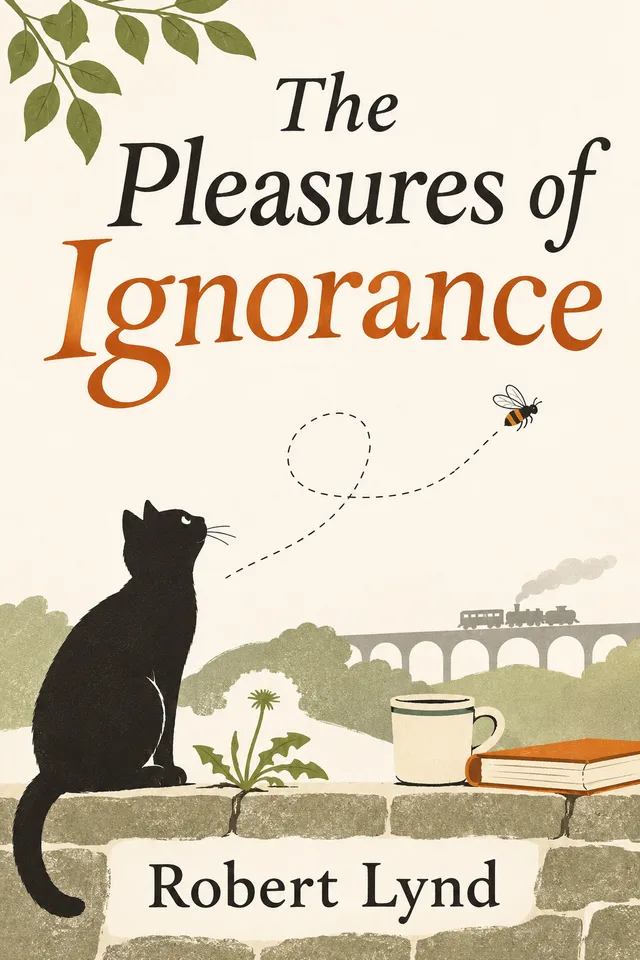
The Pleasures of Ignorance
英語 BooksWhale エディション · Robert Lynd
Robert Lynd turns cats, weeds, insects, trains, and everyday mistakes into twenty-six essays of humor, curiosity, and self-examination.
- プレビュー
- 準備済みテキストからの抜粋
- 形式
- オンラインリーダー, EPUB, PDF
- アクセス
- ライブラリ claim
本の紹介
The Pleasures of Ignorance
Robert Lynd finds subjects for thought in ordinary encounters and in the things people confidently fail to notice. These twenty-six essays range from the pleasures of not knowing to cats, springtime, insects, betting, railway travel, and the behavior of a jury. Gentle irony and shifts of perspective allow small observations to open onto questions about habit, judgment, enjoyment, and the limits of certainty.
BooksWhale エディション
このエディションの準備
このエディションはパブリックドメイン本文に基づき、BooksWhale がデジタル読書向けに準備しました。
パブリックドメイン根拠
このエディションを共有できる理由
Robert Lynd died in 1949. This edition uses the public-domain English text supplied by Project Gutenberg, without later editorial introductions or notes.
プレビューを読む
準備済みテキストからの抜粋
準備済み読書テキストから選んだプレビューです。
プレビュー章Full textプレビューを読む
The Pleasures of Ignorance
プレビュー章I — THE PLEASURES OF IGNORANCEプレビュー
It is impossible to take a walk in the country with an average townsman—especially, perhaps, in April or May—without being amazed at the vast continent of his ignorance. It is impossible to take a walk in the country oneself without being amazed at the vast continent of one's own ignorance. Thousands of men and women live and die without knowing the difference between a beech and an elm, between the song of a thrush and the song of a blackbird. Probably in a modern city the man who can distinguish between a thrush's and a blackbird's song is the exception. It is not that we have not seen the birds. It is simply that we have not noticed them. We have been surrounded by birds all our lives, yet so feeble is our observation that many of us could not tell whether or not the chaffinch sings, or the colour of the cuckoo. We argue like small boys as to whether the cuckoo always sings as he flies or sometimes in the branches of a tree—whether Chapman drew on his fancy or his knowledge of nature in the lines:
When in the oak's green arms the cuckoo sings, And first delights men in the lovely springs.
This ignorance, however, is not altogether miserable. Out of it we get the constant pleasure of discovery. Every fact of nature comes to us each spring, if only we are sufficiently ignorant, with the dew still on it. If we have lived half a lifetime without having ever even seen a cuckoo, and know it only as a wandering voice, we are all the more delighted at the spectacle of its runaway flight as it hurries from wood to wood conscious of its crimes, and at the way in which it halts hawk-like in the wind, its long tail quivering, before it dares descend on a hill-side of fir-trees where avenging presences may lurk. It would be absurd to pretend that the naturalist does not also find pleasure in observing the life of the birds, but his is a steady pleasure, almost a sober and plodding occupation, compared to the morning enthusiasm of the man who sees a cuckoo for the first time, and, behold, the world is made new.
And, as to that, the happiness even of the naturalist depends in some measure upon his ignorance, which still leaves him new worlds of this kind to conquer. He may have reached the very Z of knowledge in the books, but he still feels half ignorant until he has confirmed each bright particular with his eyes. He wishes with his own eyes to see the female cuckoo—rare spectacle!—as she lays her egg on the ground and takes it in her bill to the nest in which it is destined to breed infanticide. He would sit day after day with a field-glass against his eyes in order personally to endorse or refute the evidence suggesting that the cuckoo does lay on the ground and not in a nest. And, if he is so far fortunate as to discover this most secretive of birds in the very act of laying, there still remain for him other fields to conquer in a multitude of such disputed questions as whether the cuckoo's egg is always of the same colour as the other eggs in the nest in which she abandons it. Assuredly the men of science have no reason as yet to weep over their lost ignorance. If they seem to know everything, it is only because you and I know almost nothing. There will always be a fortune of ignorance waiting for them under every fact they turn up. They will never know what song the Sirens sang to Ulysses any more than Sir Thomas Browne did.
If I have called in the cuckoo to illustrate the ordinary man's ignorance, it is not because I can speak with authority on that bird. It is simply because, passing the spring in a parish that seemed to have been invaded by all the cuckoos of Africa, I realised how exceedingly little I, or anybody else I met, knew about them. But your and my ignorance is not confined to cuckoos. It dabbles in all created things, from the sun and moon down to the names of the flowers. I once heard a clever lady asking whether the new moon always appears on the same day of the week. She added that perhaps it is better not to know, because, if one does not know when or in what part of the sky to expect it, its appearance is always a pleasant surprise. I fancy, however, the new moon always comes as a surprise even to those who are familiar with her time-tables. And it is the same with the coming in of spring and the waves of the flowers. We are not the less delighted to find an early primrose because we are sufficiently learned in the services of the year to look for it in March or April rather than in October. We know, again, that the blossom precedes and not succeeds the fruit of the apple-tree, but this does not lessen our amazement at the beautiful holiday of a May orchard.
プレビュー章II — THE HERRING FLEETプレビュー
The last spectacle of which Christian men are likely to grow tired is a harbour. Centuries hence there may be jumping-off places for the stars, and our children's children's and so forth children may regard a ship as a creeping thing scarcely more adventurous than a worm. Meanwhile, every harbour gives us a sense of being in touch, if not with the ends of the universe, with the ends of the earth. This, more than the entrance to a wood or the source of a river or the top of a bald hill, is the beginning of infinity. Even the dirtiest coal-boat that lies beached in the harbour, a mere hulk of utilities that are taken away by dirty men in dirty carts, will in a day or two lift itself from the mud on a full tide and float away like a spirit into the sunset or curtsy to the image of the North Star. Mystery lies over the sea. Every ship is bound for Thule. That, perhaps, is why men are content day after day to stand on the pier-head and to gaze at the water and the ships and sailors running up and down the decks and pulling the ropes of sails.
We may have no reason for pretending to ourselves that the fishing-boats are ships of dreams setting out on infinite voyages. But, none the less, even in a fishing village there is always a congregation of watching men and women on the pier. Every day the crowd collects to see the harbour awake into life with the bustle of men about to set out among the nations of the fishes. By day the boats lie side by side in the harbour—stand side by side, rather, like horses in a stable. There are two rows of them, making a camp of masts on the shallow water. In other parts of the harbour white gigs are bottomed on the sand in companies of two and three. As the tide slowly rises, the masts which have been lying over on one side in a sleepy stillness begin to stir, then to sway, until with each new impulse of the sea all the boats are dancing, and soon the whole harbour is awake and merry as if every mast were a steeple with a peal of bells. It is not long till the fishermen arrive. One meets them in every cobbled lane. How magnificent the noise made by a man in sea-boots on the stones! Surely, he strikes sparks from the road. He thumps the ground as with a hammer. The earth rings. One has seen those boots in the morning hanging outside the door of his house while he slept. They have been oiled, and left there to dry. They have kept the shape of his limb and the crook of his knee in an uncanny way. They look as though he had taken off his legs before going into the house and hung them on the wall. But the fisherman is a hero not only in his boots. His sea-coat is no less magnificent. This may be of oil-skin yellow or of maroon or of stained white or of blue, with a blue jersey showing under it, and, perhaps, a red woollen muffler or a scarf with green spots on a red ground round his throat. He has not learned to be timid of colour. Even out of the mouths of his boots you may see the ends of red knitted leggings protruding. His yellow or black sou'-wester roofing the back of his neck, he comes down to harbour, as splendid as a figure at a fair. And always, when he arrives, he is smoking a pipe. As one watches him, one wonders if anybody except a fisherman, as he looks out over the harbour, knows how to smoke. He has made tobacco part of himself, like breathing.
目次
このエディションの内容
- 01Full text
- 02I — THE PLEASURES OF IGNORANCE
- 03II — THE HERRING FLEET
- 04III — THE BETTING MAN
- 05IV — THE HUM OF INSECTS
- 06V — CATS
- 07VI — MAY
- 08VII — NEW YEAR PROPHECIES
- 09VIII — ON KNOWING THE DIFFERENCE
- 10IX — THE INTELLECTUAL SIDE OF HORSE-RACING
- 11X — WHY WE HATE INSECTS
- 12XI — VIRTUE
- 13XII — JUNE
- 14XIII — ON FEELING GAY
- 15XIV — IN THE TRAIN
- 16XV — THE MOST CURIOUS ANIMAL
- 17XVI — THE OLD INDIFFERENCE
- 18XVII — EGGS: AN EASTER HOMILY
- 19XVIII — ENTER THE SPRING
- 20XIX — THE DAREDEVIL BARBER
- 21XX — WEEDS: AN APPRECIATION
- 22XXI — A JUROR IN WAITING
- 23XXII — THE THREE-HALFPENNY BIT
- 24XXIII — THE MORALS OF BEANS
- 25XXIV — ON SEEING A JOKE
- 26XXV — GOING TO THE DERBY
- 27XXVI — THIS BLASTED WORLD