英語 エディション
文学
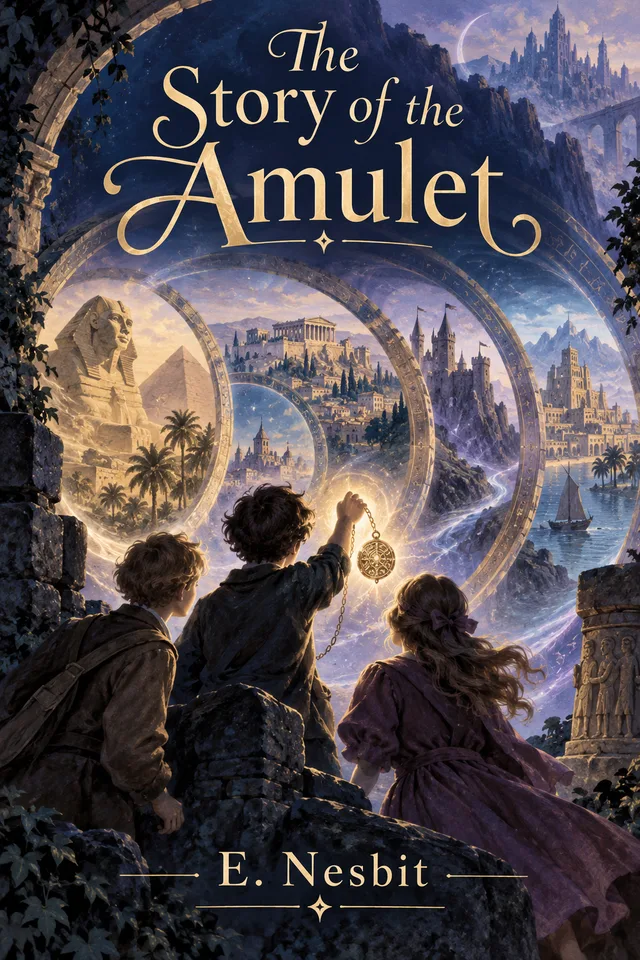
The Story of the Amulet
英語 BooksWhale エディション · E. Nesbit
Children travel through time with an ancient amulet, meeting lost civilizations and historical figures.
- プレビュー
- 準備済みテキストからの抜粋
- 形式
- オンラインリーダー, EPUB, PDF
- アクセス
- ライブラリ claim
本の紹介
The Story of the Amulet
The Psammead children use a magical amulet to enter ancient empires and legendary worlds filled with humor, danger, curiosity, and family loyalty.
BooksWhale エディション
このエディションの準備
このエディションはパブリックドメイン本文に基づき、BooksWhale がデジタル読書向けに準備しました。
パブリックドメイン根拠
このエディションを共有できる理由
The source text is public domain; E. Nesbit died in 1924 and the work dates from 1906.
プレビューを読む
準備済みテキストからの抜粋
準備済み読書テキストから選んだプレビューです。
プレビュー章Full textプレビューを読む
The Story of the Amulet
E. Nesbit
プレビュー章by E. Nesbitプレビュー
TO Dr Wallis Budge of the British Museum as a small token of gratitude for his unfailing kindness and help in the making of it
プレビュー章CHAPTER I. THE PSAMMEADプレビュー
There were once four children who spent their summer holidays in a white house, happily situated between a sandpit and a chalkpit. One day they had the good fortune to find in the sandpit a strange creature. Its eyes were on long horns like snail’s eyes, and it could move them in and out like telescopes. It had ears like a bat’s ears, and its tubby body was shaped like a spider’s and covered with thick soft fur—and it had hands and feet like a monkey’s. It told the children—whose names were Cyril, Robert, Anthea, and Jane—that it was a Psammead or sand-fairy. (Psammead is pronounced Sammy-ad.) It was old, old, old, and its birthday was almost at the very beginning of everything. And it had been buried in the sand for thousands of years. But it still kept its fairylikeness, and part of this fairylikeness was its power to give people whatever they wished for. You know fairies have always been able to do this. Cyril, Robert, Anthea, and Jane now found their wishes come true; but, somehow, they never could think of just the right things to wish for, and their wishes sometimes turned out very oddly indeed. In the end their unwise wishings landed them in what Robert called “a very tight place indeed”, and the Psammead consented to help them out of it in return for their promise never never to ask it to grant them any more wishes, and never to tell anyone about it, because it did not want to be bothered to give wishes to anyone ever any more. At the moment of parting Jane said politely—
“I wish we were going to see you again some day.”
And the Psammead, touched by this friendly thought, granted the wish. The book about all this is called Five Children and It, and it ends up in a most tiresome way by saying—
“The children did see the Psammead again, but it was not in the sandpit; it was—but I must say no more—”
The reason that nothing more could be said was that I had not then been able to find out exactly when and where the children met the Psammead again. Of course I knew they would meet it, because it was a beast of its word, and when it said a thing would happen, that thing happened without fail. How different from the people who tell us about what weather it is going to be on Thursday next, in London, the South Coast, and Channel!
The summer holidays during which the Psammead had been found and the wishes given had been wonderful holidays in the country, and the children had the highest hopes of just such another holiday for the next summer. The winter holidays were beguiled by the wonderful happenings of The Phœnix and the Carpet, and the loss of these two treasures would have left the children in despair, but for the splendid hope of their next holiday in the country. The world, they felt, and indeed had some reason to feel, was full of wonderful things—and they were really the sort of people that wonderful things happen to. So they looked forward to the summer holiday; but when it came everything was different, and very, very horrid. Father had to go out to Manchuria to telegraph news about the war to the tiresome paper he wrote for—the Daily Bellower, or something like that, was its name. And Mother, poor dear Mother, was away in Madeira, because she had been very ill. And The Lamb—I mean the baby—was with her. And Aunt Emma, who was Mother’s sister, had suddenly married Uncle Reginald, who was Father’s brother, and they had gone to China, which is much too far off for you to expect to be asked to spend the holidays in, however fond your aunt and uncle may be of you. So the children were left in the care of old Nurse, who lived in Fitzroy Street, near the British Museum, and though she was always very kind to them, and indeed spoiled them far more than would be good for the most grown-up of us, the four children felt perfectly wretched, and when the cab had driven off with Father and all his boxes and guns and the sheepskin, with blankets and the aluminium mess-kit inside it, the stoutest heart quailed, and the girls broke down altogether, and sobbed in each other’s arms, while the boys each looked out of one of the long gloomy windows of the parlour, and tried to pretend that no boy would be such a muff as to cry.
目次
このエディションの内容
- 01Full text
- 02by E. Nesbit
- 03CHAPTER I. THE PSAMMEAD
- 04CHAPTER II. THE HALF AMULET
- 05CHAPTER III. THE PAST
- 06CHAPTER IV. EIGHT THOUSAND YEARS AGO
- 07CHAPTER V. THE FIGHT IN THE VILLAGE
- 08CHAPTER VI. THE WAY TO BABYLON
- 09CHAPTER VII. “THE DEEPEST DUNGEON BELOW THE CASTLE MOAT”
- 10CHAPTER VIII. THE QUEEN IN LONDON
- 11CHAPTER IX. ATLANTIS
- 12CHAPTER X. THE LITTLE BLACK GIRL AND JULIUS CAESAR
- 13CHAPTER XI. BEFORE PHARAOH
- 14CHAPTER XII. THE SORRY-PRESENT AND THE EXPELLED LITTLE BOY
- 15CHAPTER XIII. THE SHIPWRECK ON THE TIN ISLANDS
- 16CHAPTER XIV. THE HEART’S DESIRE