英語 エディション
文学
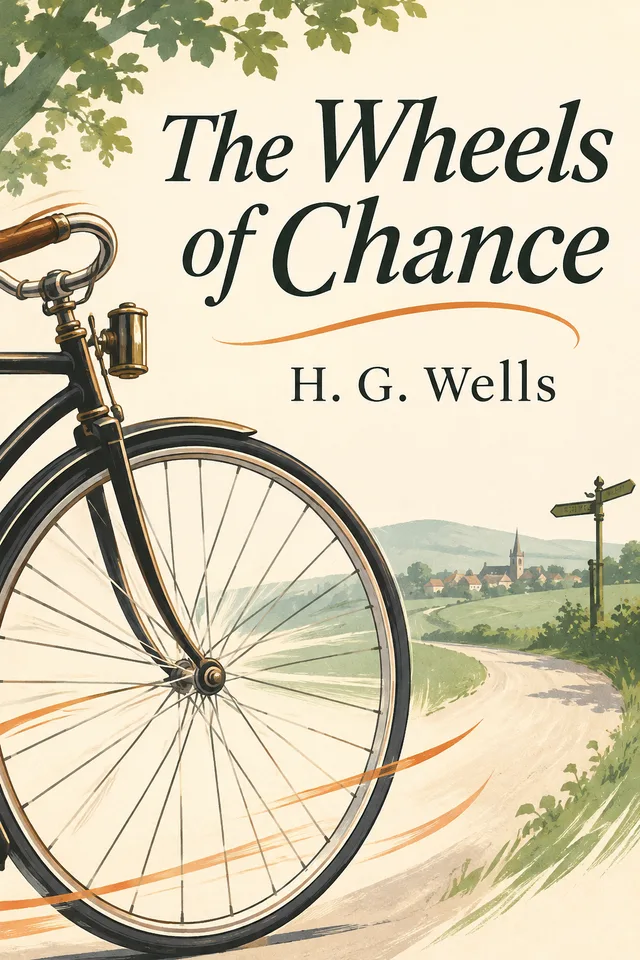
The Wheels of Chance
英語 BooksWhale エディション · H. G. Wells
A shop assistant’s cycling holiday becomes an unexpected adventure in freedom, romance, and the class divisions of Victorian England.
- プレビュー
- 準備済みテキストからの抜粋
- 形式
- オンラインリーダー, EPUB, PDF
- アクセス
- ライブラリ claim
本の紹介
The Wheels of Chance
Mr. Hoopdriver escapes his drapery shop for a bicycle tour and encounters Jessie Milton, a young woman attempting to direct her own life. H. G. Wells turns their journey through southern England into a comic exploration of social rank, self-invention, and romantic misunderstanding. The forty-one chapters capture cycling’s promise of independence in late Victorian society.
BooksWhale エディション
このエディションの準備
このエディションはパブリックドメイン本文に基づき、BooksWhale がデジタル読書向けに準備しました。
パブリックドメイン根拠
このエディションを共有できる理由
H. G. Wells died in 1946. This edition uses the original English text supplied by Project Gutenberg, identified there as public domain in the United States, without added illustrations or editorial notes.
プレビューを読む
準備済みテキストからの抜粋
準備済み読書テキストから選んだプレビューです。
プレビュー章Full textプレビューを読む
The Wheels of Chance
H. G. Wells
プレビュー章I. THE PRINCIPAL CHARACTER IN THE STORYプレビュー
If you (presuming you are of the sex that does such things)—if you had gone into the Drapery Emporium—which is really only magnificent for shop—of Messrs. Antrobus & Co.—a perfectly fictitious “Co.,” by the bye—of Putney, on the 14th of August, 1895, had turned to the right-hand side, where the blocks of white linen and piles of blankets rise up to the rail from which the pink and blue prints depend, you might have been served by the central figure of this story that is now beginning. He would have come forward, bowing and swaying, he would have extended two hands with largish knuckles and enormous cuffs over the counter, and he would have asked you, protruding a pointed chin and without the slightest anticipation of pleasure in his manner, what he might have the pleasure of showing you. Under certain circumstances—as, for instance, hats, baby linen, gloves, silks, lace, or curtains—he would simply have bowed politely, and with a drooping expression, and making a kind of circular sweep, invited you to “step this way,” and so led you beyond his ken; but under other and happier conditions,—huckaback, blankets, dimity, cretonne, linen, calico, are cases in point,—he would have requested you to take a seat, emphasising the hospitality by leaning over the counter and gripping a chair back in a spasmodic manner, and so proceeded to obtain, unfold, and exhibit his goods for your consideration. Under which happier circumstances you might—if of an observing turn of mind and not too much of a housewife to be inhuman—have given the central figure of this story less cursory attention.
Now if you had noticed anything about him, it would have been chiefly to notice how little he was noticeable. He wore the black morning coat, the black tie, and the speckled grey nether parts (descending into shadow and mystery below the counter) of his craft. He was of a pallid complexion, hair of a kind of dirty fairness, greyish eyes, and a skimpy, immature moustache under his peaked indeterminate nose. His features were all small, but none ill-shaped. A rosette of pins decorated the lappel of his coat. His remarks, you would observe, were entirely what people used to call cliché, formulae not organic to the occasion, but stereotyped ages ago and learnt years since by heart. “This, madam,” he would say, “is selling very well.” “We are doing a very good article at four three a yard.” “We could show you something better, of course.” “No trouble, madam, I assure you.” Such were the simple counters of his intercourse. So, I say, he would have presented himself to your superficial observation. He would have danced about behind the counter, have neatly refolded the goods he had shown you, have put on one side those you selected, extracted a little book with a carbon leaf and a tinfoil sheet from a fixture, made you out a little bill in that weak flourishing hand peculiar to drapers, and have bawled “Sayn!” Then a puffy little shop-walker would have come into view, looked at the bill for a second, very hard (showing you a parting down the middle of his head meanwhile), have scribbled a still more flourishing J. M. all over the document, have asked you if there was nothing more, have stood by you—supposing that you were paying cash—until the central figure of this story reappeared with the change. One glance more at him, and the puffy little shop-walker would have been bowing you out, with fountains of civilities at work all about you. And so the interview would have terminated.
But real literature, as distinguished from anecdote, does not concern itself with superficial appearances alone. Literature is revelation. Modern literature is indecorous revelation. It is the duty of the earnest author to tell you what you would not have seen—even at the cost of some blushes. And the thing that you would not have seen about this young man, and the thing of the greatest moment to this story, the thing that must be told if the book is to be written, was—let us face it bravely—the Remarkable Condition of this Young Man’s Legs.
プレビュー章IIプレビュー
But enough of these revelations. The central figure of our story is now going along behind the counter, a draper indeed, with your purchases in his arms, to the warehouse, where the various articles you have selected will presently be packed by the senior porter and sent to you. Returning thence to his particular place, he lays hands on a folded piece of gingham, and gripping the corners of the folds in his hands, begins to straighten them punctiliously. Near him is an apprentice, apprenticed to the same high calling of draper’s assistant, a ruddy, red-haired lad in a very short tailless black coat and a very high collar, who is deliberately unfolding and refolding some patterns of cretonne. By twenty-one he too may hope to be a full-blown assistant, even as Mr. Hoopdriver. Prints depend from the brass rails above them, behind are fixtures full of white packages containing, as inscriptions testify, Lino, Hd Bk, and Mull. You might imagine to see them that the two were both intent upon nothing but smoothness of textile and rectitude of fold. But to tell the truth, neither is thinking of the mechanical duties in hand. The assistant is dreaming of the delicious time—only four hours off now—when he will resume the tale of his bruises and abrasions. The apprentice is nearer the long long thoughts of boyhood, and his imagination rides cap-à-pie through the chambers of his brain, seeking some knightly quest in honour of that Fair Lady, the last but one of the girl apprentices to the dress-making upstairs. He inclines rather to street fighting against revolutionaries—because then she could see him from the window.
Jerking them back to the present comes the puffy little shop-walker, with a paper in his hand. The apprentice becomes extremely active. The shopwalker eyes the goods in hand. “Hoopdriver,” he says, “how’s that line of g-sez-x ginghams?”
Hoopdriver returns from an imaginary triumph over the uncertainties of dismounting. “They’re going fairly well, sir. But the larger checks seem hanging.”
The shop-walker brings up parallel to the counter. “Any particular time when you want your holidays?” he asks.
Hoopdriver pulls at his skimpy moustache. “No—Don’t want them too late, sir, of course.”
“How about this day week?”
Hoopdriver becomes rigidly meditative, gripping the corners of the gingham folds in his hands. His face is eloquent of conflicting considerations. Can he learn it in a week? That’s the question. Otherwise Briggs will get next week, and he will have to wait until September—when the weather is often uncertain. He is naturally of a sanguine disposition. All drapers have to be, or else they could never have the faith they show in the beauty, washability, and unfading excellence of the goods they sell you. The decision comes at last. “That’ll do me very well,” said Mr. Hoopdriver, terminating the pause.
The die is cast.
The shop-walker makes a note of it and goes on to Briggs in the “dresses,” the next in the strict scale of precedence of the Drapery Emporium. Mr. Hoopdriver in alternating spasms anon straightens his gingham and anon becomes meditative, with his tongue in the hollow of his decaying wisdom tooth.
目次
このエディションの内容
- 01Full text
- 02I. THE PRINCIPAL CHARACTER IN THE STORY
- 03II
- 04III
- 05IV. THE RIDING FORTH OF MR. HOOPDRIVER
- 06V. THE SHAMEFUL EPISODE OF THE YOUNG LADY IN GREY
- 07VI. ON THE ROAD TO RIPLEY
- 08VII.
- 09VIII.
- 10IX. HOW MR. HOOPDRIVER WAS HAUNTED
- 11X. THE IMAGININGS OF MR. HOOPDRIVER’S HEART
- 12XI. OMISSIONS
- 13XII. THE DREAMS OF MR. HOOPDRIVER
- 14XIII. HOW MR. HOOPDRIVER WENT TO HASLEMERE
- 15XIV. HOW MR. HOOPDRIVER REACHED MIDHURST
- 16XV. AN INTERLUDE
- 17XVI. OF THE ARTIFICIAL IN MAN, AND OF THE ZEITGEIST
- 18XVII. THE ENCOUNTER AT MIDHURST
- 19XVIII.
- 20XIX.
- 21XX. THE PURSUIT
- 22XXI. AT BOGNOR
- 23XXII.
- 24XXIII.
- 25XXIV. THE MOONLIGHT RIDE
- 26XXV.
- 27XXVI. THE SURBITON INTERLUDE
- 28XXVII. THE AWAKENING OF MR. HOOPDRIVER
- 29XXVIII. THE DEPARTURE FROM CHICHESTER
- 30XXIX. THE UNEXPECTED ANECDOTE OF THE LION
- 31XXX. THE RESCUE EXPEDITION
- 32XXXI.
- 33XXXII. MR. HOOPDRIVER, KNIGHT ERRANT
- 34XXXIII. THE ABASEMENT OF MR. HOOPDRIVER
- 35XXXIV.
- 36XXXV.
- 37XXXVI.
- 38XXXVII. IN THE NEW FOREST
- 39XXXVIII. AT THE RUFUS STONE
- 40XXXIX.
- 41XL.
- 42XLI. THE ENVOY