英語 エディション
文学
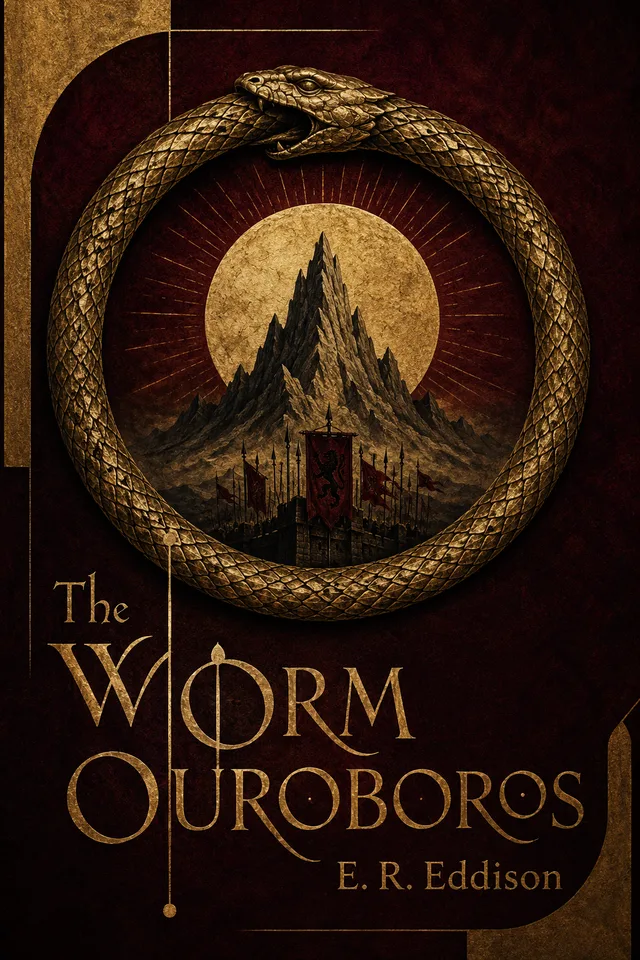
The Worm Ouroboros
英語 BooksWhale エディション · E. R. Eddison
A high-fantasy epic of Demonland, Witchland, heroic rivalry, archaic style, and mythic warfare.
- プレビュー
- 準備済みテキストからの抜粋
- 形式
- オンラインリーダー, EPUB, PDF
- アクセス
- ライブラリ claim
本の紹介
The Worm Ouroboros
The Worm Ouroboros stages a grand conflict among Demonland, Witchland, and rival lords in a deliberately archaic, ceremonial prose style. Eddison’s fantasy emphasizes honor, ambition, siege, combat, sorcery, and the cyclical hunger for heroic adventure.
BooksWhale エディション
このエディションの準備
このエディションはパブリックドメイン本文に基づき、BooksWhale がデジタル読書向けに準備しました。
パブリックドメイン根拠
このエディションを共有できる理由
E. R. Eddison died in 1945, and The Worm Ouroboros was first published or composed in 1922; these dates support the public-domain basis for this edition.
プレビューを読む
準備済みテキストからの抜粋
準備済み読書テキストから選んだプレビューです。
プレビュー章Full textプレビューを読む
The Worm Ouroboros
E. R. Eddison
True Thomas lay on Huntlie bank, A ferlie he spied wi his ee; And there he saw a Lady bright Come riding down by the Eildon Tree.
Her skirt was o the grass-green silk, Her mantle o the velvet fyne, At ilka tett of her horse’s mane Hung fifty siller bells and nine.
True Thomas he pulld aff his cap, And louted low down on his knee: “Hail to thee, Mary, Queen of Heaven! For thy peer on earth could never be.”
“O no, O no, Thomas,” she says, “That name does not belang to me; I’m but the Queen of fair Elfland, That am hither come to visit thee.
“Harp and carp, Thomas,” she says, “Harp and carp alang wi me. And if ye dare to kiss my lips, Sure of your bodie I will be.”
“Betide me weal, betide me woe, That weird shall never daunton me.” Syne he has kissed her rosy lips, All underneath the Eildon Tree.
THOMAS THE RHYMER.
_To_ W. G. E. _and to my friends_ K. H. _and_ G. C. L. M. _I dedicate this book_
It is neither allegory nor fable but a Story to be read for its own sake.
The proper names I have tried to spell simply. The _e_ in Carcë is long, like that in Phryne, the _o_ in Krothering short and the accent on that syllable: Corund is accented on the first syllable, Prezmyra on the second, Brandoch Daha on the first and fourth, Gorice on the last syllable, rhyming with thrice: Corinius rhymes with Flaminius, Galing with sailing, La Fireez with desire ease: _ch_ is always guttural, as in loch.
_9th January 1922_ E. R. E.
プレビュー章THE INDUCTIONプレビュー
There was a man named Lessingham dwelt in an old low house in Wastdale, set in a gray old garden where yew-trees flourished that had seen Vikings in Copeland in their seedling time. Lily and rose and larkspur bloomed in the borders, and begonias with blossoms big as saucers, red and white and pink and lemon-colour, in the beds before the porch.
Climbing roses, honeysuckle, clematis, and the scarlet flame-flower scrambled up the walls. Thick woods were on every side without the garden, with a gap north-eastward opening on the desolate lake and the great fells beyond it: Gable rearing his crag-bound head against the sky from behind the straight clean outline of the Screes.
Cool long shadows stole across the tennis lawn. The air was golden. Doves murmured in the trees; two chaffinches played on the near post of the net; a little water-wagtail scurried along the path. A French window stood open to the garden, showing darkly a dining-room panelled with old oak, its Jacobean table bright with flowers and silver and cut glass and Wedgwood dishes heaped with fruit: greengages, peaches, and green muscat grapes. Lessingham lay back in a hammock-chair watching through the blue smoke of an after-dinner cigar the warm light on the Gloire de Dijon roses that clustered about the bedroom window overhead.
He had her hand in his. This was their House.
“Should we finish that chapter of Njal?” she said.
She took the heavy volume with its faded green cover, and read: “He went out on the night of the Lord’s day, when nine weeks were still to winter; he heard a great crash, so that he thought both heaven and earth shook. Then he looked into the west airt, and he thought he saw thereabouts a ring of fiery hue, and within the ring a man on a gray horse. He passed quickly by him, and rode hard. He had a flaming firebrand in his hand, and he rode so close to him that he could see him plainly. He was black as pitch, and he sung this song with a mighty voice—
Here I ride swift steed, His flank flecked with rime, Rain from his mane drips, Horse mighty for harm; Flames flare at each end, Gall glows in the midst, So fares it with Flosi’s redes As this flaming brand flies;
And so fares it with Flosi’s redes As this flaming brand flies.
“Then he thought he hurled the firebrand east towards the fells before him, and such a blaze of fire leapt up to meet it that he could not see the fells for the blaze. It seemed as though that man rode east among the flames and vanished there.
“After that he went to his bed, and was senseless for a long time, but at last he came to himself. He bore in mind all that had happened, and told his father, but he bade him tell it to Hjallti Skeggi’s son. So he went and told Hjallti, but he said he had seen ‘the Wolf’s Ride, and that comes ever before great tidings.’”
They were silent awhile; then Lessingham said suddenly, “Do you mind if we sleep in the east wing to-night?”
“What, in the Lotus Room?”
“Yes.”
“I’m too much of a lazy-bones to-night, dear,” she answered.
“Do you mind if I go alone, then? I shall be back to breakfast. I like my lady with me; still, we can go again when next moon wanes. My pet is not frightened, is she?”
“No!” she said, laughing. But her eyes were a little big. Her fingers played with his watch-chain. “I’d rather,” she said presently, “you went later on and took me. All this is so odd still: the House, and that; and I love it so. And after all, it is a long way and several years too, sometimes, in the Lotus Room, even though it is all over next morning. I’d rather we went together. If anything happened then, well, we’d both be done in, and it wouldn’t matter so much, would it?”
プレビュー章I: THE CASTLE OF LORD JUSSプレビュー
OF THE RARITIES THAT WERE IN THE LOFTY PRESENCE CHAMBER FAIR AND
LOVELY TO BEHOLD, AND OF THE QUALITIES AND CONDITIONS OF THE
LORDS OF DEMONLAND: AND OF THE EMBASSY SENT UNTO THEM BY KING
GORICE XI., AND OF THE ANSWER THERETO.
The eastern stars were paling to the dawn as Lessingham followed his conductor along the grass walk between the shadowy ranks of Irish yews, that stood like soldiers mysterious and expectant in the darkness.
The grass was bathed in night-dew, and great white lilies sleeping in the shadows of the yews loaded the air of that garden with fragrance. Lessingham felt no touch of the ground beneath his feet, and when he stretched out his hand to touch a tree his hand passed through branch and leaves as though they were unsubstantial as a moonbeam.
The little martlet, alighting on his shoulder, laughed in his ear. “Child of earth,” she said, “dost think we are here in dreamland?”
He answered nothing, and she said, “This is no dream. Thou, first of the children of men, art come to Mercury, where thou and I will journey up and down for a season to show thee the lands and oceans, the forests, plains, and ancient mountains, cities and palaces of this world, Mercury, and the doings of them that dwell therein. But here thou canst not handle aught, neither make the folk ware of thee, not though thou shout thy throat hoarse. For thou and I walk here impalpable and invisible, as it were two dreams walking.”
They were now on the marble steps which led from the yew walk to the terrace opposite the great gate of the castle. “No need to unbar gates to thee and me,” said the martlet, as they passed beneath the darkness of that ancient portal, carved with strange devices, and clean through the massy timbers of the bolted gate thickly riveted with silver, into the inner court. “Go we into the lofty presence chamber and there tarry awhile. Morning is kindling the upper air, and folk will soon be stirring in the castle, for they lie not long abed when day begins in Demonland. For be it known to thee, O earth-born, that this land is Demonland, and this castle the castle of Lord Juss, and this day now dawning his birthday, when the Demons hold high festival in Juss’s castle to do honour unto him and to his brethren, Spitfire and Goldry Bluszco; and these and their fathers before them bear rule from time immemorial in Demonland, and have the lordship over all the Demons.”
She spoke, and the first low beams of the sun smote javelin-like through the eastern windows, and the freshness of morning breathed and shimmered in that lofty chamber, chasing the blue and dusky shades of departed night to the corners and recesses, and to the rafters of the vaulted roof. Surely no potentate of earth, not Croesus, not the great King, not Minos in his royal palace in Crete, not all the Pharaohs, not Queen Semiramis, nor all the Kings of Babylon and Nineveh had ever a throne room to compare in glory with that high presence chamber of the lords of Demonland. Its walls and pillars were of snow-white marble, every vein whereof was set with small gems: rubies, corals, garnets, and pink topaz. Seven pillars on either side bore up the shadowy vault of the roof; the roof-tree and the beams were of gold, curiously carved, the roof itself of mother-of-pearl. A side aisle ran behind each row of pillars, and seven paintings on the western side faced seven spacious windows on the east. At the end of the hall upon a dais stood three high seats, the arms of each composed of two hippogriffs wrought in gold, with wings spread, and the legs of the seats the legs of the hippogriffs; but the body of each high seat was a single jewel of monstrous size: the left-hand seat a black opal, asparkle with steel-blue fire, the next a fire-opal, as it were a burning coal, the third seat an alexandrite, purple like wine by night but deep sea-green by day. Ten more pillars stood in semicircle behind the high seats, bearing up above them and the dais a canopy of gold. The benches that ran from end to end of the lofty chamber were of cedar, inlaid with coral and ivory, and so were the tables that stood before the benches. The floor of the chamber was tesselated, of marble and green tourmaline, and on every square of tourmaline was carven the image of a fish: as the dolphin, the conger, the cat-fish, the salmon, the tunny, the squid, and other wonders of the deep. Hangings of tapestry were behind the high seats, worked with flowers, snake’s-head, snapdragon, dragon-mouth, and their kind; and on the dado below the windows were sculptures of birds and beasts and creeping things.
目次
このエディションの内容
- 01Full text
- 02THE INDUCTION
- 03I: THE CASTLE OF LORD JUSS
- 04II: THE WRASTLING FOR DEMONLAND
- 05III: THE RED FOLIOT
- 06IV: CONJURING IN THE IRON TOWER
- 07V: KING GORICE’S SENDING
- 08VI: THE CLAWS OF WITCHLAND
- 09VII: GUESTS OF THE KING IN CARCË
- 10VIII: THE FIRST EXPEDITION TO IMPLAND
- 11IX: SALAPANTA HILLS
- 12X: THE MARCHLANDS OF THE MORUNA
- 13XI: THE BURG OF ESHGRAR OGO
- 14XII: KOSHTRA PIVRARCHA
- 15XIII: KOSHTRA BELORN
- 16XIV: THE LAKE OF RAVARY
- 17XV: QUEEN PREZMYRA
- 18XVI: THE LADY SRIVA’S EMBASSAGE
- 19XVII: THE KING FLIES HIS HAGGARD
- 20XVIII: THE MURTHER OF GALLANDUS BY CORSUS
- 21XIX: THREMNIR’S HEUGH
- 22XX: KING CORINIUS
- 23XXI: THE PARLEY BEFORE KROTHERING
- 24XXII: AURWATH AND SWITCHWATER
- 25XXIII: THE WEIRD BEGUN OF ISHNAIN NEMARTRA
- 26XXIV: A KING IN KROTHERING
- 27XXV: LORD GRO AND THE LADY MEVRIAN
- 28XXVI: THE BATTLE OF KROTHERING SIDE
- 29XXVII: THE SECOND EXPEDITION TO IMPLAND
- 30XXVIII: ZORA RACH NAM PSARRION
- 31XXIX: THE FLEET AT MUELVA
- 32XXX: TIDINGS OF MELIKAPHKHAZ
- 33XXXI: THE DEMONS BEFORE CARCË
- 34XXXII: THE LATTER END OF ALL THE LORDS OF WITCHLAND
- 35XXXIII: QUEEN SOPHONISBA IN GALING