英語 エディション
政治
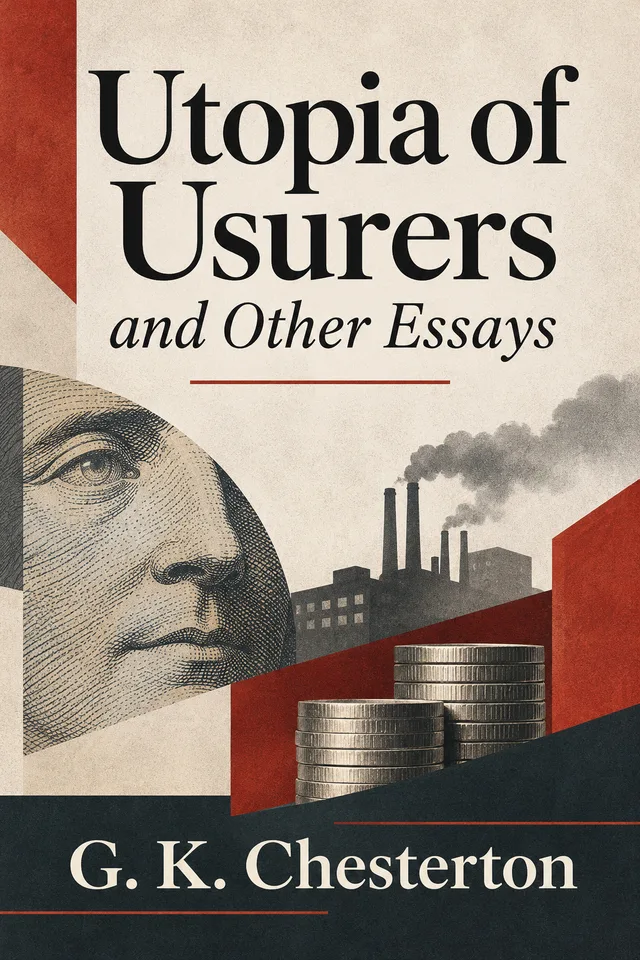
Utopia of Usurers and Other Essays
英語 BooksWhale エディション · G. K. Chesterton
Chesterton challenges concentrated wealth, industrial authority, imperial rhetoric, and fashionable arguments through paradox, satire, and polemical essays.
- プレビュー
- 準備済みテキストからの抜粋
- 形式
- オンラインリーダー, EPUB, PDF
- アクセス
- ライブラリ claim
本の紹介
Utopia of Usurers and Other Essays
Utopia of Usurers and Other Essays brings together G. K. Chesterton’s attacks on economic domination and the language used to defend it. Discussions of work, journalism, empire, political liberty, and popular culture turn public controversies into arguments about ordinary human independence. A prefatory poem and the collected essays retain his combative wit and taste for paradox.
BooksWhale エディション
このエディションの準備
このエディションはパブリックドメイン本文に基づき、BooksWhale がデジタル読書向けに準備しました。
パブリックドメイン根拠
このエディションを共有できる理由
G. K. Chesterton died in 1936. This edition uses the original English text of Utopia of Usurers and Other Essays from Project Gutenberg, which identifies this source as public domain in the United States; later editorial notes and illustrations are excluded.
プレビューを読む
準備済みテキストからの抜粋
準備済み読書テキストから選んだプレビューです。
プレビュー章Full textプレビューを読む
Utopia of Usurers and Other Essays
G. K. Chesterton
プレビュー章A SONG OF SWORDSプレビュー
“A drove of cattle came into a village called Swords; and was stopped by the rioters.”—Daily Paper. In the place called Swords on the Irish road It is told for a new renown How we held the horns of the cattle, and how We will hold the horns of the devils now Ere the lord of hell with the horn on his brow Is crowned in Dublin town. Light in the East and light in the West, And light on the cruel lords, On the souls that suddenly all men knew, And the green flag flew and the red flag flew, And many a wheel of the world stopped, too, When the cattle were stopped at Swords. Be they sinners or less than saints That smite in the street for rage, We know where the shame shines bright; we know You that they smite at, you their foe, Lords of the lawless wage and low, This is your lawful wage. You pinched a child to a torture price That you dared not name in words; So black a jest was the silver bit That your own speech shook for the shame of it, And the coward was plain as a cow they hit When the cattle have strayed at Swords. The wheel of the torrent of wives went round To break men’s brotherhood; You gave the good Irish blood to grease The clubs of your country’s enemies; you saw the brave man beat to the knees: And you saw that it was good. The rope of the rich is long and long— The longest of hangmen’s cords; But the kings and crowds are holding their breath, In a giant shadow o’er all beneath Where God stands holding the scales of Death Between the cattle and Swords. Haply the lords that hire and lend The lowest of all men’s lords, Who sell their kind like kine at a fair, Will find no head of their cattle there; But faces of men where cattle were: Faces of men—and Swords.
プレビュー章UTOPIA OF USURERSプレビュー
I. Art and Advertisement
I propose, subject to the patience of the reader, to devote two or three articles to prophecy. Like all healthy-minded prophets, sacred and profane, I can only prophesy when I am in a rage and think things look ugly for everybody. And like all healthy-minded prophets, I prophesy in the hope that my prophecy may not come true. For the prediction made by the true soothsayer is like the warning given by a good doctor. And the doctor has really triumphed when the patient he condemned to death has revived to life. The threat is justified at the very moment when it is falsified. Now I have said again and again (and I shall continue to say again and again on all the most inappropriate occasions) that we must hit Capitalism, and hit it hard, for the plain and definite reason that it is growing stronger. Most of the excuses which serve the capitalists as masks are, of course, the excuses of hypocrites. They lie when they claim philanthropy; they no more feel any particular love of men than Albu felt an affection for Chinamen. They lie when they say they have reached their position through their own organising ability. They generally have to pay men to organise the mine, exactly as they pay men to go down it. They often lie about the present wealth, as they generally lie about their past poverty. But when they say that they are going in for a “constructive social policy,” they do not lie. They really are going in for a constructive social policy. And we must go in for an equally destructive social policy; and destroy, while it is still half-constructed, the accursed thing which they construct.
The Example of the Arts
Now I propose to take, one after another, certain aspects and departments of modern life, and describe what I think they will be like in this paradise of plutocrats, this Utopia of gold and brass in which the great story of England seems so likely to end. I propose to say what I think our new masters, the mere millionaires, will do with certain human interests and institutions, such as art, science, jurisprudence, or religion—unless we strike soon enough to prevent them. And for the sake of argument I will take in this article the example of the arts.
Most people have seen a picture called “Bubbles,” which is used for the advertisement of a celebrated soap, a small cake of which is introduced into the pictorial design. And anybody with an instinct for design (the caricaturist of the Daily Herald, for instance), will guess that it was not originally a part of the design. He will see that the cake of soap destroys the picture as a picture; as much as if the cake of soap had been used to Scrub off the paint. Small as it is, it breaks and confuses the whole balance of objects in the composition. I offer no judgment here upon Millais’s action in the matter; in fact, I do not know what it was. The important point for me at the moment is that the picture was not painted for the soap, but the soap added to the picture. And the spirit of the corrupting change which has separated us from that Victorian epoch can be best seen in this: that the Victorian atmosphere, with all its faults, did not permit such a style of patronage to pass as a matter of course. Michael Angelo may have been proud to have helped an emperor or a pope; though, indeed, I think he was prouder than they were on his own account. I do not believe Sir John Millais was proud of having helped a soap-boiler. I do not say he thought it wrong; but he was not proud of it. And that marks precisely the change from his time to our own. Our merchants have really adopted the style of merchant princes. They have begun openly to dominate the civilisation of the State, as the emperors and popes openly dominated in Italy. In Millais’s time, broadly speaking, art was supposed to mean good art; advertisement was supposed to mean inferior art. The head of a black man, painted to advertise somebody’s blacking, could be a rough symbol, like an inn sign. The black man had only to be black enough. An artist exhibiting the picture of a negro was expected to know that a black man is not so black as he is painted. He was expected to render a thousand tints of grey and brown and violet: for there is no such thing as a black man just as there is no such thing as a white man. A fairly clear line separated advertisement from art.
目次
このエディションの内容
- 01Full text
- 02A SONG OF SWORDS
- 03UTOPIA OF USURERS
- 04THE ESCAPE
- 05THE NEW RAID
- 06THE NEW NAME
- 07A WORKMAN’S HISTORY OF ENGLAND
- 08THE FRENCH REVOLUTION AND THE IRISH
- 09LIBERALISM: A SAMPLE
- 10THE FATIGUE OF FLEET STREET
- 11THE AMNESTY FOR AGGRESSION
- 12REVIVE THE COURT JESTER
- 13THE ART OF MISSING THE POINT
- 14THE SERVILE STATE AGAIN
- 15THE EMPIRE OF THE IGNORANT
- 16THE SYMBOLISM OF KRUPP
- 17THE TOWER OF BEBEL
- 18A REAL DANGER
- 19THE DREGS OF PURITANISM
- 20THE TYRANNY OF BAD JOURNALISM
- 21THE POETRY OF THE REVOLUTION