英语 版本
文学
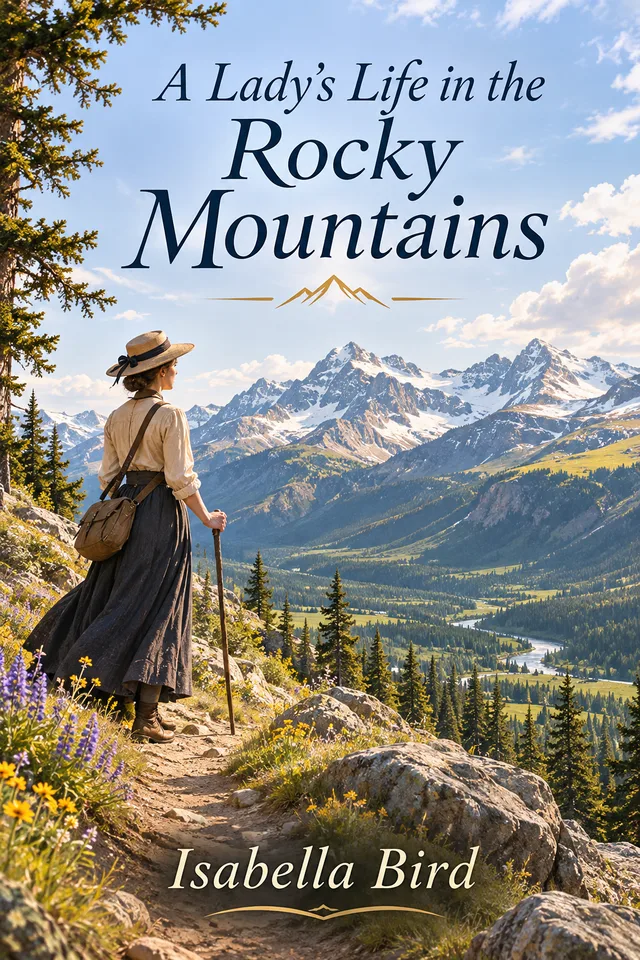
A Lady's Life in the Rocky Mountains
英语 BooksWhale 版本 · Isabella Bird
Isabella Bird’s seventeen travel letters follow solitary rides, mountain ascents and frontier encounters in the American West.
- 预览
- 文本节选
- 格式
- 在线阅读, EPUB, PDF
- 访问
- Library 获取
图书简介
A Lady's Life in the Rocky Mountains
Written from Bird’s travels in 1873, these seventeen letters describe a journey through California and Colorado, with Estes Park and the ascent of Longs Peak at its heart. Horseback travel, sudden snowstorms, frontier households and encounters with Mountain Jim give the narrative its immediate texture. Bird’s close observation of landscape and daily life is matched by her practical account of the difficulties and freedoms of travelling independently.
BooksWhale 版本
此版本如何整理
此版本基于公版文本,并由 BooksWhale 整理为适合数字阅读的版本。
公版依据
为什么此版本可以分享
Isabella Bird died in 1904; this work was first published in 1879. This edition uses the historical English text supplied by Project Gutenberg, with later editorial matter and annotations removed.
阅读预览
文本节选
预览选自整理后的阅读文本。
预览章节Full text阅读预览
A Lady's Life in the Rocky Mountains
Isabella Bird
预览章节Letter I预览
Lake Tahoe—Morning in San Francisco—Dust—A Pacific mail-train—Digger Indians—Cape Horn—A mountain hotel—A pioneer—A Truckee livery stable—A mountain stream—Finding a bear—Tahoe.
LAKE TAHOE, September 2.
I have found a dream of beauty at which one might look all one's life and sigh. Not lovable, like the Sandwich Islands, but beautiful in its own way! A strictly North American beauty—snow-splotched mountains, huge pines, red-woods, sugar pines, silver spruce; a crystalline atmosphere, waves of the richest color; and a pine-hung lake which mirrors all beauty on its surface. Lake Tahoe is before me, a sheet of water twenty-two miles long by ten broad, and in some places 1,700 feet deep. It lies at a height of 6,000 feet, and the snow-crowned summits which wall it in are from 8,000 to 11,000 feet in altitude. The air is keen and elastic. There is no sound but the distant and slightly musical ring of the lumberer's axe.
It is a weariness to go back, even in thought, to the clang of San Francisco, which I left in its cold morning fog early yesterday, driving to the Oakland ferry through streets with side-walks heaped with thousands of cantaloupe and water-melons, tomatoes, cucumbers, squashes, pears, grapes, peaches, apricots—all of startling size as compared with any I ever saw before. Other streets were piled with sacks of flour, left out all night, owing to the security from rain at this season. I pass hastily over the early part of the journey, the crossing the bay in a fog as chill as November, the number of "lunch baskets," which gave the car the look of conveying a great picnic party, the last view of the Pacific, on which I had looked for nearly a year, the fierce sunshine and brilliant sky inland, the look of long RAINLESSNESS, which one may not call drought, the valleys with sides crimson with the poison oak, the dusty vineyards, with great purple clusters thick among the leaves, and between the vines great dusty melons lying on the dusty earth. From off the boundless harvest fields the grain was carried in June, and it is now stacked in sacks along the track, awaiting freightage. California is a "land flowing with milk and honey." The barns are bursting with fullness. In the dusty orchards the apple and pear branches are supported, that they may not break down under the weight of fruit; melons, tomatoes, and squashes of gigantic size lie almost unheeded on the ground; fat cattle, gorged almost to repletion, shade themselves under the oaks; superb "red" horses shine, not with grooming, but with condition; and thriving farms everywhere show on what a solid basis the prosperity of the "Golden State" is founded. Very uninviting, however rich, was the blazing Sacramento Valley, and very repulsive the city of Sacramento, which, at a distance of 125 miles from the Pacific, has an elevation of only thirty feet. The mercury stood at 103 degrees in the shade, and the fine white dust was stifling.
In the late afternoon we began the ascent of the Sierras, whose sawlike points had been in sight for many miles. The dusty fertility was all left behind, the country became rocky and gravelly, and deeply scored by streams bearing the muddy wash of the mountain gold mines down to the muddier Sacramento. There were long broken ridges and deep ravines, the ridges becoming longer, the ravines deeper, the pines thicker and larger, as we ascended into a cool atmosphere of exquisite purity, and before 6 P.M. the last traces of cultivation and the last hardwood trees were left behind.
At Colfax, a station at a height of 2,400 feet, I got out and walked the length of the train. First came two great gaudy engines, the Grizzly Bear and the White Fox, with their respective tenders loaded with logs of wood, the engines with great, solitary, reflecting lamps in front above the cow guards, a quantity of polished brass-work, comfortable glass houses, and well-stuffed seats for the engine-drivers. The engines and tenders were succeeded by a baggage car, the latter loaded with bullion and valuable parcels, and in charge of two "express agents." Each of these cars is forty-five feet long. Then came two cars loaded with peaches and grapes; then two "silver palace" cars, each sixty feet long; then a smoking car, at that time occupied mainly by Chinamen; and then five ordinary passenger cars, with platforms like all the others, making altogether a train about 700 feet in length.
预览章节Letter II预览
A lady's "get-up"—Grizzly bears—The "Gems of the Sierras"—A tragic tale—A carnival of color.
CHEYENNE, WYOMING, September 7.
As night came on the cold intensified, and the stove in the parlor attracted every one. A San Francisco lady, much "got up" in paint, emerald green velvet, Brussels lace, and diamonds, rattled continuously for the amusement of the company, giving descriptions of persons and scenes in a racy Western twang, without the slightest scruple as to what she said. In a few years Tahoe will be inundated in summer with similar vulgarity, owing to its easiness of access. I sustained the reputation which our country-women bear in America by looking a "perfect guy"; and feeling that I was a salient point for the speaker's next sally, I was relieved when the landlady, a ladylike Englishwoman, asked me to join herself and her family in the bar-room, where we had much talk about the neighborhood and its wild beasts, especially bears. The forest is full of them, but they seem never to attack people unless when wounded, or much aggravated by dogs, or a shebear thinks you are going to molest her young.
I dreamt of bears so vividly that I woke with a furry death hug at my throat, but feeling quite refreshed. When I mounted my horse after breakfast the sun was high and the air so keen and intoxicating that, giving the animal his head, I galloped up and down hill, feeling completely tireless. Truly, that air is the elixir of life. I had a glorious ride back to Truckee. The road was not as solitary as the day before. In a deep part of the forest the horse snorted and reared, and I saw a cinnamon-colored bear with two cubs cross the track ahead of me. I tried to keep the horse quiet that the mother might acquit me of any designs upon her lolloping children, but I was glad when the ungainly, long-haired party crossed the river. Then I met a team, the driver of which stopped and said he was glad that I had not gone to Cornelian Bay, it was such a bad trail, and hoped I had enjoyed Tahoe. The driver of another team stopped and asked if I had seen any bears. Then a man heavily armed, a hunter probably, asked me if I were the English tourist who had "happened on" a "Grizzly" yesterday. Then I saw a lumberer taking his dinner on a rock in the river, who "touched his hat" and brought me a draught of ice-cold water, which I could hardly drink owing to the fractiousness of the horse, and gathered me some mountain pinks, which I admired. I mention these little incidents to indicate the habit of respectful courtesy to women which prevails in that region. These men might have been excused for speaking in a somewhat free-and-easy tone to a lady riding alone, and in an unwonted fashion. Womanly dignity and manly respect for women are the salt of society in this wild West.
My horse was so excitable that I avoided the center of Truckee, and skulked through a collection of Chinamen's shanties to the stable, where a prodigious roan horse, standing seventeen hands high, was produced for my ride to the Donner Lake. I asked the owner, who was as interested in my enjoying myself as a West Highlander might have been, if there were not ruffians about who might make an evening ride dangerous. A story was current of a man having ridden through Truckee two evenings before with a chopped-up human body in a sack behind the saddle, and hosts of stories of ruffianism are located there, rightly or wrongly. This man said, "There's a bad breed of ruffians, but the ugliest among them all won't touch you. There's nothing Western folk admire so much as pluck in a woman." I had to get on a barrel before I could reach the stirrup, and when I was mounted my feet only came half-way down the horse's sides. I felt like a fly on him. The road at first lay through a valley without a river, but some swampishness nourished some rank swamp grass, the first GREEN grass I have seen in America; and the pines, with their red stems, looked beautiful rising out of it. I hurried along, and came upon the Donner Lake quite suddenly, to be completely smitten by its beauty. It is only about three miles long by one and a half broad, and lies hidden away among mountains, with no dwellings on its shores but some deserted lumberers' cabins. Its loneliness pleased me well. I did not see man, beast, or bird from the time I left Truckee till I returned. The mountains, which rise abruptly from the margin, are covered with dense pine forests, through which, here and there, strange forms of bare grey rock, castellated, or needle-like, protrude themselves. On the opposite side, at a height of about 6,000 feet, a grey, ascending line, from which rumbling, incoherent sounds occasionally proceeded, is seen through the pines. This is one of the snow-sheds of the Pacific Railroad, which shuts out from travelers all that I was seeing. The lake is called after Mr. Donner, who, with his family, arrived at the Truckee River in the fall of the year, in company with a party of emigrants bound for California. Being encumbered with many cattle, he let the company pass on, and, with his own party of sixteen souls, which included his wife and four children, encamped by the lake. In the morning they found themselves surrounded by an expanse of snow, and after some consultation it was agreed that the whole party except Mr. Donner who was unwell, his wife, and a German friend, should take the horses and attempt to cross the mountain, which, after much peril, they succeeded in doing; but, as the storm continued for several weeks, it was impossible for any rescue party to succor the three who had been left behind. In the early spring, when the snow was hard enough for traveling, a party started in quest, expecting to find the snow-bound alive and well, as they had cattle enough for their support, and, after weeks of toil and exposure, they scaled the Sierras and reached the Donner Lake. On arriving at the camp they opened the rude door, and there, sitting before the fire, they found the German, holding a roasted human arm and hand, which he was greedily eating. The rescue party overpowered him, and with difficulty tore the arm from him. A short search discovered the body of the lady, minus the arm, frozen in the snow, round, plump, and fair, showing that she was in perfect health when she met her fate. The rescuers returned to California, taking the German with them, whose story was that Mr. Donner died in the fall, and that the cattle escaped, leaving them but little food, and that when this was exhausted Mrs. Donner died. The story never gained any credence, and the truth oozed out that the German had murdered the husband, then brutally murdered the wife, and had seized upon Donner's money. There were, however, no witnesses, and the murderer escaped with the enforced surrender of the money to the Donner orphans.
目录
本版本内容
- 01Full text
- 02Letter I
- 03Letter II
- 04Letter III
- 05Letter IV
- 06Letter V
- 07Letter VI
- 08Letter VII
- 09Letter VIII
- 10Letter IX
- 11Letter X
- 12Letter XI
- 13Letter XII
- 14Letter XIII
- 15Letter XIV
- 16Letter XV
- 17Letter XVI
- 18Letter XVII