英语 版本
文学
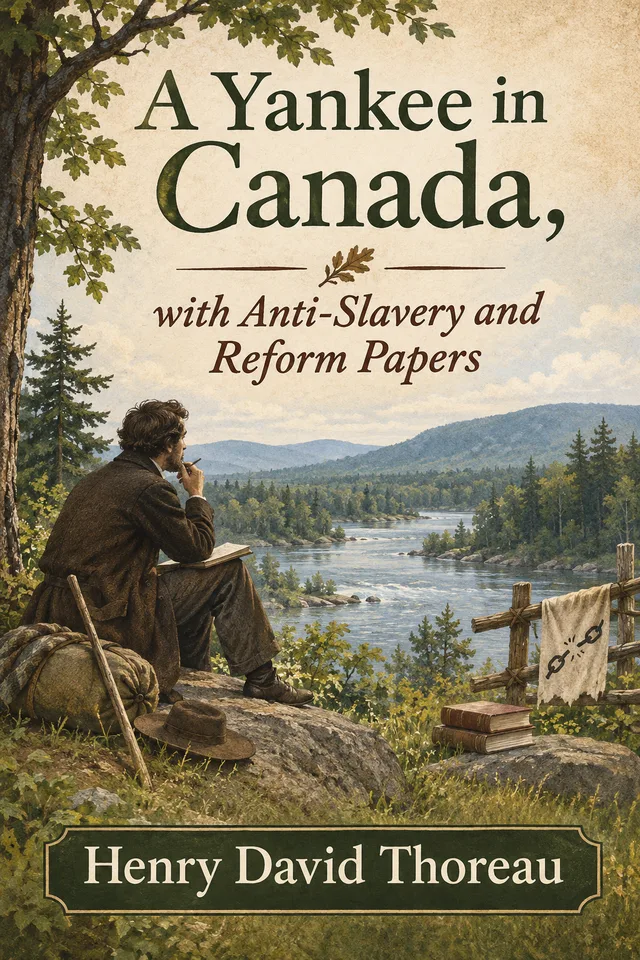
A Yankee in Canada, with Anti-Slavery and Reform Papers
英语 BooksWhale 版本 · Henry David Thoreau
Thoreau’s Canadian journey appears alongside essays on civil disobedience, slavery, John Brown, work, religion, and public responsibility.
- 预览
- 文本节选
- 格式
- 在线阅读, EPUB, PDF
- 访问
- Library 获取
图书简介
A Yankee in Canada, with Anti-Slavery and Reform Papers
A journey through Montreal, Quebec, and the surrounding countryside opens this collection of Henry David Thoreau’s prose. Travel observations are followed by essays and addresses on slavery, conscience, political resistance, John Brown, and the demands of an independent life. The volume includes Civil Disobedience and Life Without Principle, connecting the writer’s attention to ordinary experience with his arguments about individual responsibility in public affairs.
BooksWhale 版本
此版本如何整理
此版本基于公版文本,并由 BooksWhale 整理为适合数字阅读的版本。
公版依据
为什么此版本可以分享
Henry David Thoreau died in 1862; this work was first published in 1866. This edition uses the public-domain English text, excluding modern editorial notes.
阅读预览
文本节选
预览选自整理后的阅读文本。
预览章节Full text阅读预览
A Yankee in Canada, with Anti-Slavery and Reform Papers
预览章节CHAPTER I. CONCORD TO MONTREAL.预览
I fear that I have not got much to say about Canada, not having seen much; what I got by going to Canada was a cold. I left Concord, Massachusetts, Wednesday morning, September 25th, 1850, for Quebec. Fare, seven dollars there and back; distance from Boston, five hundred and ten miles; being obliged to leave Montreal on the return as soon as Friday, October 4th, or within ten days. I will not stop to tell the reader the names of my fellow-travellers; there were said to be fifteen hundred of them. I wished only to be set down in Canada, and take one honest walk there as I might in Concord woods of an afternoon.
The country was new to me beyond Fitchburg. In Ashburnham and afterward, as we were whirled rapidly along, I noticed the woodbine (Ampelopsis quinquefolia), its leaves now changed, for the most part on dead trees, draping them like a red scarf. It was a little exciting, suggesting bloodshed, or at least a military life, like an epaulet or sash, as if it were dyed with the blood of the trees whose wounds it was inadequate to stanch. For now the bloody autumn was come, and an Indian warfare was waged through the forest. These military trees appeared very numerous, for our rapid progress connected those that were even some miles apart. Does the woodbine prefer the elm? The first view of Monadnoc was obtained five or six miles this side of Fitzwilliam, but nearest and best at Troy and beyond. Then there were the Troy cuts and embankments. Keene Street strikes the traveller favorably, it is so wide, level, straight, and long. I have heard one of my relatives, who was born and bred there, say that you could see a chicken run across it a mile off. I have also been told that when this town was settled they laid out a street four rods wide, but at a subsequent meeting of the proprietors one rose and remarked, “We have plenty of land, why not make the street eight rods wide?” and so they voted that it should be eight rods wide, and the town is known far and near for its handsome street. It was a cheap way of securing comfort, as well as fame, and I wish that all new towns would take pattern from this. It is best to lay our plans widely in youth, for then land is cheap, and it is but too easy to contract our views afterward. Youths so laid out, with broad avenues and parks, that they may make handsome and liberal old men! Show me a youth whose mind is like some Washington city of magnificent distances, prepared for the most remotely successful and glorious life after all, when those spaces shall be built over and the idea of the founder be realized. I trust that every New England boy will begin by laying out a Keene Street through his head, eight rods wide. I know one such Washington city of a man, whose lots as yet are only surveyed and staked out, and except a cluster of shanties here and there, only the Capitol stands there for all structures, and any day you may see from afar his princely idea borne coachwise along the spacious but yet empty avenues. Keene is built on a remarkably large and level interval, like the bed of a lake, and the surrounding hills, which are remote from its street, must afford some good walks. The scenery of mountain towns is commonly too much crowded. A town which is built on a plain of some extent, with an open horizon, and surrounded by hills at a distance, affords the best walks and views.
As we travel northwest up the country, sugar-maples, beeches, birches, hemlocks, spruce, butternuts, and ash trees prevail more and more. To the rapid traveller the number of elms in a town is the measure of its civility. One man in the cars has a bottle full of some liquor. The whole company smile whenever it is exhibited. I find no difficulty in containing myself. The Westmoreland country looked attractive. I heard a passenger giving the very obvious derivation of this name, West-more-land, as if it were purely American, and he had made a discovery; but I thought of “my cousin Westmoreland” in England. Every one will remember the approach to Bellows Falls, under a high cliff which rises from the Connecticut. I was disappointed in the size of the river here; it appeared shrunk to a mere mountain stream. The water was evidently very low. The rivers which we had crossed this forenoon possessed more of the character of mountain streams than those in the vicinity of Concord, and I was surprised to see everywhere traces of recent freshets, which had carried away bridges and injured the railroad, though I had heard nothing of it. In Ludlow, Mount Holly, and beyond, there is interesting mountain scenery, not rugged and stupendous, but such as you could easily ramble over,—long narrow mountain vales through which to see the horizon. You are in the midst of the Green Mountains. A few more elevated blue peaks are seen from the neighborhood of Mount Holly, perhaps Killington Peak is one. Sometimes, as on the Western Railroad, you are whirled over mountainous embankments, from which the scared horses in the valleys appear diminished to hounds. All the hills blush; I think that autumn must be the best season to journey over even the Green Mountains. You frequently exclaim to yourself, what red maples! The sugar-maple is not so red. You see some of the latter with rosy spots or cheeks only, blushing on one side like fruit, while all the rest of the tree is green, proving either some partiality in the light or frosts, or some prematurity in particular branches. Tall and slender ash trees, whose foliage is turned to a dark mulberry color, are frequent. The butternut, which is a remarkably spreading tree, is turned completely yellow, thus proving its relation to the hickories. I was also struck by the bright yellow tints of the yellow-birch. The sugar-maple is remarkable for its clean ankle. The groves of these trees looked like vast forest sheds, their branches stopping short at a uniform height, four or five feet from the ground, like eaves, as if they had been trimmed by art, so that you could look under and through the whole grove with its leafy canopy, as under a tent whose curtain is raised.
预览章节CHAPTER II. QUEBEC AND MONTMORENCI.预览
About six o’clock we started for Quebec, one hundred and eighty miles distant by the river; gliding past Longueil and Boucherville on the right, and Pointe aux Trembles, “so called from having been originally covered with aspens,” and Bout de l’Isle, or the end of the island, on the left. I repeat these names not merely for want of more substantial facts to record, but because they sounded singularly poetic to my ears. There certainly was no lie in them. They suggested that some simple, and, perchance, heroic human life might have transpired there. There is all the poetry in the world in a name. It is a poem which the mass of men hear and read. What is poetry in the common sense, but a string of such jingling names? I want nothing better than a good word. The name of a thing may easily be more than the thing itself to me. Inexpressibly beautiful appears the recognition by man of the least natural fact, and the allying his life to it. All the world reiterating this slender truth, that aspens once grew there; and the swift inference is, that men were there to see them. And so it would be with the names of our native and neighboring villages, if we had not profaned them.
The daylight now failed us, and we went below; but I endeavored to console myself for being obliged to make this voyage by night, by thinking that I did not lose a great deal, the shores being low and rather unattractive, and that the river itself was much the more interesting object. I heard something in the night about the boat being at William Henry, Three Rivers, and in the Richelieu Rapids, but I was still where I had been when I lost sight of Pointe aux Trembles. To hear a man who has been waked up at midnight in the cabin of a steamboat, inquiring, “Waiter, where are we now?” is, as if at any moment of the earth’s revolution round the sun, or of the system round its centre, one were to raise himself up and inquire of one of the deck hands, “Where are we now?”
I went on deck at daybreak, when we were thirty or forty miles above Quebec. The banks were now higher and more interesting. There was an “uninterrupted succession of whitewashed cottages” on each side of the river. This is what every traveller tells. But it is not to be taken as an evidence of the populousness of the country in general, hardly even of the river banks. They have presented a similar appearance for a hundred years. The Swedish traveller and naturalist, Kalm, who descended this river in 1749, says: “It could really be called a village, beginning at Montreal and ending at Quebec, which is a distance of more than one hundred and eighty miles; for the farm-houses are never above five arpens, and sometimes but three asunder, a few places excepted.” Even in 1684 Hontan said that the houses were not more than a gunshot apart at most. Erelong we passed Cape Rouge, eight miles above Quebec, the mouth of the Chaudière on the opposite or south side, New Liverpool Cove with its lumber rafts and some shipping; then Sillery and Wolfe’s Cove and the Heights of Abraham on the north, with now a view of Cape Diamond, and the citadel in front. The approach to Quebec was very imposing. It was about six o’clock in the morning when we arrived. There is but a single street under the cliff on the south side of the cape, which was made by blasting the rocks and filling up the river. Three-story houses did not rise more than one fifth or one sixth the way up the nearly perpendicular rock, whose summit is three hundred and forty-five feet above the water. We saw, as we glided past, the sign on the side of the precipice, part way up, pointing to the spot where Montgomery was killed in 1775. Formerly it was the custom for those who went to Quebec for the first time to be ducked, or else pay a fine. Not even the Governor General escaped. But we were too many to be ducked, even if the custom had not been abolished.
目录
本版本内容
- 01Full text
- 02CHAPTER I. CONCORD TO MONTREAL.
- 03CHAPTER II. QUEBEC AND MONTMORENCI.
- 04CHAPTER III. ST. ANNE.
- 05CHAPTER IV. THE WALLS OF QUEBEC.
- 06CHAPTER V. THE SCENERY OF QUEBEC; AND THE RIVER ST. LAWRENCE.
- 07SLAVERY IN MASSACHUSETTS.
- 08PRAYERS.
- 09CIVIL DISOBEDIENCE.
- 10A PLEA FOR CAPTAIN JOHN BROWN.
- 11PARADISE (TO BE) REGAINED.
- 12HERALD OF FREEDOM.
- 13THOMAS CARLYLE AND HIS WORKS.
- 14LIFE WITHOUT PRINCIPLE.
- 15WENDELL PHILLIPS BEFORE THE CONCORD LYCEUM.
- 16THE LAST DAYS OF JOHN BROWN.