英语 版本
文学
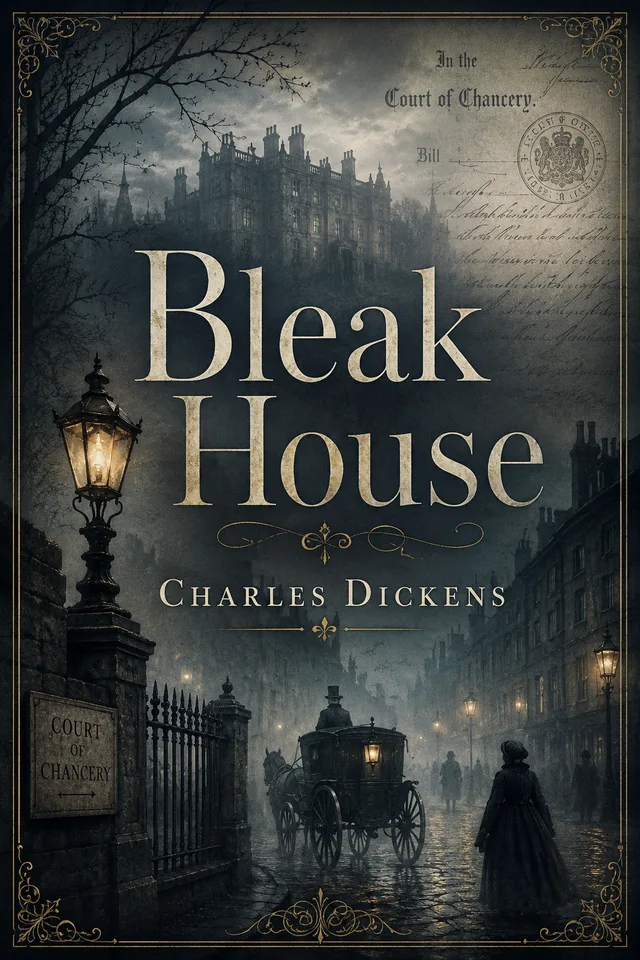
Bleak House
英语 BooksWhale 版本 · Charles Dickens
A vast Dickens novel of law, inheritance, secrecy, poverty, and moral vision.
- 预览
- 文本节选
- 格式
- 在线阅读, EPUB, PDF
- 访问
- Library 获取
图书简介
Bleak House
Bleak House moves between the fog of Chancery, the mystery of Jarndyce and Jarndyce, and the lives damaged by a legal system without mercy. This English edition offers Dickens's social panorama and narrative experiment in a clean reading layout.
BooksWhale 版本
此版本如何整理
此版本基于公版文本,并由 BooksWhale 整理为适合数字阅读的版本。
公版依据
为什么此版本可以分享
Charles Dickens died in 1870, and Bleak House was first published in serial form from 1852 to 1853. These dates support the public-domain basis for the English source text used in this edition.
阅读预览
文本节选
预览选自整理后的阅读文本。
预览章节Full text阅读预览
Bleak House
Charles Dickens
预览章节Preface预览
A Chancery judge once had the kindness to inform me, as one of a company of some hundred and fifty men and women not labouring under any suspicions of lunacy, that the Court of Chancery, though the shining subject of much popular prejudice (at which point I thought the judge’s eye had a cast in my direction), was almost immaculate. There had been, he admitted, a trivial blemish or so in its rate of progress, but this was exaggerated and had been entirely owing to the “parsimony of the public,” which guilty public, it appeared, had been until lately bent in the most determined manner on by no means enlarging the number of Chancery judges appointed—I believe by Richard the Second, but any other king will do as well.
This seemed to me too profound a joke to be inserted in the body of this book or I should have restored it to Conversation Kenge or to Mr. Vholes, with one or other of whom I think it must have originated. In such mouths I might have coupled it with an apt quotation from one of Shakespeare’s sonnets:
“My nature is subdued To what it works in, like the dyer’s hand: Pity me, then, and wish I were renewed!”
But as it is wholesome that the parsimonious public should know what has been doing, and still is doing, in this connexion, I mention here that everything set forth in these pages concerning the Court of Chancery is substantially true, and within the truth. The case of Gridley is in no essential altered from one of actual occurrence, made public by a disinterested person who was professionally acquainted with the whole of the monstrous wrong from beginning to end. At the present moment (August, 1853) there is a suit before the court which was commenced nearly twenty years ago, in which from thirty to forty counsel have been known to appear at one time, in which costs have been incurred to the amount of seventy thousand pounds, which is A FRIENDLY SUIT, and which is (I am assured) no nearer to its termination now than when it was begun. There is another well-known suit in Chancery, not yet decided, which was commenced before the close of the last century and in which more than double the amount of seventy thousand pounds has been swallowed up in costs. If I wanted other authorities for Jarndyce and Jarndyce, I could rain them on these pages, to the shame of—a parsimonious public.
There is only one other point on which I offer a word of remark. The possibility of what is called spontaneous combustion has been denied since the death of Mr. Krook; and my good friend Mr. Lewes (quite mistaken, as he soon found, in supposing the thing to have been abandoned by all authorities) published some ingenious letters to me at the time when that event was chronicled, arguing that spontaneous combustion could not possibly be. I have no need to observe that I do not wilfully or negligently mislead my readers and that before I wrote that description I took pains to investigate the subject. There are about thirty cases on record, of which the most famous, that of the Countess Cornelia de Baudi Cesenate, was minutely investigated and described by Giuseppe Bianchini, a prebendary of Verona, otherwise distinguished in letters, who published an account of it at Verona in 1731, which he afterwards republished at Rome. The appearances, beyond all rational doubt, observed in that case are the appearances observed in Mr. Krook’s case. The next most famous instance happened at Rheims six years earlier, and the historian in that case is Le Cat, one of the most renowned surgeons produced by France. The subject was a woman, whose husband was ignorantly convicted of having murdered her; but on solemn appeal to a higher court, he was acquitted because it was shown upon the evidence that she had died the death of which this name of spontaneous combustion is given. I do not think it necessary to add to these notable facts, and that general reference to the authorities which will be found at page 30, vol. ii.,* the recorded opinions and experiences of distinguished medical professors, French, English, and Scotch, in more modern days, contenting myself with observing that I shall not abandon the facts until there shall have been a considerable spontaneous combustion of the testimony on which human occurrences are usually received.**
预览章节Chapter I: In Chancery预览
London. Michaelmas term lately over, and the Lord Chancellor sitting in Lincoln’s Inn Hall. Implacable November weather. As much mud in the streets as if the waters had but newly retired from the face of the earth, and it would not be wonderful to meet a Megalosaurus, forty feet long or so, waddling like an elephantine lizard up Holborn Hill. Smoke lowering down from chimney-pots, making a soft black drizzle, with flakes of soot in it as big as full-grown snowflakes—gone into mourning, one might imagine, for the death of the sun. Dogs, undistinguishable in mire. Horses, scarcely better; splashed to their very blinkers. Foot passengers, jostling one another’s umbrellas in a general infection of ill temper, and losing their foot-hold at street-corners, where tens of thousands of other foot passengers have been slipping and sliding since the day broke (if this day ever broke), adding new deposits to the crust upon crust of mud, sticking at those points tenaciously to the pavement, and accumulating at compound interest.
Fog everywhere. Fog up the river, where it flows among green aits and meadows; fog down the river, where it rolls defiled among the tiers of shipping and the waterside pollutions of a great (and dirty) city. Fog on the Essex marshes, fog on the Kentish heights. Fog creeping into the cabooses of collier-brigs; fog lying out on the yards and hovering in the rigging of great ships; fog drooping on the gunwales of barges and small boats. Fog in the eyes and throats of ancient Greenwich pensioners, wheezing by the firesides of their wards; fog in the stem and bowl of the afternoon pipe of the wrathful skipper, down in his close cabin; fog cruelly pinching the toes and fingers of his shivering little ’prentice boy on deck. Chance people on the bridges peeping over the parapets into a nether sky of fog, with fog all round them, as if they were up in a balloon and hanging in the misty clouds.
Gas looming through the fog in divers places in the streets, much as the sun may, from the spongey fields, be seen to loom by husbandman and ploughboy. Most of the shops lighted two hours before their time—as the gas seems to know, for it has a haggard and unwilling look.
The raw afternoon is rawest, and the dense fog is densest, and the muddy streets are muddiest near that leaden-headed old obstruction, appropriate ornament for the threshold of a leaden-headed old corporation, Temple Bar. And hard by Temple Bar, in Lincoln’s Inn Hall, at the very heart of the fog, sits the Lord High Chancellor in his High Court of Chancery.
Never can there come fog too thick, never can there come mud and mire too deep, to assort with the groping and floundering condition which this High Court of Chancery, most pestilent of hoary sinners, holds this day in the sight of heaven and earth.
On such an afternoon, if ever, the Lord High Chancellor ought to be sitting here—as here he is—with a foggy glory round his head, softly fenced in with crimson cloth and curtains, addressed by a large advocate with great whiskers, a little voice, and an interminable brief, and outwardly directing his contemplation to the lantern in the roof, where he can see nothing but fog. On such an afternoon some score of members of the High Court of Chancery bar ought to be—as here they are—mistily engaged in one of the ten thousand stages of an endless cause, tripping one another up on slippery precedents, groping knee-deep in technicalities, running their goat-hair and horsehair warded heads against walls of words and making a pretence of equity with serious faces, as players might. On such an afternoon the various solicitors in the cause, some two or three of whom have inherited it from their fathers, who made a fortune by it, ought to be—as are they not?—ranged in a line, in a long matted well (but you might look in vain for truth at the bottom of it) between the registrar’s red table and the silk gowns, with bills, cross-bills, answers, rejoinders, injunctions, affidavits, issues, references to masters, masters’ reports, mountains of costly nonsense, piled before them. Well may the court be dim, with wasting candles here and there; well may the fog hang heavy in it, as if it would never get out; well may the stained-glass windows lose their colour and admit no light of day into the place; well may the uninitiated from the streets, who peep in through the glass panes in the door, be deterred from entrance by its owlish aspect and by the drawl, languidly echoing to the roof from the padded dais where the Lord High Chancellor looks into the lantern that has no light in it and where the attendant wigs are all stuck in a fog-bank! This is the Court of Chancery, which has its decaying houses and its blighted lands in every shire, which has its worn-out lunatic in every madhouse and its dead in every churchyard, which has its ruined suitor with his slipshod heels and threadbare dress borrowing and begging through the round of every man’s acquaintance, which gives to monied might the means abundantly of wearying out the right, which so exhausts finances, patience, courage, hope, so overthrows the brain and breaks the heart, that there is not an honourable man among its practitioners who would not give—who does not often give—the warning, “Suffer any wrong that can be done you rather than come here!”
目录
本版本内容
- 01Full text
- 02Preface
- 03Chapter I: In Chancery
- 04Chapter II: In Fashion
- 05Chapter III: A Progress
- 06Chapter IV: Telescopic Philanthropy
- 07Chapter V: A Morning Adventure
- 08Chapter VI: Quite at Home
- 09Chapter VII: The Ghost’s Walk
- 10Chapter VIII: Covering a Multitude of Sins
- 11Chapter IX: Signs and Tokens
- 12Chapter X: The Law-Writer
- 13Chapter XI: Our Dear Brother
- 14Chapter XII: On the Watch
- 15Chapter XIII: Esther’s Narrative
- 16Chapter XIV: Deportment
- 17Chapter XV: Bell Yard
- 18Chapter XVI: Tom-all-Alone’s
- 19Chapter XVII: Esther’s Narrative
- 20Chapter XVIII: Lady Dedlock
- 21Chapter XIX: Moving On
- 22Chapter XX: A New Lodger
- 23Chapter XXI: The Smallweed Family
- 24Chapter XXII: Mr. Bucket
- 25Chapter XXIII: Esther’s Narrative
- 26Chapter XXIV: An Appeal Case
- 27Chapter XXV: Mrs. Snagsby Sees It All
- 28Chapter XXVI: Sharpshooters
- 29Chapter XXVII: More Old Soldiers Than One
- 30Chapter XXVIII: The Ironmaster
- 31Chapter XXIX: The Young Man
- 32Chapter XXX: Esther’s Narrative
- 33Chapter XXXI: Nurse and Patient
- 34Chapter XXXII: The Appointed Time
- 35Chapter XXXIII: Interlopers
- 36Chapter XXXIV: A Turn of the Screw
- 37Chapter XXXV: Esther’s Narrative
- 38Chapter XXXVI: Chesney Wold
- 39Chapter XXXVII: Jarndyce and Jarndyce
- 40Chapter XXXVIII: A Struggle
- 41Chapter XXXIX: Attorney and Client
- 42Chapter XL: National and Domestic
- 43Chapter XLI: In Mr. Tulkinghorn’s Room
- 44Chapter XLII: In Mr. Tulkinghorn’s Chambers
- 45Chapter XLIII: Esther’s Narrative
- 46Chapter XLIV: The Letter and the Answer
- 47Chapter XLV: In Trust
- 48Chapter XLVI: Stop Him!
- 49Chapter XLVII: Jo’s Will
- 50Chapter XLVIII: Closing In
- 51Chapter XLIX: Dutiful Friendship
- 52Chapter L: Esther’s Narrative
- 53Chapter LI: Enlightened
- 54Chapter LII: Obstinacy
- 55Chapter LIII: The Track
- 56Chapter LIV: Springing a Mine
- 57Chapter LV: Flight
- 58Chapter LVI: Pursuit
- 59Chapter LVII: Esther’s Narrative
- 60Chapter LVIII: A Wintry Day and Night
- 61Chapter LIX: Esther’s Narrative
- 62Chapter LX: Perspective
- 63Chapter LXI: A Discovery
- 64Chapter LXII: Another Discovery
- 65Chapter LXIII: Steel and Iron
- 66Chapter LXIV: Esther’s Narrative
- 67Chapter LXV: Beginning the World
- 68Chapter LXVI: Down in Lincolnshire
- 69Chapter LXVII: The Close of Esther’s Narrative