英语 版本
历史
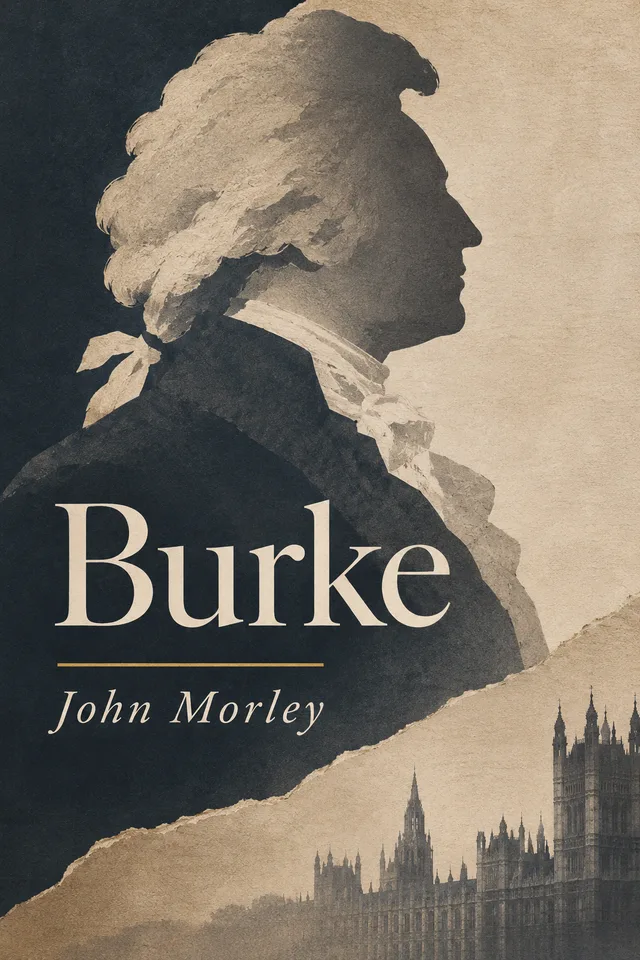
Burke
英语 BooksWhale 版本 · John Morley
John Morley follows Edmund Burke from his Irish upbringing through Parliament, the American crisis, and the French Revolution.
- 预览
- 文本节选
- 格式
- 在线阅读, EPUB, PDF
- 访问
- Library 获取
图书简介
Burke
Morley traces Burke’s path from his early writing and Irish connections to the debates that defined his parliamentary career. The biography connects his arguments over America, the impeachment of Warren Hastings, and the French Revolution with party loyalties, friendships, and the literary craft of his speeches.
BooksWhale 版本
此版本如何整理
此版本基于公版文本,并由 BooksWhale 整理为适合数字阅读的版本。
公版依据
为什么此版本可以分享
John Morley died in 1923. This is the historical English text from the 1907 edition.
阅读预览
文本节选
预览选自整理后的阅读文本。
预览章节CHAPTER I. EARLY LIFE, AND FIRST WRITINGS阅读预览
It will soon be a hundred and twenty years since Burke first took his seat, in the House of Commons, and it is eighty-five years since his voice ceased to be heard there. Since his death, as during his life, opinion as to the place to which he is entitled among the eminent men of his country has touched every extreme. Tories have extolled him as the saviour of Europe. Whigs have detested him as the destroyer of his party. One undiscriminating panegyrist calls him the most profound and comprehensive of political philosophers that has yet existed in the world. Another and more distinguished writer insists that he is a resplendent and far-seeing rhetorician, rather than a deep and subtle thinker. A third tells us that his works cannot be too much our study, if we mean either to understand or to maintain against its various enemies, open and concealed, designing and mistaken, the singular constitution of this fortunate island. A fourth, on the contrary, declares that it would be hard to find a single leading principle or prevailing sentiment in one half of these works, to which something extremely adverse cannot be found in the other half. A fifth calls him one of the greatest men, and, Bacon alone excepted, the greatest thinker, who ever devoted himself to the practice of English politics. Yet, oddly enough, the author of the fifth verdict will have it that this great man and great thinker was actually out of his mind when he composed the pieces for which he has been most widely admired and revered.
A sufficient interval has now passed to allow all the sediment of party fanaticism to fall to the bottom. The circumstances of the world have since Burke's time undergone variation enough to enable us to judge, from many points of view, how far he was the splendid pamphleteer of a faction, and how far he was a contributor to the universal stock of enduring wisdom. Opinion is slowly, but without reaction, settling down to the verdict that Burke is one of the abiding names in our history, not because he either saved Europe or destroyed the Whig party; but because he added to the permanent considerations of wise political thought, and to the maxims of wise practice in great affairs, and because he imprints himself upon us with a magnificence and elevation of expression that places him among the highest masters of literature, in one of its highest and most commanding senses. Those who have acquired a love for abstract politics amid the almost mathematical closeness and precision of Hobbes, the philosophic calm of Locke or Mill, or even the majestic and solemn fervour of Milton, are revolted by the unrestrained passion and the decorated style of Burke. His passion appears hopelessly fatal to success in the pursuit of Truth, who does not usually reveal herself to followers thus inflamed. His ornate style appears fatal to the cautious and precise method of statement, suitable to matter which is not known at all unless it is known distinctly. Yet the natural ardour which impelled Burke to clothe his judgments in glowing and exaggerated phrases, is one secret of his power over us, because it kindles in those who are capable of that generous infection a respondent interest and sympathy. But more than this, the reader is speedily conscious of the precedence in Burke of the facts of morality and conduct, of the many interwoven affinities of human affection and historical relation, over the unreal necessities of mere abstract logic. Burke's mind was full of the matter of great truths, copiously enriched from the fountains of generous and many-coloured feeling. He thought about life as a whole, with all its infirmities and all its pomps. With none of the mental exclusiveness of the moralist by profession, he fills every page with solemn reference and meaning; with none of the mechanical bustle of the common politician, he is everywhere conscious of the mastery of laws, institutions, and government over the character and happiness of men. Besides thus diffusing a strong light over the awful tides of human circumstance, Burke has the sacred gift of inspiring men to use a grave diligence in caring for high things, and in making their lives at once rich and austere. Such a part in literature is indeed high. We feel no emotion of revolt when Mackintosh speaks of Shakespeare and Burke in the same breath as being both of them above mere talent. And we do not dissent when Macaulay, after reading Burke's works over, again, exclaims, "How admirable! The greatest man since Milton."
预览章节CHAPTER II. IN IRELAND—PARLIAMENT—BEACONSFIELD预览
Burke was thirty years old before he approached even the threshold of the arena in which he was destined to be so great a figure. He had made a mark in literature, and it was to literature rather than to public affairs that his ambition turned. He had naturally become acquainted with the brother-authors who haunted the coffee-houses in Fleet Street; and Burke, along with his father-in-law, Dr. Nugent, was one of the first members of the immortal club where Johnson did conversational battle with all comers. We shall, in a later chapter, have something to say on Burke's friendships with the followers of his first profession, and on the active sympathy with which he helped those who were struggling into authorship. Meanwhile, the fragments that remain of his own attempts in this direction are no considerable contributions. His Hints for an Essay on the Drama are jejune and infertile, when compared with the vigorous and original thought of Diderot and Lessing at about the same period. He wrote an Account of the European Settlements in America. His Abridgment of the History of England comes down no further than to the reign of John. A much more important undertaking than his history of the past was his design for a yearly chronicle of the present. The Annual Register began to appear in 1759. Dodsley, the bookseller of Pall Mall, provided the sinews of war, and he gave Burke a hundred pounds a year for his survey of the great events which were then passing in the world. The scheme was probably born of the circumstances of the hour, for this was the climax of the Seven Years' War. The clang of arms was heard in every quarter of the globe, and in East and West new lands were being brought under the dominion of Great Britain.
In this exciting crisis of national affairs, Burke began to be acquainted with public men. In 1759 he was introduced, probably by Lord Charlemont, to William Gerard Hamilton, who only survives in our memories by his nickname of Single-speech. As a matter of fact, he made many speeches in Parliament, and some good ones, but none so good as the first, delivered in a debate in 1755, in which Pitt, Fox, Grenville, and Murray all took part, and were all outshone by the new luminary. But the new luminary never shone again with its first brilliance. He sought Burke out on the strength of the success of the Vindication of Natural Society, and he seems to have had a taste for good company. Horace Walpole describes a dinner at his house in the summer of 1761. "There were Garrick," he says, "and a young Mr. Burke, who wrote a book in the style of Lord Bolingbroke, that is much admired. He is a sensible man, but has not worn off his authorism yet, and thinks there is nothing so charming as writers, and to be one. He will know better one of these days." The prophecy came true in time, but it was Burke's passion for authorism that eventually led to a rupture with his first patron. Hamilton was a man of ability, but selfish and unreasonable. Dr. Leland afterwards described him compendiously as a sullen, vain, proud, selfish, canker-hearted, envious reptile.
In 1761 Hamilton went to Ireland as secretary to Lord Halifax, and Burke accompanied him in some indefinite capacity. "The absenteeism of her men of genius," an eminent historian has said, "was a worse wrong to Ireland than the absenteeism of her landlords. If Edmund Burke had remained in the country where Providence had placed him, he might have changed the current of its history." It is at least to be said that Burke was never so absorbed in other affairs as to forget the peculiar interests of his native land. We have his own word, and his career does not belie it, that in the elation with which he was filled on being elected a member of Parliament, what was first and uppermost in his thoughts was the hope of being somewhat useful to the place of his birth and education; and to the last he had in it "a dearness of instinct more than he could justify to reason." In fact the affairs of Ireland had a most important part in Burke's life at one or two critical moments, and this is as convenient a place as we are likely to find for describing in a few words what were the issues. The brief space can hardly be grudged in an account of a great political writer, for Ireland had furnished the chief ordeal, test, and standard of English statesmen.
预览章节CHAPTER III. THE CONSTITUTIONAL STRUGGLE预览
Foreign observers of our affairs looked upon the state of England between the accession of George III. and the loss of the American colonies (1760-76) with mixed disgust and satisfaction. Their instinct as absolute rulers was revolted by a spectacle of unbridled faction and raging anarchy; their envy was soothed by the growing weakness of a power which Chatham had so short a time before left at the highest point of grandeur and strength. Frederick the Great spoke with contempt of the insolence of Opposition and the virulence of parties; and vowed that, petty German prince as he was, he would not change places with the King of England. The Emperor Joseph pronounced positively that Great Britain was declining, that Parliament was ruining itself, and that the colonies threatened a catastrophe. Catherine of Russia thought that nothing would restore its ancient vigour to the realm, short of the bracing and heroic remedy of a war. Even at home, such shrewd and experienced onlookers as Horace Walpole suspected that the state of the country was more serious than it had been since the Great Rebellion, and declared it to be approaching by fast strides to some sharp crisis. Men who remembered their Roman history, fancied that they saw every symptom of confusion that preceded the ruin of the Commonwealth, and began to inquire uneasily what was the temper of the army. Men who remembered the story of the violence and insatiable factiousness of Florence, turned again to Macchiavelli and to Guicciardini, to trace a parallel between the fierce city on the Arno and the fierce city on the Thames. When the King of Sweden, in 1772, carried out a revolution, by abolishing an oligarchic council and assuming the powers of a dictator, with the assent of his people, there were actually serious men in England who thought that the English, after having been guilty of every meanness and corruption, would soon, like the Swedes, own themselves unworthy to be free. The Duke of Richmond, who happened to have a claim to a peerage and an estate in France, excused himself for taking so much pains to establish his claim to them, by gravely asking who knew that a time might not soon come when England would not be worth living in, and when a retreat to France might be a very happy thing for a free man to have?
The reign had begun by a furious outbreak of hatred between the English and the Scotch. Lord Bute had been driven from office, not merely because he was supposed to owe his power to a scandalous friendship with the king's mother, but because he was accused of crowding the public service with his detested countrymen from the other side of the Tweed. He fell, less from disapproval of his policy, than from rude prejudice against his country. The flow of angry emotion had not subsided before the whisper of strife in the American colonies began to trouble the air; and before that had waxed loud, the Middlesex election had blown into a portentous hurricane. This was the first great constitutional case after Burke came into the House of Commons. As, moreover, it became a leading element in the crisis which was the occasion of Burke's first remarkable essay in the literature of politics, it is as well to go over the facts.
The Parliament to which he had first been returned, now approaching the expiry of its legal term, was dissolved in the spring of 1768. Wilkes, then an outlaw in Paris, returned to England, and announced himself as a candidate for the city. When the election was over, his name stood last on the poll. But his ancient fame as the opponent and victim of the court five years before, was revived. After his rejection in the city, he found himself strong enough to stand for the county of Middlesex. Here he was returned at the head of the poll after an excited election. Wilkes had been tried in 1764, and found guilty by the King's Bench of republishing Number Forty-five of the North Briton, and of printing and publishing the Essay on Woman. He had not appeared to receive sentence, and had been outlawed in consequence. After his election for Middlesex, he obtained a reversal of his outlawry on a point of technical form. He then came up for sentence under the original verdict. The court sent him to prison for twenty-two months, and condemned him to pay a fine of a thousand pounds.
目录
本版本内容
- 01CHAPTER I. EARLY LIFE, AND FIRST WRITINGS
- 02CHAPTER II. IN IRELAND—PARLIAMENT—BEACONSFIELD
- 03CHAPTER III. THE CONSTITUTIONAL STRUGGLE
- 04CHAPTER IV. THE ROCKINGHAM PARTY—PARIS—ELECTION AT BRISTOL—THE AMERICAN WAR
- 05CHAPTER V. ECONOMICAL REFORM—BURKE IN OFFICE—FALL OF HIS PARTY
- 06CHAPTER VI. BURKE AND HIS FRIENDS
- 07CHAPTER VII. THE NEW MINISTRY—WARREN HASTINGS—BURKE'S PUBLIC POSITION
- 08CHAPTER VIII. THE FRENCH REVOLUTION
- 09CHAPTER IX. BURKE AND HIS PARTY—PROGRESS OF THE REVOLUTION—IRELAND—LAST YEARS
- 10CHAPTER X. BURKE'S LITERARY CHARACTER