英语 版本
历史
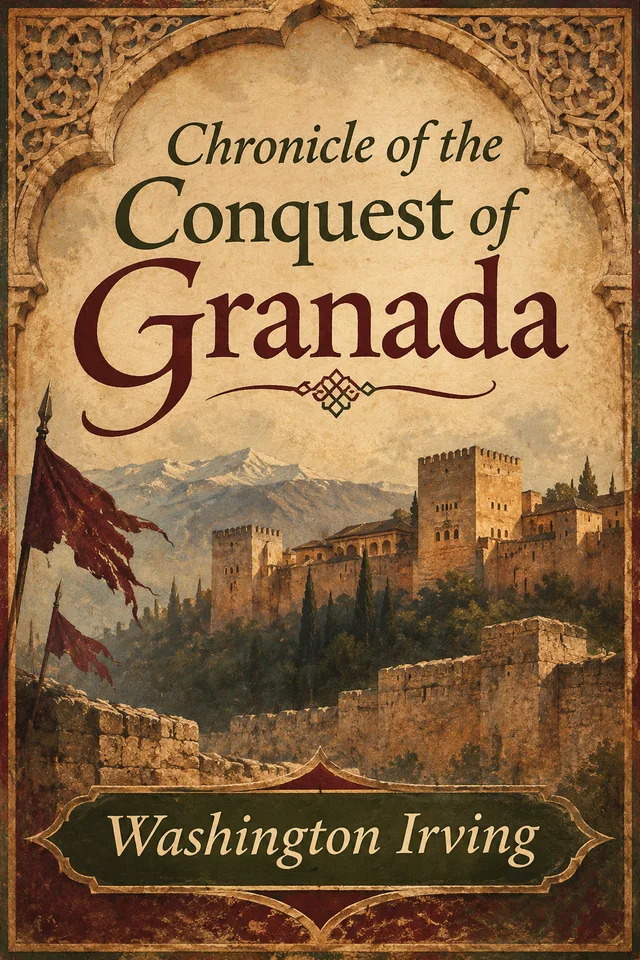
Chronicle of the Conquest of Granada
英语 BooksWhale 版本 · Washington Irving
Washington Irving recounts the final campaign against the kingdom of Granada through battles, negotiations, and the fall of the city.
- 预览
- 文本节选
- 格式
- 在线阅读, EPUB, PDF
- 访问
- Library 获取
图书简介
Chronicle of the Conquest of Granada
Irving follows the war that ended Nasrid rule in Granada, from disputes among its rulers to the siege and surrender of the city. The chronicle alternates between the Christian and Muslim courts and uses the fictional chronicler Fray Antonio Agapida to frame the narrative. This edition contains all 100 numbered chapters with their original chapter titles, plus Irving’s introduction, note to the revised edition, and appendix.
BooksWhale 版本
此版本如何整理
此版本基于公版文本,并由 BooksWhale 整理为适合数字阅读的版本。
公版依据
为什么此版本可以分享
Washington Irving died in 1859. The original English work dates to 1829; this edition uses the text provided by Project Gutenberg and marked public domain in the United States.
阅读预览
文本节选
预览选自整理后的阅读文本。
预览章节INTRODUCTION.阅读预览
Although the following Chronicle bears the name of the venerable Fray Antonio Agapida, it is rather a superstructure reared upon the fragments which remain of his work. It may be asked, Who is this same Agapida, who is cited with such deference, yet whose name is not to be found in any of the catalogues of Spanish authors? The question is hard to answer. He appears to have been one of the many indefatigable authors of Spain who have filled the libraries of convents and cathedrals with their tomes, without ever dreaming of bringing their labors to the press. He evidently was deeply and accurately informed of the particulars of the wars between his countrymen and the Moors, a tract of history but too much overgrown with the weeds of fable. His glowing zeal, also, in the cause of the Catholic faith entitles him to be held up as a model of the good old orthodox chroniclers, who recorded with such pious exultation the united triumphs of the cross and the sword. It is deeply to be regretted, therefore, that his manuscripts, deposited in the libraries of various convents, have been dispersed during the late convulsions in Spain, so that nothing is now to be met of them but disjointed fragments. These, however, are too precious to be suffered to fall into oblivion, as they contain many curious facts not to be found in any other historian. In the following work, therefore, the manuscript of the worthy Fray Antonio will be adopted wherever it exists entire, but will be filled up, extended, illustrated, and corroborated by citations from various authors, both Spanish and Arabian, who have treated of the subject. Those who may wish to know how far the work is indebted to the Chronicle of Fray Antonio Agapida may readily satisfy their curiosity by referring to his manuscript fragments, carefully preserved in the Library of the Escurial.
Before entering upon the history it may be as well to notice the opinions of certain of the most learned and devout historiographers of former times relative to this war.
Marinus Siculus, historian to Charles V., pronounces it a war to avenge ancient injuries received by the Christians from the Moors, to recover the kingdom of Granada, and to extend the name and honor of the Christian religion.
Estevan de Garibay, one of the most distinguished Spanish historians, regards the war as a special act of divine clemency toward the Moors, to the end that those barbarians and infidels, who had dragged out so many centuries under the diabolical oppression of the absurd sect of Mahomet, should at length be reduced to the Christian faith.
Padre Mariana, also a venerable Jesuit and the most renowned historian of Spain, considers the past domination of the Moors a scourge inflicted on the Spanish nation for its iniquities, but the conquest of Granada the reward of Heaven for its great act of propitiation in establishing the glorious tribunal of the Inquisition! No sooner (says the worthy father) was this holy office opened in Spain than there shone forth a resplendent light. Then it was that, through divine favor, the nation increased in power, and became competent to overthrow and trample down the Moorish domination.
Having thus cited high and venerable authority for considering this war in the light of one of those pious enterprises denominated crusades, we trust we have said enough to engage the Christian reader to follow us into the field and stand by us to the very issue of the encounter.
预览章节NOTE TO THE REVISED EDITION.预览
The foregoing introduction, prefixed to the former editions of this work, has been somewhat of a detriment to it. Fray Antonio Agapida was found to be an imaginary personage, and this threw a doubt over the credibility of his Chronicle, which was increased by a vein of irony indulged here and there, and by the occasional heightening of some of the incidents and the romantic coloring of some of the scenes. A word or two explanatory may therefore be of service.
The idea of the work was suggested while I was occupied at Madrid in writing the Life of Columbus. In searching for traces of his early life I was led among the scenes of the war of Granada, he having followed the Spanish sovereigns in some of their campaigns, and been present at the surrender of the Moorish capital. I actually wove some of these scenes into the biography, but found they occupied an undue space, and stood out in romantic relief not in unison with the general course of the narrative. My mind, however, had become so excited by the stirring events and romantic achievements of this war that I could not return with composure to the sober biography I had in hand. The idea then occurred, as a means of allaying the excitement, to throw off a rough draught of the history of this war, to be revised and completed at future leisure. It appeared to me that its true course and character had never been fully illustrated. The world had received a strangely perverted idea of it through Florian’s romance of “Gonsalvo of Cordova,” or through the legend, equally fabulous, entitled “The Civil Wars of Granada,” by Ginez Perez de la Hita, the pretended work of an Arabian contemporary, but in reality a Spanish fabrication. It had been woven over with love-tales and scenes of sentimental gallantry totally opposite to its real character; for it was, in truth, one of the sternest of those iron conflicts sanctified by the title of “holy wars.” In fact, the genuine nature of the war placed it far above the need of any amatory embellishments. It possessed sufficient interest in the striking contrast presented by the combatants of Oriental and European creeds, costumes, and manners, and in the hardy and harebrained enterprises, the romantic adventures, the picturesque forays through mountain regions, the daring assaults and surprisals of cliff-built castles and cragged fortresses, which succeeded each other with a variety and brilliancy beyond the scope of mere invention.
The time of the contest also contributed to heighten the interest. It was not long after the invention of gunpowder, when firearms and artillery mingled the flash and smoke and thunder of modern warfare with the steely splendor of ancient chivalry, and gave an awful magnificence and terrible sublimity to battle, and when the old Moorish towers and castles, that for ages had frowned defiance to the battering-rams and catapults of classic tactics, were toppled down by the lombards of the Spanish engineers. It was one of the cases in which history rises superior to fiction.
The more I thought about the subject, the more I was tempted to undertake it, and the facilities at hand at length determined me. In the libraries of Madrid and in the private library of the American consul, Mr. Rich, I had access to various chronicles and other works, both printed and in manuscript, written at the time by eyewitnesses, and in some instances by persons who had actually mingled in the scenes recorded and gave descriptions of them from different points of view and with different details. These works were often diffuse and tedious, and occasionally discolored by the bigotry, superstition, and fierce intolerance of the age; but their pages were illumined at times with scenes of high emprise, of romantic generosity, and heroic valor, which flashed upon the reader with additional splendor from the surrounding darkness. I collated these various works, some of which have never appeared in print, drew from each facts relative to the different enterprises, arranged them in as clear and lucid order as I could command, and endeavored to give them somewhat of a graphic effect by connecting them with the manners and customs of the age in which they occurred. The rough draught being completed, I laid the manuscript aside and proceeded with the Life of Columbus. After this was finished and sent to the press I made a tour in Andalusia, visited the ruins of the Moorish towns, fortresses, and castles, and the wild mountain-passes and defiles which had been the scenes of the most remarkable events of the war, and passed some time in the ancient palace of the Alhambra, the once favorite abode of the Moorish monarchs. Everywhere I took notes, from the most advantageous points of view, of whatever could serve to give local verity and graphic effect to the scenes described. Having taken up my abode for a time at Seville, I then resumed my manuscript and rewrote it, benefited by my travelling notes and the fresh and vivid impressions of my recent tour. In constructing my chronicle I adopted the fiction of a Spanish monk as the chronicler. Fray Antonio Agapida was intended as a personification of the monkish zealots who hovered about the sovereigns in their campaigns, marring the chivalry of the camp by the bigotry of the cloister, and chronicling in rapturous strains every act of intolerance toward the Moors. In fact, scarce a sally of the pretended friar when he bursts forth in rapturous eulogy of some great stroke of selfish policy on the part of Ferdinand, or exults over some overwhelming disaster of the gallant and devoted Moslems, but is taken almost word for word from one or other of the orthodox chroniclers of Spain.
预览章节CHAPTER I. — OF THE KINGDOM OF GRANADA, AND THE TRIBUTE WHICH IT PAID TO THE CASTILIAN CROWN.预览
The history of those bloody and disastrous wars which have caused the downfall of mighty empires (observes Fray Antonio Agapida) has ever been considered a study highly delectable and full of precious edification. What, then, must be the history of a pious crusade waged by the most Catholic of sovereigns to rescue from the power of the infidels one of the most beautiful but benighted regions of the globe? Listen, then, while from the solitude of my cell I relate the events of the conquest of Granada, where Christian knight and turbaned infidel disputed, inch by inch, the fair land of Andalusia, until the Crescent, that symbol of heathenish abomination, was cast down, and the blessed Cross, the tree of our redemption, erected in its stead.
Nearly eight hundred years were past and gone since the Arabian invaders had sealed the perdition of Spain by the defeat of Don Roderick, the last of her Gothic kings. Since that disastrous event one portion after another of the Peninsula had been gradually recovered by the Christian princes, until the single but powerful and warlike territory of Granada alone remained under the domination of the Moors.
This renowned kingdom, situated in the southern part of Spain and washed on one side by the Mediterranean Sea, was traversed in every direction by sierras or chains of lofty and rugged mountains, naked, rocky, and precipitous, rendering it almost impregnable, but locking up within their sterile embraces deep, rich, and verdant valleys of prodigal fertility.
In the centre of the kingdom lay its capital, the beautiful city of Granada, sheltered, as it were, in the lap of the Sierra Nevada, or Snowy Mountains. Its houses, seventy thousand in number, covered two lofty hills with their declivities and a deep valley between them, through which flowed the Darro. The streets were narrow, as is usual in Moorish and Arab cities, but there were occasionally small squares and open places. The houses had gardens and interior courts, set out with orange, citron, and pomegranate trees and refreshed by fountains, so that as the edifices ranged above each other up the sides of the hills, they presented a delightful appearance of mingled grove and city. One of the hills was surmounted by the Alcazaba, a strong fortress commanding all that part of the city; the other by the Alhambra, a royal palace and warrior castle, capable of containing within its alcazar and towers a garrison of forty thousand men, but possessing also its harem, the voluptuous abode of the Moorish monarchs, laid out with courts and gardens, fountains and baths, and stately halls decorated in the most costly style of Oriental luxury. According to Moorish tradition, the king who built this mighty and magnificent pile was skilled in the occult sciences, and furnished himself with the necessary funds by means of alchemy. Such was its lavish splendor that even at the present day the stranger, wandering through its silent courts and deserted halls, gazes with astonishment at gilded ceilings and fretted domes, the brilliancy and beauty of which have survived the vicissitudes of war and the silent dilapidation of ages.
The city was surrounded by high walls, three leagues in circuit, furnished with twelve gates and a thousand and thirty towers. Its elevation above the sea and the neighborhood of the Sierra Nevada crowned with perpetual snows tempered the fervid rays of summer, so that while other cities were panting with the sultry and stifling heat of the dog-days, the most salubrious breezes played through the marble halls of Granada.
The glory of the city, however, was its Vega or plain, which spread out to a circumference of thirty-seven leagues, surrounded by lofty mountains, and was proudly compared to the famous plain of Damascus. It was a vast garden of delight, refreshed by numerous fountains and by the silver windings of the Xenil. The labor and ingenuity of the Moors had diverted the waters of this river into thousands of rills and streams, and diffused them over the whole surface of the plain. Indeed, they had wrought up this happy region to a degree of wonderful prosperity, and took a pride in decorating it as if it had been a favorite mistress. The hills were clothed with orchards and vineyards, the valleys embroidered with gardens, and the wide plains covered with waving grain. Here were seen in profusion the orange, the citron, the fig, and the pomegranate, with great plantations of mulberry trees, from which was produced the finest silk. The vine clambered from tree to tree, the grapes hung in rich clusters about the peasant’s cottage, and the groves were rejoiced by the perpetual song of the nightingale. In a word, so beautiful was the earth, so pure the air, and so serene the sky of this delicious region that the Moors imagined the paradise of their Prophet to be situated in that part of the heaven which overhung the kingdom of Granada.
目录
本版本内容
- 01INTRODUCTION.
- 02NOTE TO THE REVISED EDITION.
- 03CHAPTER I. — OF THE KINGDOM OF GRANADA, AND THE TRIBUTE WHICH IT PAID TO THE CASTILIAN CROWN.
- 04CHAPTER II. — OF THE EMBASSY OF DON JUAN DE VERA TO DEMAND ARREARS OF TRIBUTE FROM THE MOORISH MONARCH.
- 05CHAPTER III. — DOMESTIC FEUDS IN THE ALHAMBRA—RIVAL SULTANAS—PREDICTIONS CONCERNING BOABDIL, THE HEIR TO THE THRONE—HOW FERDINAND MEDITATES WAR AGAINST GRANADA, AND HOW HE IS ANTICIPATED.
- 06CHAPTER IV. — EXPEDITION OF MULEY ABUL HASSAN AGAINST THE FORTRESS OF ZAHARA.
- 07CHAPTER V. — EXPEDITION OF THE MARQUES OF CADIZ AGAINST ALHAMA.
- 08CHAPTER VI. — HOW THE PEOPLE OF GRANADA WERE AFFECTED ON HEARING OF THE CAPTURE OF ALHAMA, AND HOW THE MOORISH KING SALLIED FORTH TO REGAIN IT.
- 09CHAPTER VII. — HOW THE DUKE OF MEDINA SIDONIA AND THE CHIVALRY OF ANDALUSIA HASTENED TO THE RELIEF OF ALHAMA.
- 10CHAPTER VIII. — SEQUEL OF THE EVENTS AT ALHAMA.
- 11CHAPTER IX. — EVENTS AT GRANADA, AND RISE OF THE MOORISH KING, BOABDIL EL CHICO.
- 12CHAPTER X. — ROYAL EXPEDITION AGAINST LOXA.
- 13CHAPTER XI. — HOW MULEY ABUL HASSAN MADE A FORAY INTO THE LANDS OF MEDINA SIDONIA, AND HOW HE WAS RECEIVED.
- 14CHAPTER XII. — FORAY OF SPANISH CAVALIERS AMONG THE MOUNTAINS OF MALAGA.
- 15CHAPTER XIII. — EFFECTS OF THE DISASTERS AMONG THE MOUNTAINS OF MALAGA.
- 16CHAPTER XIV. — HOW KING BOABDIL EL CHICO MARCHED OVER THE BORDER.
- 17CHAPTER XV. — HOW THE COUNT DE CABRA SALLIED FORTH FROM HIS CASTLE IN QUEST OF KING BOABDIL.
- 18CHAPTER XVI. — THE BATTLE OF LUCENA.
- 19CHAPTER XVII. — LAMENTATIONS OF THE MOORS FOR THE BATTLE OF LUCENA.
- 20CHAPTER XVIII. — HOW MULEY ABUL HASSAN PROFITED BY THE MISFORTUNES OF HIS SON BOABDIL.
- 21CHAPTER XIX. — CAPTIVITY OF BOABDIL EL CHICO.
- 22CHAPTER XX. — OF THE TREATMENT OF BOABDIL BY THE CASTILIAN SOVEREIGNS.
- 23CHAPTER XXI. — RETURN OF BOABDIL FROM CAPTIVITY.
- 24CHAPTER XXII. — FORAY OF THE MOORISH ALCAYDES, AND BATTLE OF LOPERA.
- 25CHAPTER XXIII. — RETREAT OF HAMET EL ZEGRI, ALCAYDE OF RONDA.
- 26CHAPTER XXIV. — OF THE RECEPTION AT COURT OF THE COUNT DE CABRA AND THE ALCAYDE DE LOS DONCELES.
- 27CHAPTER XXV. — HOW THE MARQUES OF CADIZ CONCERTED TO SURPRISE ZAHARA, AND THE RESULT OF HIS ENTERPRISE.
- 28CHAPTER XXVI. — OF THE FORTRESS OF ALHAMA, AND HOW WISELY IT WAS GOVERNED BY THE COUNT DE TENDILLA.
- 29CHAPTER XXVII. — FORAY OF CHRISTIAN KNIGHTS INTO THE TERRITORY OF THE MOORS.
- 30CHAPTER XXVIII. — ATTEMPT OF EL ZAGAL TO SURPRISE BOABDIL IN ALMERIA.
- 31CHAPTER XXIX. — HOW KING FERDINAND COMMENCED ANOTHER CAMPAIGN AGAINST THE MOORS, AND HOW HE LAID SIEGE TO COIN AND CARTAMA.
- 32CHAPTER XXX. — SIEGE OF RONDA.
- 33CHAPTER XXXI. — HOW THE PEOPLE OF GRANADA INVITED EL ZAGAL TO THE THRONE, AND HOW HE MARCHED TO THE CAPITAL.
- 34CHAPTER XXXII. — HOW THE COUNT DE CABRA ATTEMPTED TO CAPTURE ANOTHER KING, AND HOW HE FARED IN HIS ATTEMPT.
- 35CHAPTER XXXIII. — EXPEDITION AGAINST THE CASTLES OF CAMBIL AND ALBAHAR.
- 36CHAPTER XXXIV. — ENTERPRISE OF THE KNIGHTS OF CALATRAVA AGAINST ZALEA.
- 37CHAPTER XXXV. — DEATH OF MULEY ABUL HASSAN.
- 38CHAPTER XXXVI. — OF THE CHRISTIAN ARMY WHICH ASSEMBLED AT THE CITY OF CORDOVA.
- 39CHAPTER XXXVII. — HOW FRESH COMMOTIONS BROKE OUT IN GRANADA, AND HOW THE PEOPLE UNDERTOOK TO ALLAY THEM.
- 40CHAPTER XXXVIII. — HOW KING FERDINAND HELD A COUNCIL OF WAR AT THE ROCK OF THE LOVERS.
- 41CHAPTER XXXIX. — HOW THE ROYAL ARMY APPEARED BEFORE THE CITY OF LOXA, AND HOW IT WAS RECEIVED; AND OF THE DOUGHTY ACHIEVEMENTS OF THE ENGLISH EARL.
- 42CHAPTER XL. — CONCLUSION OF THE SIEGE OF LOXA.
- 43CHAPTER XLI. — CAPTURE OF ILLORA.
- 44CHAPTER XLII. — OF THE ARRIVAL OF QUEEN ISABELLA AT THE CAMP BEFORE MOCLIN, AND OF THE PLEASANT SAYINGS OF THE ENGLISH EARL.
- 45CHAPTER XLIII. — HOW KING FERDINAND ATTACKED MOCLIN, AND OF THE STRANGE EVENTS THAT ATTENDED ITS CAPTURE.
- 46CHAPTER XLIV. — HOW KING FERDINAND FORAGED THE VEGA; AND OF THE BATTLE OF THE BRIDGE OF PINOS, AND THE FATE OF THE TWO MOORISH BROTHERS.
- 47CHAPTER XLV. — ATTEMPT OF EL ZAGAL UPON THE LIFE OF BOABDIL, AND HOW THE LATTER WAS ROUSED TO ACTION.
- 48CHAPTER XLVI. — HOW BOABDIL RETURNED SECRETLY TO GRANADA, AND HOW HE WAS RECEIVED.—SECOND EMBASSY OF DON JUAN DE VERA, AND HIS PERILS IN THE ALHAMBRA.
- 49CHAPTER XLVII. — HOW KING FERDINAND LAID SIEGE TO VELEZ MALAGA.
- 50CHAPTER XLVIII. — HOW KING FERDINAND AND HIS ARMY WERE EXPOSED TO IMMINENT PERIL BEFORE VELEZ MALAGA.
- 51CHAPTER XLIX. — RESULT OF THE STRATAGEM OF EL ZAGAL TO SURPRISE KING FERDINAND.
- 52CHAPTER L. — HOW THE PEOPLE OF GRANADA REWARDED THE VALOR OF EL ZAGAL.
- 53CHAPTER LI. — SURRENDER OF VELEZ MALAGA AND OTHER PLACES.
- 54CHAPTER LII. — OF THE CITY OF MALAGA AND ITS INHABITANTS.—MISSION OF HERNANDO DEL PULGAR.
- 55CHAPTER LIII. — ADVANCE OF KING FERDINAND AGAINST MALAGA.
- 56CHAPTER LIV. — SIEGE OF MALAGA.
- 57CHAPTER LV. — SIEGE OF MALAGA CONTINUED.—OBSTINACY OF HAMET EL ZEGRI.
- 58CHAPTER LVI. — ATTACK OF THE MARQUES OF CADIZ UPON GIBRALFARO.
- 59CHAPTER LVII. — SIEGE OF MALAGIA CONTINUED.—STRATAGEMS OF VARIOUS KINDS.
- 60CHAPTER LVIII. — SUFFERINGS OF THE PEOPLE OF MALAGA.
- 61CHAPTER LIX. — HOW A MOORISH SANTON UNDERTOOK TO DELIVER THE CITY OF MALAGA FROM THE POWER OF ITS ENEMIES.
- 62CHAPTER LX. — HOW HAMET EL ZEGRI WAS HARDENED IN HIS OBSTINACY BY THE ARTS OF A MOORISH ASTROLOGER.
- 63CHAPTER LXI. — SIEGE OF MALAGA CONTINUED.—DESTRUCTION OF A TOWER BY FRANCISCO RAMIREZ DE MADRID.
- 64CHAPTER LXII. — HOW THE PEOPLE OF MALAGA EXPOSTULATED WITH HAMET EL ZEGRI.
- 65CHAPTER LXIII. — HOW HAMET EL ZEGRI SALLIED FORTH WITH THE SACRED BANNER TO ATTACK THE CHRISTIAN CAMP.
- 66CHAPTER LXIV. — HOW THE CITY OF MALAGA CAPITULATED.
- 67CHAPTER LXV. — FULFILMENT OF THE PROPHECY OF THE DERVISE.—FATE OF HAMET EL ZEGRI.
- 68CHAPTER LXVI. — HOW THE CASTILIAN SOVEREIGNS TOOK POSSESSION OF THE CITY OF MALAGA, AND HOW KING FERDINAND SIGNALIZED HIMSELF BY HIS SKILL IN BARGAINING WITH THE INHABITANTS FOR THEIR RANSOM.
- 69CHAPTER LXVII. — HOW KING FERDINAND PREPARED TO CARRY THE WAR INTO A DIFFERENT PART OF THE TERRITORIES OF THE MOORS.
- 70CHAPTER LXVIII. — HOW KING FERDINAND INVADED THE EASTERN SIDE OF THE KINGDOM OF GRANADA, AND HOW HE WAS RECEIVED BY EL ZAGAL.
- 71CHAPTER LXIX. — HOW THE MOORS MADE VARIOUS ENTERPRISES AGAINST THE CHRISTIANS.
- 72CHAPTER LXX. — HOW KING FERDINAND PREPARED TO BESIEGE THE CITY OF BAZA, AND HOW THE CITY PREPARED FOR DEFENCE.
- 73CHAPTER LXXI. — THE BATTLE OF THE GARDENS BEFORE BAZA.
- 74CHAPTER LXXII. — SIEGE OF BAZA.—EMBARRASSMENTS OF THE ARMY.
- 75CHAPTER LXXIII. — SIEGE OF BAZA CONTINUED.—HOW KING FERDINAND COMPLETELY INVESTED THE CITY.
- 76CHAPTER LXXIV. — EXPLOIT OF HERNANDO PEREZ DEL PULGAR AND OTHER CAVALIERS.
- 77CHAPTER LXXV. — CONTINUATION OF THE SIEGE OF BAZA.
- 78CHAPTER LXXVI. — HOW TWO FRIARS FROM THE HOLY LAND ARRIVED AT THE CAMP.
- 79CHAPTER LXXVII. — HOW QUEEN ISABELLA DEVISED MEANS TO SUPPLY THE ARMY WITH PROVISIONS.
- 80CHAPTER LXXVIII. — OF THE DISASTERS WHICH BEFELL THE CAMP.
- 81CHAPTER LXXIX. — ENCOUNTERS BETWEEN THE CHRISTIANS AND MOORS BEFORE BAZA, AND THE DEVOTION OF THE INHABITANTS TO THE DEFENCE OF THEIR CITY.
- 82CHAPTER LXXX. — HOW QUEEN ISABELLA ARRIVED AT THE CAMP, AND THE CONSEQUENCES OF HER ARRIVAL.
- 83CHAPTER LXXXI. — THE SURRENDER OF BAZA.
- 84CHAPTER LXXXII. — SUBMISSION OF EL ZAGAL TO THE CASTILIAN SOVEREIGNS.
- 85CHAPTER LXXXIII. — EVENTS AT GRANADA SUBSEQUENT TO THE SUBMISSION OF EL ZAGAL.
- 86CHAPTER LXXXIV. — HOW FERDINAND TURNED HIS HOSTILITIES AGAINST THE CITY OF GRANADA.
- 87CHAPTER LXXXV. — THE FATE OF THE CASTLE OF ROMA.
- 88CHAPTER LXXXVI. — HOW BOABDIL EL CHICO TOOK THE FIELD, AND HIS EXPEDITION AGAINST ALHENDIN.
- 89CHAPTER LXXXVII. — EXPLOIT OF THE COUNT DE TENDILLA.
- 90CHAPTER LXXXVIII. — EXPEDITION OF BOABDIL EL CHICO AGAINST SALOBRENA.—EXPLOIT OF HERNAN PEREZ DEL PULGAR.
- 91CHAPTER LXXXIX. — HOW KING FERDINAND TREATED THE PEOPLE OF GUADIX, AND HOW EL ZAGAL FINISHED HIS REGAL CAREER.
- 92CHAPTER XC. — PREPARATIONS OF GRANADA FOR A DESPERATE DEFENCE.
- 93CHAPTER XCI. — HOW KING FERDINAND CONDUCTED THE SIEGE CAUTIOUSLY, AND HOW QUEEN ISABELLA ARRIVED AT THE CAMP.
- 94CHAPTER XCII. — OF THE INSOLENT DEFIANCE OF TARFE THE MOOR, AND THE DARING EXPLOIT OF HERNAN PEREZ DEL PULGAR.
- 95CHAPTER XCIII. — HOW QUEEN ISABELLA TOOK A VIEW OF THE CITY OF GRANADA, AND HOW HER CURIOSITY COST THE LIVES OF MANY CHRISTIANS AND MOORS.
- 96CHAPTER XCIV. — THE LAST RAVAGE BEFORE GRANADA.
- 97CHAPTER XCV. — CONFLAGRATION OF THE CHRISTIAN CAMP.—BUILDING OF SANTA FE.
- 98CHAPTER XCVI. — FAMINE AND DISCORD IN THE CITY.
- 99CHAPTER XCVII. — CAPITULATION OF GRANADA.
- 100CHAPTER XCVIII. — COMMOTIONS IN GRANADA.
- 101CHAPTER XCIX. — SURRENDER OF GRANADA.
- 102CHAPTER C. — HOW THE CASTILIAN SOVEREIGNS TOOK POSSESSION OF GRANADA.
- 103APPENDIX.