英语 版本
文学
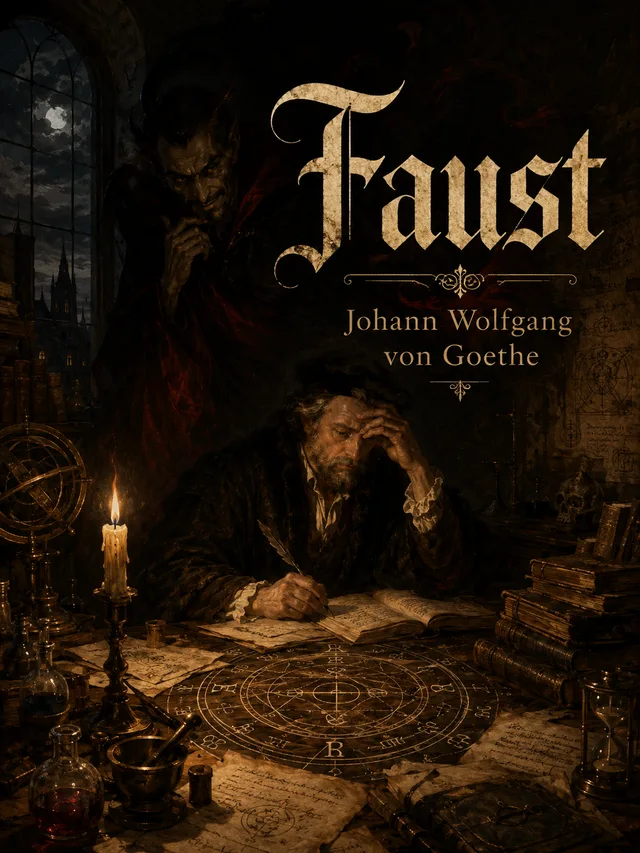
Faust
英语 BooksWhale 版本 · Johann Wolfgang von Goethe
A complete English BooksWhale translation of Goethe’s Faust, joining philosophical drama, temptation, love, striving, and redemption.
- 预览
- 文本节选
- 格式
- 在线阅读, EPUB, PDF
- 访问
- Library 获取
图书简介
Faust
Faust presents Johann Wolfgang von Goethe’s great dramatic poem in a complete English BooksWhale-authorized translation covering both Part One and Part Two. The work follows Faust’s restless pursuit of knowledge, experience, love, power, and meaning through encounters with Mephistopheles, Gretchen, the imperial court, classical myth, and the final vision of redemption. This edition is suited for readers of world literature, German classics, philosophical drama, Romanticism, and enduring stories about ambition and the human spirit.
BooksWhale 版本
此版本如何整理
此版本基于公版文本,并由 BooksWhale 整理为适合数字阅读的版本。
公版依据
为什么此版本可以分享
Johann Wolfgang von Goethe died in 1832; Faust Part One was first published in 1808 and Part Two in 1832. The German source work is public domain, and this English edition is a BooksWhale-authorized translation prepared from the public-domain original.
阅读预览
文本节选
预览选自整理后的阅读文本。
预览章节Part 1阅读预览
FAUST
The Tragedy, Parts One and Two
Johann Wolfgang von Goethe
Preface
Few works of European literature have pursued the possibilities and dangers of human striving with the intensity of Johann Wolfgang von Goethe’s Faust. At once a drama, a philosophical poem, a tragedy, a comedy, and a vast meditation on civilization, Faust reaches beyond the boundaries of any single genre. Its central figure is not simply a scholar dissatisfied with knowledge, nor merely a man tempted by supernatural power. Faust embodies a deeply human restlessness: the desire to experience more, understand more, possess more, and ultimately discover whether life can offer a moment so complete that one might wish it never to end.
At the beginning of the drama, Faust has devoted himself to learning. He has studied philosophy, law, medicine, theology, and the accumulated wisdom of his age, yet his knowledge has brought him neither certainty nor peace. Surrounded by books, he feels imprisoned rather than enlightened. His despair prepares the way for Mephistopheles, the brilliant, mocking spirit who challenges ideals, exposes weaknesses, and offers Faust a path beyond the limits of ordinary existence. Their agreement sets the drama in motion, but the relationship between them is far more complex than a simple tale of temptation. Mephistopheles becomes antagonist, companion, provocateur, and ironic commentator on Faust’s endless pursuit.
The tragedy of Gretchen gives this philosophical struggle an intensely personal and emotional dimension. Faust’s hunger for experience enters the life of an innocent young woman with devastating consequences. Through Gretchen, Goethe explores love, desire, guilt, social judgment, responsibility, and spiritual redemption. Her story remains among the most powerful parts of the work precisely because the grand questions of philosophy are transformed into irreversible human suffering.
Yet Faust is larger than the fate of any one character. Goethe worked on the drama across much of his life, and its extraordinary range reflects decades of intellectual and artistic development. Religion and skepticism, science and magic, classical mythology and modern society, politics, economics, art, sensuality, ambition, and salvation all enter its expanding world. Especially in the second part, the drama moves far beyond the intimate tragedy of its earlier scenes into a symbolic landscape in which individual desire becomes connected with the ambitions and contradictions of civilization itself.
What gives Faust its enduring vitality is its refusal to provide easy moral answers. Faust’s striving is dangerous, often selfish, and sometimes destructive, yet it is also inseparable from his refusal to accept intellectual and spiritual stagnation. Mephistopheles, meanwhile, may represent negation and cynicism, but his wit frequently reveals uncomfortable truths. Goethe allows opposing forces to remain in tension rather than reducing them to a simple lesson.
For modern readers, Faust continues to speak with remarkable urgency. In an age defined by expanding knowledge, technological power, ambition, and dissatisfaction, Faust’s longing to cross every boundary feels strikingly familiar. The work asks what knowledge is worth without wisdom, what freedom means without responsibility, and whether relentless progress can truly satisfy the human spirit.
To read Faust is therefore to enter not only Goethe’s imaginative universe, but also a continuing conversation about what it means to desire, to fail, to create, and to seek meaning in a world whose possibilities always seem greater than our ability to master them.
Faust: The Tragedy, Part One
Dedication
You draw near again, wavering forms,
That once appeared early to my clouded sight.
Shall I attempt this time to hold you fast?
Does my heart still incline to that old illusion?
You press upon me! Very well, then rule,
As out of mist and vapor you rise around me;
My breast feels youthfully shaken
By the magic breath that circles your procession.
You bring with you the images of happy days,
And many dear shades rise up;
Like an old, half-faded legend,
First love and friendship come up with them;
The pain grows new, the lament repeats
预览章节Part 2预览
Who spurs and works and, as devil, must create.
But you, true sons of God,
Rejoice in the living, abundant beauty!
May what is becoming, what eternally works and lives,
Embrace you within love’s gracious bounds,
And what hovers in wavering appearance,
Fix it with enduring thoughts!
(Heaven closes; the Archangels disperse.)
MEPHISTOPHELES (alone).
From time to time I like to see the Old One,
And take care not to break with him.
It is very pretty of a great lord
To speak so humanely even with the devil.
FAUST: The Tragedy, Part One
Night
In a high-vaulted, narrow Gothic room, Faust,
restless in his chair at the desk.
FAUST:
I have now, alas! philosophy,
Law, and medicine,
And unfortunately theology too,
Thoroughly studied, with ardent effort.
Here I stand now, poor fool that I am!
And am as wise as I was before;
I am called Master, even called Doctor,
And for some ten years already
I have led my students by the nose
Up, down, crosswise and crooked—
And see that we can know nothing!
That almost burns my heart.
True, I am cleverer than all the fools,
Doctors, masters, clerks, and priests;
Neither scruples nor doubts torment me,
I fear neither hell nor devil—
But for that, all joy is also torn from me;
I do not imagine that I know what is right,
I do not imagine that I could teach anything,
To improve and convert human beings.
Nor do I have goods or money,
Nor honor and glory in the world;
No dog would want to live like this any longer!
Therefore I have given myself to magic,
In hopes that through spirit’s power and mouth
Many a secret might become known to me;
That I need no longer, with sour sweat,
Say what I do not know;
That I may recognize what holds
The world together in its innermost being,
Behold all working power and seed,
And no longer rummage in words.
O if you, full moonlight,
Would look for the last time upon my pain,
You whom I have watched so many a midnight
At this desk.
Then, over books and paper,
Sad friend, you appeared to me!
Ah! could I but walk on mountain heights
In your dear light,
Hover around mountain caves with spirits,
Weave over meadows in your twilight,
Freed from all the smoke of knowledge,
Bathe myself healthy in your dew!
Woe! Am I still stuck in this prison?
Accursed, musty hole of walls,
Where even the dear light of heaven
Breaks dimly through painted panes!
Confined by this heap of books,
Which worms gnaw, which dust covers,
Which up to the high vault
Is hemmed in by smoke-stained paper;
Surrounded by glasses, boxes all around,
Stuffed full with instruments,
Ancestral household junk crammed in—
That is your world! That is called a world!
And do you still ask why your heart
Contracts anxiously in your breast?
Why an unexplained pain
Hinders every stirring of life in you?
Instead of living nature,
Into which God created mankind,
Only smoke and mold surround you,
Animal skeletons and dead men’s bones.
Flee! Up! Out into the wide land!
And this mysterious book,
From Nostradamus’ own hand—
Is it not enough of a guide for you?
Then you will know the course of the stars,
And when nature instructs you,
Then the power of the soul will open in you,
How spirit speaks to spirit.
In vain does dry pondering here
Explain the sacred signs to you.
You hover, spirits, beside me;
Answer me, if you hear me!
(He opens the book and sees the sign of the Macrocosm.)
Ha! What bliss flows in this sight
At once through all my senses!
I feel young, holy happiness of life
Glowing anew through nerves and veins.
Was it a god who wrote these signs,
Which quiet the inner raging in me,
预览章节Part 3预览
Sound there around, where soft human beings are.
The message I hear well, but faith is lacking to me;
The miracle is faith’s dearest child.
Toward those spheres I dare not strive,
Whence the gracious news resounds;
And yet, accustomed to this sound from youth,
It calls me now back into life.
Once the kiss of heavenly love
Plunged down upon me in solemn Sabbath stillness;
Then the fullness of the bell’s tone rang so full of foreboding,
And a prayer was ardent delight;
An incomprehensibly gracious yearning
Drove me to wander through forest and meadow,
And under a thousand hot tears
I felt a world arise within me.
This song proclaimed the lively games of youth,
The free happiness of spring’s festival;
Memory now, with childlike feeling,
Holds me back from the last, solemn step.
Oh sound on, you sweet heavenly songs!
The tear wells up, the earth has me again!
CHORUS OF DISCIPLES:
Has the buried one
Already upward
Living, exalted,
Gloriously risen;
Is he near creative joy
In the air of becoming.
Ah! at earth’s breast
We are here for sorrow.
He left his own
Languishing here behind;
Ah! we weep,
Master, for your happiness!
CHORUS OF ANGELS:
Christ is risen
From the womb of decay.
Tear yourselves from bonds
Joyfully loose!
Actively praising him,
Proving love,
Brotherly feeding,
Preaching as you travel,
Promising bliss—
The Master is near you,
He is here for you!
Before the Gate
Walkers of every kind stream out.
SOME JOURNEYMEN:
Why go out there?
OTHERS:
We are going out to the hunting lodge.
THE FIRST:
But we want to wander to the mill.
A JOURNEYMAN:
I advise you to go to the Water Court.
SECOND:
The road there is not beautiful.
THE SECOND GROUP:
What are you doing then?
A THIRD:
I am going with the others.
FOURTH:
Go up to Burgdorf; surely there you will find
The prettiest girls and the best beer,
And quarrels of the first sort.
FIFTH:
You over-merry fellow,
Does your hide itch for the third time?
I do not care to go; that place frightens me.
MAIDSERVANT:
No, no! I am going back to town.
ANOTHER:
We shall surely find him standing by those poplars.
FIRST:
That is no great happiness for me;
He will walk at your side,
With you alone he dances on the green.
What do your joys matter to me?
ANOTHER:
Today he is surely not alone;
The curly-head, he said, would be with him.
STUDENT:
Thunder! how the fine girls stride!
Brother, come! We must accompany them.
A strong beer, a biting tobacco,
And a maid in finery—that is my taste.
BURGHER GIRL:
Just look at the handsome lads!
It is truly a shame.
They could have the very best company,
And they run after those maids!
SECOND STUDENT (to the first).
Not so fast! Back there come two;
They are dressed quite prettily,
My neighbor is among them;
I am very fond of the girl.
They walk their quiet step
And will still take us along in the end.
FIRST:
Brother, no! I do not like to be constrained.
Quick! so that we do not lose the game.
The hand that guides her broom on Saturday
Will caress you best on Sunday.
BURGHER:
No, I do not like him, the new mayor!
Now that he is mayor, he only grows bolder every day.
And what does he do for the town?
Does it not grow worse every day?
One must obey more than ever,
And pay more than ever before.
BEGGAR (sings).
You good gentlemen, you fair ladies,
So well dressed and rosy-cheeked,
May it please you to look upon me,
And see and ease my need!
Do not let me grind my song here in vain!
Only he is glad who likes to give.
A day that all people celebrate—
May it be harvest day for me.
目录
本版本内容
- 01Part 1
- 02Part 2
- 03Part 3
- 04Part 4
- 05Part 5
- 06Part 6
- 07Part 7
- 08Part 8
- 09Part 9
- 10Part 10
- 11Part 11
- 12Part 12
- 13Part 13
- 14Part 14
- 15Part 15
- 16Part 16
- 17Part 17
- 18Part 18
- 19Part 19
- 20Part 20
- 21Part 21
- 22Part 22
- 23Part 23
- 24Part 24
- 25Part 25
- 26Part 26
- 27Part 27
- 28Part 28