英语 版本
教育
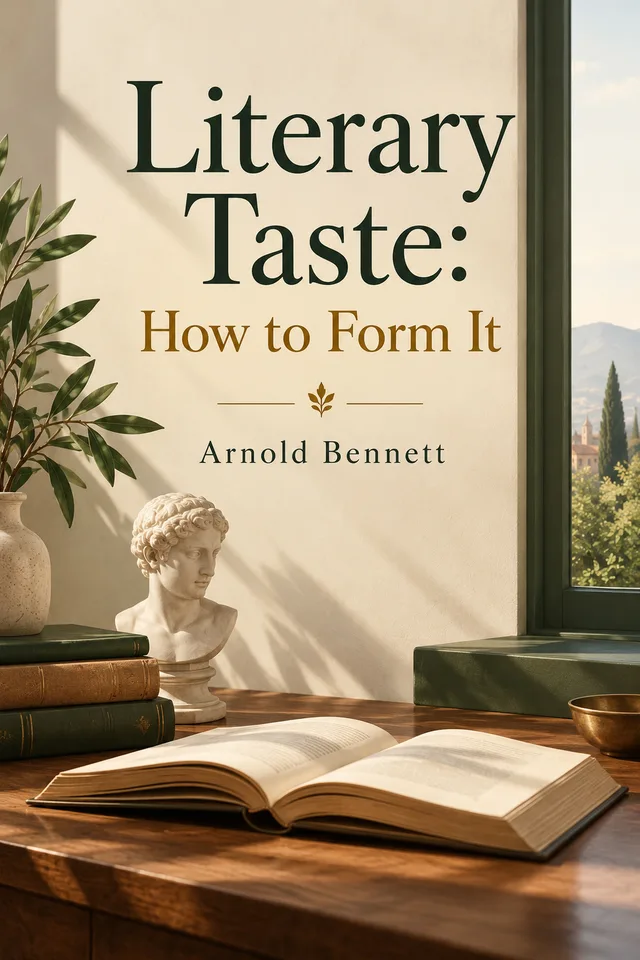
Literary Taste: How to Form It
英语 BooksWhale 版本 · Arnold Bennett
Bennett offers a practical approach to literary appreciation through attentive reading, poetry, prose, and the gradual formation of a personal library.
- 预览
- 文本节选
- 格式
- 在线阅读, EPUB, PDF
- 访问
- Library 获取
图书简介
Literary Taste: How to Form It
How does a reader develop literary judgment rather than merely collect opinions about books? Arnold Bennett addresses that question through fourteen chapters on pleasure, attention, form, and the experience of reading. Practical suggestions about prose, poetry, and building a library connect his argument with particular authors and works. This English text retains the reading lists that form part of Bennett’s original advice.
BooksWhale 版本
此版本如何整理
此版本基于公版文本,并由 BooksWhale 整理为适合数字阅读的版本。
公版依据
为什么此版本可以分享
Arnold Bennett died in 1931. This edition uses the original English text preserved by Project Gutenberg, excluding separate notes and later editorial material.
阅读预览
文本节选
预览选自整理后的阅读文本。
预览章节Chapter I — THE AIM阅读预览
At the beginning a misconception must be removed from the path. Many people, if not most, look on literary taste as an elegant accomplishment, by acquiring which they will complete themselves, and make themselves finally fit as members of a correct society. They are secretly ashamed of their ignorance of literature, in the same way as they would be ashamed of their ignorance of etiquette at a high entertainment, or of their inability to ride a horse if suddenly called upon to do so. There are certain things that a man ought to know, or to know about, and literature is one of them: such is their idea. They have learnt to dress themselves with propriety, and to behave with propriety on all occasions; they are fairly "up" in the questions of the day; by industry and enterprise they are succeeding in their vocations; it behoves them, then, not to forget that an acquaintance with literature is an indispensable part of a self-respecting man's personal baggage. Painting doesn't matter; music doesn't matter very much. But "everyone is supposed to know" about literature. Then, literature is such a charming distraction! Literary taste thus serves two purposes: as a certificate of correct culture and as a private pastime. A young professor of mathematics, immense at mathematics and games, dangerous at chess, capable of Haydn on the violin, once said to me, after listening to some chat on books, "Yes, I must take up literature." As though saying: "I was rather forgetting literature. However, I've polished off all these other things. I'll have a shy at literature now."
This attitude, or any attitude which resembles it, is wrong. To him who really comprehends what literature is, and what the function of literature is, this attitude is simply ludicrous. It is also fatal to the formation of literary taste. People who regard literary taste simply as an accomplishment, and literature simply as a distraction, will never truly succeed either in acquiring the accomplishment or in using it half-acquired as a distraction; though the one is the most perfect of distractions, and though the other is unsurpassed by any other accomplishment in elegance or in power to impress the universal snobbery of civilised mankind. Literature, instead of being an accessory, is the fundamental sine qua non of complete living. I am extremely anxious to avoid rhetorical exaggerations. I do not think I am guilty of one in asserting that he who has not been "presented to the freedom" of literature has not wakened up out of his prenatal sleep. He is merely not born. He can't see; he can't hear; he can't feel, in any full sense. He can only eat his dinner. What more than anything else annoys people who know the true function of literature, and have profited thereby, is the spectacle of so many thousands of individuals going about under the delusion that they are alive, when, as a fact, they are no nearer being alive than a bear in winter.
I will tell you what literature is! No—I only wish I could. But I can't. No one can. Gleams can be thrown on the secret, inklings given, but no more. I will try to give you an inkling. And, to do so, I will take you back into your own history, or forward into it. That evening when you went for a walk with your faithful friend, the friend from whom you hid nothing— or almost nothing...! You were, in truth, somewhat inclined to hide from him the particular matter which monopolised your mind that evening, but somehow you contrived to get on to it, drawn by an overpowering fascination. And as your faithful friend was sympathetic and discreet, and flattered you by a respectful curiosity, you proceeded further and further into the said matter, growing more and more confidential, until at last you cried out, in a terrific whisper: "My boy, she is simply miraculous!" At that moment you were in the domain of literature.
预览章节Chapter II — YOUR PARTICULAR CASE预览
The attitude of the average decent person towards the classics of his own tongue is one of distrust—I had almost said, of fear. I will not take the case of Shakespeare, for Shakespeare is "taught" in schools; that is to say, the Board of Education and all authorities pedagogic bind themselves together in a determined effort to make every boy in the land a lifelong enemy of Shakespeare. (It is a mercy they don't "teach" Blake.) I will take, for an example, Sir Thomas Browne, as to whom the average person has no offensive juvenile memories. He is bound to have read somewhere that the style of Sir Thomas Browne is unsurpassed by anything in English literature. One day he sees the Religio Medici in a shop-window (or, rather, outside a shop-window, for he would hesitate about entering a bookshop), and he buys it, by way of a mild experiment. He does not expect to be enchanted by it; a profound instinct tells him that Sir Thomas Browne is "not in his line"; and in the result he is even less enchanted than he expected to be. He reads the introduction, and he glances at the first page or two of the work. He sees nothing but words. The work makes no appeal to him whatever. He is surrounded by trees, and cannot perceive the forest. He puts the book away. If Sir Thomas Browne is mentioned, he will say, "Yes, very fine!" with a feeling of pride that he has at any rate bought and inspected Sir Thomas Browne. Deep in his heart is a suspicion that people who get enthusiastic about Sir Thomas Browne are vain and conceited poseurs. After a year or so, when he has recovered from the discouragement caused by Sir Thomas Browne, he may, if he is young and hopeful, repeat the experiment with Congreve or Addison. Same sequel! And so on for perhaps a decade, until his commerce with the classics finally expires! That, magazines and newish fiction apart, is the literary history of the average decent person.
And even your case, though you are genuinely preoccupied with thoughts of literature, bears certain disturbing resemblances to the drab case of the average person. You do not approach the classics with gusto— anyhow, not with the same gusto as you would approach a new novel by a modern author who had taken your fancy. You never murmured to yourself, when reading Gibbon's Decline and Fall in bed: "Well, I really must read one more chapter before I go to sleep!" Speaking generally, the classics do not afford you a pleasure commensurate with their renown. You peruse them with a sense of duty, a sense of doing the right thing, a sense of "improving yourself," rather than with a sense of gladness. You do not smack your lips; you say: "That is good for me." You make little plans for reading, and then you invent excuses for breaking the plans. Something new, something which is not a classic, will surely draw you away from a classic. It is all very well for you to pretend to agree with the verdict of the elect that Clarissa Harlowe is one of the greatest novels in the world—a new Kipling, or even a new number of a magazine, will cause you to neglect Clarissa Harlowe, just as though Kipling, etc., could not be kept for a few days without turning sour! So that you have to ordain rules for yourself, as: "I will not read anything else until I have read Richardson, or Gibbon, for an hour each day." Thus proving that you regard a classic as a pill, the swallowing of which merits jam! And the more modern a classic is, the more it resembles the stuff of the year and the less it resembles the classics of the centuries, the more easy and enticing do you find that classic. Hence you are glad that George Eliot, the Brontës, Thackeray, are considered as classics, because you really do enjoy them. Your sentiments concerning them approach your sentiments concerning a "rattling good story" in a magazine.
预览章节Chapter III — WHY A CLASSIC IS A CLASSIC预览
The large majority of our fellow-citizens care as much about literature as they care about aeroplanes or the programme of the Legislature. They do not ignore it; they are not quite indifferent to it. But their interest in it is faint and perfunctory; or, if their interest happens to be violent, it is spasmodic. Ask the two hundred thousand persons whose enthusiasm made the vogue of a popular novel ten years ago what they think of that novel now, and you will gather that they have utterly forgotten it, and that they would no more dream of reading it again than of reading Bishop Stubbs's Select Charters. Probably if they did read it again they would not enjoy it—not because the said novel is a whit worse now than it was ten years ago; not because their taste has improved—but because they have not had sufficient practice to be able to rely on their taste as a means of permanent pleasure. They simply don't know from one day to the next what will please them.
In the face of this one may ask: Why does the great and universal fame of classical authors continue? The answer is that the fame of classical authors is entirely independent of the majority. Do you suppose that if the fame of Shakespeare depended on the man in the street it would survive a fortnight? The fame of classical authors is originally made, and it is maintained, by a passionate few. Even when a first-class author has enjoyed immense success during his lifetime, the majority have never appreciated him so sincerely as they have appreciated second-rate men. He has always been reinforced by the ardour of the passionate few. And in the case of an author who has emerged into glory after his death the happy sequel has been due solely to the obstinate perseverance of the few. They could not leave him alone; they would not. They kept on savouring him, and talking about him, and buying him, and they generally behaved with such eager zeal, and they were so authoritative and sure of themselves, that at last the majority grew accustomed to the sound of his name and placidly agreed to the proposition that he was a genius; the majority really did not care very much either way.
And it is by the passionate few that the renown of genius is kept alive from one generation to another. These few are always at work. They are always rediscovering genius. Their curiosity and enthusiasm are exhaustless, so that there is little chance of genius being ignored. And, moreover, they are always working either for or against the verdicts of the majority. The majority can make a reputation, but it is too careless to maintain it. If, by accident, the passionate few agree with the majority in a particular instance, they will frequently remind the majority that such and such a reputation has been made, and the majority will idly concur: "Ah, yes. By the way, we must not forget that such and such a reputation exists." Without that persistent memory-jogging the reputation would quickly fall into the oblivion which is death. The passionate few only have their way by reason of the fact that they are genuinely interested in literature, that literature matters to them. They conquer by their obstinacy alone, by their eternal repetition of the same statements. Do you suppose they could prove to the man in the street that Shakespeare was a great artist? The said man would not even understand the terms they employed. But when he is told ten thousand times, and generation after generation, that Shakespeare was a great artist, the said man believes—not by reason, but by faith. And he too repeats that Shakespeare was a great artist, and he buys the complete works of Shakespeare and puts them on his shelves, and he goes to see the marvellous stage-effects which accompany King Lear or Hamlet, and comes back religiously convinced that Shakespeare was a great artist. All because the passionate few could not keep their admiration of Shakespeare to themselves. This is not cynicism; but truth. And it is important that those who wish to form their literary taste should grasp it.
目录
本版本内容
- 01Chapter I — THE AIM
- 02Chapter II — YOUR PARTICULAR CASE
- 03Chapter III — WHY A CLASSIC IS A CLASSIC
- 04Chapter IV — WHERE TO BEGIN
- 05Chapter V — HOW TO READ A CLASSIC
- 06Chapter VI — THE QUESTION OF STYLE
- 07Chapter VII — WRESTLING WITH AN AUTHOR
- 08Chapter VIII — SYSTEM IN READING
- 09Chapter IX — VERSE
- 10Chapter X — BROAD COUNSELS
- 11Chapter XI — AN ENGLISH LIBRARY: PERIOD I
- 12SUMMARY OF THE FIRST PERIOD.
- 13Chapter XII — AN ENGLISH LIBRARY: PERIOD II
- 14SUMMARY OF THE PERIOD.
- 15Chapter XIII — AN ENGLISH LIBRARY: PERIOD III
- 16SUMMARY OF THE NINETEENTH CENTURY.
- 17Chapter XIV — MENTAL STOCKTAKING